
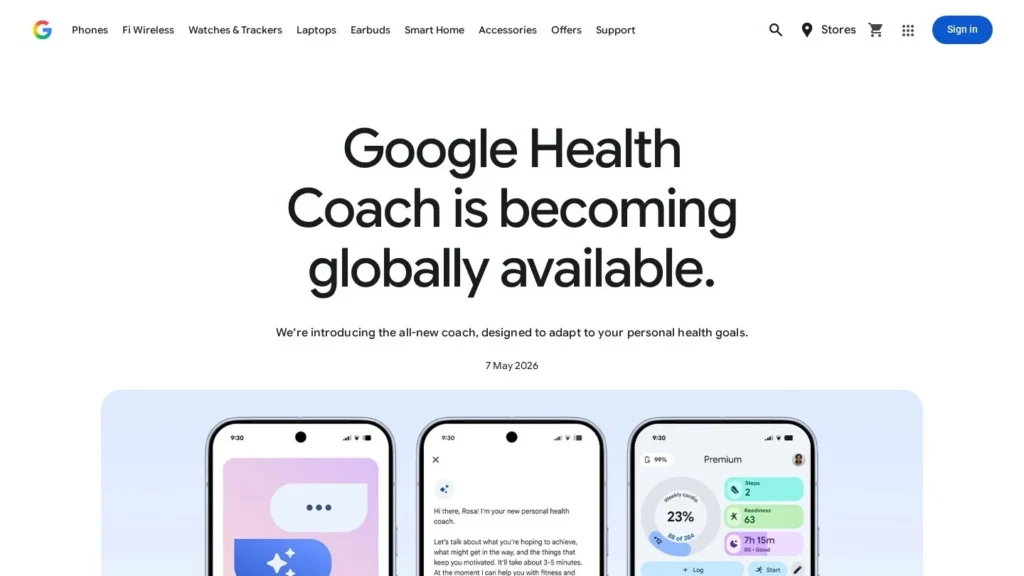
Google Health Coach puts a Gemini-built personal trainer in the Google Health app for $9.99 a month, and anyone already paying for Google AI Pro or Ultra gets it at no extra cost. It plans a user’s training week, builds workouts around the equipment at hand, rewrites the plan when an injury or a busy week intrudes, and reads sleep and health data from a Fitbit or Pixel Watch.
It is best for Fitbit and Pixel Watch owners who want structured, adaptive coaching without paying for a human trainer. The main thing to know is the hardware link: the Fitness and Sleep features need a connected Fitbit or Pixel watch, and other devices were listed as coming later. We rate it 8.5/10 on our scale. We have not used the coach ourselves; this review is based on Google’s published product pages and announcements, plus independent reporting.
A Coach Inside Google Health Premium at $9.99 a Month
- Google Health Coach requires Google Health Premium at $9.99 a month or $99 a year, and Google AI Pro and Ultra subscribers get Premium included.
- It left public preview with a global rollout from May 19 to May 26, 2026, seven months after a U.S.-only Android preview began on October 27, 2025.
- The coach writes multi-week plans, builds workouts around readiness and equipment, and changes the plan for injuries or busy days.
- Google says it does not use Fitbit users’ health and wellness data for Google Ads.
- It is built first for Fitbit and Pixel Watch owners; without a connected watch, the app shows only the Today and Health tabs.
Dates, Prices and Eligibility Rules for the Coach
Google has published more about the coach’s scope and price than about its usage, so the hard facts center on dates, prices and eligibility.
| Fact | Detail | Source and Date |
|---|---|---|
| Public preview start | Opened to eligible U.S. Fitbit Premium users on Android, with iOS to follow | Google Keyword blog, October 27, 2025 |
| Onboarding time | A five to ten minute conversation by text or voice to learn goals and motivations | Google Keyword blog, October 27, 2025 |
| Subscription price | $9.99 a month or $99 a year for Google Health Premium | Google Store product page, viewed October 2026 |
| Bundled access | Google Health Premium included with Google AI Pro and Ultra at no extra cost | Google Store product page, viewed October 2026 |
| General availability | Out of preview, rolling out globally from May 19 and fully available May 26, 2026 | Google Store product page, viewed October 2026 |
| Model and evaluation | Built on Gemini models and grounded in a SHARP framework: safety, helpfulness, accuracy, relevance and personalization | Google Store product page, viewed October 2026 |
| Ad data policy | Google says Fitbit users’ health and wellness data is not used for Google Ads | Google Store product page, viewed October 2026 |
| Hardware offer | Fitbit Air, a $99.99 screenless band shipping May 26, 2026, includes three months of Premium | Thurrott, May 22, 2026 |
| App transition | Google Health app replaced the Fitbit app; Google Fit users to be invited to migrate later in 2026 | Thurrott, May 22, 2026 |
For a buyer, the price facts matter most. At $99 a year the coach works out to $8.25 a month, and the Google AI Pro and Ultra bundle means some people already have access without paying anything more. The second point is pace: Google moved from a U.S. Android preview to global availability in about seven months, which suggests the product is a priority rather than an experiment.
The ad policy and the SHARP framework are Google’s own statements rather than independent audits. They are useful commitments, they are the main published trust signals for a product that handles sleep, heart and health record data, and an independent review would add to them.
Fitbit and Pixel Watch Data Feeding the Google Health App
Google Health Coach lives inside the Google Health app on Android and iOS. It reads data from a connected Fitbit or Pixel Watch, such as sleep, heart rate variability, resting heart rate and cardio load, and combines it with what the user tells it in conversation.
Moving From a Fitbit Account and Connecting a Device
- Install and sign in: download the Google Health app and sign in with a Google account; Fitbit account holders must move to a Google account first.
- Connect a device: pair a Fitbit or Pixel Watch to add the Fitness and Sleep tabs; without one, the app shows Today and Health.
- Talk to the coach: answer an onboarding conversation about goals and motivations by typing or speaking. It can be skipped and resumed, but more detail gives more tailored plans.
- Set a goal: pick a target, such as Google’s own example of running a 10K in three months, and review the multi-week plan the coach proposes.
Morning, Post-Workout and Bedtime Check-Ins
Once a plan exists, the coach works on a schedule. The Today view delivers updates at set moments, such as after waking, after a workout and before bed. A weekly notification recommends plan changes, and the Fitness view tracks weekly progress and cardio load against the plan.
It can also build a session on the spot. Google’s examples include a 30-minute hotel room workout and a routine for someone with 20-pound dumbbells and resistance bands. The coach weighs the user’s goals, readiness score, recent activity and available equipment, and it applies feedback from past workouts to future ones. When an injury or a packed week disrupts training, the plan is revised rather than abandoned.
Sleep and Health Guidance
On the sleep side, the coach explains possible causes of poor rest, recommends wind-down routines and ways to improve deep sleep, finds patterns, draws charts and compares sleep quality with people in the same demographic group. It also connects data points, for example linking cardio load to sleep quality.
The Health tab gathers vitals and metrics such as heart rate variability and weight. Through Ask Coach, users can ask about nutrition, women’s health and life stages, warning signs of conditions such as prediabetes, and how to prepare for a doctor’s visit. Since the full launch, the coach can also summarize health records and accepts logs by voice, image or document.
Wellness Guidance You Can Accept or Ignore
The user stays in charge. People accept or adjust plans, report how workouts felt and decide whether to follow the advice. The coach gives wellness guidance and does not book appointments, contact clinicians or act in other apps. Anyone with a medical condition should treat its suggestions as preparation for a conversation with a doctor, which is how Google frames its doctor-visit feature.
Premium Bundled Free for AI Pro and Ultra Subscribers
Google sells the coach as part of a consumer subscription. Prices below are from Google’s product page and Thurrott’s May 2026 report.
| Plan | Price | Billing | What’s Included | Limits |
|---|---|---|---|---|
| Google Health app without Premium | Free download | None | Today and Health tabs; Fitness and Sleep tabs with a connected watch | No access to the coach |
| Google Health Premium, monthly | $9.99 a month | Monthly | Google Health Coach and Premium features | Coach built first for Fitbit and Pixel Watch users |
| Google Health Premium, annual | $99 a year | Yearly | Same as monthly | Same as monthly |
| Google AI Pro or Ultra | Included | Through the Google AI plan | Google Health Premium at no extra cost | Requires an active AI Pro or Ultra plan |
| Fitbit Air band | $99.99 one time | Hardware purchase | Screenless band plus three months of Premium | Premium bills normally after three months |
$119.88 a Year Monthly or $99 Paid Upfront
These scenarios use Google’s published prices; the usage patterns are our own illustrations.
- A Fitbit owner paying monthly: 12 months at $9.99 comes to $119.88. Switching to the $99 annual plan saves $20.88 a year.
- A new user buying a Fitbit Air: the band costs $99.99 and includes three months of Premium. Paying monthly for the other nine months adds $89.91, for $189.90 in the first year.
- A Google AI Pro subscriber: Premium is included, so the coach adds no cost beyond a compatible watch the user may already own.
The variable cost is hardware. The full experience depends on a Fitbit or Pixel Watch, so someone starting from nothing pays for a device before the subscription. There are no usage charges for chatting with the coach in Google’s published pricing.
Google Health Coach Compared With WHOOP Coach and EGYM Genius
Most AI coaching for individuals comes bundled with a wearable or a gym’s equipment. Google Health Coach and WHOOP Coach are tied to wearables; EGYM Genius is tied to a gym’s smart strength machines.
| Agent | Starting Price | Free Plan | Main Strength | Main Trade-Off | Best For |
|---|---|---|---|---|---|
| Google Health Coach | $9.99 a month or $99 a year | No (app is free; coach needs Premium) | Low price, plans that adapt to equipment and injuries | Built first for Fitbit and Pixel Watch owners | Fitbit and Pixel Watch owners |
| WHOOP Coach | Part of a WHOOP membership | No | Recovery-aware strength workouts and proactive check-ins | Requires a WHOOP band and membership | Athletes already training with WHOOP |
| EGYM Genius | Quote through the gym | No | Plans that adjust weights on gym machines after each workout | Needs a gym with EGYM equipment | Members of gyms running EGYM Smart Strength |
For someone who already owns a Fitbit or Pixel Watch, Google’s coach is the cheapest route to adaptive training plans. WHOOP Coach suits people who care most about recovery and strength data from the WHOOP band. EGYM Genius is a different model: the gym pays and the plan lives on the machines. Gym owners comparing member-facing and front desk tools should start with our AI agents for fitness guide, and health-focused buyers can see our healthcare agents.
Fitbit and Pixel Watch Owners and AI Pro Subscribers
- Fitbit and Pixel Watch owners: the coach was built for these devices first and reads their sleep, heart and activity data.
- Google AI Pro and Ultra subscribers: Premium is included, so trying the coach costs nothing extra.
- People training for a specific goal: it lays out multi-week plans toward targets such as a 10K and adjusts them weekly.
- Travelers and home exercisers: it builds sessions around whatever equipment is available, from a hotel room to a pair of dumbbells.
- Anyone recovering from a minor setback: plans are rewritten for injuries and busy weeks instead of being dropped.
Gym Owners and People With Other Wearables
- Gyms and studios: it is a consumer product; business owners need front desk and member tools such as those in our fitness guide.
- Owners of other wearables: support beyond Fitbit and Pixel Watch was described as coming later, and the Fitness and Sleep tabs need a connected watch.
- People who need medical care: the coach gives wellness guidance and prepares users for a doctor’s visit; it does not replace one.
- Anyone unwilling to move to a Google account: Fitbit accounts must be migrated to Google accounts to keep using the app.
- Lifters who want machine-level tracking: a gym system such as EGYM Genius adjusts weights on the equipment itself.
Health Data Moving Under Your Main Google Login
- Account migration: Fitbit account users must move to a Google account, which puts health data under the same login as other Google services. Google says it does not use Fitbit users’ health and wellness data for Google Ads.
- Device support: the coach launched first for Fitbit and Pixel Watch users. Without a connected watch, the Fitness and Sleep tabs do not appear.
- iPhone sync: in brief testing reported by Thurrott, the app was slow to sync data from Apple Health on iPhone.
- Advice quality depends on data: plans use readiness, recent activity and workout feedback, so regular wear and consistent feedback give the best recommendations.
- Health topics: the coach discusses nutrition, menopause symptoms and warning signs of conditions such as prediabetes. Treat these answers as general information and check anything clinical with a professional.
- Regional availability: Google describes the coach as available in supported countries, so availability can vary by market.
Global Rollout Out of Preview in May 2026
- In May 2026, Google moved Google Health Coach out of preview with a global rollout from May 19 that reached full availability on May 26, priced through Google Health Premium at $9.99 a month or $99 a year.
- On May 22, 2026, Thurrott reported that the Google Health app had begun replacing the Fitbit app on iOS and Android, alongside the $99.99 Fitbit Air band.
- On October 27, 2025, Fitbit head of product Andy Abramson announced the public preview of the personal health coach for eligible U.S. Premium users on Android.
A Low-Cost Yes for Anyone Wearing a Fitbit or Pixel Watch
For anyone with a Fitbit or Pixel Watch, yes. Google Health Coach scores 8.5/10 on our scale, carried by a low published price, quick setup and plans that respond to readiness, equipment and injuries. For Google AI Pro and Ultra subscribers, it is already paid for.
Google could lift the score by widening its scope and device support. The coach advises rather than acts, its best features depend on Google’s own wearables, and its trust signals are Google’s own commitments; it has no public ratings of its own yet. Try it on the monthly plan for a full training block, check whether the weekly plan changes match how you actually feel, and switch to the annual plan only if they do.
Device Requirements, Cost and the Old Fitbit Premium
How Much Does Google Health Coach Cost?
The coach requires Google Health Premium, which costs $9.99 a month or $99 a year. Google AI Pro and Ultra subscribers get Premium at no extra cost, and buyers of the Fitbit Air band get three months included.
Do I Need a Fitbit or Pixel Watch to Use Google Health Coach?
Anyone can download the Google Health app and sign up, but the coach launched first for Fitbit and Pixel Watch users, with other devices to follow. Without a connected Fitbit or Pixel watch, the app shows only the Today and Health tabs.
Is Fitbit Premium the Same as Google Health Premium?
Yes. Google renamed Fitbit Premium to Google Health Premium when the Google Health app replaced the Fitbit app in May 2026. Fitbit account holders have to move to a Google account.
Does Google Use My Health Data for Ads?
Google says it does not use Fitbit users’ health and wellness data for Google Ads. It also says the coach is evaluated against a framework covering safety, helpfulness, accuracy, relevance and personalization.
How Is Google Health Coach Different From WHOOP Coach?
Both are wearable-linked AI coaches. Google’s coach is priced at $9.99 a month and works with Fitbit and Pixel Watch, while WHOOP Coach comes with a WHOOP membership and band and focuses on recovery and strength training data.


User Reviews
Nobody has rated it here yet. Be the first AI Agents Choice user to rate Google Health Coach.