
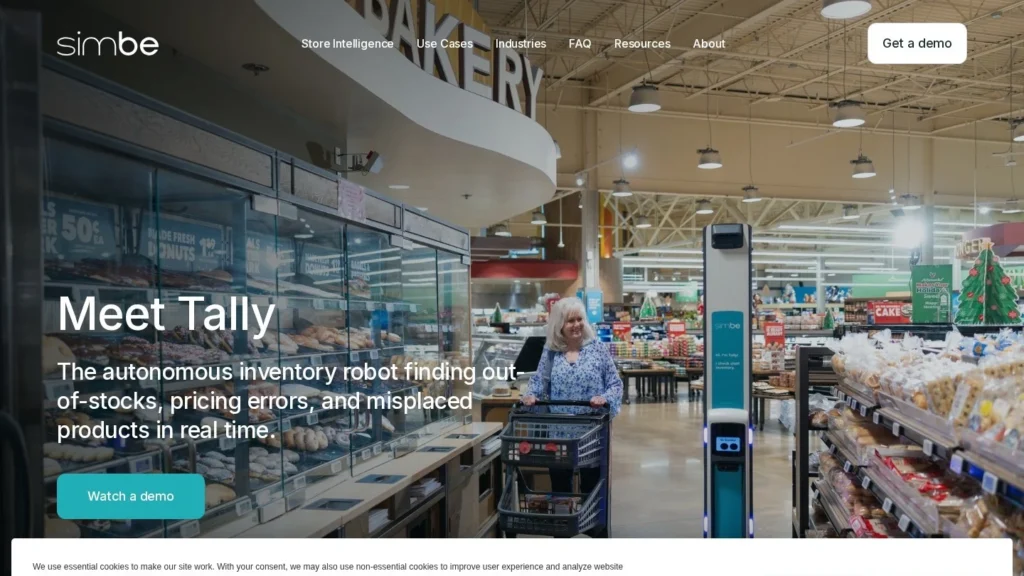
Simbe’s Tally robots have scanned 18 billion price tags and found 132 million that were wrong, according to the company, and by September 2026 Simbe had 3,000 autonomous units under contract across more than 75 retail banners. Tally drives itself through store aisles several times a day, spots out-of-stocks, price errors and misplaced products, and hands associates a prioritized list of fixes. It is best for grocers, warehouse clubs and big-box chains with large stores and frequent shelf problems.
Tally is hardware in every store on a subscription priced by quote, and it finds problems for people to fix. We rate it 7.9/10 on our scale. We have not used Simbe ourselves; this review is based on Simbe’s product page, its announcements and coverage in Fortune, Fast Company and Robotics 24/7.
3,000 Shelf Robots Across 75 Retail Banners
- Simbe had 3,000 autonomous units under contract across more than 75 retail banners in nearly a dozen countries by September 2026.
- Tally scans every aisle several times a day, runs up to 12 hours per charge and sends associates prioritized tasks in a mobile app.
- Simbe reports 99% shelf label identification accuracy and 18 billion price tags scanned, 132 million of them incorrect.
- Pricing is a per-store Robotics-as-a-Service subscription billed annually, with no published figures.
- Against Afresh and Blue Yonder, Tally supplies the shelf truth that ordering and planogram agents depend on, rather than replacing them.
Store Counts and Unit Totals From Simbe and the Press
Simbe is one of the few retail AI companies with hardware in thousands of stores. These figures come from its own page and from press coverage.
| Fact | Detail | Source and Date |
|---|---|---|
| Fleet size | 3,000 autonomous units under contract worldwide, across more than 75 retail banners in nearly a dozen countries | Robotics 24/7, September 21, 2026 |
| Store manager view | More than 90% of store managers working with Tally say it improves their jobs, according to Simbe | Robotics 24/7, September 21, 2026 |
| Safety certification | First and only company to earn UL 3300 certification for a robot designed to operate in public, according to Simbe | Robotics 24/7, September 21, 2026 |
| Series C | $50 million led by Goldman Sachs growth equity, at a valuation three times the July 2023 round, with about 75 employees at the time | Fortune, October 24, 2024 |
| Return claim | CEO Brad Bogolea said Tally saves retailers about 4 to 6 times the cost of the service | Fortune, October 24, 2024 |
| Store results | Stores using Tally cut online order fulfillment time in half, saw 60% fewer out-of-stocks and 90% fewer pricing errors, according to Simbe | Fast Company, March 18, 2025 |
| Recognition | No. 28 on Fast Company’s World’s 50 Most Innovative Companies of 2025 | Fast Company, March 18, 2025 |
| Scan volume | 18 billion price tags scanned (132 million incorrect), 607 million out-of-stock instances detected and 45 billion shelf photos captured | Simbe Tally page, viewed October 2026 |
| Accuracy | 99% shelf label identification accuracy and 10 times more out-of-stocks detected than manual audits, according to Simbe | Simbe Tally page, viewed October 2026 |
| Tally 4.0 | Up to 12 hours of runtime, new ultra-high-resolution cameras and NVIDIA edge processing, available from mid-2026 | Robotics 24/7, January 12, 2026 |
The scan totals put the problem in perspective. Simbe’s figures imply that about 0.73% of the price tags Tally reads are wrong, and that 42% of the out-of-stocks it finds are controllable by the store. For a large grocer with tens of thousands of tags per store, even a fraction of a percent is hundreds of shelf-edge errors a day to fix.
The fleet number matters more than any single metric. Fortune reported hundreds of robots and 29 retail brands in October 2024; Simbe reported 3,000 units under contract and more than 75 banners by September 2026. That growth, after rival Bossa Nova shut down in 2023, suggests retailers are renewing rather than abandoning shelf robots.
A Robot Capturing Images, Software Making Tasks
Tally is the main data-capture device in Simbe’s Store Intelligence platform. The robot captures images; the software turns them into tasks and reports.
What the Robot Does
- Moves on its own: Tally plans paths, avoids obstacles, turns in place in tight aisles and locates itself within 1 to 2 inches in a 150,000 square foot store, according to Simbe.
- Scans every aisle: more than a dozen high-resolution cameras plus depth and fisheye cameras capture standard shelves, fresh areas, bunkers, coolers, freezers, hooks and top stock, without a camera flash.
- Runs on a schedule: scans happen several times a day, including night scans, with up to 12 hours of operation per charge before Tally docks itself.
- Processes at the edge: onboard NVIDIA hardware handles computer vision so results arrive within minutes.
What the Software Does
The platform compares what Tally sees with what should be there. It flags out-of-stocks, low stock, misplaced items, price and promotion errors and planogram gaps, then sends associates a prioritized task list in the Simbe Mobile App. Managers and head office get dashboards, high-resolution images and a Virtual Tour for walking the store remotely. Brand Insights lets retailers share shelf data with suppliers such as Coca-Cola and Frito-Lay, as Schnucks does.
Add-Ons
- Tally RFID: reads more than 100,000 RFID tags per run with a range of up to 40 feet and saves up to 50 labor hours a week, according to Simbe.
- Tally Spot: fixed sensors added in 2025 for areas that need constant watching.
About One Day per Store to Deploy
Simbe says a typical deployment takes about one day per store, including mapping the store and integrating with inventory and pricing systems. Routine maintenance is light: wiping sensors and keeping the dock clear. Country Supplier moved from a three-store pilot to 55 stores in under four months.
Why Retailers Use a Robot Instead of Manual Audits
Manual shelf audits are slow and infrequent. A person with a handheld scanner might check a department once a week; Tally checks every aisle several times a day. Simbe says Tally detects 10 times more out-of-stocks than manual audits, and Fast Company reported that it reads 15,000 to 30,000 products an hour. The result is what co-founder Jeff Gee calls a realogram: a picture of what is really on the shelf that other systems can use. That shelf truth is valuable beyond the store, which is why Simbe positions it as data for replenishment, forecasting and omnichannel fulfillment teams as well.
Associates Restock, Managers Prioritize
Associates restock shelves, replace price tags and fix planogram issues from the task list. Managers decide which tasks come first and use the data in replenishment and pricing decisions. Tally makes the problems visible; the store still has to act.
A Per-Store Robotics-as-a-Service Subscription
Simbe does not publish prices. It sells Tally mainly as a Robotics-as-a-Service subscription.
| Plan | Price | Billing | What’s Included | Limits |
|---|---|---|---|---|
| Tally Robotics-as-a-Service | Custom quote per store | Monthly fee billed annually (reported) | Robot hardware, software, maintenance and analytics | Price varies by store count, store size, scan frequency and capabilities |
| Tally RFID | Custom quote | Subscription | RFID counting and locating for tagged goods | For stores using RFID tags |
| Tally Spot | Custom quote | Subscription | Fixed sensors for continuous monitoring | Covers selected areas |
| Brand data sharing | Revenue share | Ongoing | Retailer sells shelf data to suppliers | Simbe takes a share of the revenue (reported) |
Testing Simbe’s 4 to 6 Times Payback Claim
Without published prices, these scenarios use Simbe’s own ratios and claims with our own illustrative wage and volume assumptions.
- Payback test: Simbe’s CEO says Tally saves 4 to 6 times its cost. If a quote comes in at a given annual amount per store, the vendor claim implies savings of four to six times that amount; build your business case on whether you can document even half of it.
- An apparel or general merchandise store using Tally RFID: if Tally RFID saves the full 50 labor hours a week Simbe cites, at an assumed $20 an hour loaded cost that is $1,000 a week, or $52,000 a year per store.
- A grocer with 40,000 price tags per store: at the 0.73% error rate implied by Simbe’s totals, about 290 tags would be wrong at any given scan, each a potential checkout overcharge or lost margin.
Scan Frequency, Add-Ons and Renewal Terms to Price
- How do scan frequency and store size change the per-store fee?
- Are RFID and Tally Spot priced as add-ons or bundled?
- What happens to pricing and hardware at renewal, and are upgrades to Tally 4.0 included?
- How is revenue from brand data sharing split, and who owns the images?
Other costs to plan for: associate time to act on task lists, store Wi-Fi coverage for the robot, integration work with inventory and pricing systems, and change management with store teams. Ask how hardware refreshes, such as moving to Tally 4.0, are handled within the subscription term.
Simbe Tally Compared With Afresh, Blue Yonder AI Agents and Manhattan Active Agents
Tally is unusual among retail AI agents because it works in the physical store. The closest listed options are software agents that use shelf and inventory data.
| Agent | Starting Price | Free Plan | Main Strength | Main Trade-Off | Best For |
|---|---|---|---|---|---|
| Simbe Tally | Custom quote (per-store subscription) | No | Autonomous robot that audits every aisle several times a day | Hardware in each store; people still fix shelves | Grocers, clubs and big-box stores that need shelf accuracy |
| Afresh | Custom quote | No | Writes grocery store orders for every item | Relies on store counts for inventory accuracy | Grocery chains fighting fresh shrink |
| Blue Yonder AI Agents | Custom quote | No | Shelf Ops Agent edits planograms at scale from plain language | Plans the shelf rather than checking it | Large retailers on Blue Yonder |
| Manhattan Active Agents | Custom quote | No | Store Associate Agent with real-time sales and inventory insight | Depends on system data, not shelf images | Retailers on Manhattan Active Omni |
These products work better together than apart. Blue Yonder’s Shelf Ops Agent plans the planogram; Tally checks whether the shelf matches it. Afresh writes orders from estimated inventory; Tally’s scans show what is actually on the shelf. If you can buy only one, choose Tally when shelf accuracy and pricing errors are the main problem, and an ordering agent when overstock and shrink are. See more in our AI agents for retail guide.
Large-Format Grocers and Warehouse Clubs
- Large-format grocers: big stores with tens of thousands of items are where manual shelf audits fall furthest behind.
- Warehouse clubs: BJ’s Wholesale Club worked with Simbe on a version with longer-range vision and pallet analysis.
- Home improvement and farm stores: Country Supplier went from a three-store pilot to 55 stores in under four months.
- Retailers with heavy online pickup: Simbe says stores using Tally cut online order fulfillment time in half by knowing where items are.
- Retailers that want to sell shelf data to brands: Brand Insights turns scans into a data product suppliers will pay for.
Small Shops and Online-Only Sellers
- Small stores: a walk-through by staff may cover a small footprint as well as a robot.
- Online-only retailers: Tally is for physical shelves.
- Retailers without staff to act on tasks: the robot finds problems and store staff fix them, so these retailers need capacity to act on the lists.
- Buyers who want public pricing or month-to-month terms: the subscription is quoted and billed annually.
Vendor Accuracy Claims and Task Completion Rates
- Vendor-reported metrics: accuracy, out-of-stock and pricing error figures come from Simbe; measure them in a pilot against manual audits.
- Action rate: savings depend on associates completing task lists; track completion as closely as detection.
- Category history: Bossa Nova Robotics, which had robots in 600 Walmart supercenters, lost that contract and shut down in 2023, so check contract terms on renewals and hardware.
- Hardware generations: Tally 4.0 became available from mid-2026; ask whether existing robots will be upgraded within your term.
- Shopper experience: a robot in the aisles during open hours needs store staff and customers to be comfortable with it; night scans are an option.
- Data ownership: if you share shelf data with brands, agree in writing who owns it and how revenue is split.
Tally 4.0 and Ten Years of Shelf Scanning
- On September 21, 2026, Robotics 24/7 reported Simbe passed 3,000 autonomous units under contract, marking ten years since Tally’s introduction.
- On January 12, 2026, Simbe unveiled Tally 4.0 with up to 12 hours of runtime, new cameras and NVIDIA edge processing, available from mid-2026.
- On March 18, 2025, Fast Company named Simbe No. 28 on its World’s 50 Most Innovative Companies list.
Big Grocers Get the Most Proven Shelf Robot Available
For large grocers, clubs and big-box chains, Tally is the most proven shelf-scanning robot on the market. It scores 7.9/10 on our scale: strong on autonomy and safety certification, with room to grow through published pricing and public user ratings. A fleet of 3,000 units under contract and a chainwide rollout at Schnucks show that retailers keep paying for it after the pilot.
The value depends on what your store teams do with the task lists. Run a pilot that measures out-of-stocks, price errors and task completion against manual audits in matched stores, and ask Simbe to show the 4 to 6 times return on your own numbers before signing a multi-store contract.
What Grocers Usually Ask Simbe About Tally
How Much Does Simbe Tally Cost?
Simbe does not publish prices. Tally is sold mainly as a Robotics-as-a-Service subscription covering hardware, software, maintenance and analytics, reported as a per-store monthly fee billed annually.
What Does the Tally Robot Detect?
Tally detects out-of-stocks, low stock, misplaced products, price and promotion errors and planogram issues. With Tally RFID it also counts and locates RFID-tagged goods.
Is Tally Safe to Run While Shoppers Are in the Store?
Simbe says it is the first company to earn UL 3300 certification for a robot designed to operate in public. Tally moves at less than a third of human walking speed and uses dozens of sensors, rounded edges and a low center of gravity.
How Long Does It Take to Deploy Tally in a Store?
Simbe says a typical deployment takes about one day, including store mapping and integration with inventory and pricing systems.
Which Retailers Use Simbe Tally?
Named customers include Schnucks, BJ’s Wholesale Club, Wakefern and ShopRite, and Country Supplier, which owns C-A-L Ranch and Coastal Farm and Ranch.


User Reviews
Nobody has rated it here yet. Be the first AI Agents Choice user to rate Simbe Tally.