

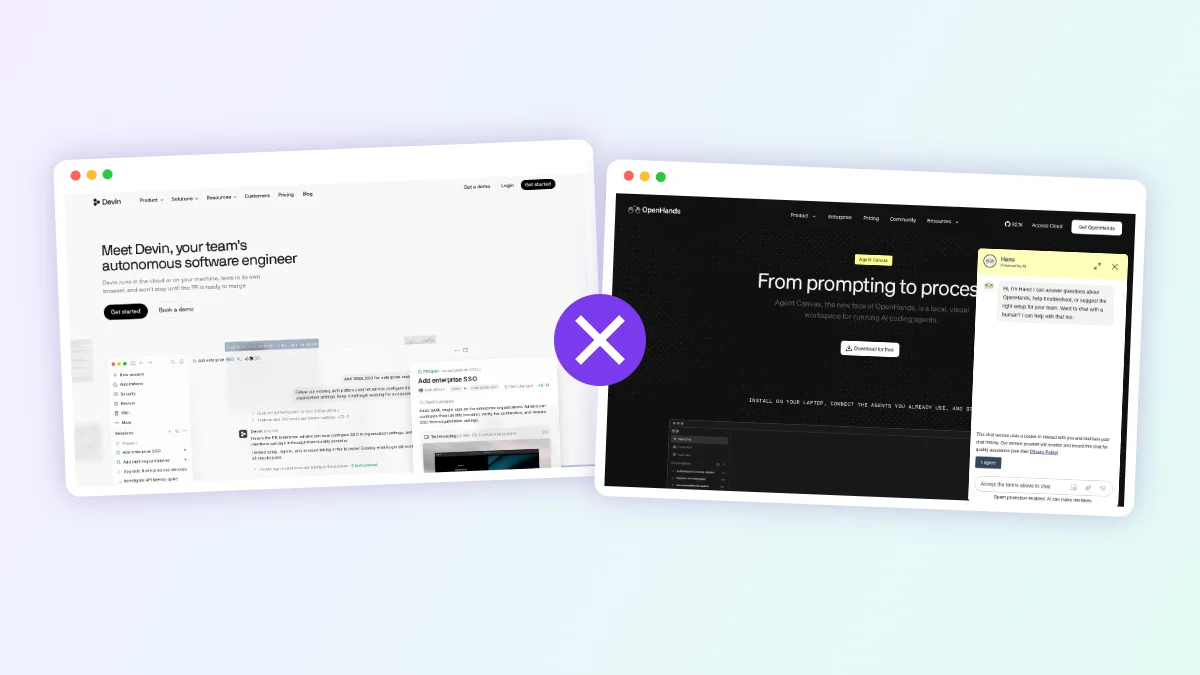
Devin starts at $20 a month and runs every task on Cognition’s cloud machines. OpenHands costs nothing to self-host, but you supply the servers, the setup time and the model bill. In the Devin vs OpenHands choice, Devin suits teams that want a managed agent working from Slack and tickets, while OpenHands suits developers who want control over models, data and where the agent runs.
The two are linked by history. OpenHands began in March 2024 as OpenDevin, an open alternative to Devin, and both now do the same core job: take a software task, write and run code in a sandbox, and hand back changes for a person to review. This comparison is based on published pricing and documentation; we did not test either tool hands-on.
Key Takeaways
- Devin is a paid, hosted product with a free tier, a $20 Pro plan, a $200 Max plan and Teams seats at $40 each.
- OpenHands is MIT-licensed and free to self-host; a Teams plan costs $500 a month for up to 10 users.
- With OpenHands you pay your language model provider separately, which can exceed the plan cost on long tasks.
- Devin needs little setup. OpenHands needs developer time to install, pick models and choose a backend.
- Both produce code that still needs human review before it ships.
Devin vs OpenHands Side by Side
| Devin | OpenHands | |
|---|---|---|
| Maker | Cognition | OpenHands (formerly All Hands AI) |
| License | Proprietary | MIT open source |
| Entry price | Free tier; Pro $20 a month | Free to self-host |
| Team pricing | $40 per full seat, $80 monthly minimum | $500 a month for up to 10 users, $50 per extra seat |
| Model costs | Covered by plan quotas and prepaid credits | Paid separately to your LLM provider |
| Where it runs | Cognition’s cloud virtual machines | Laptop, Docker, remote VM, Modal or OpenHands Cloud |
| Choice of model | Managed by Cognition; ChatGPT subscriptions can be linked for GPT models | Any model via your own key, local models or bundled agents |
| Main surfaces | Web app, Slack, GitHub, Linear, CLI, Devin Desktop | Agent Canvas, desktop app (preview), Slack, GitHub, CLI, Python SDK |
| Setup effort | Low | Moderate, developer skills needed |
Pricing: Subscription Quotas vs Free Software Plus Model Bills
Devin’s free plan includes limited agent usage plus Devin Review, its pull request reviewer, and DeepWiki, which writes documentation for a codebase. Pro costs $20 a month and Max $200 a month, both for one user. Teams costs $40 per full seat with an $80 monthly minimum, and free flex seats can draw on shared credits, up to 200 members. Pro and Teams seats carry daily and weekly quotas; Max has a weekly one only. Extra usage is bought as prepaid credits that roll over. Enterprise deals are priced in Agent Compute Units, and Cognition does not publish the rate.
OpenHands works the other way round. The Agent Canvas software is free and MIT-licensed, with community support. Teams costs $500 a month for up to 10 users plus $50 for each additional seat, adds role-based access, SSO and budget controls, and caps usage at 5,000 sessions a month. It comes with a 30-day trial. Enterprise is custom, with unlimited users and SLA-backed support. On every tier, model usage is billed by your LLM provider.
Seat math alone favors Devin for small teams. Ten full Devin seats cost $400 a month against $500 for OpenHands Teams, and at 15 users the figures are $600 and $750. That comparison leaves out what matters most: Devin’s seats come with usage quotas, while OpenHands seats come with no model usage at all. A team running long sessions on premium models could spend more on tokens than on either subscription.
Seat figures use published list prices only. They exclude Devin credit top-ups, OpenHands model costs and any annual discounts.
How Each One Runs
A developer hands Devin a task in the web app, in Slack or from a Linear ticket. Devin plans the work, writes and runs code in a sandboxed cloud machine, and opens a pull request. Automations can start sessions when events happen in Slack, GitHub or Linear. Cognition has added agents for adjacent work: Auto-Triage for incident investigation, Security Swarm for vulnerability hunting and Devin Review for code review. In June 2026 it renamed its Windsurf editor Devin Desktop, which can dispatch work to local, cloud and third-party agents.
OpenHands centers on Agent Canvas, a workspace for conversations, files, terminals and automations. Its default agent works with whichever model you pick, and the same workspace can drive Claude Code, Codex or Gemini CLI using subscriptions you already have. Each agent can run in its own git worktree, so parallel tasks do not collide. Agents read repository guidance from an AGENTS.md file, connect to MCP servers, and can be triggered on a schedule or from Slack and GitHub. A Python SDK lets teams build their own agent apps on the same engine.
Setup and Control
Devin is close to sign-up-and-go. You connect GitHub and Slack, then assign work. The trade is control: code runs on Cognition’s infrastructure, the model choice is largely Cognition’s, and costs move with quotas and credits.
OpenHands asks more of you up front. Someone has to install Agent Canvas on macOS, Linux or Windows, choose a backend from a laptop to a remote VM or OpenHands Cloud, and connect a model key or a local model. In return, code and prompts can stay on your own hardware, and you can swap models or agents without changing vendors. The project has been reshaped several times, and its older Docker-based local GUI is now marked legacy, so some online tutorials are out of date.
Who Each One Suits
- Pick Devin if your team wants a managed agent that takes tickets from Slack, GitHub or Linear, you would rather pay a predictable seat price than run infrastructure, and you value the extra review, triage and security agents in one product.
- Pick OpenHands if you need to self-host for privacy or compliance, want to choose or change models freely, already pay for Claude Code or Codex and want one place to run them, or want to build custom agents with an SDK.
- Neither fits non-developers who want to build an app from a prompt. Both assume someone who can read and review code.
For more options across both styles, see our AI coding agents category and the open-source AI agents list.
Limits to Weigh Before Choosing
Devin’s quota and credit system makes the real monthly cost hard to predict, and automations stop when credits run out. Its most striking productivity figures, such as the share of code Cognition says Devin writes internally, come from the company itself. The product lineup also changes quickly, so check which tools your plan includes.
OpenHands shifts cost and effort onto you. Model spending sits outside any plan, and the $500 Teams entry point is steep for a three-person team that wants admin controls. Its pricing page lists no compliance certification and points to a trust center instead. For both tools, agent-written code needs careful human review before merging.
FAQ
Is OpenHands a Free Alternative to Devin?
Largely, yes. OpenHands started as OpenDevin and is free to self-host under the MIT license. You still pay for the language model it uses, and paid Teams and Enterprise plans add admin features.
How Much Does Devin Cost per Month?
Devin has a limited free plan, Pro at $20 a month and Max at $200 a month for individuals. Teams seats cost $40 each with an $80 monthly minimum, and Enterprise pricing is custom.
Can OpenHands Use Claude or GPT Models?
Yes. OpenHands works with any model through your own API key or a local model, and Agent Canvas can also run Claude Code, Codex and Gemini CLI using existing subscriptions.
Can I Run Devin on My Own Servers?
Devin’s self-serve plans run on Cognition’s cloud machines, and its public pricing lists no self-hosted option. Teams that need code to stay on their own hardware should ask about Enterprise terms or look at OpenHands.
Which Is Better for a Small Team?
On list prices, Devin is cheaper for a few users, since Teams seats are $40 each against OpenHands’ $500 Teams plan. A small team comfortable with setup can also use free OpenHands and pay only model costs.
