
Open-source, model-agnostic platform for running autonomous AI coding agents locally, on your own servers or in the cloud.

Free; Teams $500 per month for up to 10 usersFree planAutonomous AI software engineering agent (open source)

No user reviews yet. Be the first to rate it.

Visit website
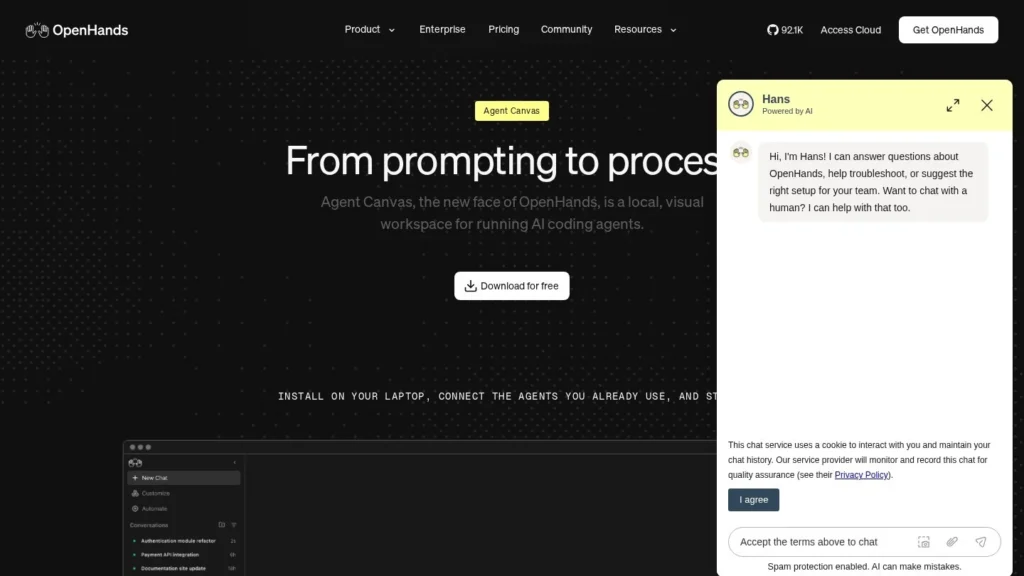
OpenHands website screenshot
OpenHands website

Quick Facts

DeveloperOpenHands (formerly All Hands AI)
Websiteopenhands.dev/product/canvas
Agent typeAutonomous AI software engineering agent (open source)
Best forDevelopers and engineering teams that want a self-hostable coding agent, their choice of LLM, and the option to run Claude Code, Codex or Gemini CLI from one workspace.
Not ideal forNon-developers, or teams that want a fully managed coding assistant inside their IDE with no setup.
Pricing modelFree open source; paid self-hosted Teams and Enterprise plans
Starting priceFree; Teams $500 per month for up to 10 users
Pricing detailsAgent Canvas is free and MIT-licensed to self-host, with your own LLM key. Teams costs $500 a month for up to 10 users, plus $50 per extra seat, capped at 5,000 sessions a month, with a 30-day trial. Enterprise is custom with unlimited seats and SLA support. LLM usage is paid separately.
Free planYes
Free trial30-day trial on Teams
ChannelsBrowser workspace, desktop app (preview), Slack, GitHub, CLI, Python SDK
What it does on its ownAgents work on tasks end to end in sandboxed workspaces, including writing code and running terminal commands; automations can run on schedules or in response to events.
IntegrationsGitHub, Slack, MCP, Claude Code, Codex, Gemini CLI, Docker, Modal, OpenAI-compatible LLM providers
PlatformsmacOS, Linux, Windows, self-hosted VM, OpenHands Cloud
Company founded2024
Details last verified28 October 2026
CategoriesCoding & Software Development, Free AI Agents, IT & DevOps, Open-Source AI Agents
User ratingNo reviews yet

OpenHands costs nothing to self-host, and its open-source repository shows about 92,000 GitHub stars. It is an AI coding agent that writes and edits code, runs terminal commands and works through software tasks with little hand-holding. The project began in March 2024 as OpenDevin, an open alternative to Devin, and the company behind it now goes by the OpenHands name after starting as All Hands AI.

The current front end is Agent Canvas, a workspace where developers run and supervise one or several agents at once.

How It Works

A developer installs Agent Canvas on macOS, Linux or Windows, connects an agent and gives it a task. The default OpenHands Agent works with whatever language model you pick, through your own API key, a local model or OpenHands’ own model service. Agent Canvas can also drive outside agents such as Claude Code, Codex and Gemini CLI using an existing subscription.

Each agent can run in its own git worktree, so several tasks proceed in parallel without colliding. The backend can be your laptop, Docker, a remote VM, Modal or OpenHands Cloud, and you can switch between them. Automations run on a schedule or fire on events, and can be started from Slack or GitHub. Agents follow repository guidance in an AGENTS.md file and can use MCP servers and skills. A Python SDK lets teams build their own agent applications on the same engine.

Pricing

Agent Canvas is free and MIT-licensed, with community support. The Teams plan costs $500 a month for up to 10 users, plus $50 per additional seat, and adds role-based access, SSO, budgeting controls and up to 5,000 sessions a month. It comes with a 30-day trial. Enterprise pricing is custom, with unlimited users, uncapped usage and SLA-backed support. In every case, model usage is billed separately by your LLM provider.

What to Watch Out For

OpenHands is built for developers. Setting it up, choosing models and reviewing agent changes takes engineering time, and the agent’s code still needs human review before it ships. Model costs sit outside the subscription, so long agent sessions on premium models can cost more than the plan itself. The product has been reshaped several times, and the older Docker-based local GUI is now marked legacy, so some tutorials online are out of date. The pricing page lists no compliance certification and points to a trust center instead.

Recent News

On August 21, 2026 it shipped Agent Canvas 1.15, adding a setup checklist, easier automation discovery and a conversation overview with grouped Git commits.

Features

  • Agent Canvas workspace for conversations, files, terminals and automations
  • Run several agents in parallel, each in its own git worktree
  • Bring your own agent, including Claude Code, Codex and Gemini CLI
  • Works with any LLM via your own key or local models
  • Scheduled and event-driven automations from Slack or GitHub
  • Switch backends between laptop, remote VM and OpenHands Cloud
  • MCP connections, Agent Skills and AGENTS.md repo guidance
  • Python SDK for building custom agent apps

Pros and Cons

Pros

  • Core product is free and MIT-licensed
  • No lock-in to one model or one agent vendor
  • Can run fully on your own hardware for privacy
  • Large open-source community on GitHub
  • Frequent releases through 2026

Cons

  • Requires developer skills to set up and manage
  • LLM costs are separate and can add up on long tasks
  • Teams plan starts at $500 a month, steep for very small teams
  • Product has changed shape often, with older local GUI docs now marked legacy

User Reviews

No reviews yet. Be the first to rate OpenHands.

Write a Review