
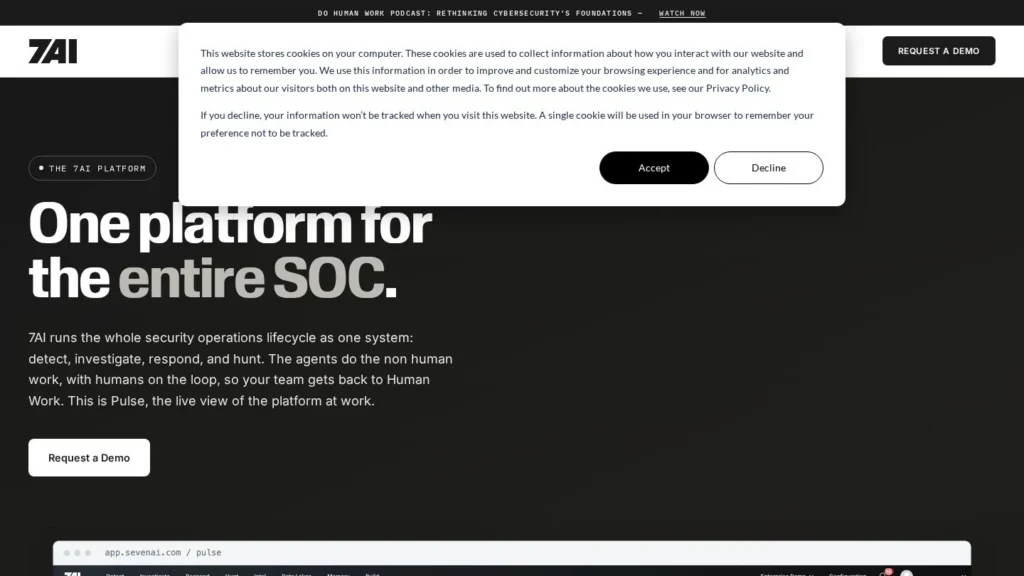
7AI sells an agentic security operations platform. Its more than 40 AI agents take in alerts from the endpoint, identity, cloud and email tools a company already owns, investigate each one end to end and escalate only the cases a person needs to see. DXC Technology’s CISO says it cut tier 1 analyst time by 80%. It is best for enterprises and large mid-market security teams that want AI to work every alert, with the option of handing the whole job to 7AI’s managed service.
Pricing is shared on request, and the company was founded in 2024, so its track record is still building. It has strong backing, with a $130 million Series A in December 2025. This review is based on 7AI’s published platform pages, its funding announcement and press coverage as of October 2026; we have not tested it hands-on.
Forty Agents and DXC’s Tier 1 Time Savings
- What it does: more than 40 AI agents triage and investigate every alert across your existing security tools, escalating only what needs a person.
- Customer result: DXC Technology’s CISO reports an 80% reduction in tier 1 analyst time and 95% to 99% fewer tickets for humans to review.
- Funding: a $130 million Series A in December 2025, led by Index Ventures, for $166 million raised in total.
- Pricing: quote-only, with self-run, PLAID-assisted and fully managed PLAID ELITE options.
- Our score: 8.2/10, strong on autonomy and early ratings, with room to grow through published pricing and a longer track record.
7AI’s $130 Million Round and Running Investigation Totals
7AI publishes running totals on its website and disclosed early metrics with its Series A. Each item below was checked on the linked page.
| Fact | Detail | Source and date |
|---|---|---|
| Series A | $130 million led by Index Ventures, with Blackstone Innovations Investments, Greylock, CRV and Spark; called the largest cybersecurity Series A in history by the company | 7AI press release, December 4, 2025 |
| Total funding | $166 million, including a $36 million seed round in June 2025 | SiliconANGLE, December 4, 2025 |
| Agents | More than 40 agents, each focused on a task such as hunting malicious activity or collecting data from a compromised device | SiliconANGLE, December 4, 2025 |
| First 10 months | More than 2.5 million alerts processed and over 650,000 investigations completed | 7AI press release, December 4, 2025 |
| Investigations to date | More than 14 million investigations completed to a conclusion; 1,038 analyst years given back | 7AI platform page, accessed October 2026 |
| Time saved | Customers report saving 30 minutes to 2.5 hours per investigation; mean time to respond of 7 minutes cited by the CEO | 7AI press release, December 4, 2025 |
| DXC Technology | Deployed in eight weeks; CISO Mike Baker reports an 80% cut in tier 1 analyst time and 95% to 99% fewer tickets for humans | 7AI press release, December 2025, and platform page |
| Sample week | 6,119 alerts, 96% handled before a human, 193 escalated | 7AI platform page, accessed October 2026 |
| User rating | 4.9 out of 5 from seven ratings | Gartner Peer Insights, accessed October 2026 |
The jump from about 650,000 investigations at the Series A to more than 14 million on the platform page today suggests fast growth in use, though both are 7AI’s own counts. The DXC figures are the most concrete: a large IT services company deploying in eight weeks and reporting an 80% cut in tier 1 time is a meaningful reference for other enterprises.
Treat the sample week with care. A 96% deflection rate depends on how noisy your alerts are and how strict your escalation rules are. Ask 7AI to run its proof of value on your own alerts and measure how many cases reach a person.
How 7AI Works Alerts Through a Federated SIEM
7AI sits on top of the security tools you already use. It ingests alerts through integrations with your detection products and queries data where it lives through a Federated SIEM, so it does not require copying all telemetry into one store, which the company says reduces storage costs.
The Alert Pipeline
- Intake. Alerts arrive from endpoint, identity, cloud, email, network and threat intelligence sources.
- Triage. Agents categorize and group related alerts, then decide which need deeper work.
- Investigation. Specialized agents gather evidence, for example collecting technical data from a possibly compromised device or checking a file against malware databases on request, and work the case end to end with the reasoning shown.
- Determination. Each case gets a verdict. Cases that need a person appear as summary cards ranked by severity, with a natural-language description.
- Response. Response runs guided or automatic, depending on your settings, and each conclusion can become a recorded action.
Beyond Triage
The platform also covers threat hunting, both ad hoc and based on threat intelligence, detection tuning that tries to surface what existing tools miss, enterprise insights and security posture views. 7AI contrasts its approach with SOAR: instead of running pre-written playbooks, its agents reason through each alert and show the steps they took. Customers can still encode their own logic through Skills.
Three Ways to Run It
Companies can run the platform themselves, with dedicated AI security engineers from 7AI. They can add PLAID (People-Led, AI-Driven) services for hands-on customization, including new third-party integrations. Or they can choose PLAID ELITE, in which 7AI’s experts run security operations 24×7. On-demand digital forensics and incident response is available as a separate service, and partners can build their own offerings on 7AI.
Exceptions, Audit Trails and Humans on the Loop
Customers define what counts as malicious and can create exceptions for specific users or departments. The platform keeps an audit trail of agent reasoning. Humans are “on the loop”: they see what the agents decided and step in on escalations rather than approving every step.
Where It Fits in a Security Stack
7AI is not an EDR, email gateway or identity product. It assumes you already have detection tools and sits above them as the layer that works their alerts. That makes it vendor-neutral, which matters for companies that run CrowdStrike on endpoints, Microsoft for identity and email, and a separate cloud security tool, and do not want an analyst agent that only understands one of them. The Federated SIEM is the other half of the pitch: by querying data where it lives, 7AI says it can augment or even replace SIEM infrastructure, which could cut storage costs for teams paying to centralize every log.
Proof of Value and Rollout
7AI says a proof of value completes in about a week and deployment takes days. During that week, the useful measures are how many alerts the agents close without a person, how often analysts disagree with a verdict, and how long escalated cases take to resolve. DXC Technology, one of the largest public references, went from start to what 7AI calls the world’s largest agentic security operation in eight weeks.
Escalations and Response Policy Remain the SOC’s Job
Your team handles escalated cases, sets response policies and decides how much automatic response to allow. Business context the tools cannot see, and final calls on serious incidents, stay with people unless you hand them to the managed service.
Four Quote-Only Packages From Platform to PLAID ELITE
7AI does not publish prices. The options below are how the company packages the product.
| Plan | Price | Billing | What’s Included | Limits |
|---|---|---|---|---|
| 7AI Platform | Custom quote | Contract | AI agents for triage, investigation, response and hunting; Federated SIEM; dedicated AI security engineers | You run operations |
| 7AI Platform + PLAID | Custom quote | Contract | Platform plus professional services for customization and expert guidance, including extra integrations | Services scoped per customer |
| PLAID ELITE | Custom quote | Contract | Fully managed 24×7 security operations run by 7AI experts | Managed service |
| DFIR | Custom quote | On demand | Digital forensics and incident response | Per engagement |
Sizing 7AI by the Analyst Hours It Could Free Each Week
With no list prices, the useful exercise is sizing the work 7AI would replace. If your SOC investigates 100 alerts a week and 7AI’s customer range of 30 minutes to 2.5 hours saved per investigation holds, that is 50 to 250 analyst hours a week. Compare that with the quote.
A mid-size company with a small SOC. The platform alone, run by your team, is the likely fit. Ask for a proof of value on a month of your alerts and get the quote tied to alert volume or data sources so it does not jump unexpectedly.
A company without round-the-clock analysts. PLAID ELITE replaces an outsourced MDR or a night shift. Compare its quote against your current MDR contract or the cost of hiring analysts for 24×7 coverage.
A large enterprise. DXC Technology deployed in eight weeks. Budget for PLAID services if you need integrations with less common tools, and confirm whether forensics work after an incident falls under DFIR pricing.
7AI Compared With Dropzone AI, Prophet AI and Torq Socrates
All four products aim to take tier 1 alert work off human analysts, and none publishes list prices. They differ in packaging and how much they automate.
| Tool | Starting Price | Free Plan | Main Strength | Main Trade-Off | Best For |
|---|---|---|---|---|---|
| 7AI | Custom quote | No | Swarm of 40-plus agents plus an optional fully managed service | Pricing by quote; newer company | Enterprises wanting AI to work every alert |
| Dropzone AI | Custom quote | No | Investigates every security alert with a full work log | Response stays with humans | SOC teams facing alert overload |
| Prophet AI | Custom quote (per investigation) | No (free proof of value) | Per-investigation pricing with no data-ingest fees and fast setup | Figures are quoted | Teams wanting usage-based AI triage |
| Torq Socrates | Custom quote | No | AI SOC analyst inside a hyperautomation platform | Automation design takes effort | Teams building many automated workflows |
7AI stands out for its managed service option and for querying data in place rather than requiring a central data store. Dropzone AI focuses tightly on investigation with a transparent work log. Prophet AI’s per-investigation pricing and quick setup suit teams that want to start small. Torq Socrates fits buyers who also want a broad automation platform. For platform-native options, see Purple AI and CrowdStrike Charlotte AI, or browse our cybersecurity agents page.
SOCs Drowning in Tier 1 Alerts Across Many Vendors
- SOCs buried in tier 1 alerts: agents work every alert and escalate only the ones needing a person.
- Companies with tools from many vendors: 7AI works across endpoint, identity, cloud and email sources rather than one vendor’s stack.
- Organizations without 24×7 analysts: PLAID ELITE provides fully managed operations.
- Large enterprises and service providers: DXC’s eight-week deployment is a reference for complex environments; see our enterprise agents page.
- Teams frustrated by SOAR playbook upkeep: agents reason through cases instead of following fixed scripts.
Where a Small Business or Single-EDR Team May Fit Better Elsewhere
- Small businesses wanting a list price: everything is quoted.
- Buyers who need a long vendor track record: 7AI was founded in 2024 and launched in 2025.
- Teams happy with their EDR vendor’s built-in agent: a platform-native analyst may be simpler to run.
- Organizations that need offensive testing: 7AI defends; tools such as XBOW look for weaknesses.
Vendor Metrics and a Seven-Rating Gartner Score
- Vendor figures: investigation counts, analyst years saved and false-positive reductions come from 7AI and its customers.
- Small rating sample: the 4.9 Gartner Peer Insights score comes from seven ratings.
- Integration coverage: the platform page lists data categories rather than named products, so confirm your tools before signing.
- Automatic response: start with guided response and widen automation as trust builds.
- Services dependence: extra integrations come through PLAID services, which may add cost.
- Data access: agents query your security tools and data sources directly, so review the permissions you grant, ask how investigation data is stored, and check the privacy and security documents linked from 7AI’s site.
- Measuring success: agree on metrics such as escalation rate, verdict accuracy and response time before the proof of value, so the result is judged on your numbers rather than the vendor’s.
Index Ventures Leads 7AI’s December 2025 Series A
On December 4, 2025, 7AI raised a $130 million Series A led by Index Ventures, with Index partner Shardul Shah joining the board and Blackstone Innovations Investments joining as a new investor. The company said it would scale through a channel-first model and work with federal agency partners in 2026. SiliconANGLE reported that the platform comprises more than 40 agents and that the round followed a $36 million seed in June 2025.
A 6.4 Shortlist Pick for Busy Security Teams
For enterprises whose analysts cannot keep up with alerts, 7AI deserves a place on the shortlist. It scores 8.2/10 on our scale. The agents work alerts end to end across many vendors’ tools, early reviewers rate it highly, and the DXC result shows it can run at large scale.
Published pricing, a longer track record and a public integration list would lift the score further. A proof of value with your own alerts is a good next step: measure the share of cases that still reach a person, and compare the quote with your current MDR or analyst costs.
Short Answers on 7AI Pricing and PLAID
How Much Does 7AI Cost?
7AI does not publish prices. It quotes the platform, the platform with PLAID services, the fully managed PLAID ELITE service and DFIR separately. Request a proof of value and a quote based on your alert volume.
What Is PLAID in 7AI?
PLAID stands for People-Led, AI-Driven. It is 7AI’s services layer: PLAID adds hands-on customization and expert guidance to the platform, and PLAID ELITE is a fully managed 24×7 security operations service.
Does 7AI Replace a SIEM?
7AI says its agents can augment or replace SIEM infrastructure. Its Federated SIEM queries data where it lives instead of copying it into a central store. Whether you can retire your SIEM depends on your compliance and retention needs.
Who Founded 7AI?
7AI was founded in 2024 by CEO Lior Div and CTO Yonatan Striem Amit and is based in Boston. It came out of stealth in February 2025 and has raised $166 million.
How Is 7AI Different From Dropzone AI?
Both investigate alerts autonomously. 7AI pairs its agents with optional managed services, including 24×7 PLAID ELITE, and supports guided or automatic response. Dropzone AI focuses on investigation with a detailed work log and leaves response to humans.
User Reviews
Nobody has rated it here yet. Be the first AI Agents Choice user to rate 7AI.