
Google says an ADK 2.0 workflow cut tokens per run from 5,152 to 2,265 in its refund-processing example, and latency from 7.2 to 5.7 seconds, by letting code rather than the model decide routine routing. That idea runs through the Agent Development Kit: a free, Apache 2.0 framework for building agents that mix model reasoning with deterministic steps, available in Python, Java, Go, TypeScript and Kotlin.
Google ADK is best for developers building production agents on Gemini or Google Cloud, especially multi-agent systems that need predictable control flow. It is designed around Google’s models and cloud, and hosting there adds a growing list of metered platform services. The framework is free, Agent Runtime hosting starts at $0.085 per vCPU-hour, and we rate it 8.7/10 on our scale. We have not used ADK ourselves; this review is based on Google’s GitHub repository, developer and cloud blogs and published Google Cloud pricing.
A Free Apache 2.0 Framework With Releases Every Two Weeks
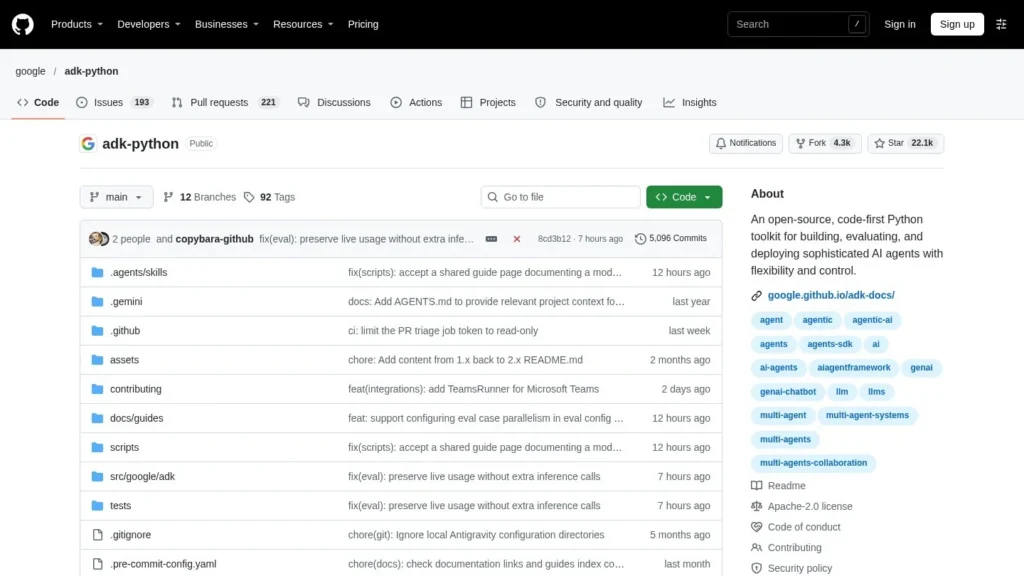
- ADK is free under Apache 2.0; the Python repository has about 22,000 stars and 4,300 forks, with releases roughly every two weeks.
- In Google’s refund example, an ADK 2.0 workflow used 2,265 tokens per run against 5,152 for a plain LLM agent, and ran in 5.7 seconds instead of 7.2.
- ADK 2.0 became generally available at Google I/O in May 2026, adding chat, task and single-turn delegation modes for sub-agents.
- Agent Runtime on Google Cloud costs $0.085 per vCPU-hour and $0.009 per GiB-hour, with idle time between turns not billed; Sessions and Memory Bank charges began September 1, 2026.
- Against the OpenAI Agents SDK and LangGraph, ADK covers the most languages and includes managed hosting, but is most at home on Google Cloud.
Design and Pricing Facts From Google’s Own Pages
Google publishes more about ADK’s design and pricing than about its adoption. These are the figures we could confirm on Google’s own pages.
| Fact | Detail | Source and Date |
|---|---|---|
| GitHub stars | About 22,000 stars, 4,300 forks and 152 watchers for adk-python | google/adk-python on GitHub, viewed October 2026 |
| License and cadence | Apache 2.0; releases roughly every two weeks | GitHub repository, viewed October 2026 |
| Languages | Python, Java, Go, TypeScript and Kotlin | Google Developers Blog, July 1, 2026 |
| Token savings | 2,265 tokens per run with an ADK 2.0 workflow versus 5,152 for a plain LLM agent in a refund example on gemini-3.5-flash with mock APIs | Google Developers Blog, July 1, 2026 |
| Latency | 5.7 seconds per run versus 7.2 seconds in the same example | Google Developers Blog, July 1, 2026 |
| ADK 2.0 availability | Generally available; collaborative workflows in Python v2.0.0 with chat, task and single-turn modes | Google Cloud blog, May 19, 2026 |
| Agent Runtime compute | $0.085 per vCPU-hour list; $0.0765 on a 1-year and $0.068 on a 3-year savings plan | Google Cloud pricing, viewed October 2026 |
| Agent Runtime memory | $0.009 per GiB-hour list; $0.0081 and $0.0072 on 1-year and 3-year plans | Google Cloud pricing, viewed October 2026 |
| Sessions and Memory Bank | 1 vCPU-hour per 3 million reads or 1 million writes, plus about $0.30 per GiB-month storage, billed from September 1, 2026 | Google Cloud pricing, viewed October 2026 |
| Agent Gateway | $0.085 per vCPU-hour, equal to 15,000 API calls or authorization requests, effective July 13, 2026 | Google Cloud pricing, viewed October 2026 |
The token figures are the most useful number here, with a caveat: they come from one illustrative example that Google built, using mock API responses. The point holds more broadly, though. When routine routing happens in code instead of in a model call, an agent uses fewer tokens and finishes faster, and that saving repeats on every run.
The pricing rows show the other side. The framework is free, but Google is steadily adding metered services around it, from Sessions and Memory Bank to Agent Gateway. Each is cheap per unit, and together they make Google Cloud the natural home for ADK agents.
Code-First Agents Tested in a Local Web UI
ADK is code-first: agent logic, tools and orchestration are written in your language of choice, then tested in a local web UI and deployed where you like.
Agents, Tools and Delegation
Each agent has instructions, a model and tools. Tools can be pre-built, custom functions, OpenAPI specs or MCP servers. Agents can be composed into hierarchies, and ADK 2.0’s collaborative workflows give three ways to hand work to a sub-agent:
- Chat mode: the sub-agent takes over the conversation with the user, and control returns to the parent manually.
- Task mode: the sub-agent can ask the user clarifying questions, then returns to the parent automatically when the assignment is done.
- Single-turn mode: no user interaction; sub-agents run in parallel and return like tools.
The ADK 2.0 Workflow Runtime
The workflow runtime runs agents and code steps as a directed graph with routing, fan-out and fan-in, loops, retries, state management, human-in-the-loop steps and nested workflows. Transitions can be decided by code instead of the model, and each node receives only the data it needs. Dynamic workflows can be written with ordinary Python control flow and asyncio, using decorators rather than explicit graph definitions. Google says 2.0 workflows have been available in Python since March 2026 and came to Go on July 1.
Testing, Evaluation and Deployment
- ADK Web: a built-in browser UI for running, testing and debugging agents locally.
- adk eval: a command for evaluating agents against test cases, with a bundled sample.
- Tool Confirmation: a human-in-the-loop step that asks for approval before a tool runs.
- Agent Config: a way to define agents without writing code.
- Deployment: containerize for Cloud Run or Docker, or scale on Vertex AI Agent Engine, Google Cloud’s managed agent runtime.
- Agents CLI: packages Google’s ADK skills for building, evaluating and deploying agents, and works with Antigravity, Gemini CLI, Claude Code and Cursor.
pip install google-adk and Choosing a Model
- Install: run pip install google-adk on Python 3.11 or newer, or use the Java, Go, TypeScript or Kotlin SDK.
- Pick a model: Gemini is the default target, and other models can be used.
- Write agents and tools: define instructions, tools and sub-agents, or a workflow graph.
- Test locally: run ADK Web to chat with the agent and inspect each step, then run adk eval.
- Deploy: ship to Cloud Run, Docker or Agent Runtime and connect Sessions and Memory Bank if needed.
Developers Design the Logic, Operators Watch the Bills
Developers design the agents, choose which steps are deterministic, write tools and set approval rules. Operators have to monitor deployments, manage cloud costs and keep evaluation sets current. Business users can only build agents without code through Agent Config or Google’s higher-level agent products.
Free Software, Paid Models and Google Cloud Hosting
ADK itself is free. Costs come from the model you call and from wherever you host. The table lists the Google Cloud agent services most ADK deployments touch, from Google’s pricing page in October 2026.
| Item | Price | Billing | What’s Included | Limits |
|---|---|---|---|---|
| ADK framework | Free | None | Full framework under Apache 2.0 in five languages | You host it or pay for hosting |
| Agent Runtime compute | $0.085 per vCPU-hour ($0.0765 1-year, $0.068 3-year plan) | Usage, rounded to the second | Runtime and sandbox environments, including Code Execution and Computer Use | Idle time between turns not billed |
| Agent Runtime memory | $0.009 per GiB-hour ($0.0081 and $0.0072 on plans) | Usage | Memory for running agents | Billed alongside compute |
| Agent storage | About $0.30 per GiB-month | Usage | Storage for Sessions and Memory Bank | Includes revisions for Memory Bank |
| Sessions and Memory Bank operations | 1 vCPU-hour ($0.085) per 3 million reads or 1 million writes | Usage from September 1, 2026 | Conversation state and long-term memory | Memory generation tokens billed separately |
| Agent Gateway | $0.085 per vCPU-hour (15,000 calls or authorization requests) | Usage from July 13, 2026 | Agent-to-anywhere gateway traffic | Optional |
| Model tokens | Per model price list | Usage | Gemini or other models | Billed separately |
Hosting Bills for Small and Large ADK Workloads
These scenarios use Google’s list prices. Workload sizes are our own illustrative assumptions, and model tokens are left out because they depend on the model you choose.
- A small internal agent: one vCPU and 2 GiB of memory active for 200 hours a month costs $17 in compute and $3.60 in memory, about $20.60 a month before tokens.
- An always-on production agent: 4 vCPUs and 8 GiB running all 720 hours of a month is 2,880 vCPU-hours and 5,760 GiB-hours, about $296.64 at list price or about $237.31 on a 3-year savings plan, a saving of roughly $59 a month.
- Memory and gateway traffic: 10 million session writes cost 10 vCPU-hours, or $0.85; 1.5 million gateway calls cost 100 vCPU-hours, or $8.50; 50 GiB of stored sessions adds about $15 a month.
The platform charges are small next to model spend for most agents, which is why ADK 2.0’s token savings matter more than hosting rates. Other costs to plan for include memory-generation tokens for Memory Bank, embedding charges, retries in long workflows and running hosting outside Google Cloud if you choose Docker elsewhere.
Google ADK Compared With OpenAI Agents SDK, LangGraph and Microsoft Agent Framework
All four are free, open-source developer frameworks backed by large companies or well-funded vendors. The differences are languages, workflow style and which cloud each favors.
| Framework | Starting Price | Free Plan | Main Strength | Main Trade-Off | Best For |
|---|---|---|---|---|---|
| Google ADK | Free (Apache 2.0); Agent Runtime from $0.085 per vCPU-hour | Yes | Five languages, graph workflows and managed hosting | Leans toward Gemini and Google Cloud | Teams on Google Cloud or Gemini |
| OpenAI Agents SDK | Free (MIT); pay for tokens and tools | Yes | Small API with native sandboxes and tracing | Hosted tools are OpenAI-only; Python first | Python teams on OpenAI models |
| LangGraph | Free; LangSmith Plus $39 per seat a month | Yes | Fine control over state and checkpoints | Steeper learning curve | Teams needing precise workflow control |
| Microsoft Agent Framework | Free (MIT) | Yes | .NET and Python with Azure integration | Fewer languages than ADK | Microsoft and Azure shops |
ADK and LangGraph are the closest in spirit: both model agents as graphs and give developers control over each transition. ADK adds more languages and a managed runtime; LangGraph has a longer track record and its own hosted platform. The OpenAI Agents SDK is lighter and quicker to learn but ties hosted tools to OpenAI. Microsoft Agent Framework is the natural choice for .NET teams on Azure. TypeScript teams may also compare Mastra. See more in our agent frameworks and open-source agents guides.
Google Cloud Teams and Gemini Builders
- Teams on Google Cloud: Agent Runtime, Sessions, Memory Bank and Agent Gateway give a managed path from prototype to production.
- Gemini users: ADK is optimized for Gemini, and Google’s token-saving example ran on gemini-3.5-flash.
- Polyglot engineering groups: Python, Java, Go, TypeScript and Kotlin SDKs let backend and mobile teams share one framework.
- Builders of multi-agent systems that must be predictable: ADK 2.0 lets code decide routing and limits each node to the data it needs.
- Teams that want local testing and evaluation built in: ADK Web and adk eval come with the framework.
No-Code Teams and Shops Committed to Another Cloud
- Non-technical teams: Agent Config helps, but ADK is a developer framework; a no-code agent builder will be faster.
- Teams committed to another cloud: ADK runs anywhere, but its managed runtime, memory and governance services are Google Cloud products.
- Projects that need every feature in every language: ADK 2.0 workflows reached Python and Go first, and Kotlin is still in beta.
- Very small prototypes: a lighter SDK may get a single agent running with less structure.
The Gemini Focus and Newly Metered Cloud Services
- Google Cloud focus: Google calls ADK model-agnostic, but it is optimized for Gemini and its best hosting and governance options are on Google Cloud.
- New metered services: Agent Gateway billing began July 13, 2026, and Sessions, Memory Bank and Skill Registry billing on September 1, 2026; more services, such as Semantic Governance Policy, are priced for later in 2026.
- Language coverage: check that the features you need are available in your SDK language before you commit.
- Benchmarks are illustrative: the token and latency savings come from one Google example with mock APIs, not a customer deployment.
- Fast release pace: with releases about every two weeks and a 2.0 rewrite of workflows in 2026, pin versions and read release notes.
- No public user ratings yet: judge it on a pilot of your own workload.
ADK 2.0 Goes General at Google I/O 2026
- May 19, 2026: at Google I/O, Google said ADK 2.0 was generally available, with collaborative workflows in Python 2.0.0, ADK for Kotlin and Android in beta, an Agents CLI and a Skill Registry in public preview.
- July 1, 2026: Google published why it built ADK 2.0, launched 2.0 workflows for Go and reported about 50% token savings in a refund-processing example.
- July to September 2026: Google’s pricing page set Agent Gateway billing from July 13 and Sessions and Memory Bank billing from September 1, 2026.
Right for Teams Committed to Gemini and Google Cloud
For teams building on Gemini or Google Cloud, yes. Google ADK scores 8.7/10 on our scale: strong on integrations, autonomy and pricing value, with room to grow through easier setup for non-developers and public user ratings. The framework is free, ships in five languages, and ADK 2.0’s mix of deterministic code and model-led steps is a practical answer to the reliability and token-cost problems that affect many agents in production.
The main trade-off is its focus on Google’s stack. If you are on another cloud, ADK still works, but you give up the managed runtime and memory services that make it convenient. Start with ADK Web and adk eval on a real task, measure tokens per run with and without a workflow, and price hosting on your own cloud before deciding.
ADK 2.0 Changes, Model Choice and Language Support
Is Google ADK Free to Use?
Yes. ADK is open source under the Apache 2.0 license. You pay for the models it calls and for hosting; on Google Cloud’s Agent Runtime that starts at $0.085 per vCPU-hour and $0.009 per GiB-hour, with idle time between turns not billed.
Does Google ADK Only Work With Gemini?
No. Google describes ADK as optimized for Gemini but model-agnostic and deployment-agnostic. Its best managed services, such as Agent Runtime and Memory Bank, are on Google Cloud.
What Changed in ADK 2.0?
ADK 2.0 added a graph-based workflow runtime that mixes deterministic code steps with model-led steps, plus chat, task and single-turn modes for delegating to sub-agents. It became generally available in May 2026, and Google reported about half the tokens per run in a refund-processing example.
Which Languages Does Google ADK Support?
Python, Java, Go, TypeScript and Kotlin. The Python SDK needs Python 3.11 or newer, and Kotlin, aimed at Android, was in beta as of May 2026.
How Does Google ADK Compare With LangGraph?
Both model agents as graphs with explicit control over transitions. ADK supports more languages and includes managed hosting on Google Cloud, while LangGraph is tied to the LangChain ecosystem and its LangSmith platform, which starts at $39 per seat a month on the Plus plan.
User Reviews
Nobody has rated it here yet. Be the first AI Agents Choice user to rate Google Agent Development Kit (ADK).