
Browserbase is the browser layer underneath many AI agents. It runs headless browsers in the cloud on demand, so an agent can load pages, log in, click, fill forms and extract data without the developer running a browser fleet. Its open-source Stagehand framework adds AI actions to ordinary browser scripts. It is best for developers and AI companies building agents that must work on real websites. It is infrastructure: you build the agent, and costs grow with browser hours, proxies and calls.
There is a free plan, and the Developer plan costs $20 a month. In June 2025 Browserbase raised a $40 million Series B at a reported $300 million valuation, with more than 1,000 paying customers including Perplexity and Vercel. We rate it 8.6/10 on our scale. We have not used it hands-on; this review is based on Browserbase’s pricing page and coverage of its funding round.
Free to Start, $20 for 100 Browser Hours
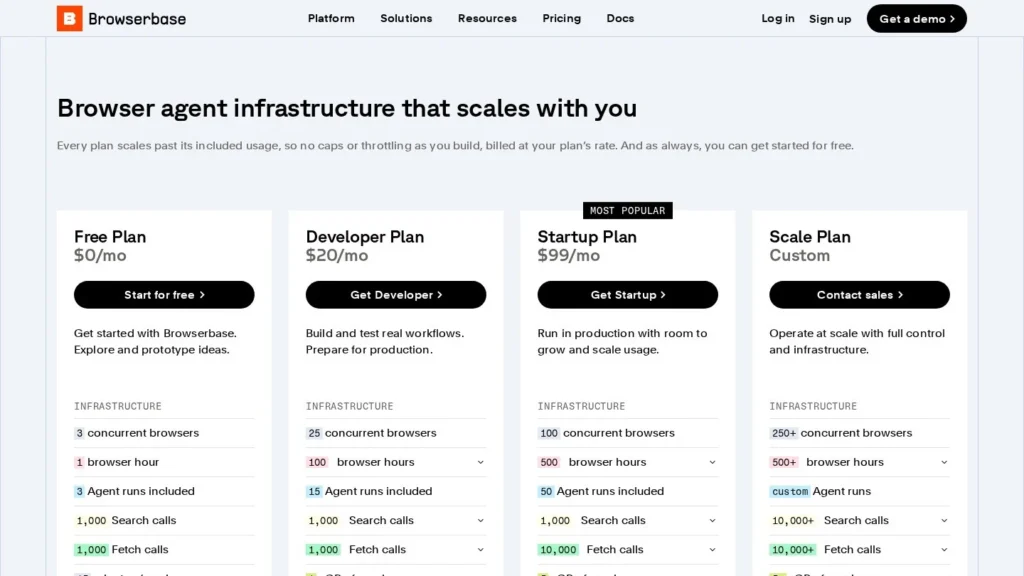
- Starting price: free plan; Developer $20 a month for 100 browser hours; Startup $99 for 500 hours.
- Scale behind it: 50 million-plus sessions in the first half of 2025 and more than 1,000 paying customers, as reported at its Series B.
- Stagehand: its open-source framework was reported at 1.3 million downloads a month.
- Security: SOC 2 compliance, with HIPAA BAA, DPA and SSO on the Scale plan.
- Our score: 8.6/10, strong on pricing transparency and integrations, with autonomy and setup scores reflecting that buyers build their own agent.
Series B Traction Numbers and Price Sheet
Browserbase disclosed unusually detailed traction alongside its Series B. These figures come from coverage of that round and from its pricing page.
| Fact | Detail | Source and Date |
|---|---|---|
| Series B | $40 million led by Notable Capital, with CRV and Kleiner Perkins | SiliconANGLE, June 17, 2025 |
| Valuation | Reported $300 million, about four times its valuation the previous September | SiliconANGLE, June 17, 2025 |
| Developers | More than 20,000 developers had used the platform | AIM Media House, June 17, 2025 |
| Sessions | More than 50 million browser sessions in 2025 by mid-June, double all of 2024 | AIM Media House, June 17, 2025 |
| Customers and revenue | More than 1,000 paying customers and revenue above $3 million | AIM Media House, June 17, 2025 |
| Stagehand adoption | Downloaded more than 1.3 million times a month | AIM Media House, June 17, 2025 |
| Named customers | Commure, 11x, Perplexity, Vercel, Pursuit and Structify | AIM Media House, June 17, 2025 |
| Team | Team of 30; founded by Paul Klein IV about 16 months before the round | AIM Media House, June 17, 2025 |
| Entry plans | Free; Developer $20 a month; Startup $99 a month; Scale custom | Browserbase pricing |
| Overage | $0.12 per browser hour on Developer, $0.10 on Startup | Browserbase pricing |
The session count is the most telling number. Fifty million sessions in under six months, double the previous year’s total, shows agent builders are leaning on hosted browsers rather than running their own. The customer list, with Perplexity, Vercel and 11x, means the platform is already carrying production agent traffic for well-known AI companies.
The revenue figure puts that in proportion. Revenue above $3 million at the time of a $300 million valuation means investors were paying for growth. For buyers, that suggests a well-funded vendor that is still young, so plans and features may keep changing.
Browsers, Network and Anti-Bot Handling for Your Agent
Browserbase sits between your agent and the web. Your code decides what to do; Browserbase supplies the browser, network and anti-bot handling that let it happen at scale.
Three Free Browsers and a Stagehand Connection
- Create an account: start on the free plan with 3 concurrent browsers and 1 browser hour.
- Connect your code: point your browser automation scripts or Stagehand at Browserbase instead of a local browser.
- Choose AI usage: bring your own model keys or use Model Gateway to pay for model tokens at market price.
- Configure sessions: turn on proxies, captcha solving and stealth settings as your plan allows.
- Scale up: move to Developer, Startup or Scale as concurrency and hours grow.
What the Platform Does
- Runs browsers: starts headless browsers in the cloud, up to 250 or more at once on Scale.
- Handles friction: automatic captcha solving from Developer up, basic stealth on Developer and Startup, advanced stealth and verified agents on Scale.
- Routes traffic: built-in proxies with included data and per-GB overage.
- Gives agents shortcuts: search and fetch APIs return results and page content without a full session.
- Runs agent tasks: plans include agent runs, from 3 on Free to 50 on Startup.
Stagehand
Stagehand is the open-source framework Browserbase created and maintains. It lets developers combine traditional scripts with AI agents in one workflow: AI handles steps that need adaptability, such as finding a button on a changing page, while scripts handle steps that need reliability. Browserbase positions it as a more capable alternative to Puppeteer and Selenium. In 2025 it added Python support alongside Node.js, with session recordings, token tracking and detailed logging.
Director
Director, launched with the Series B in June 2025, is aimed at business users. It turns natural language prompts, such as placing an order or checking a package’s status, into browser automations and generates reusable code.
Developers Own Credentials, Site Choices and Results
Developers design the agent, decide which sites it may visit, handle credentials and review results. Browserbase supplies the browsers and tools, not the judgment about what an agent should do.
Good First Projects
Teams usually start with a narrow job that already breaks on local browsers: logging in to a supplier portal to download invoices, checking prices or stock across a handful of sites, filling the same form on many accounts, or giving an AI assistant the ability to read pages that block simple fetch requests. Each is easy to measure in browser hours and success rate, which makes plan sizing straightforward.
Testing Three Sites Twenty Times Each
- Pick three target sites: one simple, one with a login and one with strong bot defenses.
- Measure success rate: run each task 20 times and count clean completions.
- Time each session: browser hours drive cost, so record average minutes per task.
- Test Stagehand on a changing page: see whether AI actions recover when a layout shifts.
- Check proxy use: note how many megabytes a typical task consumes.
- Review recordings and logs: make sure you can debug a failed run quickly.
With those numbers, multiply minutes per task by monthly task volume to estimate browser hours, then compare the Developer and Startup totals using the overage rates below.
Published Plans and Overage Rates
Browserbase publishes its plans and overage rates. Every plan can scale past its included usage at the plan’s rate.
| Plan | Price | Billing | What’s Included | Limits |
|---|---|---|---|---|
| Free | $0 | None | 3 concurrent browsers, 1 browser hour, 3 agent runs, 1,000 search and fetch calls, $5 in model tokens | 15-minute sessions, no captcha solving or stealth, 7-day retention |
| Developer | $20 per month | Monthly | 25 concurrent browsers, 100 browser hours, 1GB proxies, 15 agent runs, captcha solving, basic stealth | $0.12 per extra hour, $12 per extra GB, 30-day retention |
| Startup | $99 per month | Monthly | 100 concurrent browsers, 500 browser hours, 5GB proxies, 50 agent runs, 10,000 fetch calls | $0.10 per extra hour, $10 per extra GB, 30-day retention |
| Scale | Custom | Contract | 250+ browsers, usage-based hours and proxies, advanced stealth, verified agents, HIPAA BAA, DPA, SSO | Sales-led |
Search calls past the allowance cost $5 per 1,000 by default, and fetch calls $1 per 1,000 on Developer and $0.50 on Startup. Model usage through Model Gateway is billed at market price.
Three Hundred Browser Hours on the Developer Plan
A solo developer using 300 browser hours a month. Developer’s $20 covers 100 hours, and 200 extra hours at $0.12 add $24, for $44 a month.
A startup using 1,000 browser hours a month. On Startup, $99 covers 500 hours and 500 more at $0.10 add $50, for $149 a month. On Developer the same hours would cost $128, but with only 25 concurrent browsers instead of 100, so the choice depends on how many sessions run at once.
Hidden and variable costs. Proxy data, search and fetch calls and AI model tokens are billed separately from browser hours. Sites with strong bot defenses may push you to Scale for advanced stealth.
Browserbase Compared With Anchor Browser, Steel and Browser Use
These four all give AI agents browsers to work in, but they differ on price, openness and how much of the agent they provide.
| Tool | Starting Price | Free Plan | Main Strength | Main Trade-Off | Best For |
|---|---|---|---|---|---|
| Browserbase | Free; Developer $20 per month | Yes | Mature hosted browser fleet with Stagehand and published overage | You build the agent | Developers scaling production agents |
| Anchor Browser | Free; paid from $50 per month | Yes | Reliable logged-in sessions for agents at scale | Higher paid entry price | Agents that must log in to sites |
| Steel | $0 plus usage; Scale $250 per month | Yes (one-time credits) | Open-source browser API you can self-host | Paid tier jumps to $250 | Teams that want to self-host |
| Browser Use | Free; pay as you go | Limited | Open-source agent that drives the browser for you | Less infrastructure control | Developers who want a ready agent |
Browserbase has the lowest paid entry point of the hosted options and the most public traction. Steel is the choice if you want to run the browser layer yourself, Anchor Browser focuses on logged-in sessions, and Browser Use provides more of the agent itself. More options are on our browser automation agents and agent frameworks pages.
The biggest decision is build versus buy. Infrastructure such as Browserbase or Steel gives you full control and more say over cost at volume, but your team writes and maintains the agent. Agent products such as Browser Use, Skyvern or Airtop do more of the work out of the box. Teams with engineers and many distinct workflows tend to prefer infrastructure; teams with a few business workflows and no engineers usually do better with a finished agent.
AI Startups and Developers Outgrowing Local Browsers
- AI startups: companies such as Perplexity and 11x use it for production agent traffic.
- Developers outgrowing local browsers: concurrency, proxies and captcha handling come built in.
- Teams with existing browser scripts: Stagehand lets them keep scripted steps and add AI only where pages are unpredictable.
- Healthcare and regulated builders: HIPAA BAA and DPA are available on Scale.
Self-Hosters and Non-Technical Users May Prefer Other Options
- Non-technical users: an end-user agent such as Claude in Chrome or Fellou is simpler.
- Teams that must self-host: Browserbase is a hosted service; Steel can run on your own servers.
- Very occasional automation: a few tasks a month do not need browser infrastructure.
- Projects that rely on evading site rules: automation should respect each site’s terms.
Metered Hours, Proxies and Tokens to Budget
Usage adds up. Browser hours, proxy data, search and fetch calls and model tokens are all metered. Set budgets and alerts, and log session lengths, since a stuck agent can keep a browser open.
Plan limits shape reliability. The free plan caps sessions at 15 minutes and does not include captcha solving or stealth. Advanced stealth and verified agents come with Scale, which matters for sites with strong bot defenses.
Legal and ethical use is your responsibility. Logging in to sites, scraping data and solving captchas can conflict with terms of service or privacy rules. Get clearance for each target site and handle any personal data carefully.
Credentials need care. If your agents log in to customer or supplier accounts, decide where passwords and session cookies are stored, who can see session recordings and how long logs are kept. Data retention runs from 7 days on Free to 30 days on Developer and Startup, and longer on Scale.
Expect change. Browserbase is a young, fast-growing company; its entry plan dropped from $39 to $20 at the Series B, and products such as Director are new. Recheck pricing before annual budgeting.
Notable Capital Leads a $40 Million Series B
On June 17, 2025, Browserbase raised a $40 million Series B led by Notable Capital, with Kleiner Perkins and CRV, at a reported $300 million valuation. At the same time it launched Director for natural language automations, added Python support to Stagehand and cut its entry plan from $39 to $20 a month.
Built for Agents on Real Websites, Rated 7.2
For developers building agents that must work on real websites, yes. Browserbase scores 8.6/10 on our scale. It has a free plan, a $20 entry tier, published overage rates, a widely used open-source framework and strong traction with AI companies, plus SOC 2 and HIPAA options for regulated teams.
It is infrastructure rather than an agent you can hand a task to without code, which is reflected in its autonomy and setup scores. Start on the free plan with Stagehand, measure browser hours per task, then pick Developer or Startup based on how many sessions you need at once.
Browserbase Plan Prices and Hours
How Much Does Browserbase Cost?
There is a free plan. Developer costs $20 a month with 100 browser hours, Startup costs $99 a month with 500 hours, and Scale is quoted. Extra hours cost $0.12 or $0.10 depending on plan.
Does Browserbase Have a Free Plan?
Yes. The free plan includes 3 concurrent browsers, 1 browser hour, 3 agent runs, 1,000 search and fetch calls and $5 in model tokens, with sessions capped at 15 minutes and 7-day data retention.
What Is Stagehand?
Stagehand is Browserbase’s open-source framework for combining browser scripts with AI actions. It supports Node.js and Python and was reported at more than 1.3 million downloads a month in June 2025.
Does Browserbase Solve Captchas?
Automatic captcha solving is included from the Developer plan up. The free plan does not include it, and advanced stealth and verified agents are on Scale.
Is Browserbase HIPAA Compliant?
Browserbase offers a HIPAA business associate agreement and a data processing agreement on its Scale plan, and states SOC 2 compliance.
How Does Browserbase Compare With Steel?
Both run cloud browsers for agents. Browserbase starts at $20 a month for 100 hours; Steel offers one-time free credits and a $250 Scale plan, and its browser code is open source for self-hosting.
User Reviews
Nobody has rated it here yet. Be the first AI Agents Choice user to rate Browserbase.