
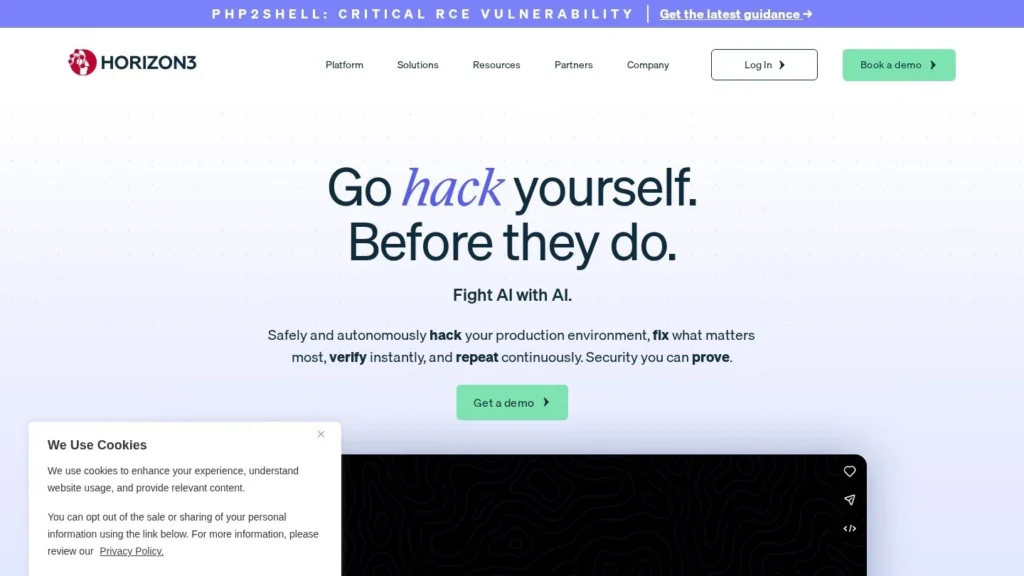
NodeZero is an autonomous penetration tester from Horizon3.ai. It attacks your internal network, external perimeter, AWS and Azure cloud, Kubernetes and Active Directory the way an intruder would, chains small weaknesses into proven attack paths, and re-tests once you fix them. Horizon3.ai says it has run more than 300,000 pentests in production for over 6,500 organizations, including the NSA and CISA. It is best for security and IT teams that want to test infrastructure often instead of once a year.
Pricing is published, which is rare in this market: $15 per asset per test, or $50 to $85 per asset per year with unlimited testing. Two things to note are that web application testing is priced separately and premium support adds 10% to 20%. This review is based on Horizon3.ai’s published pricing, marketplace listing and coverage of the company as of October 2026; we have not tested it hands-on.
Public Per-Asset Pricing and 300,000 Production Pentests
- Published pricing: $15 per asset per test on Flex, or $50 to $85 per asset per year with unlimited pentests.
- Scale: more than 300,000 production pentests for over 6,500 organizations, including the NSA and CISA, by the company’s count.
- User ratings: 4.7 out of 5 from 151 ratings on Gartner Peer Insights.
- Backing: a $250 million Series E in August 2026 at a valuation above $2 billion, with ARR up 120% year over year.
- Our score: 9.0/10, the highest marks going to autonomy, published pricing and user sentiment.
Traction From the 2026 Funding Round and Public Prices
Horizon3.ai disclosed detailed traction with its 2026 funding round, and its prices are public. Each item below was checked on the linked page.
| Fact | Detail | Source and date |
|---|---|---|
| Series E | $250 million at a valuation above $2 billion, co-led by NightDragon and New Enterprise Associates | SiliconANGLE, August 3, 2026 |
| Total funding | $428.5 million; the June 2025 Series D valued the company at $650 million | SiliconANGLE, August 3, 2026 |
| Growth | Annual recurring revenue up 120% year over year | SiliconANGLE, August 3, 2026 |
| Customers | More than 6,500 organizations, up from about 3,000 at the Series D | SiliconANGLE, August 3, 2026 |
| Pentests run | More than 300,000 pentests in production | SiliconANGLE, August 3, 2026 |
| Named users | The NSA, CISA, four Fortune 10 companies, multinational banks and healthcare networks | SiliconANGLE, August 3, 2026 |
| Founders | CEO Snehal Antani, former CTO of Splunk; Anthony Pillitiere, former deputy CTO at US Special Operations Command; founded 2019 | SiliconANGLE, August 3, 2026 |
| Pricing | Flex $15 per asset per test; Core $50, Pro $65 and Elite $85 per asset per year with unlimited testing | Horizon3.ai pricing page, accessed October 2026 |
| Marketplace packages | Core $25,000, Pro $32,500 and Elite $42,500 for 500 assets for 12 months; 12, 24 and 36-month terms | AWS Marketplace listing, accessed October 2026 |
| User rating | 4.7 out of 5 from 151 ratings; 71% five-star | Gartner Peer Insights, accessed October 2026 |
Two numbers stand out for buyers. The jump from about 3,000 to more than 6,500 organizations in roughly a year, together with 120% ARR growth, suggests many teams are replacing or supplementing annual human pentests with continuous autonomous ones. The 151 ratings on Gartner Peer Insights averaging 4.7 give an outside view that most AI security agents do not have yet.
The funding also matters for a multi-year contract. With $428.5 million raised and a plan to add blue-team agents that remediate findings, Horizon3.ai is likely to keep expanding the product. The usage and customer figures come from the company.
A Cloud Service That Attacks Your Defined Scope
NodeZero runs as a cloud service. You define the scope, launch a test and let it work. Annual plans count each asset once per 12 months and allow unlimited tests, which changes how teams use it: pentesting becomes something you run after a change, not a yearly project.
A Typical Test
- Set scope. Choose the environment: internal network, external attack surface, AWS or Azure cloud, Kubernetes, or a phishing impact test.
- Autonomous attack. NodeZero discovers assets and looks for weak credentials, misconfigurations and identity gaps, then chains them into attack paths as an intruder would.
- Proof. Findings come with the path NodeZero took. Gartner Peer Insights reviewers mention proof-of-concept commands that let teams confirm results themselves.
- Fix guidance. Fix Actions explain what to change, and reports summarize results for security and IT teams.
- Verify. After remediation, a one-click Verify re-tests the issue to confirm it is closed.
What Each Tier Adds
Every plan includes internal, external, cloud and Kubernetes pentesting, the Active Directory password audit, phishing impact testing, Fix Actions with Verify, the Vulnerability Management Hub, Endpoint Security Effectiveness and an MCP Server. Core adds scheduling and Threat Informed Perspectives. Pro adds Tripwires and Rapid Response. Elite adds risk-based exposure management, vulnerability prioritization using Tenable, Rapid7 and Qualys scanner data, NodeZero Insights, high-value targeting, advanced data pilfering and threat actor intelligence. SiliconANGLE also reported that NodeZero can seed environments with honeypot decoys to catch AI-driven attackers.
Flex or an Annual Plan
The pricing model shapes how you use the product. Flex suits a team that needs one or two tests a year, for an audit or after a large migration, and wants to pay only for what it tests. Annual plans suit teams that want testing to become routine: run a test after a firewall change, again after a new cloud account goes live, and again when a fix is deployed. Because each asset counts once per 12 months on Core, Pro and Elite, the marginal cost of an extra test is zero, which encourages the habit Horizon3.ai is selling. The upgrade path also follows maturity. Core covers testing, Pro adds Tripwires and Rapid Response, and Elite adds prioritization that pulls in scanner data from Tenable, Rapid7 and Qualys so teams fix the exposures that matter first.
Who Runs It Day to Day
In most organizations NodeZero sits with the security team, but infrastructure and IT staff do much of the work because they own the systems it attacks. A practical setup gives security the job of scheduling tests and reading results, and gives system owners the Fix Actions for their assets, with Verify used to close the loop. Every plan also includes an MCP Server for connecting AI tools.
Scope Approval and Fixes Remain Your Team’s Job
Your team decides what is in scope, approves testing of production systems and does the fixing. NodeZero covers infrastructure, cloud and identity; web applications are a separate product, and social engineering beyond phishing impact tests or physical security needs human testers. Horizon3.ai is building blue-team agents to remediate findings, but today remediation is your job.
How Horizon3.ai Counts Assets and Charges for Them
Horizon3.ai publishes per-asset pricing. An asset is any server, workstation, network device, cloud resource or internet-facing service, and a machine with several hostnames or addresses counts once.
| Plan | Price | Billing | What’s Included | Limits |
|---|---|---|---|---|
| Flex | $15 per asset per test | 12-month term | Internal, external, cloud and Kubernetes pentesting, AD password audit, phishing impact, Fix Actions with Verify, MCP Server | Assets counted each time they are tested; no add-ons |
| Core | $50 per asset | Annual | Everything in Flex plus scheduling and Threat Informed Perspectives | Each asset counted once per 12 months; unlimited pentests |
| Pro | $65 per asset | Annual | Core plus Tripwires and Rapid Response | Unlimited pentests |
| Elite | $85 per asset | Annual | Pro plus exposure management, vulnerability prioritization, Insights and threat actor intelligence | Unlimited pentests |
| WebApp Flex | $10,000 per app per test | 12-month term | Web application pentest | Add-on or standalone |
| WebApp Continuous | Custom quote | Per app | Unlimited testing of each licensed app | Volume discounts |
| Enhanced support | 10% of subscription | Annual | Faster support, quarterly engagement, live chat, remediation advice, assigned CSM | $7,500 minimum |
| Premier support | 20% of subscription | Annual | Top-priority support, monthly engagement, architecture guidance | $25,000 minimum |
On AWS Marketplace, 500-asset packages for 12 months are listed at $25,000 for Core, $32,500 for Pro and $42,500 for Elite, with 24 and 36-month terms also offered. Marketplace fees are non-cancellable and non-refundable.
A 500-Asset Company Testing Every Quarter
A 500-asset company testing quarterly. On Flex, four tests of 500 assets cost $30,000 a year. Core covers the same assets for $25,000 with unlimited tests, so annual plans win once you test more than three times a year.
A 2,000-asset enterprise on Pro. 2,000 assets at $65 come to $130,000 a year. Adding Enhanced support at 10% brings the total to $143,000. Two web applications tested once each on WebApp Flex add $20,000.
A small team with 200 assets. Core costs $10,000 a year for unlimited tests. Enhanced support at 10% would be $1,000, but the $7,500 minimum applies, so most small teams will stick with standard support, which is included.
Variable costs. Asset counts grow as cloud environments grow, so budget for expansion at renewal. Web apps, premium support and a designated support engineer ($50,000 a year on Premier) are extra, and remediation time is the real cost of any pentest.
NodeZero Compared With XBOW, Dropzone AI and CrowdStrike Charlotte AI
NodeZero is an offensive agent: it looks for ways in before attackers do. XBOW is the closest rival but focuses on web applications, while Dropzone AI and Charlotte AI defend by investigating alerts.
| Tool | Starting Price | Free Plan | Main Strength | Main Trade-Off | Best For |
|---|---|---|---|---|---|
| NodeZero | $15 per asset per test (Flex) | No | Unlimited autonomous network, cloud and identity pentests at published prices | Web app testing costs extra | Teams testing internal and cloud infrastructure often |
| XBOW | $4,000 per on-demand pentest | No | Finds and exploits web application flaws, with proof for each | Continuous platform pricing is quoted | Application security teams |
| Dropzone AI | Custom quote | No | Investigates every security alert with a full work log | Defensive only; does not test for weaknesses | SOC teams facing alert overload |
| CrowdStrike Charlotte AI | Custom quote on top of Falcon (from $59.99 per device a year) | No (15-day Falcon trial) | Triage and investigation of live detections | Defensive only; tied to Falcon | Falcon customers running a SOC |
NodeZero and XBOW complement each other more than they compete. NodeZero tests the network, cloud and identity layers at a per-asset price, and XBOW tests web applications per test. A company with both needs might buy NodeZero for infrastructure and XBOW or NodeZero’s own WebApp option for applications. Defensive agents answer a different question, how to handle alerts when something gets through. See more on our cybersecurity agents page.
Annual Pentesters and Infrastructure-Focused IT Teams
- Teams that pentest once a year and want more: unlimited testing on annual plans lets you test after every major change.
- IT and infrastructure teams: coverage of Active Directory, internal networks, cloud and Kubernetes matches what they run; see our IT and DevOps agents page.
- Budget-conscious buyers: published per-asset prices make it easy to forecast cost before talking to sales.
- Organizations with compliance testing needs: Horizon3.ai links PCI and NIS 2 compliance resources, and reports document each test.
- Government and regulated enterprises: the NSA, CISA and Fortune 10 companies use it, according to the company; see our enterprise agents page.
Web App-Heavy Risks and Full Red Team Needs
- Teams whose main risk is web applications: web app testing costs $10,000 per app per test, so an application-focused tool may be cheaper.
- Organizations needing a full red team: physical intrusion and broad social engineering still need people.
- SOCs with heavy alert volume: NodeZero finds weaknesses but does not triage live alerts.
- Very small offices without IT staff: someone has to scope tests and fix what NodeZero finds.
Live Attack Techniques and Costs That Grow With Assets
- Live testing: NodeZero performs real attack techniques, so agree scope, timing and contacts with system owners before each run.
- Asset growth: per-asset pricing rises with your environment; check how assets are counted at renewal.
- Contract terms: marketplace fees are non-cancellable and non-refundable, and Flex runs on a 12-month term.
- Reviewer feedback: some Gartner Peer Insights reviewers say jobs cannot be scheduled to run only once and that password-reuse findings can be hard to interpret.
- Vendor figures: customer counts, pentests run and growth rates come from Horizon3.ai.
NightDragon and NEA Lead a $250 Million Series E
On August 3, 2026, SiliconANGLE reported that Horizon3.ai raised a $250 million Series E at a valuation above $2 billion, co-led by NightDragon and New Enterprise Associates, with new investors including PSG Equity, Sapphire and SAIC Ventures. The company said it would expand into Australia and Singapore and build autonomous blue-team agents that remediate findings without human intervention.
Among the Highest-Scoring Security Agents We Cover
Yes, for organizations that want to pentest infrastructure regularly at a known price. NodeZero scores 9.0/10 on our scale, among the highest of the security agents we cover. It does the whole job on its own, from discovery to proven attack path to verified fix, its prices are on the website, and 151 Gartner Peer Insights ratings averaging 4.7 back up the vendor’s claims.
Including web application testing and premium support in more plans, and publishing more detail on certifications, would lift the score further. Start by counting assets, compare Flex with Core for your testing frequency, and run the first tests on a non-critical segment before running it on production.
Asset Definitions, Cloud Coverage and Per-Asset Cost
How Much Does NodeZero Cost Per Asset?
Flex costs $15 per asset per test. Annual plans cost $50 per asset for Core, $65 for Pro and $85 for Elite, each with unlimited pentests. Web application testing is extra, from $10,000 per app per test.
What Counts as an Asset in NodeZero?
Horizon3.ai counts any server, workstation, network device, cloud resource or internet-facing service as an asset. A single machine with several hostnames or IP addresses counts as one asset.
Can NodeZero Test AWS, Azure and Kubernetes?
Yes. Every plan includes internal, external, AWS and Azure cloud and Kubernetes pentesting, along with an Active Directory password audit and phishing impact testing.
How Is NodeZero Different From XBOW?
NodeZero focuses on networks, cloud, identity and infrastructure and is priced per asset with unlimited testing on annual plans. XBOW focuses on web applications and sells on-demand tests from $4,000. Many companies need both kinds of coverage.
Who Founded Horizon3.ai?
Horizon3.ai was founded in 2019 by CEO Snehal Antani, former CTO of Splunk, and Anthony Pillitiere, former deputy CTO at US Special Operations Command. The company raised a $250 million Series E in August 2026.
User Reviews
Nobody has rated it here yet. Be the first AI Agents Choice user to rate NodeZero by Horizon3.ai.