
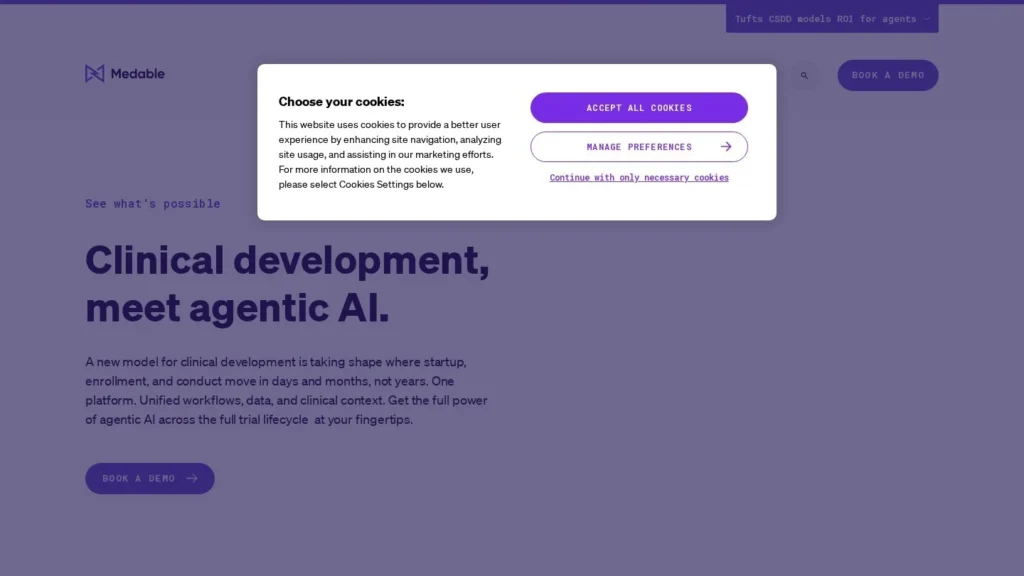
Medable AI Agents are best for sponsors and contract research organizations already running trials on Medable’s platform that want monitoring, trial master file and investigator oversight work partly automated. The agents gather and summarize data, file documents and brief investigators, with humans signing off on critical steps. Pricing is shared by quote, and most of the agents are less than a year old.
The platform beneath them is established: Medable says it has been deployed in nearly 400 trials across 70 countries and 120 languages, serving more than a million patients. We score the agents 7.7/10 on our scale, with credit for integrations and focus, and with price transparency and track record as areas still to build. This review is based on Medable’s announcements and trade coverage as of November 2026; we have not tested it hands-on.
Medable’s Quote-Only Agents and Its Three Ready-Made Ones
- Starting price: custom quote only; Medable sells Agent Studio and its agents through sales with live demos.
- Three ready-made agents: a CRA Agent (September 2025), a TMF Agent (January 2026) and a PI Summary Agent for eCOA data (February 2026).
- Platform scale: nearly 400 trials, 70 countries, 120 languages and more than a million patients, according to Medable.
- Integrations: Veeva EDC and Vault, CTMS, IRT, eCOA, Wingspan, OpenText, Salesforce, Microsoft and Gmail.
- Our score: 7.7/10, with quote-based pricing and a short public track record as the areas to grow.
Platform Scale and Launch Dates Instead of Customer Results
Medable publishes platform scale and launch details rather than per-customer agent results. Each item below was checked on the source page; efficiency figures are Medable’s or third-party estimates it cites.
| Fact | Detail | Source and Date |
|---|---|---|
| Agent platform launch | Agent Studio and the CRA Agent, which Medable calls the industry’s first agentic AI platform for clinical development | Medable press release, September 3, 2025 |
| Platform scale | Nearly 400 trials, 70 countries, 120 languages and more than one million patients | Medable press release, September 3, 2025 |
| Build speed claim | Studies built 35 times faster with Studio and AI (Medable marketing claim) | Medable press release, September 3, 2025 |
| Value estimate | A Tufts CSDD analysis cited by Medable puts the value of AI monitoring agents at up to $21 million net per program and up to 82 times return | Medable press release, September 3, 2025 |
| White space | New drugs spend about 45% of development time in unproductive white space, a third-party figure Medable cites | Medable press release, September 3, 2025 |
| TMF Agent | Launched with integrations to Veeva Vault, Wingspan and OpenText; more agents planned through 2026 | BiopharmaTrend, January 8, 2026 |
| Manual workload | Reconciliation often takes over a third of data managers’ and CRAs’ time; more than 95% of TMF documents are still handled manually, per Medable data | BiopharmaTrend, January 8, 2026 |
| PI Summary Agent | Per-participant AI summaries of eCOA data for investigators, available in Medable’s eCOA platform | Clinical Leader, February 3, 2026 |
| Recognition | Galien Foundation Best Digital Health Solution; Inc. 5000 listings in 2023 and 2024 | Medable press release, September 3, 2025 |
For a buyer, the workload figures explain where the agents aim. If reconciliation takes over a third of a CRA’s time and nearly all TMF documents are still handled by hand, even partial automation frees real capacity. The value estimate is large, but it is a modeled figure for AI monitoring agents in general, not a measured Medable result.
The launch dates matter as much. All three agents arrived within six months, so few studies will have run to completion with them. Treat early deployments as pilots with careful measurement, especially for TMF work that regulators inspect.
The ambition behind the agents is stated plainly. Medable, led by co-founders Dr. Michelle Longmire as CEO and Tim Smith as CTO, describes a 1:1:1 vision of one-day study start, one-day patient recruitment and one-year study conduct, and its long-term goal is to compress a trial lifecycle that often runs 10 to 15 years into under one year. Buyers do not need to share that goal to benefit, but it explains why the company is shipping agents at this pace.
Agent Studio Agents Inside the Clinical Trial Platform
Medable’s agents sit inside its clinical trial platform and reach into the other systems a study team uses. Each is built on Agent Studio and targets one role in the trial.
Agent Studio
Agent Studio is a no-code tool for life sciences teams to build and run agents. Medable describes it as system agnostic, and it connects to Veeva EDC, eCOA, IRT and CTMS systems as well as Salesforce, Microsoft and Gmail. Teams can use Medable’s ready-made agents or build their own for specific workflows.
CRA Agent
- Gather: it collects monitoring data from connected trial systems.
- Summarize: it condenses the data into what a clinical research associate needs to act on.
- Automate routine work: it handles routine monitoring tasks and communications with sites.
- Escalate: critical areas stay with humans, who review and decide.
TMF Agent
The TMF Agent takes on trial master file processing: ingesting documents, classifying them, extracting metadata and preparing them before submission. Workflow orchestration and human validation are built in to keep the file auditable. It connects to Veeva Vault, Wingspan and OpenText, three common eTMF and document systems.
PI Summary Agent
Inside Medable’s eCOA platform, the PI Summary Agent continuously monitors patient-reported data and writes a summary for each participant that highlights the most important points. Investigators keep full access to the underlying data, and Medable frames the agent as a way to make remote oversight proactive and traceable.
Clinical Judgment and Regulated Sign-Off Remain Human
Clinical judgment, protocol decisions, safety assessments and sign-off on regulated documents stay with people. Medable’s own descriptions stress human-in-the-loop control for critical areas, validation of TMF work and investigator access to source data.
Rolling Out Like a Validated System Change
Because the work is regulated, rollout looks more like a validated system change than a software trial. A sensible path is to choose one agent and one study, document intended use and acceptance criteria with your quality team, and run the agent alongside existing processes for a period so outputs can be compared. For the TMF Agent, sample its classifications and metadata against human filing before trusting it at volume. For the CRA Agent, track how much monitoring time it frees and whether issues reach sites faster. Expand only once the numbers hold up.
Demos and Enterprise Deals Instead of a Price List
Medable does not publish prices. Based on its announcements, buying works like this.
| Plan | Price | Billing | What’s Included | Limits |
|---|---|---|---|---|
| Demo | Free | None | Live demonstration of Agent Studio and ready-made agents | Not on your study data |
| Agent Studio and agents | Custom quote | Enterprise contract | CRA Agent, TMF Agent, custom agents and integrations | Scoped by study and module |
| eCOA platform with PI Summary Agent | Custom quote | Enterprise contract | eCOA data capture with per-participant AI summaries | Requires Medable eCOA |
Applying Medable’s Workload Figures to a Sponsor Team
With no prices, the useful sums are about time. These scenarios apply Medable’s workload figures to illustrative team sizes we chose.
- A sponsor with 10 CRAs: if reconciliation takes a third of each CRA’s time, that is about 3.3 full-time roles spent on reconciliation. Halving it would free about 1.7 roles.
- A TMF team filing 50,000 documents a year: at Medable’s figure of more than 95% handled manually, over 47,500 documents pass through human hands. Automated classification and metadata extraction target that volume.
- A program-level view: the Tufts estimate of up to $21 million in net value per program is a ceiling for AI monitoring agents generally; use it to frame a business case, not as a forecast.
Costs to clarify: computer system validation for regulated use, integration work for each connected system, per-study or per-module fees and whether custom agents built in Agent Studio cost extra.
Questions to Ask Sales
- Measured results: which studies have used each agent, and what time savings or error rates were recorded?
- Validation support: what documentation does Medable provide for computer system validation?
- Integration depth: can the agents write back to your EDC, CTMS and eTMF, or only read from them?
- Pricing model: is the fee per study, per agent, per user or per module?
- Roadmap: which new agents are planned for 2026, and are they included in your contract?
Medable AI Agents Compared With IQVIA.ai, Veeva AI Agents and K Pro by Owkin
Clinical development agents tend to come from the vendors whose platforms already hold trial data. That shapes the choice more than features do.
| Tool | Starting Price | Free Plan | Main Strength | Main Trade-Off | Best For |
|---|---|---|---|---|---|
| Medable AI Agents | Custom quote | No (demo) | Role-specific agents for CRAs, TMF and investigators on a trial platform | Young agents with short track records | Sponsors and CROs running decentralized or hybrid trials |
| IQVIA.ai | Custom quote | No | Orchestrator agents across trial start-up, data review and field insights | No self-serve access | Large sponsors already buying IQVIA services |
| Veeva AI Agents | Usage-based; quote from Veeva | No | Agents inside Vault applications used across commercial and clinical | Only for Veeva customers | Companies standardized on Veeva Vault |
| K Pro by Owkin | Custom quote (multi-year license) | No | Research agents built for pharma R&D questions | Focused on research rather than trial operations | R&D and competitive intelligence teams |
If your trials already run on Medable, its agents are the shortest path. Veeva’s agents make sense where Vault is the system of record, and IQVIA suits sponsors who outsource heavily to IQVIA. Owkin’s K Pro answers research questions rather than running trial operations. Medable’s TMF Agent also connects to Veeva Vault, so the two are not mutually exclusive. A practical way to decide is to map where your trial data already lives: the vendor that holds most of it will usually give its agents the richest context, and switching platforms just to get an agent rarely pays off. Medable’s no-code Agent Studio is its main differentiator for teams that want to shape agents to their own workflows. More options are on our life sciences agents page.
Clinical Ops Teams With Stretched CRAs
- Existing Medable customers: the PI Summary Agent sits inside the eCOA platform you already use.
- Clinical operations teams with stretched CRAs: the CRA Agent targets reconciliation and routine site communication.
- TMF and document teams: automated classification and metadata extraction address a task Medable says is still over 95% manual.
- Sponsors running decentralized trials across many countries: the platform spans 70 countries and 120 languages.
- Teams that want to build their own agents: Agent Studio is no-code. See our healthcare agents page for related tools.
Small Sites and Academic Groups
- Small sites and academic groups: the agents are sold as enterprise contracts without public pricing.
- Teams outside clinical development: discovery and commercial work fit other tools.
- Sponsors wanting proven multi-year results: the agents launched between September 2025 and February 2026.
- Companies fully committed to one platform vendor: if Veeva or IQVIA already runs your trials, test their agents first.
Modeled Savings and Validation Work
- Vendor and modeled figures: the 35 times faster study build and the $21 million Tufts estimate are not measured results from your studies.
- Validation burden: regulated use needs documented validation of agent outputs in your quality system, which takes time.
- Integration depth: confirm how deeply the agents read and write in your specific EDC, CTMS and eTMF systems.
- Early track record: plan the first deployment as a measured pilot with clear success metrics.
- Data governance: patient data flows across systems, so review data processing terms and where summaries are stored.
- Platform fit: the PI Summary Agent lives inside Medable’s eCOA platform, so sponsors using another eCOA vendor cannot use it without switching.
- Fast-moving roadmap: new agents are planned through 2026, so features and contract terms may shift between renewal cycles.
Agent Studio and the CRA Agent Debut at DPharm
On September 3, 2025, Medable launched Agent Studio and its CRA Agent, with live demos at DPharm later that month.
On January 8, 2026, Medable released a TMF Agent for trial master file processing ahead of the J.P. Morgan Healthcare Conference, saying more specialized agents would follow through 2026. On February 3, 2026, it introduced the PI Summary Agent to help investigators oversee eCOA data.
Sponsors and CROs on Medable Have Bottlenecks to Test It On
For sponsors and CROs already on Medable, the agents are worth piloting. They score 7.7/10 on our scale. Each targets a specific, well-known bottleneck: CRA reconciliation, manual TMF filing and investigator oversight of remote patient data. They connect to the systems trials actually run on, including Veeva, CTMS, IRT and common eTMF tools, and they keep people in charge of critical decisions.
The score reflects what is not yet public: prices, independent results and a long track record. Start with one agent on one study, measure hours saved and error rates against a baseline, and involve your quality team in validation from day one. If the first agent delivers, Medable’s plan to add more specialized agents through 2026 gives you room to expand on the same foundation. Compare more options on our life sciences agents page.
CRA Agent Duties and TMF Agent Compatibility
How Much Do Medable AI Agents Cost?
Medable does not publish pricing. Agent Studio and its agents are sold through enterprise contracts after a demo, typically scoped by study and module.
What Does the Medable CRA Agent Do?
It gathers and summarizes data from connected trial systems, automates routine monitoring and communications and keeps humans in the loop for critical areas, aiming to cut the time CRAs spend on reconciliation.
Does the TMF Agent Work With Veeva Vault?
Yes. Medable’s TMF Agent integrates with Veeva Vault, Wingspan and OpenText, and handles ingestion, classification, metadata extraction and pre-submission preparation with human validation.
Can I Build My Own Agents on Medable?
Yes. Agent Studio is a no-code tool for life sciences teams to build custom agents, and it connects to EDC, eCOA, IRT and CTMS systems plus Salesforce, Microsoft and Gmail.
Which Tasks Stay With People on Medable?
Clinical and safety decisions and sign-off on regulated documents stay with people, and Medable keeps humans in the loop for those. Pricing is shared by quote rather than through a self-serve trial.
User Reviews
Nobody has rated it here yet. Be the first AI Agents Choice user to rate Medable AI Agents.