
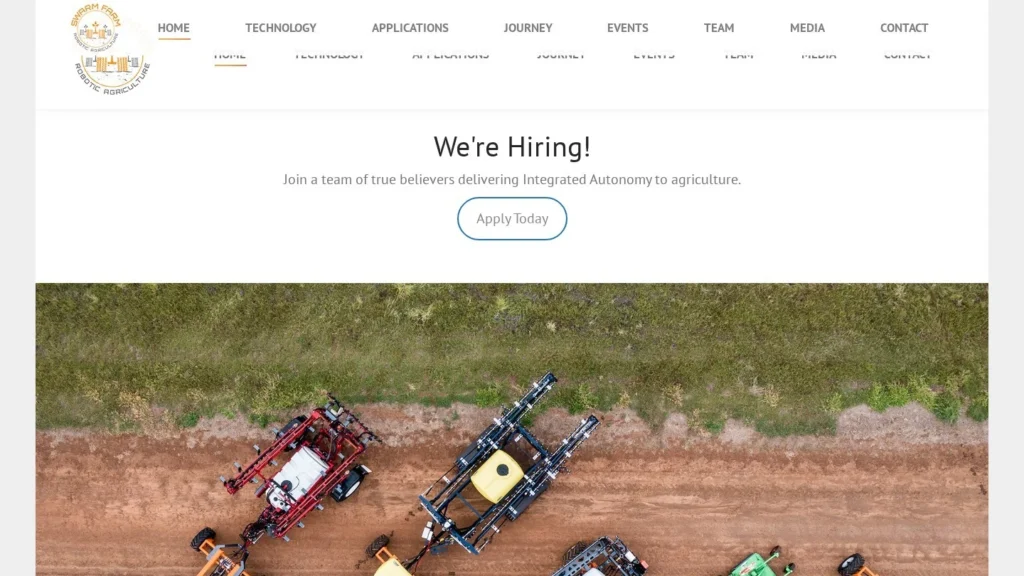
SwarmFarm Robotics has been selling autonomous farm robots since 2016, long before most agriculture AI startups existed. By October 2025 it had about 200 SwarmBots working across Australia, and a SwarmBot 5 is reported to cost A$330,000 plus A$12,500 a year for support. That price buys a machine that drives paddocks on its own and runs partner equipment such as weed-detecting spot sprayers and mowers.
SwarmBot suits large Australian and North American growers who spend heavily on fallow weed control or spraying labor and want several lighter machines instead of one big tractor. Points to weigh are the six-figure entry price, implements bought separately and a North American rollout that is still growing. We rate it 8.1/10 on our scale. We have not used a SwarmBot ourselves; this review is based on trade press, investor material and funding coverage.
A$330,000 SwarmBots and About 200 in Australian Fields
- A SwarmBot 5 is reported at A$330,000 (about US$233,841) plus A$12,500 (about US$8,858) a year for support; implements are extra.
- About 200 SwarmBots were deployed across Australia by October 2025, mainly for weed control in fallow.
- SwarmFarm raised a $30 million Series B in October 2025, led by Edaphon with QIC and the Clean Energy Finance Corporation joining, to expand in North America.
- The platform is open: SwarmConnect partners such as WEED-IT, Bilberry and Goldacres supply the sprayers and applications the robot carries.
- Against Agtonomy, Ecorobotix ARA and Carbon Robotics LaserWeeder, SwarmBot is the most general-purpose platform and the one with the longest commercial record.
Investor and Trade Press Figures on a Private Robot Maker
SwarmFarm is private and shares fewer figures itself, but investors and trade press have documented its scale and price. These are the figures we could confirm.
| Fact | Detail | Source and Date |
|---|---|---|
| Series B | $30 million led by Edaphon; QIC and the Clean Energy Finance Corporation (which put in $7 million) joined; Tenacious Ventures, GrainInnovate and Emmertech returned | Grain Central, October 2, 2025 |
| Earlier funding | $12 million Series A announced in February 2023, led by Emmertech | Grain Central, October 2, 2025 |
| Fleet size | About 200 SwarmBots deployed across Australia, mainly for weed control in fallow | Grain Central, October 2, 2025 |
| Price | SwarmBot 5 at A$330,000 (about US$233,841) plus A$12,500 (about US$8,858) a year for support | Future Farming, viewed November 2026 |
| Field hours | A farm review reports the SwarmBot 5 scoring well after 7,500 hours on an Australian farm | Future Farming, viewed November 2026 |
| Investor-reported impact | 145+ SwarmBots in commercial operation, 300,000+ farming hours saved, 7.1 million liters of chemical output reduced, 7 million+ acres farmed across Australia and the US | QIC profile, viewed November 2026 |
| First US unit | First commercial US delivery went to Beck’s Hybrids in Atlanta, Indiana | Future Farming, April 29, 2024 |
| Partner network | SwarmConnect partners named include WEED-IT, Bilberry, Weedseeker, Hayes Spraying, Rasmussen Brothers Engineering, Goldacres and Croplands | Future Farming, April 29, 2024 |
| History | Founded by farmers Andrew and Jocie Bate at Gindie in Central Queensland; first SwarmBot sold in 2016; manufacturing moved to the Toowoomba area | Grain Central, October 2, 2025 |
| Development | SwarmBot development began in 2012 | Future Farming, viewed November 2026 |
Two numbers matter most to a buyer. The 7,500-hour field report suggests the machine holds up through several seasons of real work, which is the main worry with any first-generation farm robot. The fleet count, which grew from the 145-plus in QIC’s profile to about 200 in October 2025, shows a slow but steady build rather than a rush of pilot units.
The investor-reported savings, such as 7.1 million liters of chemical output avoided, come from material published by a shareholder, so treat them as directional. The $30 million round, with a government green bank among the backers, mainly signals that SwarmFarm has the money to support customers in North America, where its footprint is still small.
A Driverless Carrier for Other Makers’ Tools
SwarmBot is a platform: a driverless machine that carries tools made by other companies. CEO Andrew Bate has described the idea as “Integrated Autonomy,” and told Grain Central that the future of agriculture “isn’t bigger machines or bolt-on driverless kits.”
The Robot
The current model, the SwarmBot 5, is aimed at horticulture, orchards and large-scale cropping. It runs on diesel, with electric drive being explored for specific uses. The robots are lighter than conventional machinery, and SwarmFarm pitches several of them working a property together as an alternative to a single large tractor and boom.
Applications and Implements
The robot does its work through applications and implements from partners. The best-known use is spot spraying of weeds in fallow, where camera and sensor systems from companies such as WEED-IT, Bilberry and Weedseeker detect weeds and trigger spraying only where needed. Sprayers and other equipment come from manufacturers such as Goldacres, Croplands, Hayes Spraying and Rasmussen Brothers Engineering. Grain Central also lists mowers among the attachments. SwarmFarm does not build or sell implements itself.
SwarmConnect
SwarmConnect is the developer network that lets third parties build applications and attachments for the platform. It is what makes SwarmBot an open system rather than a single-purpose machine: as partners add applications, the same robot can take on new jobs. SwarmFarm’s stated roadmap includes non-chemical weeding and adjusting crop protection jobs automatically to current and forecast weather.
What the Farmer Does
Farmers control and monitor the robots through a mobile app. A farm still has to decide which paddocks, crops and jobs the robots will cover, choose and buy implements from partners, schedule work and check results. The robots drive and spray on their own; deciding what to spray, when and with which product stays with the grower and agronomist.
Questions to Ask Before Buying
Because SwarmFarm sells through conversations rather than a public price list, a buyer should arrive with a short list of questions. These are the ones that decide whether the numbers work on a particular farm.
- Applications: which SwarmConnect applications are available in your region today, and which partner sprayer and detection system the robot will carry for your main job.
- Hours and coverage: how many hectares one robot can cover in a typical spraying window on your soil type and terrain, and how many robots you would need to finish on time.
- Support: what the annual support package includes, where the nearest technician is based and how quickly parts reach your farm.
- Supervision: how the robot handles obstacles, people and lost connections, and how much checking a farm worker needs to do during a shift.
- Data: who owns field and application records, and whether they can be exported to your farm management software.
Ask for a reference farm with similar crops and weed pressure, ideally in your own region. A grower who has run a SwarmBot for several seasons will tell you more about uptime, support response and real savings than any brochure figure.
The Reported SwarmBot 5 and Support Package Prices
SwarmFarm does not publish a price list. The figures below are from Future Farming’s coverage of the SwarmBot 5.
| Plan | Price | Billing | What’s Included | Limits |
|---|---|---|---|---|
| SwarmBot 5 | About A$330,000 (about US$233,841), reported | One-time purchase | Autonomous platform and app control | Diesel power; implements not included |
| Support package | About A$12,500 (about US$8,858) a year, reported | Annual | Ongoing support for the robot | Scope set by SwarmFarm |
| Implements and applications | Set by each partner | Bought separately | Sprayers, weed detection systems, mowers | Depends on partner and dealer |
Owning a Small SwarmBot Fleet Over Several Seasons
These scenarios use the reported robot and support prices. Fleet size, ownership period and hours are our own illustrative assumptions, and implements are left out because they vary by partner.
- One robot over five years: A$330,000 for the robot plus five years of support at A$12,500 comes to A$392,500.
- Two robots over five years: A$660,000 for the robots plus A$125,000 of support comes to A$785,000.
- Cost per working hour: if one robot logs 7,500 hours over those five years, roughly the figure in the Future Farming field report, the robot and support work out to about A$52 an hour before fuel, implements and maintenance.
Set those figures against what the robot replaces: operator wages for spraying, fuel for heavier machines, and herbicide spent on blanket spraying where spot spraying would do. Grain Central reported that SwarmFarm claims lower herbicide costs, reduced equipment outlay and lower emissions; the size of those savings will depend on weed pressure and how many hours the robots run each season.
SwarmBot Compared With Agtonomy, Ecorobotix ARA and Carbon Robotics LaserWeeder
Field robots split into retrofit kits that make existing tractors driverless, single-purpose weeding machines and open platforms. SwarmBot is the third kind.
| Agent | Starting Price | Free Plan | Main Strength | Main Trade-Off | Best For |
|---|---|---|---|---|---|
| SwarmBot | About A$330,000 plus A$12,500 a year (reported) | No | Open platform carrying many partner implements; long track record | High entry price; implements extra | Large broadacre and horticulture farms in Australia and North America |
| Agtonomy | Custom quote | No | Makes existing tractors autonomous for mowing, spraying and hauling | No published pricing | Vineyards and orchards in the western US |
| Ecorobotix ARA | About $300,000 per unit (reported) | No | Plant-by-plant precision spraying | High price plus an annual software fee | Vegetable, pasture and row-crop growers |
| Carbon Robotics LaserWeeder | Custom quote | No | Chemical-free laser weeding | No published prices | Vegetable and organic growers with high hand-weeding costs |
SwarmBot is the choice for farms that want one autonomous machine to take on several jobs as partners add applications. Agtonomy suits growers who would rather convert tractors they already own, while Ecorobotix and Carbon Robotics are specialist weeding machines. Growers comparing more options can browse AI agents for agriculture, including Burro for hauling and Norm by FBN for agronomy questions.
Big Broadacre Farms Fighting Fallow Weeds
- Large broadacre farms with fallow weed pressure: spot spraying in fallow is the job SwarmBots do most, and it is where labor and herbicide savings show up first.
- Horticulture and orchard operations: the SwarmBot 5 is aimed at these crops as well as broadacre.
- Farms short of skilled operators: robots that work without a driver ease the hardest seasonal hiring.
- Growers who already use partner spraying technology: farms familiar with WEED-IT or Bilberry systems can move them onto an autonomous carrier.
- Operations planning a multi-year autonomy shift: an open platform can take on new applications as SwarmConnect partners release them.
Small Farms and Growers Keeping Their Tractors
- Small farms: a reported A$330,000 robot plus support and implements is easiest to justify with large hectares or long seasons.
- Growers who want to keep their tractors: a retrofit autonomy kit such as Agtonomy may cost less and use equipment already in the shed.
- Farms outside Australia and North America: SwarmFarm has said it is looking for the right time to enter Europe, so local support elsewhere is limited.
- Buyers who want software-only advice: SwarmBot is machinery; an agronomy assistant answers questions without a capital purchase.
Separate Robot, Support and Implement Costs
- Total cost: the robot, the yearly support package and partner implements are separate purchases, so get a full quote before comparing with a new sprayer.
- North American support: the first US commercial unit was delivered in 2024 and the 2025 Series B is meant to build the region, so check service coverage near your farm.
- Diesel power: the SwarmBot 5 runs on diesel, with electric drive only being explored.
- Partner dependence: weed detection quality depends on the partner system you run, so test the application on your own weeds and crop stage.
- Self-reported impact: hours saved, chemical avoided and acres farmed come from investor and company material rather than independent trials.
- Safety detail: ask how the robot detects people, animals and obstacles and what happens when it loses connection. The sources we reviewed do not describe this, and SwarmFarm could help buyers by publishing it.
SwarmFarm Adds $30 Million With QIC and CEFC Backing
- On October 2, 2025, Grain Central reported that SwarmFarm raised a $30 million Series B led by Edaphon, with QIC and the Clean Energy Finance Corporation joining, to expand into North America and grow its partner ecosystem.
Proven for Big Growers Short on Operators
For large growers with fallow weed pressure and a shortage of operators, SwarmBot is one of the most proven autonomous options available. It scores 8.1/10 on our scale: excellent on autonomy, solid on integrations through SwarmConnect, with a high entry cost, setup through dealers and partners, and room to publish more safety documentation weighing on the score. A field report of 7,500 hours on one SwarmBot 5 and a fleet of about 200 robots point to a machine that works in real conditions.
Model the purchase like any other machinery decision. Work out how many hours a robot will run each season, which partner applications you will use, and what labor, fuel and herbicide it replaces. At the reported price, the case is strongest for farms that can keep a robot busy for most of the year. Farms that only need a few weeks of spraying each season will usually do better with a contractor or a retrofit kit until robot prices fall.
Broadacre Growers’ SwarmBot Questions
How Much Does a SwarmBot Cost?
Future Farming reported the SwarmBot 5 at A$330,000, about US$233,841, plus an A$12,500 annual support package. Implements such as sprayers and weed detection systems are bought separately from partner manufacturers.
What Jobs Can a SwarmBot Do?
The most common use is spot spraying weeds in fallow with partner camera systems, in broadacre and horticulture. Grain Central also lists mowers among the attachments, and SwarmConnect lets partners add new applications.
Is SwarmBot Available in the US?
Yes. SwarmFarm delivered its first commercial US unit to Beck’s Hybrids in Indiana in 2024, and its October 2025 Series B is aimed at growing in North America. Most robots still work in Australia.
How Does SwarmBot Compare With Ecorobotix ARA?
Ecorobotix ARA is a specialist precision sprayer reported at about $300,000, while SwarmBot is an autonomous carrier for many partner implements. ARA targets plant-by-plant spraying; SwarmBot targets farms that want one robot for several jobs.
Does SwarmFarm Make Its Own Sprayers?
No. SwarmFarm builds the autonomous platform and its software, and partners such as Goldacres, Croplands, WEED-IT and Bilberry supply the sprayers and detection systems it carries.


User Reviews
Nobody has rated it here yet. Be the first AI Agents Choice user to rate SwarmBot by SwarmFarm Robotics.