
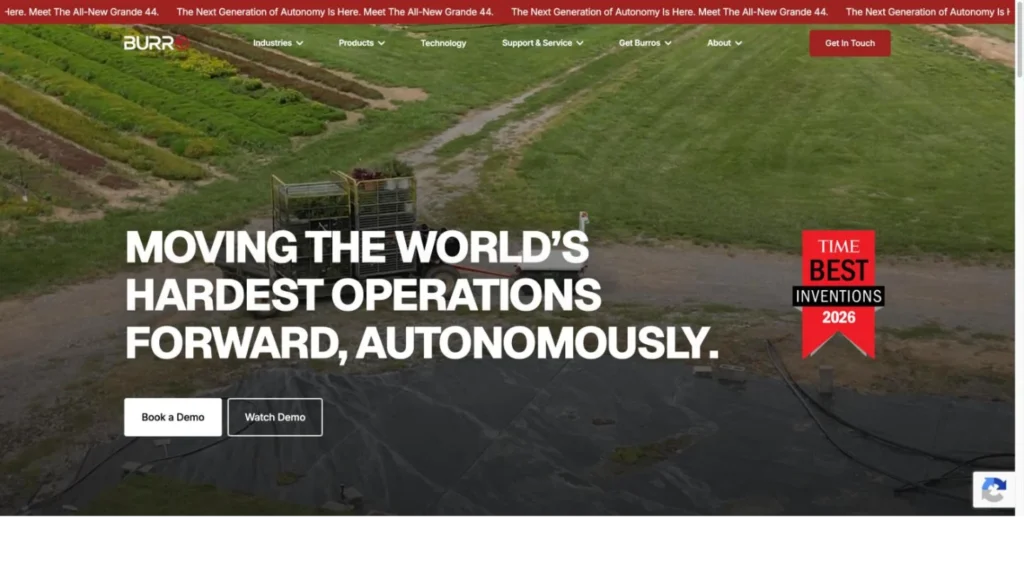
Burro’s pitch is a robot that a farm worker can set up by walking. The worker leads it along a route once, the robot saves the path, and from then on it hauls plants, produce or tools on its own while the crew keeps working. According to an October 2026 MyChesCo report, Burro has deployed more than 800 of these electric robots across 17 countries and logged more than one million hours of autonomous operation.
It fits nurseries, vineyards, orchards and berry farms that move material over the same routes every day. Pricing is shared by quote, and the robot focuses on carrying, towing, mowing and spot spraying while crews load and unload. We rate it 7.8/10 on our scale. We have not used Burro; this review is based on Burro’s product pages and reporting by MyChesCo and Ben Franklin Technology Partners.
800 Robots in 17 Countries and a Million Autonomous Hours
- Burro reports more than 800 robots deployed in 17 countries and more than one million hours of autonomous operation, according to an October 2026 report.
- Robots learn a route by following a worker once, then repeat it, follow rows and stop for obstacles, with no site infrastructure needed.
- Mesa Vineyards reported mowing costs falling from $22 to $5 an acre and chemical costs cut by up to 75% with Burro, company-reported figures.
- Pricing is shared by quote; Burro sells directly and through about 50 dealers.
- It scores 7.8/10 on our scale: easy to deploy and safety-minded, with pricing by quote and a focus on lighter hauling and field work.
Augean Robotics’ Operating Data
Burro, legally Augean Robotics, has published more operating data than most farm robot makers, though the customer results come from the company itself.
| Fact | Detail | Source and Date |
|---|---|---|
| Fleet size | More than 800 autonomous robots deployed across 17 countries over eight years | MyChesCo, October 27, 2026 |
| Operating hours | More than one million hours of autonomous operation | MyChesCo, October 27, 2026 |
| Distribution | Direct sales plus 50 dealers worldwide | MyChesCo, October 27, 2026 |
| Grande 44 | 44 HP peak, 18 HP continuous; tows 6,000 lb, carries 1,500 lb; 10 kWh battery expandable to 40 kWh; production began August 2026 | MyChesCo, October 27, 2026 |
| Recognition | Grande 44 named to TIME’s Best Inventions of 2026 list | MyChesCo, October 27, 2026 |
| Mesa Vineyards | Mowing costs reported down from $22 to $5 an acre and chemical costs cut by up to 75% on a 40,000-acre operation | MyChesCo, October 27, 2026 |
| Bell-Hopewell Nursery | More than 4,500 autonomous miles, supporting growth from one potting line to three | MyChesCo, October 27, 2026 |
| Series B | $24 million led by Catalyst Investors and Translink Capital, with S2G Ventures, Toyota Ventures, F-Prime Capital and Cibus Capital returning | Ben Franklin Technology Partners, January 11, 2024 |
| Team | 44 employees in Philadelphia at the time of the Series B | Ben Franklin Technology Partners, January 11, 2024 |
| Grande 15 sensors | 12 cameras, a 3D LiDAR that sees 40 meters in all directions and RTK GPS | Burro Grande product page, viewed October 2026 |
| Update cadence | New software, capabilities and AI models delivered over the air every two weeks | Burro Grande product page, viewed October 2026 |
Two numbers matter most for a buyer. More than 800 robots and one million autonomous hours suggest a product past the prototype stage, which Burro’s chief executive Charlie Andersen has stressed, saying the industry has plenty of prototypes and very few products. And the Mesa Vineyards result, mowing cost falling from $22 to $5 an acre, is a 77% cut per pass, large enough to matter even if your farm sees half of it.
Read those results for what they are. MyChesCo noted they come from existing customers on earlier models and do not establish the same savings for the new Grande 44.
Pop-Up Autonomy on an Electric Flatbed
Burro robots are electric, four-wheel-drive platforms with a flatbed for pallet-sized loads and a standard 2-inch hitch. Burro calls its approach Pop-Up Autonomy: the robot works out of the box without changes to the site.
Teaching a Route
- Follow: a worker walks the route while Burro’s cameras and AI track that one person, matching their speed and path at a set distance.
- Reverse: pressing Reverse sends the robot backward as the worker walks toward it.
- Save: at the end, the robot prompts the user to save the route, which can be named and recalled.
- Share: saved routes and training can be shared across the fleet, so one robot’s lessons reach the others.
Autonomy Modes
The Grande 15 spec table lists People Following, Teach and Repeat using vision, GPS and LiDAR, Row Following, Crop Row Scouting, and obstacle stopping, avoidance and path planning. Burro also describes a Guard Dog mode for patrols that sends SMS intruder alerts with a link to a live feed.
Fleet Software
BOSS PLUS on the robot lets a site be mapped once, including road and traffic rules indoors and outdoors, after which any authorized user on site can dispatch robots. BOSS Web gives managers a dashboard with each robot’s position, activity and camera view, and the BOSS Cloud API lets companies build their own automations. New software and AI models arrive over the air every two weeks, with release notes published online.
The Models
The Grande 15 has 12 horsepower, carries 1,000 pounds, tows 5,000 pounds on flat paved surfaces and runs up to 15 miles on a 10 kWh lithium iron phosphate battery that charges in about 12 hours and can be swapped in the field. Top speed is 5.8 miles an hour. The Grande 44, shipping since late 2026, delivers 44 horsepower at peak, tows up to 6,000 pounds, carries up to 1,500 pounds and takes batteries from 10 to 40 kWh; Burro built its driving software with field data and simulation in NVIDIA Isaac Sim. Attachments include the Cortador 48-inch autonomous brush cutter, the Sprayito vision-based spot sprayer and an autonomous charging dock.
Safety Hardware
Each Grande carries front and rear bumper bars that stop the robot on contact, the 360-degree LiDAR for obstacle detection, wide field-of-view cameras, an E-stop button, flashing and area lights front and rear, chime alerts for detected obstacles and a horn that adjusts its volume to background noise. The software accounts for the width of an attached trailer, and the robot is designed to push through tall weeds and branches while still stopping for people.
Where Burro Works
Burro lists depot yards and industrial transport, nurseries, berries, vineyards, orchards and vegetation management as its markets, with tasks that include carrying, towing, scouting, patrolling, mowing, pushing, pulling and powering attachments. Altman Plants is featured as a customer on the product page. Outside farming, MyChesCo reported an industrial site where a Burro runs nightly vehicle inventory scans across 4,000 parking spaces, replacing one full-time position.
Loading, Route Teaching and Hitching Stay Manual
Workers still load and unload, choose and teach routes, hitch trailers and handle exceptions. The optional magnetic remote control helps with hitching and sending robots on routes. Burro’s own materials describe the robot as working alongside crews rather than replacing them.
Sold by a Direct Team and About 50 Dealers
Burro does not publish prices. Robots and options are sold through its direct sales team and about 50 dealers in 17 countries.
| Plan | Price | Billing | What’s Included | Limits |
|---|---|---|---|---|
| Burro Grande 15 | Custom quote | Purchase through Burro or a dealer | Robot with 10 kWh battery, BOSS PLUS autonomy and BOSS Web access | 1,000 lb payload, 5,000 lb tow on flat paved surfaces, 15-mile range |
| Burro Grande 44 | Custom quote | Purchase through Burro or a dealer | Heavier-duty robot with 10 kWh battery expandable to 40 kWh | 1,500 lb payload, 6,000 lb tow |
| Attachments and options | Custom quote | Add-on | Cortador brush cutter, Sprayito spot sprayer, extended battery, remote control, tire options | Sold separately |
| Autonomous Charging Dock | Custom quote | Add-on | Dock that lets robots recharge without a worker | Sold separately |
What a Robot Has to Beat in Labor Hours
Without list prices, these scenarios show what a robot has to beat. They use our own illustrative assumptions for acreage, passes, wages and hours, plus Mesa Vineyards’ company-reported per-acre costs.
- A 200-acre vineyard mowing program: six mowing passes a season is 1,200 acre-passes. At $22 an acre that costs $26,400; at the $5 Mesa reported with Burro, $6,000. The $20,400 difference is the annual budget a robot, mower attachment and service plan would have to fit inside.
- A nursery moving plants by hand: two workers spending three hours a day pushing carts, at an assumed $20 an hour over 250 working days, cost $30,000 a year. If a robot takes over most of that walking, those hours move to potting and shipping.
- Fleet math: divide the quoted price of each robot by its expected years of service, add batteries and service, and compare the yearly figure with the hours of hauling or mowing it replaces.
Costs to plan for include extra batteries, the charging dock, attachments, tire options for your ground, and dealer service visits.
Burro Compared With Agtonomy, Carbon Robotics LaserWeeder and Ecorobotix ARA
All four do physical work on farms, but they solve different problems. Burro is the only one built to work beside people on foot.
| Agent | Starting Price | Free Plan | Main Strength | Main Trade-Off | Best For |
|---|---|---|---|---|---|
| Burro | Custom quote through dealers | No (demo) | Learns routes by following a worker; hauls, mows and spot sprays | Smaller payloads than a tractor | Nurseries, berries, vineyards and yards |
| Agtonomy | Custom quote | No (demo) | Makes Kubota and Bobcat tractors run without a driver | Needs partner machines and dealers | Vineyards and nut orchards with tractor work |
| Carbon Robotics LaserWeeder | Custom quote; leases available | No (demo) | Kills weeds with lasers, no herbicide | Heavy equipment; weeding only | Vegetable and organic row crops |
| Ecorobotix ARA | About $300,000 per unit (reported) | No | Plant-by-plant spraying that cuts chemical use | Tractor and driver required | Vegetables, pasture and turf |
If your bottleneck is people walking loads around, Burro fits best. If it is tractor drivers, Agtonomy fits better. For weeds, Carbon and Ecorobotix go much deeper than Burro’s Sprayito attachment. More choices are in our AI agents for agriculture and logistics guides.
Nurseries, Berry Farms and Vineyards Moving Loads
- Nurseries: moving plants between potting lines, greenhouses and shipping areas is the work Burro was built for, as Bell-Hopewell Nursery’s 4,500 autonomous miles show.
- Berry farms, vineyards and orchards: robots can carry picked produce along rows while crews keep harvesting.
- Vineyards mowing between rows: the Cortador attachment and Mesa Vineyards’ reported cost drop make mowing a strong case.
- Yards and industrial sites: Burro also sells into depot yards and distribution sites, including nightly inventory scans of 4,000 parking spaces at one facility.
- Teams without technical staff: routes are taught by walking, and the robot needs no site infrastructure.
Broadacre Farms and Fast Long Hauls Call for Larger Machines
- Broadacre farms: a 1,000 to 1,500 pound payload is small next to tractor and trailer work.
- Operations needing fast long hauls: the Grande 15 tops out at 5.8 miles an hour.
- Farms wanting automated picking: Burro carries and tows; people still pick and load.
- Buyers who need a published price: every robot is quoted.
- Sites with very rough terrain beyond spec: check tow ratings, which assume flat paved surfaces on the Grande 15.
Older-Model Results and Battery Planning
- Company-reported results: the Mesa Vineyards, Bell-Hopewell and industrial results come from Burro and earlier models, not independent tests of the Grande 44.
- Battery planning: a full charge takes about 12 hours on the Grande 15, so plan spare batteries or a charging dock for long days.
- Spec conditions: towing figures assume flat paved surfaces and range depends on speed and load.
- Frequent updates: new software and AI models arrive every two weeks. Read the release notes and check behavior after updates in busy seasons.
- New model timing: the Grande 44 began customer deliveries only in the third quarter of 2026.
- Dealer coverage: with about 50 dealers worldwide, confirm a service partner near you before buying.
Grande 44 Shipments Begin in October 2026
- On October 27, 2026, MyChesCo reported that Burro began commercial shipments of the Grande 44, after a June 2026 pre-order period and production starting in August, and that the model was named to TIME’s Best Inventions of 2026 list.
Among the Most Proven Load-Hauling Robots
For farms and nurseries where people spend hours walking loads around, Burro is one of the most proven robots on the market. It scores 7.8/10 on our scale. Setup is easy by farm robot standards, the safety hardware is thorough and the fleet software includes a cloud API. Pricing value scores lower because prices are shared by quote, and public user ratings have not appeared yet.
Run a demo on your busiest route and time it against your crew. If a robot can absorb a few hours of cart pushing or mowing a day, the reported results from Mesa Vineyards and Bell-Hopewell suggest the payback case is worth taking to a dealer.
Burro Prices Come From Sales or a Dealer
How Much Does a Burro Robot Cost?
Burro does not publish prices. Robots, batteries, attachments and the charging dock are quoted by Burro’s sales team or one of its roughly 50 dealers.
How Do You Teach a Burro a New Route?
A worker walks the route while the robot follows, matching speed and path. At the end, the robot prompts the user to save the route, which can then be repeated or shared with other robots in the fleet.
How Much Can the Burro Grande Carry?
The Grande 15 carries 1,000 pounds and tows 5,000 pounds on flat paved surfaces. The Grande 44 carries up to 1,500 pounds and tows up to 6,000 pounds.
Is Burro Safe Around Farm Workers?
Burro robots have front and rear bumper bars, 360-degree 3D LiDAR, wide-angle cameras, an E-stop button, lights, chime alerts and a horn that adjusts to background noise, and they stop for people and obstacles.
Who Owns Burro?
Burro is the trading name of Augean Robotics, a Philadelphia company led by chief executive Charlie Andersen. Its $24 million Series B, closed in late 2023, was led by Catalyst Investors and Translink Capital, with S2G Ventures, Toyota Ventures, F-Prime Capital and Cibus Capital returning.
Can Burro Mow and Spray?
Yes, with attachments. The Cortador is a 48-inch autonomous brush cutter for mowing, including on slopes, and the Sprayito is a vision-based spot sprayer.

User Reviews
Nobody has rated it here yet. Be the first AI Agents Choice user to rate Burro.