
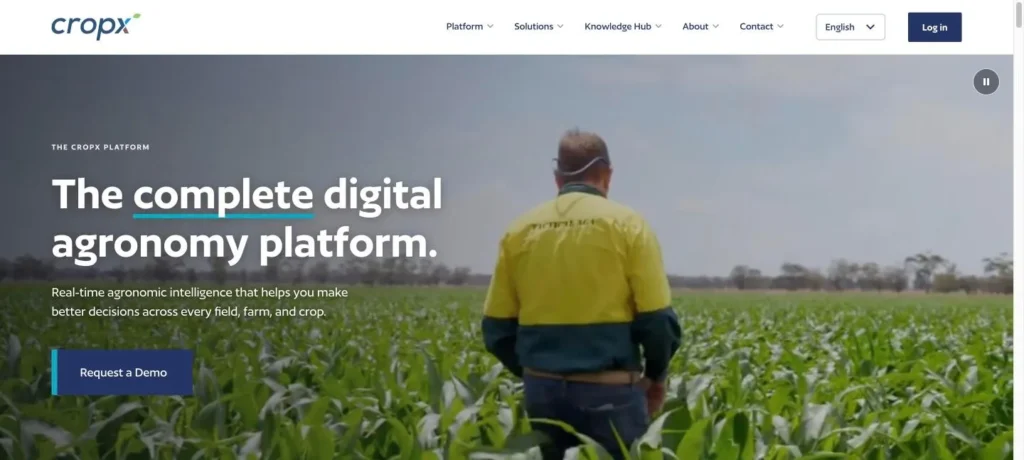
CropX is a digital agronomy platform that combines soil sensors, weather stations, satellite imagery and machine data, then tells growers when and how much to irrigate, when disease risk is rising and when to spray. It can automate irrigation schedules on its own, and AI ranks alerts so the most urgent field comes first. CropX does not publish prices; sensors and software are sold by quote through regional sales teams.
It fits irrigated row-crop, orchard, vineyard and dairy operations that want one place for soil moisture, disease risk and machine data, plus advisers and dealers who manage many farms. Smallholders on a tight budget, or growers who only want a chat assistant, should look elsewhere. We rate it 7.2/10 on our scale.
Soil Sensors on 2,000+ Farms in 70+ Countries
- Scale: 15,000+ sensor deployments and 2,000+ farm deployments.
- Crops: 80+ crop types supported.
- Connections: 180+ integrations and machinery types, including John Deere, CNH, CLAAS and Reinke.
- Disease: risk models for 50+ fungal diseases, no sensor required.
- Price: custom quote; the iOS app is free to download.
CropX by the Numbers
These figures describe the platform’s reach and the results customers have posted.
| Fact | Detail | Source |
|---|---|---|
| Founded | 2014 | CropX product brochure |
| Offices | Netherlands, Israel, United States, Australia, New Zealand | CropX product brochure |
| Countries in use | 70+ | CropX home |
| Sensor deployments | 15,000+ | CropX home |
| Farm deployments | 2,000+ | CropX home |
| Integrations and machine types | 180+ | CropX home |
| Soil moisture accuracy (Vertex 4) | ±0.5% volumetric water content | CropX product brochure |
| Disease control savings | More than 40% in practice | Disease management page |
| Colorado 400-acre farm | Irrigation cut by one-third | CropX home |
| California citrus trial | 68% less water and 5% more yield on 50 trees | CropX product brochure |
| App Store rating | 4.8 from 6 ratings | App Store listing |
The deployment numbers show a mature product with real field time. Fifteen thousand sensors across two thousand farms is a meaningful base, and the 180+ machine and software connections mean CropX rarely has to be the only tool on the farm.
The results are case studies, not controlled studies. A one-third irrigation cut or a 68% water saving tells you what is possible on a well-run farm. Treat them as a ceiling and test on your own fields.
How CropX Turns Soil Data Into an Irrigation Plan
CropX gathers data from sensors, satellites and machines, runs it through agronomic models and returns a recommendation. On some setups it acts on that recommendation by scheduling irrigation itself.
Sensors That Calibrate Themselves
The Vertex 4 soil sensor is a 66 cm probe with three sensors and virtual readings every 10 cm. It measures soil moisture, electrical conductivity and temperature. Software detects field capacity and calibrates set points without a technician, which removes a common setup headache. A newer Apex multi-depth sensor adds higher resolution root zone data.
When and How Much to Water
The irrigation module rates each field as Refill, Optimal or Full and recommends when and how much to irrigate. Forecasts combine crop coefficient, weather and predicted water use, and recommendations cover pivot, drip and sprinkler systems. Variable rate irrigation matches water to soil type or slope. Growers can automate schedules from desktop or phone.
Disease Risk and Spray Timing
Disease Control calculates a daily infection risk from fungal growth conditions, crop stage, crop type and past sprays. It recommends the day and time to spray to limit product lost to the environment, across 24 crops from onions and potatoes to grapes and winter wheat.
Alerts Ranked by Urgency
On a farm with dozens of fields, the hard part is knowing what to look at first. CropX uses AI to prioritize alerts and predict risks, and the mobile app sends alerts on irrigation, nutrient leaching, salinity, temperature, fungal disease and spray applications. A grower opens the app and sees the field that needs action today at the top of the list.
Machine and Software Connections
CropX imports fields from John Deere Operations Center and Climate FieldView and exchanges data wirelessly with Deere machines. Recent product updates added CNH and CLAAS connections, Reinke ReinCloud 3, WiseConn drip control and the Cool Farm Platform for Scope 3 emissions reporting. The 2025 purchase of Acclym, formerly Agritask, brought enterprise customers onto the platform.
A Colorado Corn Farm’s Irrigation Season
A 400-acre family farm in eastern Colorado installs Vertex sensors in each pivot field in May. By mid-June, the platform rates two fields as Full after a storm and one as Refill on sandy ground. The grower holds water on the two wet fields and runs the third pivot at a variable rate that puts more water on the sand. In July, a heat wave pushes all fields toward Refill, and CropX moves the schedule forward two days. A disease alert flags rising risk in one field, with a suggested spray window for Thursday morning. The grower and his agronomist check the field, agree and spray. By season end, water use is well below the old fixed schedule.
What Growers and Agronomists Still Decide
People install and maintain sensors, choose crops and products, and approve or override each recommendation. Agronomists still walk fields to confirm disease and pest problems. Automation runs only where a grower has connected compatible irrigation controls and set the rules.
CropX Pricing: Quoted by Farm, Sensors and Modules
CropX does not publish prices, and its G2 listing has no pricing details. Buyers request a demo through regional sales teams. The weather station includes an annual subscription for platform access and support.
| Plan | Price | Billing | What’s Included | Limits |
|---|---|---|---|---|
| On-Farm (growers) | Custom quote | Not published | Sensors, irrigation, disease and nutrient modules, mobile app | Priced by fields and hardware |
| Service Providers (advisers, dealers) | Custom quote | Not published | Multi-farm management and grower reporting | Not published |
| Enterprise (agribusiness) | Custom quote | Not published | Platform, APIs, sustainability reporting | Not published |
| Strato 1 weather station | Custom quote | Annual subscription included | Station, gateway, platform integration and support | Hardware purchase |
Cost Scenarios
- A single-pivot farm: expect a hardware cost for one or two sensors plus a yearly software fee; ask for both in writing.
- A crop consultant with 50 clients: the Service Provider tier is built for multi-farm work; ask about volume pricing on sensors.
- A food company tracking Scope 3 emissions: the Enterprise tier adds sustainability reporting and APIs.
With no public pricing, compare the quote with your yearly pumping and water cost. If CropX saves even a modest share of water and energy, the sensor and software fees can pay back in one or two seasons. For more on judging agent spending, see how to control AI agent costs.
CropX Compared With Instacrops, AGMRI, Taranis and Norm by FBN
CropX is the most sensor-heavy option here. The others lean on imagery, chat or WhatsApp advice.
| Agent | Starting Price | Free Plan | Main Strength | Main Weakness | Best For |
|---|---|---|---|---|---|
| CropX | Custom quote | No | Soil sensors plus 180+ machine and software links | No public pricing | Irrigated farms and multi-farm advisers |
| Instacrops | Custom quote | Limited WhatsApp agent | Field monitoring with irrigation control | Quoted pricing | Latin American fruit and nut growers |
| AGMRI AI Agent | Custom quote | No | Answers from imagery, soil and yield data | Needs an AGMRI subscription | Retailers and larger row-crop farms |
| Taranis Ag Assistant | Custom quote | No | Leaf-level scouting imagery | Sold mostly through retailers | Ag retailers and crop advisors |
| Norm by FBN | Free with FBN membership | Yes | Label-grounded agronomy answers | Advice only, no sensors | US and Canadian row-crop farms |
Choose CropX when water is the biggest cost and you want sensor-backed decisions. Choose Instacrops for WhatsApp-first monitoring in Latin American orchards, and AGMRI or Taranis for imagery-led scouting. See more agriculture AI agents.
Who Gets the Most From CropX
- Pivot and drip irrigators: daily water calls based on root zone moisture, not a fixed calendar.
- Vineyards: CropX Vision reads vine water stress from a phone photo, with unlimited readings in each enrolled block.
- Dairy farms with effluent: a module for effluent and lagoon manure irrigation.
- Crop advisers and irrigation dealers: one login for many growers’ fields.
- Mixed-fleet farms: connections to John Deere, CNH, CLAAS and Reinke equipment.
Who Should Skip CropX
- Dryland farms: most of the value comes from irrigation decisions.
- Buyers who want a public price list: every plan is quoted.
- Growers who want a chat assistant: CropX gives dashboards and alerts, not a conversational agent.
Practical Watch-Outs for CropX Buyers
- Sensor placement drives accuracy. One probe in an unrepresentative spot can mislead a whole field.
- Hardware needs upkeep. Plan for battery charging, gateway checks and removal before harvest.
- Results posted by CropX are case studies. Ask for references from farms like yours.
- User reviews are scarce. The App Store has only six ratings, and G2 has none.
- Automated irrigation only works with compatible controllers. Confirm your pivot or drip system connects.
- Farm data moves between many systems. Review data rights, and read our guide to AI agent data leakage.
Questions for the CropX Demo
Ask for the full cost of sensors, gateways and software for your acreage, how many sensors each field needs, which of your irrigation controllers can be automated, how alerts are ranked, and who owns the data if you leave.
A Good Match for Irrigated Farms That Want Sensor-Backed Decisions
CropX turns soil, weather and machine data into daily irrigation and spray calls, and it can run irrigation schedules for the grower. Its wide machine connections make it easy to slot into an existing farm.
The gaps are pricing and public reviews. Every plan is quoted, and outside opinions are thin, so references matter.
We rate it 7.2/10. Irrigated farms and advisers should shortlist it. Growers in Latin American orchards should also look at Instacrops, and imagery-led teams at AGMRI AI Agent.
Growers’ Questions About CropX
How Much Does CropX Cost?
CropX does not publish prices. Sensors, software and support are quoted by its sales teams.
Can CropX Control My Irrigation Automatically?
Yes, it can automate irrigation schedules when connected to compatible controls, and it gives recommendations for pivot, drip and sprinkler systems.
Does CropX Work Without Sensors?
Some modules do. Disease risk, satellite imagery and record keeping work without in-field sensors.
Which Equipment Brands Does CropX Connect To?
John Deere, CNH, CLAAS and Reinke, plus Climate FieldView, WiseConn and third-party soil sensors such as Sentek.
Which Languages Does the CropX App Support?
English, Dutch, French, German, Portuguese and Spanish.



User Reviews
Nobody has rated it here yet. Be the first AI Agents Choice user to rate CropX.