
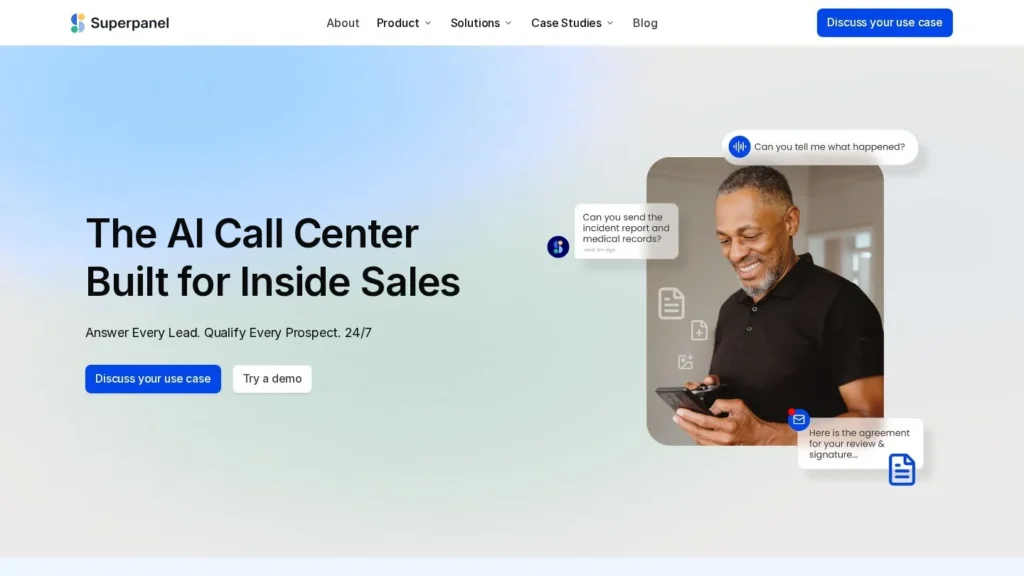
McCready Law, a plaintiff personal injury firm of about 160 professionals across Midwest offices, gets 20% of its signed retainers through Superpanel, according to an April 2026 release. Superpanel is an AI intake teammate that contacts new leads, gathers their story and documents, scores the case and escalates to staff, and it reports more than 15,000 signed cases in the past year.
Superpanel suits high-volume plaintiff firms in personal injury, employment and lemon law whose intake teams cannot keep up with inquiries. Superpanel could help buyers by publishing pricing, naming its case management integrations and adding independent detail to its self-reported performance figures. We rate it 7.5/10 on our scale. We have not used Superpanel; this review is based on its funding coverage, its McCready Law release and its legal technology directory listing.
Superpanel in Five Facts for Intake Managers
- McCready Law says Superpanel drives 20% of its signed retainers.
- Superpanel reports 250,000+ intake workflows and 15,000+ signed cases in the past year.
- It collects, checks, renames and files supporting documents, with 60,000+ documents handled so far.
- It escalates ambiguous cases to people and leans toward flagging possible cases rather than missing them.
- Pricing is by quote; a $5.3 million seed round in September 2025 was co-led by Outlander VC and Field Ventures.
Superpanel by the Numbers
Superpanel is young, founded in 2024, and most of its numbers come from its own release.
| Fact | Detail | Source and Date |
|---|---|---|
| Seed round | $5.3 million co-led by Outlander VC and Field Ventures; LOI Venture, Zenda Capital, 8-Bit Capital, Behind Genius Ventures | TechCrunch, September 23, 2025 |
| Automation share | About half of legal intake work automated, per the CEO | TechCrunch, September 23, 2025 |
| Beta | 18-month private beta with law firms before launch | Legal IT Insider, September 23, 2025 |
| Peak automation | Up to 80% of the work in some intake processes, per the CEO | Legal IT Insider, September 23, 2025 |
| Workflows | 250,000+ intake workflows completed | Superpanel release, April 30, 2026 |
| Signed cases | 15,000+ cases signed in the past year | Superpanel release, April 30, 2026 |
| Documents | 60,000+ supporting documents collected, verified and organized | Superpanel release, April 30, 2026 |
| Staff capacity | Up to 4x more inbound inquiries per intake staff member | Superpanel release, April 30, 2026 |
| Conversion | Up to 300% higher conversion within six months of full deployment | Superpanel release, April 30, 2026 |
| McCready Law | About 160 professionals; Superpanel drives 20% of signed retainers | Superpanel release, April 30, 2026 |
| Target firms | Plaintiff firms with 20 to 499 lawyers in North America | Legal Technology Hub, viewed November 2026 |
The McCready figure is the most concrete. Twenty percent of signed retainers at a 160-person firm is a measurable share of new business, not a pilot. The company-wide counts also hang together: 60,000 documents across 15,000 signed cases is about 4.0 documents per signed case, which gives a sense of how much document chasing the platform takes off an intake desk.
Customer and investor comments point the same way. Eamon Graziano, a fractional COO at firms including The Consumer Protection Law Group, said the return was immediate and the product paid for itself within months, and described it as a teammate that does not forget or need retraining. Jordan Kretchmer of Outlander VC called intake one of the biggest unsolved bottlenecks in law. Both are interested parties, but they describe the same problem: intake work that slips when staff are busy.
The “up to” figures, 4 times the inquiries per staff member and 300% higher conversion, are best cases from Superpanel’s own release. Treat them as the top of the range and measure your own baseline before rollout so you can tell what changed.
What Superpanel Does Between First Contact and Signed Case
Superpanel combines generative AI with rules-based logic. The generative side holds the conversation; the rules side applies each firm’s criteria for case type, geography and required documents. Human reviewers come in at critical points.
Reaching the Lead While They Still Care
When an inquiry arrives, Superpanel contacts the lead by phone, text or email. It helps the person work out whether they have a problem a firm can help with, listens to their account of what happened and asks follow-up questions when details are missing.
Scoring Viability Against Firm Rules
Superpanel analyzes the answers against the firm’s intake logic, such as practice area, jurisdiction, dates and injuries, and estimates which leads are likely viable. It deliberately leans toward false positives: it would rather pass a borderline case to a person than turn away a good one. Cases that are not viable yet but could become so, for example while treatment continues, get an automatic follow-up later.
Collecting and Filing the Evidence
Superpanel then decides what supporting evidence the case needs, contacts the right people to get it, categorizes what arrives, checks that it is the right material and renames and files each document in the right place. This step is where intake teams often lose days chasing photos and forms, and it is where Superpanel claims much of its time savings.
A Lemon Law Inquiry, Step by Step
A car owner fills out a web form late on a Thursday about a new truck that has been back to the dealer four times. Superpanel texts the owner, asks about the purchase date, mileage and repair visits, and checks the answers against the firm’s lemon law criteria for that state. The case looks viable, so it requests the purchase contract and repair orders, confirms the documents match the truck described and files them under a consistent naming scheme. One repair order is missing a date, so Superpanel follows up. By Monday the intake specialist sees a scored case with the story and documents in order, reviews it and moves it to an attorney for sign-off.
Setting Up a Firm’s Intake Rules
Superpanel applies custom intake logic for each firm. Before launch, the firm spells out what makes a case worth signing in each practice area: which case types it takes, which states or counties it covers, deadlines such as statutes of limitation, and the documents it needs before a retainer goes out. Those rules drive both the viability score and the document checklist, so the quality of the setup decides the quality of the output. Firms with written intake scripts and checklists will get there faster than firms where the rules live in one intake manager’s head.
Escalation and Review
When there is a risk of ambiguity, Superpanel escalates to a member of the intake team, and humans review the work at critical points. Superpanel describes every workflow as auditable. Firms decide what counts as a sign-ready case and who signs the retainer.
Rolling Superpanel Out Across Offices
McCready Law uses Superpanel across multiple offices, which points to a practical rollout path. Start with one practice area and one intake channel, such as web form inquiries, and have the intake team review every escalation and every scored case for the first weeks. Compare signed cases, time to signature and documents collected before signature with the months before launch. Once results hold, add phone and text, then other offices. Keep a named intake lead responsible for the rules, since Superpanel applies them exactly as written, and review its escalation queue daily.
Buying Superpanel Without a Price List
Superpanel does not publish pricing.
| Plan | Price | Billing | What’s Included | Limits |
|---|---|---|---|---|
| Superpanel intake platform | Custom quote | Quoted after a demo | Lead engagement by phone, SMS and email, viability scoring, document collection and filing, follow-ups, escalation | Built for plaintiff firms |
Staffing Math for a Busy Intake Desk
Without a price, the useful calculation is intake staffing. This scenario uses illustrative volumes; substitute your own.
- Today: a firm gets 2,000 inquiries a month and each intake specialist works about 250, so it needs 8 specialists.
- At Superpanel’s best case of 4 times the inquiries per person: the same volume would need about 2 specialists, freeing the rest for signing and client care.
- At McCready’s share: if Superpanel drove 20% of signed retainers, a firm signing 100 cases a month would trace about 20 of them to the platform.
Compare the quote with the cost of the intake hires you would otherwise make and with the fee value of the extra signed cases. Ask how pricing scales, whether by inquiry, signed case, seat or flat fee, because each model rewards different volumes.
Superpanel Against Eve, Supio and Filevine LOIS at Intake
Plaintiff firms can buy intake automation as a standalone tool or as part of a wider AI platform.
| Agent | Starting Price | Free Plan | Main Strength | Main Trade-Off | Best For |
|---|---|---|---|---|---|
| Superpanel | Custom quote | No | Dedicated intake teammate that also collects and files documents | Integrations not named, no public pricing | High-volume plaintiff intake teams |
| Eve | Custom quote | No | AI across plaintiff practice areas, including intake | Broader platform to adopt | Plaintiff firms across practice areas |
| Supio | Custom quote (demo) | No | Medical records, demands and intake for large caseloads | Built around later case stages | Large PI and mass tort firms |
| Filevine LOIS | Free LOIS Explore and 90-day trial; paid plans by quote | Limited | AI inside the Filevine case system | Best for Filevine users | Firms running cases in Filevine |
Choose Superpanel when intake is the bottleneck and you want a specialist that works the first contact through document collection. Choose Eve or Supio if you want one AI platform across the life of a case. Filevine users should test Filevine LOIS first, since it lives in their case system. TechCrunch also named Clio Grow, LegalClerk.ai, MyCase and Whippy.ai as competitors, so firms already on Clio or MyCase should check what their current intake tools cover before adding another. Firms short of staff rather than software can compare Finch, which supplies paralegals backed by AI agents. See our AI agents for law firms guide for more.
Plaintiff Firms That Fit Superpanel
- High-volume PI firms: McCready Law uses it across multiple offices to handle inbound inquiries.
- Employment and lemon law practices: Superpanel names these consumer-facing practices as targets.
- Firms losing cases to slow follow-up: it contacts leads quickly and keeps following up for missing details.
- Intake teams buried in document chasing: it requests, checks and files supporting evidence.
- Mass tort and class action firms: the company names them as potential users for screening large inquiry volumes.
Firms Better Served by Another Intake Setup
- Defense and corporate firms: Superpanel targets consumer-facing plaintiff work.
- Small practices with few inquiries: a part-time intake person may be the more economical fit.
- Firms that need named integrations now: Superpanel has not yet listed its case management connections publicly, so confirm yours in the demo.
- Buyers who need certifications on paper: Superpanel has not yet published security certifications, so ask what it holds.
Intake Questions to Settle Before Superpanel Goes Live
- Solicitation and ethics: automated outreach to people who contacted the firm is different from cold outreach, but check your state’s rules on client contact and AI disclosure.
- Consent for texts and calls: make sure your web forms and ads capture consent for automated messages.
- Confidentiality: leads share sensitive injury and medical details; ask where data is stored and who can see it.
- False positives: Superpanel leans toward flagging possible cases, which protects good cases but adds review work.
- System handoff: confirm exactly how intakes and documents reach your case management system.
- Self-reported results: the 4x and 300% figures are best cases from Superpanel’s release.
- Rule drift: when the firm changes which cases it takes, update Superpanel’s intake logic the same day, or it will keep scoring and chasing documents on the old criteria.
Superpanel Milestones in 2025 and 2026
- September 23, 2025: Superpanel emerged with a $5.3 million seed round co-led by Outlander VC and Field Ventures.
- September 23, 2025: Coverage described its 18-month private beta and its focus on plaintiff firms.
- April 30, 2026: Superpanel announced McCready Law as a customer, reporting 15,000+ signed cases in the past year.
How We Arrived at 7.5/10 for Superpanel
Superpanel goes further than an answering service: it follows a lead from the first message through document collection and filing and hands staff a scored, organized case. The McCready Law result and the volume of signed cases suggest it works in production at real plaintiff firms.
The design choice buyers should understand before a demo is Superpanel’s deliberate bias toward false positives. An intake tool that rejects too aggressively loses fee income silently, because nobody sees the good cases it turned away. Superpanel accepts more review work for staff in exchange for fewer missed cases, which suits contingency-fee practices where one strong case can pay for months of intake effort.
We give it 7.5/10 on our scale. Autonomy is its strength, and the score reflects details Superpanel has not yet published: pricing, named integrations, security certifications, public reviews and independent metrics. Publishing those would make it easier to evaluate. Firms should ask for references, confirm the case management handoff and run a pilot on one practice area with a clear baseline.
Intake Managers’ Questions About Superpanel
What Does Superpanel Cost for a Plaintiff Firm?
Superpanel does not publish pricing. Firms book a demo and get a quote. Ask how the price scales with inquiries or signed cases.
Which Channels Does Superpanel Use to Reach Leads?
Superpanel contacts leads by phone, SMS and email, guides them through their story and follows up when details or documents are missing.
Does Superpanel Decide Which Cases a Firm Takes?
No. It scores viability against the firm’s rules and leans toward flagging possible cases. Ambiguous cases go to a person, and the firm decides what to sign.
Can Superpanel Collect Medical Records and Photos?
Superpanel identifies the evidence a case needs, contacts people to obtain it, checks it, categorizes it and files it. It reports more than 60,000 documents collected and organized.
Which Practice Areas Does Superpanel Support?
It targets consumer-facing plaintiff work such as personal injury, employment and lemon law, with mass tort and class action named as potential uses.
User Reviews
Nobody has rated it here yet. Be the first AI Agents Choice user to rate Superpanel.