
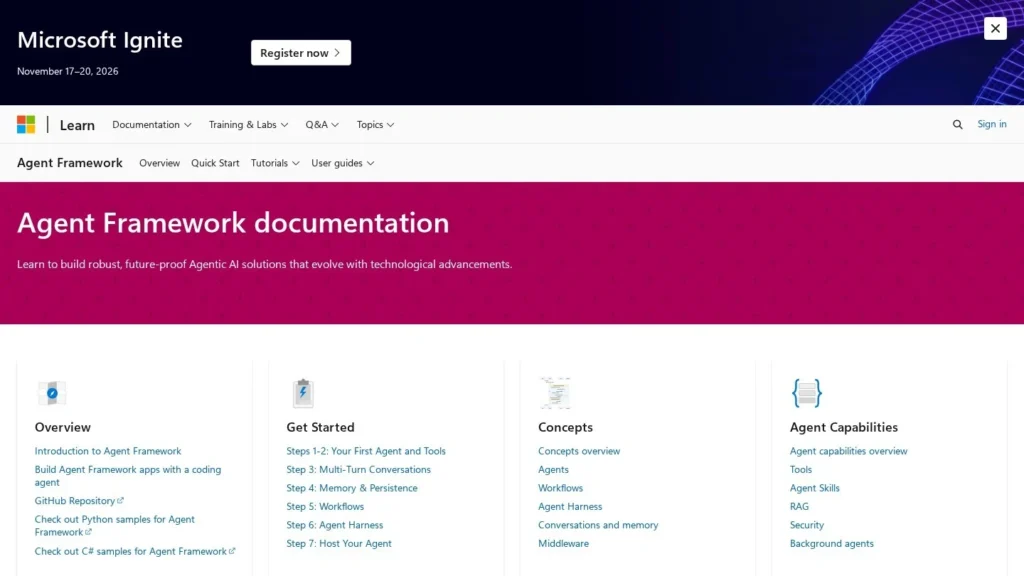
Microsoft Agent Framework reached version 1.0 in April 2026, giving .NET and Python developers stable APIs for building agents and multi-agent systems. It merges AutoGen, the multi-agent toolkit that came out of Microsoft Research, and Semantic Kernel, Microsoft’s enterprise SDK, into a single open-source project under the MIT license, with more than 14,000 GitHub stars.
For new agent work, Microsoft points developers here. AutoGen now gets only bug fixes and security patches, Semantic Kernel remains active, and both have migration guides. The framework is the code-first counterpart to Copilot Studio, Microsoft’s low-code agent builder, and suits teams that want to own every part of how their agents behave.
How It Works
Developers create an agent, give it type-safe function tools and connect it to a model. First-party connectors cover Microsoft Foundry, Azure OpenAI, OpenAI, Anthropic Claude, Amazon Bedrock, Google Gemini and Ollama. Middleware hooks, memory and context providers shape what the agent sees and does, which is where teams add logging, content filters or company-specific rules.
For larger jobs, graph-based workflows chain agents and functions with streaming, checkpointing and human-in-the-loop approval. Built-in orchestration patterns include sequential, concurrent, handoff, group chat and Magentic-One, a planner-led pattern from Microsoft Research. The framework supports the Model Context Protocol for tools, plus interoperability with the Agent2Agent protocol and AG-UI front ends. In preview are DevUI, a browser-based local debugger, along with hosted agents, memory, observability and evaluations in Microsoft Foundry, and integrations with the GitHub Copilot and Claude Code SDKs.
Pricing
The framework is free and open source. Teams pay for the models they call and for wherever they host agents, whether Azure, another cloud or their own servers. Packages install through pip for Python and NuGet for .NET, so there is no sign-up or license key.
What to Watch Out For
This is a developer toolkit, not a finished agent, so expect engineering work on hosting, security and monitoring. Some of the most useful operational features sit in preview and in Microsoft Foundry, which pulls teams toward Azure even though the core runs anywhere. Teams moving from AutoGen should plan migration time, since it is now in maintenance mode, and check that A2A support covers their needs before relying on it.
Recent News
Microsoft moved the framework to release candidate on February 19, 2026, and shipped version 1.0 for .NET and Python in early April 2026.
User Reviews
No reviews yet. Be the first to rate Microsoft Agent Framework.