
Honolulu cut review cycles for one- and two-family homes from an average of 3.4 to 1.4 after it began using CivCheck, and applications averaged 7.7 corrections instead of 23.5, according to city-reported figures cited by Stateline in August 2026. Those are the clearest public results for any AI plan review tool, and they explain why Denver, Seattle and other cities, more than 20 in all by the company’s count, have tried it.
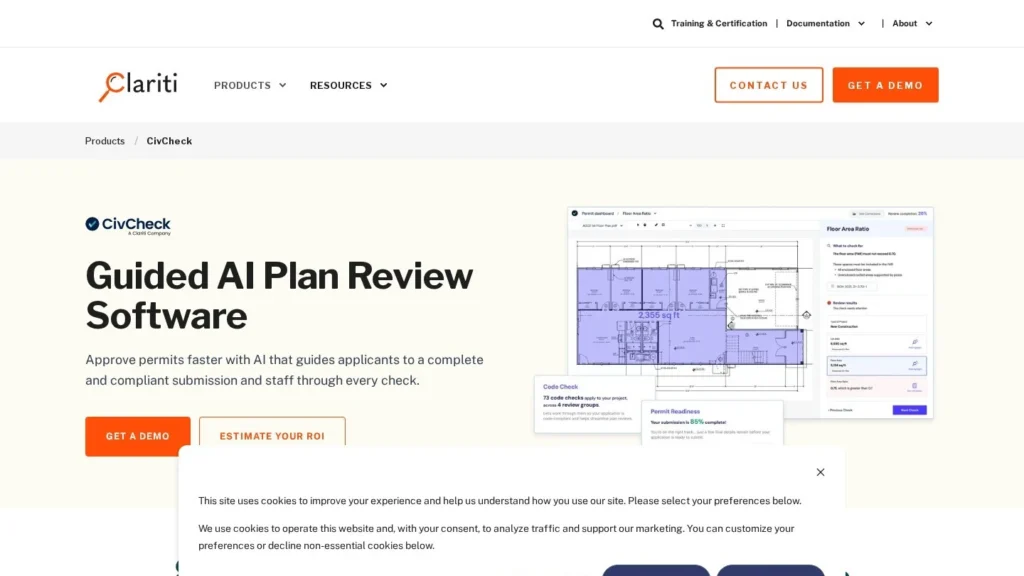
CivCheck pre-checks building permit applications against local codes and hands reviewers cited findings to approve. It suits building and planning departments with long queues and a high share of incomplete submissions. The business model is the main point to plan for: Clariti publishes no prices, and a 2026 Florida League of Cities guide reports that applicants, not cities, pay a per-application fee in the standard setup. Starting price is a custom quote, and we rate CivCheck 8.0/10 on our scale. We have not used CivCheck ourselves; this review is based on Clariti’s product page and announcements, city results and news coverage.
Honolulu’s Review Cycles Drop From 3.4 to 1.4
- Honolulu reported review cycles falling from 3.4 to 1.4 and corrections per application from 23.5 to 7.7 with CivCheck, and applicant time in the process falling from 73 days to 32.5.
- Seattle’s pilot measured about 87% accuracy on completeness checks and 92% on design-compliance checks, with intake review days down about 50%.
- Clariti, a permitting software company, bought CivCheck in October 2025 and still sells it standalone or integrated with other permitting systems.
- A 2026 Florida League of Cities guide reports the standard model is free to partner cities, with applicants paying a per-application prescreening fee.
- CivCheck never approves or denies a permit: staff review every AI interpretation, which makes it a decision-support tool rather than a fully autonomous agent.
City-Reported Evidence Next to Vendor Claims
CivCheck has more public, city-reported evidence behind it than most government AI tools, along with vendor claims that should be read more cautiously.
| Fact | Detail | Source and Date |
|---|---|---|
| Honolulu review cycles | Average review cycles for single- and two-family projects fell from 3.4 to 1.4 (city-reported) | Stateline via Route Fifty, August 21, 2026 |
| Honolulu corrections | Applications averaged 7.7 corrections with CivCheck versus 23.5 without | Stateline via Route Fifty, August 21, 2026 |
| Honolulu applicant time | Average time in the process fell from 73 days to 32.5 days | Stateline via Route Fifty, August 21, 2026 |
| Seattle pilot | About 87% accuracy on completeness checks, 92% on design compliance, about 50% fewer intake-review days and 35% fewer correction cycles per review | Stateline via Route Fifty, August 21, 2026 |
| City count | Works with more than 20 cities, from pilots to full implementation (company figure) | Stateline via Route Fifty, August 21, 2026 |
| Acquisition | Acquired by Clariti; terms not disclosed; Clariti to invest millions over several years in engineering, product and customer teams | Clariti announcement, October 8, 2025 |
| Denver | Selected to screen plan submissions before they enter the official review queue, with phased implementation later in 2026 | Clariti press release on Business Wire, March 2026 |
| Pricing model | Free to partner cities in the standard model; applicants pay a per-application prescreening fee | Florida League of Cities buyer’s guide, 2026 |
| Vendor claims | Code interpretation accuracy of 98% or more; residential reviews in Honolulu from 90 minutes to as little as 15 | CivCheck product page, viewed October 2026 |
| Seattle executive order | Seattle’s mayor issued an executive order in July 2025 to speed permitting using CivCheck’s AI software | GeekWire, 2025 |
The Honolulu figures matter because they come from the city, not the vendor, and they measure what applicants feel: fewer rounds of corrections and less time waiting. Our arithmetic on those numbers shows about 59% fewer review cycles, about 67% fewer corrections and about 55% less time in the process. They also came as part of a broader overhaul that included Honolulu’s HNL Build platform, so not every gain can be credited to CivCheck alone.
The Seattle pilot is the more sober benchmark. Accuracy of 87% to 92% is useful for a pre-check, but it means roughly one finding in ten or more still needs a reviewer to catch it. That is why every serious deployment keeps staff sign-off in place.
An Applicant Portal and a Reviewer Tool
CivCheck has two sides: a portal for applicants and a review tool for staff. Clariti calls it guided AI plan review, and the design keeps a licensed reviewer in charge of every decision.
The Applicant Pre-Check
- Upload: applicants submit plans and documents to a guided portal. CivCheck reads PDFs, forms and hand-drawn plans, so applicants do not need BIM or specialist software.
- Check: the AI flags missing documents and likely code issues across zoning, building, fire, accessibility, plumbing and structural requirements.
- Fix: it explains what to correct and shows a Permit Application Readiness score.
- Submit: the applicant sends a pre-checked package to the city.
The Staff Review
Reviewers receive the application with the AI’s pre-check results, automatic calculations of loads, capacities, dimensions and ratios with step-by-step breakdowns, and links to the relevant code sections with plain-language summaries. A validation tool flags areas that need attention and explains the reasoning behind each AI interpretation. Staff approve or correct each finding, and Clariti says those corrections help the system improve.
Local Codes and Setup
CivCheck starts from templates based on major code families, including the California Building Code and California Residential Code, and a department typically runs 200 to 250 critical life-safety and health checks tuned to how it enforces them. Clariti says rule updates take two to three minutes, followed by about 24 hours of testing. The intake module can be set up in 40 hours or less, completeness and intake checks can be live in a few weeks with good documentation, and residential code compliance is ready for testing within a few months.
Standalone First, Permitting Integrations Later
CivCheck can run standalone first, with integrations added later. Clariti lists connections to major cloud permitting systems, electronic plan review tools, GIS and identity and access management, and it planned an integration with its own Clariti Enterprise platform for spring 2026.
Licensed Reviewers Make Every Permit Decision
Every permit decision and every code interpretation. Denver’s announcement describes CivCheck as a decision-support tool, not an autonomous approval engine, with final approvals left to licensed professionals. Clariti’s co-CEO Cyrus Symoom told Stateline the tool is a fact-checker and does not replace human permit decisions.
An ROI Calculator and a Demo in Place of a Price List
Clariti publishes no price list for CivCheck; its product page offers an ROI calculator and a demo. The best public description of the business model comes from a Florida League of Cities buyer’s guide.
| Item | Price | Billing | What’s Included | Limits |
|---|---|---|---|---|
| City platform (standard model) | Free to partner cities (reported) | Partnership agreement | Applicant portal, AI pre-check and staff review tools | Terms set by agreement |
| Applicant prescreening | Per-application fee (amount not published) | Per application | AI pre-check of an application before submission | City may choose to cover part of the fee |
| Custom or integrated deployments | Custom quote | Contract | Integration with permitting, plan review and GIS systems | Scope set by contract |
Time Saved for a City Handling 1,000 Applications
The useful math is on time saved. These scenarios use Honolulu’s city-reported results and other published figures; the application volumes are our illustrative assumptions.
- A city with 1,000 residential applications a year: at Honolulu’s results, average review cycles drop by 2.0 per application, or about 2,000 fewer review cycles a year, and corrections drop by 15.8 per application, about 15,800 fewer a year.
- Denver-style first-round goals: Stateline reported that only about 37% of Denver applications pass the first round and the city wants 80%. On 1,000 applications, that is 370 passing today against a goal of 800, or 430 more first-round passes.
- Cost of delay for builders: Govstream.ai founder Saf Rabah estimates each month of delay removed saves about $5,000 per new housing unit. Applied to Honolulu’s 40.5-day reduction, about 1.33 months, that is roughly $6,650 per unit, an outside estimate combined with city data rather than a CivCheck figure.
Other costs to watch: the applicant fee, which builders and homeowners pay unless the city covers it; staff time to tune checks to local amendments; training; and integration work with your permitting system. Stateline also reported that Denver’s council approved a five-year contract of about $4.6 million for an AI guided plan review platform in March 2026, about $920,000 a year. The article did not name the vendor, though Clariti announced the same month that Denver had selected CivCheck, so ask Denver for the contract before assuming any figure applies to your city.
CivCheck Compared With Govstream.ai, Polimorphic and Citibot
AI permitting tools split between plan review, which checks drawings against code, and front-door help, which answers residents and guides them to the right permit. CivCheck is the plan review specialist here.
| Agent | Starting Price | Free Plan | Main Strength | Main Trade-Off | Best For |
|---|---|---|---|---|---|
| CivCheck | Custom quote; reported free to cities with applicant fees | No | Code checks on plans with city-reported results | Applicant-paid fee model; no published prices | Building departments with review backlogs |
| Govstream.ai | Custom quote | No | Permit research and application assistants on top of existing systems | Early-stage company with results mostly from back tests | Cities that want to fix intake and wrong-permit filings |
| Polimorphic | $2 per call (AI Voice, 12-month contract) | No | Phone, web search and workflows for city departments | Not a plan review tool | Permit offices with heavy phone and walk-in traffic |
| Citibot | Custom quote | No | Phone, chat and text answers from one knowledge base | Does not process permits end to end | Cities wanting 24/7 resident answers |
CivCheck and Govstream.ai overlap at intake but start from different ends. CivCheck reads the drawings and checks them against code; Govstream.ai starts with the applicant’s question and steers them to the right permit and documents. A large department could use both. Polimorphic and Citibot handle the calls and chats around permitting rather than the plans. See more options in our AI agents for government and AI agents for construction guides.
Building Departments Buried in Incomplete Submissions
- Building departments with many incomplete submissions: completeness checks before submission attack the problem that drives most correction cycles.
- Cities under pressure to speed housing: Honolulu’s drop from 73 to 32.5 days in the process is the kind of result elected officials ask for.
- Departments on any permitting system: CivCheck can run standalone and integrate later, so it does not require switching platforms.
- Clariti customers: the integration with Clariti Enterprise and Launch keeps everything with one vendor.
- Agencies serving small builders and homeowners: the tool reads PDFs and hand-drawn plans, so applicants do not need design software.
Cities That Prefer Not to Charge Applicants
- Cities that will not pass fees to applicants: if the standard applicant-paid model is off the table, expect a different price conversation.
- Departments with very low volume: setup and tuning time may outweigh savings on a few hundred applications a year.
- Agencies that want automatic approvals: CivCheck is built to support reviewers, not to issue permits.
- Offices whose main problem is phone and email volume: Polimorphic or Citibot fit that work better.
Seattle’s 87% and 92% Accuracy and Honolulu Staff Feedback
- Accuracy levels: Seattle’s pilot measured 87% and 92% on its two test areas. Keep reviewers checking every finding.
- Staff reaction: Stateline, citing Honolulu Civil Beat, reported that an anonymous survey of more than 150 Honolulu employees after the city’s wider HNL Build launch was largely negative. Budget for training and change management so staff feel supported through the change.
- Who pays: an applicant fee is a cost to residents and builders. Agree the amount, waivers and any city subsidy before launch.
- Local code amendments: templates start from model codes. Ask how fast your local amendments are loaded and tested.
- Vendor claims and city data: figures such as 98% accuracy and up to 90% faster reviews are Clariti’s own. City-reported results are the firmest basis for a decision.
Stateline Reports Honolulu and Seattle Results
- On August 20, 2026, Stateline reported Honolulu and Seattle results for CivCheck as part of a look at cities using AI to speed housing permits; Route Fifty republished it on August 21.
- In March 2026, Denver selected CivCheck to screen plan submissions before formal review, with phased implementation planned for later in 2026.
- On October 8, 2025, Clariti acquired CivCheck and said the product would remain available standalone.
The Strongest Public Evidence Among Plan Review Tools
For building departments buried in incomplete applications, CivCheck has the strongest public evidence of any AI plan review tool we track. It scores 8.0/10 on our scale: solid on integrations and setup speed, moderate on autonomy because staff approve every finding by design, and lower on pricing value because there is no public price list and the standard model charges applicants a fee.
Honolulu’s results, from 3.4 to 1.4 review cycles and 73 to 32.5 days in the process, are the reason to take a demo. Seattle’s 87% to 92% accuracy is the reason to keep reviewers in charge. Ask for a pilot on your own permit types, agree the applicant fee up front and plan for staff training before any citywide rollout.
Who Pays for CivCheck, the City or the Applicant
Who Pays for CivCheck, the City or the Applicant?
A 2026 Florida League of Cities buyer’s guide reports that in the standard model the platform is free to partner cities and applicants pay a per-application prescreening fee. Cities can choose to cover part of that fee, and other deployments are priced by quote.
Does CivCheck Approve Building Permits?
No. CivCheck pre-checks applications and gives reviewers findings with code references, but staff approve every AI interpretation and make the permit decision. Denver describes it as a decision-support tool.
How Accurate Is CivCheck’s AI Plan Review?
Seattle’s pilot measured about 87% accuracy on completeness checks and 92% on design-compliance checks. Clariti claims 98% or more on code interpretation, a vendor figure.
Is CivCheck Still Sold After the Clariti Acquisition?
Yes. Clariti bought CivCheck in October 2025 and says it remains a standalone product that can integrate with any permitting software, as well as with Clariti’s own platforms.
How Does CivCheck Compare With Govstream.ai?
CivCheck checks plans and documents against code before review. Govstream.ai focuses on helping applicants and staff research permit requirements and complete applications. CivCheck has more city-reported results; Govstream.ai is an earlier-stage company.
User Reviews
Nobody has rated it here yet. Be the first AI Agents Choice user to rate CivCheck.