
Bellevue, Washington found that 78% of a random sample of its recent residential building permits were missing at least one required document on first submission. In a back test of 276 real 2025 permits, Govstream.ai’s assistants lifted the share of complete first submissions to 67% from 22%, according to the city’s own case study published in August 2026. Each correction cycle avoided saves applicants two to four weeks, by the city’s estimate.
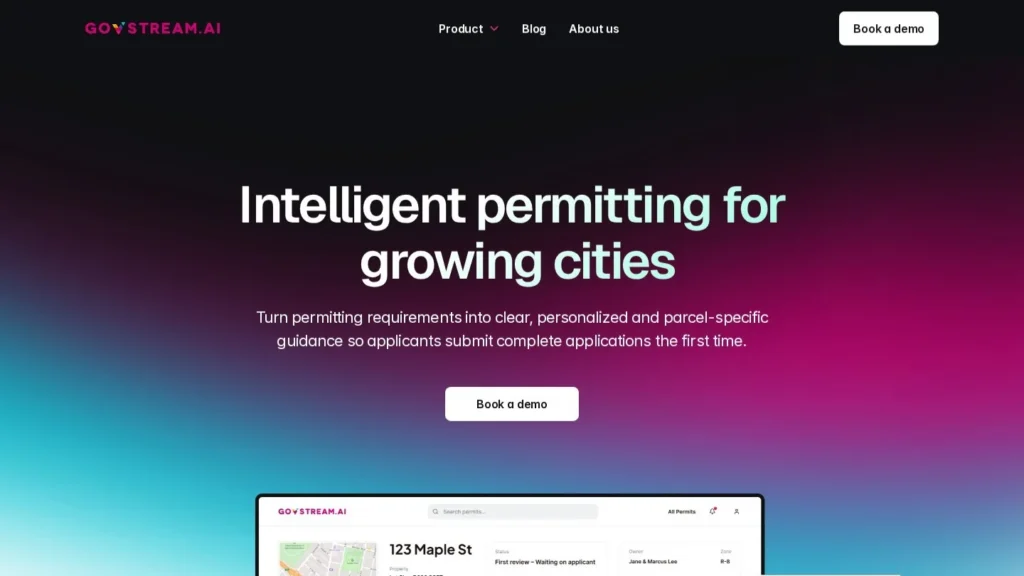
Govstream.ai builds AI assistants that help permit staff and applicants pick the right permit, gather the right documents and file a complete application. It suits development services departments where wrong-permit filings and missing documents drive delays. It is an early-stage company: it had five employees at its 2025 seed round, pricing is shared by quote, and several of its strongest numbers come from back tests while live results are still building. Starting price is a custom quote, and we rate it 7.3/10 on our scale. We have not used Govstream.ai ourselves; this review is based on city case studies and announcements, and news coverage.
Bellevue’s Complete First Submissions Rose From 22% to 67%
- In Bellevue’s back test of 276 residential permits, first-submission completeness rose from 22% to 67%, and the assistants correctly identified 96% of required documents.
- Bellevue staff estimated 152 hours saved in one month in mid-2026, and use grew from about 40 pilot users to nearly 200 staff.
- The Research Assistant drafts citation-backed answers and recommends a permit path; the Application Assistant reads plans, fills forms and scores completeness.
- Govstream.ai raised a $3.6 million seed round in 2025, led by 47th Street Partners, and Louisville picked it through the city’s first AI request for proposals.
- Pricing is by quote only, and staff review every AI-drafted answer, so plan for a phased rollout with tuning rounds.
Two City Customers With Unusually Detailed Results
Most of what is known about Govstream.ai comes from its two public customers, which have published unusually detailed results for a young vendor.
| Fact | Detail | Source and Date |
|---|---|---|
| Residential back test | First-submission completeness rose from 22% to 67% on 276 real 2025 residential building permits; 96% of required documents correctly identified | City of Bellevue case study, August 2026 |
| Tree permit back test | Completeness rose from 40% to 76% on 265 permits after three tuning rounds; document identification rose from 74% to 86% | City of Bellevue case study, August 2026 |
| Staff time | Staff estimated 152 hours saved in one month (June to July 2026) | City of Bellevue case study, August 2026 |
| Adoption | Grew from about 40 pilot users to nearly 200 Bellevue staff | City of Bellevue case study, August 2026 |
| Early Bellevue signals | About 30% fewer routine inquiries, up to 50% fewer re-submittals and up to 2X faster starts to first review | GeekWire, 2025 |
| Louisville pilot | Early tests suggested more than 50% fewer avoidable resubmissions | Stateline via Route Fifty, August 21, 2026 |
| Seed round | $3.6 million led by 47th Street Partners, with Nellore Capital, Ascend and angels Kevin Merritt (Socrata founder) and Andreas Huber (First Due co-founder and CEO) | GeekWire, 2025 |
| Company | Founded July 2024; five employees at the seed round with plans to reach 10 to 12 within a year | GeekWire, 2025 |
| Louisville selection | Chosen through Louisville Metro’s first RFP for AI projects, for remodels and new construction permitting | Louisville Metro announcement, January 7, 2026 |
The Bellevue back test is the number to focus on. A jump from 22% to 67% complete first submissions means far fewer applications bounce back for missing paperwork, and Bellevue says each correction cycle adds two to four weeks. The 96% document identification rate also means the assistant still misses some requirements, which is why staff review stays in place.
The company’s size matters as much as the results. A five-person team at the seed round, with angel investors from Socrata and First Due, brings deep government software experience in a small team. Cities should ask how many deployments the team supports at once and who handles tuning.
A Permitting Assistant Layered on the City’s Own Systems
Govstream.ai does not replace a city’s permitting system. It sits on top of it, using the city’s codes, policies, zoning rules, GIS and parcel data, permit history and configured business rules to answer questions and prepare applications. GeekWire described it at launch as a conversational copilot for permit technicians, planners and reviewers that answers questions, checks documents and compares plan sets.
Research Assistant
The Research Assistant answers permitting questions in plain language, recommends a permit path based on the property’s conditions and lists the documents, plans and information the project needs. Bellevue says it produces citation-backed draft responses in under a minute. Founder Safouen Rabah told Stateline that applicants often pick the wrong permit, and about one in five Bellevue tree permit applications never reached issuance, often because they were filed under the wrong permit type or needed no permit at all.
Application Assistant
The Application Assistant carries the research forward. It extracts project details from uploaded plans and documents, fills in the correct forms and scores the application’s completeness in real time, so gaps show up before submission instead of after.
Rollout and Tuning
Bellevue ran the work as a public-private design partnership launched in 2025. Phase 1 put two staff-facing assistants in place; Phase 2, under way in 2026, adds real-time guidance for customers before they apply and AI-supported triage to flag issues early. Staff refine rule configurations after each tuning round, using data on where applicants get stuck. Louisville’s pilot made the assistants available to residents and builders through the city website, email and phone.
Why Cities Are Buying
The pitch is about housing costs as much as staff time. Rabah told GeekWire that each month of permitting delay removed saves about $5,000 per new housing unit on average, and he argues that permitting should be a two-way process in which cities guide applicants instead of simply receiving uploads that no one validates. Louisville framed its pilot the same way: Mayor Craig Greenberg said the city wants to use the data it already holds to ease the pain points that delay people, and the city’s chief information officer, Chris Seidt, described the pilot as a way to learn how to deploy AI that adds to staff expertise. Louisville said its pilot would conclude in spring 2026 and that it would share findings and recommendations publicly.
Staff Review Every Drafted Reply and Approve Every Permit
In Bellevue, staff review every AI-drafted response before customers receive it. Plan review decisions and permit approvals stay with city staff, and someone has to own the rule configurations as codes and policies change.
Procurement Through RFPs and Design Partnerships
Govstream.ai does not publish prices. Its public deployments came through a design partnership in Bellevue and a request for proposals in Louisville, so expect a procurement process rather than a sign-up page.
| Item | Price | Billing | What’s Included | Limits |
|---|---|---|---|---|
| Research Assistant | Custom quote | Set by city contract | Plain-language answers, permit path recommendations and required document lists with citations | Staff review drafts before customers see them |
| Application Assistant | Custom quote | Set by city contract | Extraction from plans, form filling and real-time completeness scoring | Tuned per permit type |
| Customer guidance and triage | Custom quote | Set by city contract | Pre-application guidance for residents and AI triage of applications | In development in Bellevue in 2026 |
Review Hours Removed for a City Handling 1,000 Applications
With no public prices, the useful arithmetic is the work removed. These scenarios use Bellevue’s published results; the application volumes are our illustrative assumptions.
- A city with 1,000 residential permit applications a year: at Bellevue’s back-test rates, incomplete first submissions would fall from 780 to 330, or 450 fewer. At two to four weeks per correction cycle, that is 900 to 1,800 applicant-weeks of delay avoided.
- Staff hours: if Bellevue’s estimated 152 hours saved in one month held all year, that would be 1,824 hours, or about 0.9 of a full-time position at 2,080 hours a year.
- A smaller permit type: on 265 tree permits, completeness moving from 40% to 76% means incomplete filings fall from 159 to about 64.
- Cost of delay for builders: combining the 900 to 1,800 applicant-weeks above with Rabah’s estimate of about $5,000 per housing unit per month of delay gives roughly $1.0 million to $2.1 million in avoided holding costs a year. That is a rough outside estimate built on the founder’s own figure, not a measured result.
Other costs to ask about: staff time for tuning rounds, configuration of each permit type, integration with your permitting system and GIS, and whether customer-facing channels such as phone and email cost extra. Use the staff-hours figure to set a ceiling before the first quote.
Govstream.ai Compared With CivCheck, Polimorphic and Citibot
Govstream.ai works at the front door of permitting: questions, permit choice and application completeness. CivCheck works on the plans themselves. Polimorphic and Citibot answer residents across city departments.
| Agent | Starting Price | Free Plan | Main Strength | Main Trade-Off | Best For |
|---|---|---|---|---|---|
| Govstream.ai | Custom quote | No | Permit research and application assistants on top of existing systems | Small team; many results from back tests | Cities fixing wrong-permit and incomplete filings |
| CivCheck | Custom quote; reported free to cities with applicant fees | No | Code checks on plans with city-reported results | Applicant-paid fee model | Building departments with plan review backlogs |
| Polimorphic | $2 per call (AI Voice, 12-month contract) | No | Phone, web search and workflows for city departments | Not specialized in permit applications | Offices with heavy phone and walk-in traffic |
| Citibot | Custom quote | No | Phone, chat and text answers from one knowledge base | Does not process permits end to end | Cities wanting 24/7 resident answers |
The closest decision is between Govstream.ai and CivCheck, and many large departments may want both: Govstream.ai to get the right application in the door, CivCheck to check the drawings once it arrives. CivCheck has more city-reported live results; Govstream.ai has strong back-test data and a narrower focus on the applicant’s first steps. See more options in our AI agents for government and AI agents for construction guides.
Departments Swamped by Incomplete or Wrong-Permit Filings
- Departments where most applications arrive incomplete: Bellevue’s 78% baseline is the problem the product is built to fix.
- Cities with many wrong-permit filings: permit path recommendations address applications filed under the wrong type or needing no permit.
- Teams that want to keep their permitting system: the assistants sit on top of existing systems and data.
- Departments that measure before they buy: Bellevue’s method, a back test on a year of real permits, is easy to copy and gives a clear baseline for judging any pilot.
- Cities willing to act as design partners: Bellevue and Louisville both worked closely with the company, which suits agencies that want input into the product.
Drawing Compliance Reviews and Agencies Wanting a Big Vendor
- Departments that need code compliance review of drawings: CivCheck is built for that job.
- Agencies that need a large vendor: a team of five at the seed round, planning for 10 to 12, may be smaller than some procurement rules require, so ask how support is staffed.
- Buyers who need published prices: every deal is quoted.
- Cities that want a finished resident-facing product today: Bellevue’s customer guidance phase was still in development in 2026.
Back-Tested Gains and Tuning Effort Before Live Results
- Back tests versus live results: Bellevue’s completeness gains come from historical permits. Ask for live metrics once Phase 2 is running.
- Tuning effort: tree permits needed three tuning rounds to reach 76% completeness. Budget staff time for each permit type.
- Document coverage: at 96% document identification, a small share of requirements still need staff to catch them. Keep staff review on every response.
- Vendor capacity: ask how many cities the team supports at once and what happens if key staff leave.
- Records and privacy: applicant questions and documents may be public records. Settle retention and data use terms in the contract.
Louisville Names Govstream.ai in Its AI Permitting Pilot
- On August 21, 2026, Route Fifty republished Stateline’s report naming Govstream.ai as a contractor in Louisville’s AI permitting pilot and quoting founder Saf Rabah on wrong-permit filings.
- In August 2026, Bellevue published early results from its Govstream.ai design partnership, including the 276-permit back test.
- On January 7, 2026, Louisville announced its first AI pilot project, with Govstream.ai working on permitting for remodels and new construction.
- In 2025, Govstream.ai raised a $3.6 million seed round led by 47th Street Partners.
Promising Permitting Results From an Early-Stage Vendor
Govstream.ai scores 7.3/10 on our scale. Its results are promising and unusually well documented for a young company: a city-published back test showing complete first submissions rising from 22% to 67%, and staff use growing to nearly 200 people in Bellevue. Published pricing, more live results, a lighter setup and public ratings would all lift the score as the company grows.
For a city whose permit queue is clogged with incomplete or wrong applications, a pilot is worth running, ideally on one or two permit types with clear before-and-after measures, as Bellevue did. Call Bellevue and Louisville first, and ask the company how it will staff your deployment.
Bellevue Results, Cost and Whether It Replaces Permit Staff
What Does Govstream.ai Do for a City Permitting Office?
It answers permitting questions with citations, recommends the right permit, lists required documents, pulls details from uploaded plans into forms and scores completeness. Staff review the AI’s responses before customers receive them.
How Much Does Govstream.ai Cost?
Govstream.ai does not publish prices. Cities buy through procurement or design partnerships, such as Louisville’s AI request for proposals. Ask how pricing scales with users, permit volume and permit types.
What Results Has Bellevue Reported With Govstream.ai?
In a back test of 276 residential permits, complete first submissions rose from 22% to 67% and 96% of required documents were identified. Staff estimated 152 hours saved in one month in mid-2026.
Does Govstream.ai Replace Our Permitting Software?
No. It sits on top of the systems a city already uses, drawing on codes, GIS and parcel data and permit history. Permit decisions stay with staff.
Is Govstream.ai or CivCheck Better for Plan Review?
CivCheck is built to check plans against building and zoning codes. Govstream.ai focuses on research, permit choice and application completeness, so it works earlier in the process. Some cities may need both.
User Reviews
Nobody has rated it here yet. Be the first AI Agents Choice user to rate Govstream.ai.