
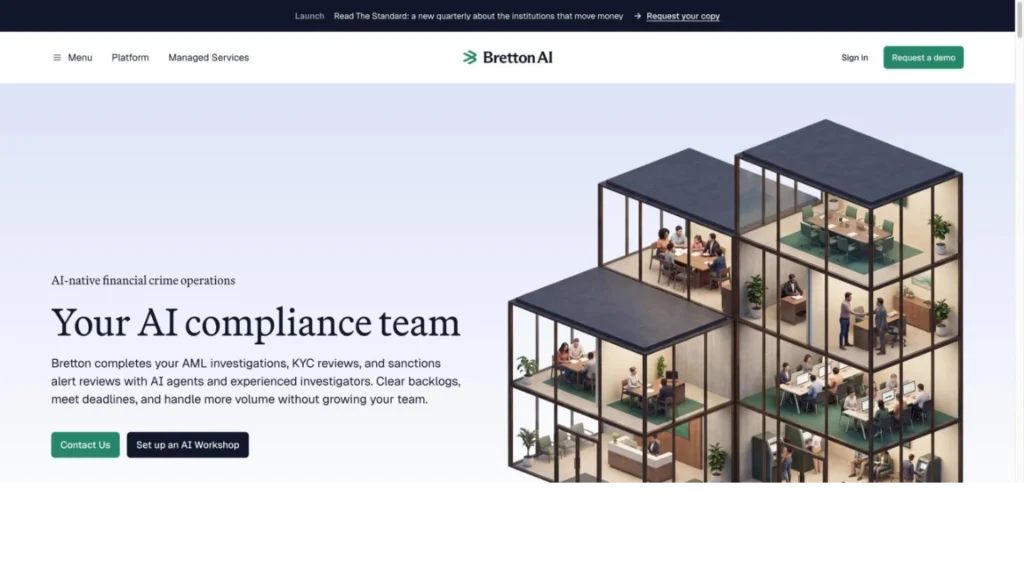
Bretton AI is the strongest fit for banks and fintechs whose compliance teams handle heavy volumes of KYC, AML and sanctions alerts and need investigation work done faster without losing the audit trail. Its agents gather evidence, apply policy and draft the case narrative; an analyst reviews before the decision is final. The company says the agents have completed more than 1.2 million level one and level two investigations and removed more than 195,000 hours of manual work.
Cost and access are the main planning points. Pricing is shared by quote, and Bretton reported an average contract value of $201,000 in February 2026, the same month it raised a $75 million Series B and dropped its old name, Greenlite AI. This review is based on Bretton’s product page, its announcements and news coverage as of October 2026; we have not tested it hands-on.
A $201,000 Average Contract and 1.2 Million Investigations
- Starting price: Custom quote only; the reported average contract value was $201,000 in February 2026.
- Scale: More than 1.2 million L1 and L2 investigations completed and 195,000-plus hours of manual work removed, by Bretton’s count.
- Independent check: Kaufman Rossin validated the KYC, AML and sanctions agents in October 2026, a rare step for an AI agent vendor.
- Security: SOC 2 Type II, GDPR, zero data retention and a log that explains every agent action.
- Our score: 7.8/10, with high marks for autonomy and trust, and room to grow through published pricing and a lower entry cost.
Operating Data Bretton Publishes on Its Agents
Bretton publishes more operating data than most compliance software vendors. Each figure below was checked on the source page; results are the company’s own unless stated.
| Fact | Detail | Source and date |
|---|---|---|
| Series B | $75 million led by Sapphire Ventures, with Greylock, Thomson Reuters Ventures, Canvas Ventures, Y Combinator and new investor TIAA Ventures | Business Wire, February 9, 2026 |
| Series A | $15 million as Greenlite AI, bringing total funding to $20 million | FinTech Global, May 22, 2025 |
| Investigations | More than 1.2 million L1 and L2 financial crime investigations completed | Business Wire, February 9, 2026 |
| Work removed | More than 195,000 hours of manual work and more than $10 million in compliance headcount costs and risk reduction | Business Wire, February 9, 2026 |
| Contract size | Average contract value of $201,000, up from $85,000 at the Series A and $25,000 at the 2023 seed | Business Wire, February 9, 2026 |
| Customers | Robinhood, Mercury, Gusto, Lead Bank and Coastal Community Bank; five publicly traded companies signed in 2025 | Business Wire, February 9, 2026 |
| Customer results | A $15 billion-plus institution cut outsourcing spend by $5.35 million in year one; a Fortune 500 company halved institutional onboarding time; an FDIC-regulated bank cut loan origination timelines by up to 90% | Business Wire, February 9, 2026 |
| Earlier results | One fintech cut alert handling by 90%; a broker-dealer expanded operations across 12 markets | FinTech Global, May 22, 2025 |
| Independent validation | Kaufman Rossin reviewed accuracy and stability, explainability, change management, monitoring and model risk governance of the KYC, AML and sanctions agents | The Paypers, October 28, 2026 |
| Security | SOC 2 Type II, GDPR compliant, zero data retention, independent model validation | Bretton product page, accessed October 2026 |
For a buyer, the most useful numbers are the contract value and the validation. An average of $201,000 a year tells you who Bretton sells to: institutions with alert queues large enough that the savings are measured in analyst headcount or outsourcing contracts. The jump from $25,000 to $201,000 in about three years also suggests buyers are expanding their use after the first deployment.
The Kaufman Rossin review matters because model risk management is often what slows AI projects at banks. An outside firm examining explainability and change management gives your model risk team a starting file, alongside your own validation. The investigation counts and savings are Bretton’s figures and are worth testing in a pilot.
Agents Layered Over Your Existing Compliance Stack
Bretton sells agents that sit on top of an institution’s existing compliance stack rather than replacing it. Alerts still come from your transaction monitoring system and customer data still lives in your core and KYC tools. The agents do the investigative legwork in between.
The Investigation Workflow
- Pick up the alert. The agent takes a transactional alert from your AML software or a KYC or KYB review from the onboarding queue.
- Gather evidence. It pulls data from core providers, KYC systems, internal tools and outside sources, and handles incomplete records, according to the company.
- Analyze and research. It reviews transaction patterns, cross-references documents for enhanced due diligence and researches the people and entities involved to build a risk profile.
- Apply policy. Your internal procedures and external regulations are applied the same way to each case, which the company pitches as more consistent than a rotating team of analysts.
- Draft the output. The agent writes the investigation report and narrative, covering L1 data gathering and L2 decision support.
- Human review. An analyst reviews the draft and makes the final call. Kaufman Rossin’s review describes mandatory human review before final decisions as part of the design.
Trust Infrastructure
The part of Bretton that sets it apart from general-purpose agent builders is its governance layer. The company says Trust Infrastructure builds regulatory guidance, model risk management, continuous AI evaluation and quality assurance into each agent, and it logs and explains every agent action. Kaufman Rossin described the design as combining language model reasoning with deterministic rule-based logic, structured outputs and human review.
Setup and Deployment
Deployment runs on enterprise infrastructure including virtual private clouds. The product page groups integrations by type: core providers, internal tools, AML software and KYC systems. If a connector does not exist, Bretton’s forward deployed engineering team builds it, a job the company says takes days. Expect a pilot on one alert type, then expansion. Bretton also launched managed services in July 2026, according to its newsroom listing on Business Wire.
Analysts Approve Conclusions and Decide on Filings
Analysts approve or reject the agent’s conclusions, decide whether to file, and handle escalations. Compliance leaders own the policies the agent applies, and model risk teams own ongoing monitoring. Bretton positions the agents as doing the work of L1 and L2 investigators, not as the accountable officer.
Demo First, Contract Sized to the Institution
Bretton AI does not publish a price list. Every deal starts with a demo, and contracts are sized to the institution and the workflows covered.
| Plan | Price | Billing | What’s Included | Limits |
|---|---|---|---|---|
| Enterprise contract | Custom quote | Annual contract | KYC, KYB, AML and sanctions agents, Trust Infrastructure, integrations built by forward deployed engineers | No self-serve option or free trial |
| Reported average | $201,000 average contract value | Annual | Varies by workflows and volume | Company-reported average, not a list price |
What the Average Deal Works Out to Each Month
The average deal. At the reported $201,000 average contract value, a year of Bretton works out to $16,750 a month. That is a mid-market or enterprise budget line, compared with the $85,000 average the company reported at its 2025 Series A.
Time per case. Bretton’s own totals, 195,000 hours removed across 1.2 million investigations, average out to about 9.75 minutes saved per investigation. Multiply that by your monthly alert volume to see whether the savings cover the contract; teams with smaller queues may find the numbers harder to make work.
Outsourcing replacement. The strongest case is an institution paying a business process outsourcer for alert review. Bretton says one $15 billion-plus customer cut that spend by $5.35 million in its first year. If your outsourcing bill is a fraction of that, ask for a narrower first contract on a single alert type.
Variable costs. Budget for internal time from compliance, IT and model risk during the pilot, your own model validation, and any custom connectors. Ask how pricing changes as volume or the number of covered workflows grows.
Pricing Basis and Launch Scope to Pin Down
- Pricing basis: whether the contract is priced per investigation, per alert type, per workflow or as a platform fee.
- Scope at launch: which of KYC, KYB, AML and sanctions workflows are included in year one.
- Connector costs: whether forward deployed engineering work on custom integrations is included.
- Validation materials: what documentation from the Kaufman Rossin review your model risk team can receive.
Bretton AI Compared With Casca, Salient and interface.ai
Few AI agents for banks overlap directly with Bretton, so this comparison sets it against the other agent vendors a bank is likely to evaluate this year, each aimed at a different team.
| Tool | Starting Price | Free Plan | Main Strength | Main Trade-Off | Best For |
|---|---|---|---|---|---|
| Bretton AI | Custom quote (reported $201,000 average contract) | No | Audit-ready KYC, AML and sanctions investigations with outside validation | Higher entry cost; access through a demo | Compliance teams with large alert queues |
| Casca | Custom quote | No | AI loan origination with 40-plus automated KYB checks | Built for business lending, not ongoing monitoring | Banks running SBA and small business loans |
| Salient | Custom quote | No | Voice agents for servicing and collections calls | Covers borrower calls, not compliance investigations | Auto and consumer lenders |
| interface.ai | Custom quote | No | Voice and chat agents with caller authentication for credit unions | Front-line service only | Credit unions and community banks |
Bretton is the only one of the four focused on financial crime operations. Casca touches KYB at the point of lending, which can overlap with onboarding reviews, but it does not run AML alert investigations. Salient and interface.ai sit in the contact center. A bank modernizing several teams could reasonably run more than one; see our banking agents page for the full list.
Banks and Fintechs With Growing Alert Backlogs
- Banks and fintechs with growing alert backlogs: the agents handle L1 data gathering and L2 drafting, which is where most analyst time goes.
- Institutions paying outsourcers for alert review: Bretton’s largest published saving came from cutting outsourcing spend.
- Sponsor banks and banking-as-a-service providers: customers such as Lead Bank and Coastal Community Bank show fit for partner-heavy programs with many onboarding reviews.
- Teams that must satisfy examiners: logged, explained actions and an independent model validation give model risk and audit teams evidence to work from.
- Large enterprises with KYB onboarding: Bretton reports a Fortune 500 customer halved institutional client onboarding time. More enterprise options are on our enterprise agents page.
Small Credit Unions With Modest Alert Volume May Need a Lighter Option
- Small credit unions and community banks with modest alert volume: a contract averaging $201,000 takes a large queue to recover.
- Teams wanting a self-serve trial: there is no free plan or published price.
- Institutions wanting fully automated decisions: the design keeps a human reviewer before final decisions.
- Buyers mainly after customer service automation: look at interface.ai or other front-line agents instead.
Self-Reported Savings and Integration Details to Confirm
- Vendor-reported results: the investigation counts, hours saved and customer savings come from Bretton. Ask for references at an institution like yours.
- Integration specifics: confirm your transaction monitoring and core platforms are covered and who maintains custom connectors.
- Your own model risk work: the Kaufman Rossin validation helps, but regulators expect your institution to validate and monitor models it relies on.
- Accountability stays with you: agent drafts still need analyst review, and filing decisions remain your responsibility.
- Fast growth: a rename, a Series B, managed services and new financial crime domains in one year mean the product and contract terms may change quickly. Lock in service levels and data terms in writing.
Kaufman Rossin Validates Bretton’s KYC and AML Agents
On October 28, 2026, The Paypers reported that Kaufman Rossin independently validated Bretton’s KYC, AML and sanctions agents, reviewing governance, outputs, explainability and monitoring. Bretton’s chief executive, Will Lawrence, said banks need to know an agent followed policy and can explain its decisions, not only that it reached the right answer.
On February 9, 2026, the company raised a $75 million Series B led by Sapphire Ventures and rebranded from Greenlite AI to Bretton AI, saying it would expand into more financial crime domains and serve larger institutions. On May 22, 2025, as Greenlite AI, it closed a $15 million Series A backed by Greylock, Thomson Reuters Ventures and Canvas Ventures.
Built to Hold Up Under Examiner Scrutiny
For banks and fintechs with heavy alert volumes and serious examiner scrutiny, Bretton AI is one of the most credible agent products available, and it scores 7.8/10 on our scale. It does real investigative work across systems, it is built around explainability and audit logs, and it has an outside validation that most rivals cannot show. Customers such as Robinhood, Mercury and regulated banks, plus more than 1.2 million completed investigations by the company’s count, suggest it works in production.
Published pricing and a lower entry point would lift the score. With quote-based pricing and a reported $201,000 average contract, smaller institutions may find the cost harder to justify. If you are a candidate, start with one alert type, measure minutes saved per case against your own baseline and have your model risk team review the Kaufman Rossin findings early. Compare other options on our banking agents page.
Bretton’s Contract Values and Quoting Process
How Much Does Bretton AI Cost?
Bretton does not publish pricing, and contracts are quoted after a demo. The company reported an average contract value of $201,000 in February 2026, up from $85,000 in 2025.
Is Bretton AI the Same as Greenlite AI?
Yes. Greenlite AI renamed itself Bretton AI on February 9, 2026, when it announced its $75 million Series B. The team, led by co-founder and chief executive Will Lawrence, and the compliance agents carried over.
Do Bretton AI Agents Make Final AML Decisions?
No. The agents gather evidence, analyze cases and draft the narrative, and a human reviews before the final decision. Kaufman Rossin’s validation described mandatory human review as part of the system.
Is Bretton AI Secure Enough for a Regulated Bank?
Bretton lists SOC 2 Type II, GDPR compliance, zero data retention and virtual private cloud deployment, and it logs and explains each agent action. Its customers include banks regulated by the OCC, FDIC and Federal Reserve. Your own security and model risk reviews still apply.
Which Compliance Decisions Stay With Analysts?
It does not replace your transaction monitoring system, customer service tools or loan origination software, and it does not file reports on its own authority. It works best where there is a steady queue of alerts or reviews to investigate.
User Reviews
Nobody has rated it here yet. Be the first AI Agents Choice user to rate Bretton AI.