
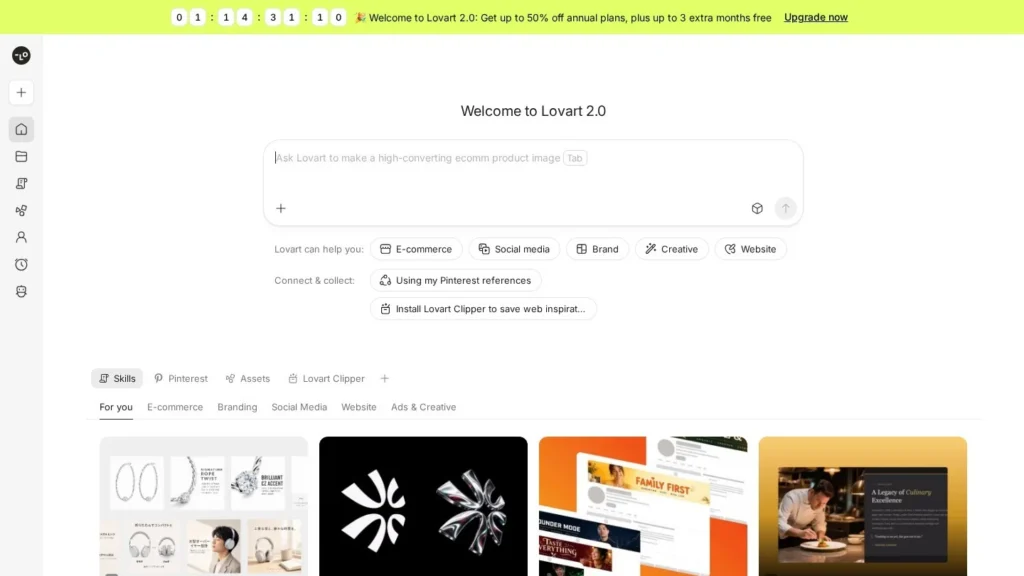
One prompt can return up to 40 finished design assets in Lovart, from a full brand kit to social posts, packaging mockups and storyboards. The design agent left beta in July 2025 and, according to a Google Cloud customer story, now has more than 5 million users.
It is aimed at marketers, small brands and freelance designers who need a lot of on-brand visual material quickly. This review is based on Lovart’s published information and third-party reporting; we did not test it hands-on.
How It Works
You describe a project in plain language or upload a reference image. Lovart’s planning layer, which the company calls MCoT, breaks the request into steps, gathers references and then generates the assets. The results land on ChatCanvas, an infinite canvas where you keep chatting with the agent next to the work.
Editing happens in the same place. Touch Edit adds elements to a selected part of an image, and you can adjust layers, text and layout. Brand Kits store colors, fonts and logos so later batches stay consistent, and the agent remembers earlier preferences and uploaded files.
Lovart does not build its own foundation models. It runs Google’s Nano Banana for images, Veo 3 for video with synced audio and Gemini for tasks such as tagging prompts and judging outputs, and it is also reported to use GPT models.
Pricing
There is a free tier with a small daily credit allowance. Paid plans are named Starter, Basic, Pro and Ultimate, with a Team plan sold through sales. Third-party snapshots from September 2026 disagree on figures: Starter is listed at about $19 a month, and Ultimate at somewhere between about $160 and $199 a month.
Every task spends credits, and the cost per task changes with the model and the complexity of the job, so a credit does not equal a fixed number of images. Monthly credits are reported not to roll over.
What to Watch Out For
Costs are the main unknown. Video and high-end image models burn credits faster, and plan details have shifted more than once since launch. Commercial-use rights on the free tier are not clearly stated.
The quality of output also depends on models Lovart licenses rather than owns. Its parent company, Evoken, is a Chinese startup, and the materials reviewed list no security certifications, so procurement teams with strict data rules should ask questions before uploading brand assets.
Recent News
Lovart launched globally and exited beta on July 23, 2025, reporting more than 800,000 users in 70 countries at the time. In June 2026 its parent Evoken raised nearly $300 million at a post-money valuation above $2 billion and said annual recurring revenue topped $300 million, as The Standard reported. On August 5, 2026, Bloomberg reported that Evoken is exploring a Hong Kong IPO and is close to a round valuing it at about $3 billion.
User Reviews
No reviews yet. Be the first to rate Lovart.