
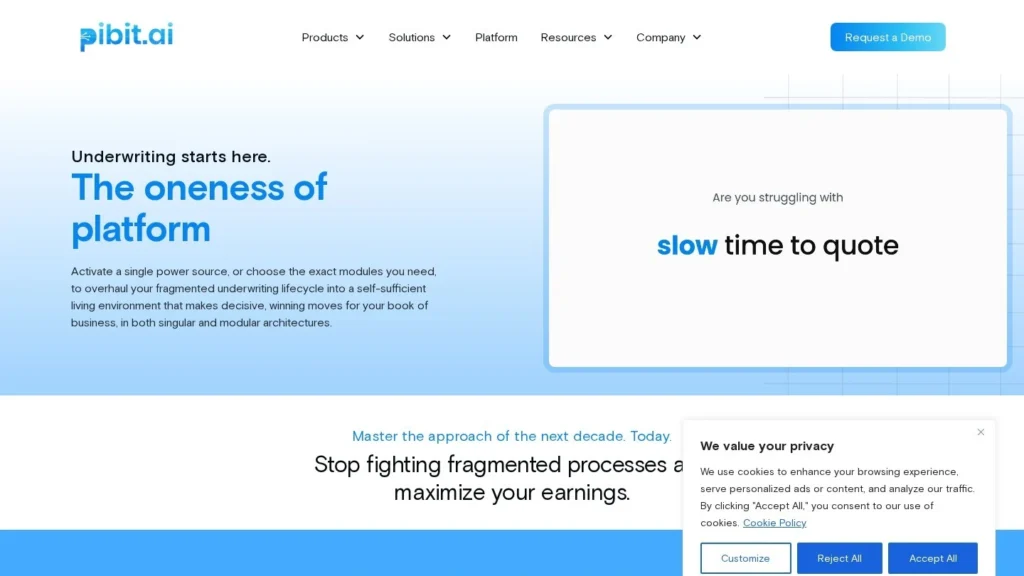
Pibit.AI says insurers using its CURE platform have reported up to 85% faster underwriting, 32% more gross written premium per underwriter and up to 700 basis points of loss-ratio improvement. Kinetic, a workers’ compensation insurer, says the platform helps it handle more than $1 billion in submissions a year and grow premium by close to 100%. Those are customer-reported figures published with the company’s $7 million Series A in November 2025.
CURE is best for commercial, specialty and excess and surplus lines carriers and MGAs with high submission volumes and underwriters stuck re-keying loss runs. Its security credentials are detailed: SOC 2 Type II, ISO 27001 and a dedicated data stack for each client. Pricing is shared by quote, and most public results so far come from Pibit and its customers. We rate it 7.8/10 on our scale; a published pricing guide and more public reviews would give buyers more to work with. We have not used CURE ourselves; this review is based on Pibit’s platform page and case studies, funding coverage and trade press.
85 Percent Faster Underwriting, as Customers Report It
- Pibit reports customer results of up to 85% faster underwriting, 32% more premium per underwriter and up to 700 basis points better loss ratios.
- CURE covers intake and clearance, extraction and research, triage and risk analysis, rating, quote and bind, and portfolio management, licensed together or by module.
- Every extracted field gets a confidence score, and low-confidence data is corrected before an underwriter sees it.
- SOC 2 Type II and ISO 27001 certified, with US AWS hosting, SSO and a dedicated data and AI stack per client.
- Pricing is quote only; Sixfold and Bevaya are the closest alternatives on our site.
More Customer Metrics Than Funding Disclosures
Pibit has published more customer metrics than funding, which is typical of a company that grew on a small round.
| Fact | Detail | Source and Date |
|---|---|---|
| Funding | $7 million Series A led by Stellaris Venture Partners, with Y Combinator and Arali Ventures | Unite.AI, November 20, 2025 |
| Team | More than 125 employees; founder and CEO Akash Agarwal; based in San Francisco | Sovereign Magazine, November 20, 2025 |
| Customer-reported results | Up to 85% faster underwriting, 32% more gross written premium per underwriter, up to 700 basis points loss-ratio improvement | Unite.AI, November 20, 2025 |
| Kinetic | Handles more than $1 billion in annual submissions and grew premium by close to 100%, according to CEO Adam Price | Sovereign Magazine, November 20, 2025 |
| Named customers | HDVI, Shepherd Insurance, RMS Insurance Brokerage, Kinetic and Method Insurance | Unite.AI, November 20, 2025 |
| Shepherd case study | Loss runs read in any carrier format with no templates; 25% underwriter time saved | Pibit case study, viewed November 2026 |
| Platform metrics | 20% higher hit ratio, twice the underwriter throughput and 70% shorter quote time | Pibit platform page, viewed November 2026 |
| Security | SOC 2 Type II and ISO 27001; aligned with NIST AI RMF, NIST SP 800-53 Rev. 5 and CSA CCM v4 | Pibit platform page, viewed November 2026 |
The numbers tell a story of focus. Pibit reached more than 125 employees and a list of named carriers and MGAs before a $7 million Series A, which suggests a services-heavy model where experts sit behind the software. That matches the platform page, which says low-confidence data goes to agentic correction and platform experts before reaching an underwriter.
For buyers, the loss-ratio figure is the most valuable and the one that takes longest to confirm. Underwriting speed and throughput show up within weeks; loss-ratio gains take policy years to prove. It helps to ask which customers reported the 700 basis points, over what period and on which lines.
CURE Sits in Front of Existing Insurer Systems
CURE, short for Centralized Underwriting Risk Environment, sits in front of an insurer’s existing systems rather than replacing them. Pibit describes it as non-invasive: submissions arrive, CURE processes them and the results reach underwriters inside a single workbench.
Intake and Clearance
Submissions come in from email and agent portals. ClearCURE triages them so underwriters see the accounts worth quoting first. Event-driven orchestration moves each submission through the next stages automatically.
Extraction and Research
DocumentCURE parses unstructured documents such as applications, schedules and loss runs. Pibit’s Shepherd case study describes template-agnostic extraction that combines language models, natural language processing and computer vision, so a new loss-run layout does not break the pipeline. Every extracted field carries a confidence score. Automation scales with that score, and low-confidence values go through agentic correction and Pibit’s platform experts before an underwriter sees them. ResearchCURE then enriches the account with external data.
Risk Analysis and Decision Support
RiskCURE evaluates each account against portfolio-specific signals and provides portfolio-level insight. The platform also supports rating and pricing, quote and bind, and portfolio management. WorkflowCURE brings tasks, collaboration and decision tracking into one interface so a team can see where each submission stands.
Learning From Underwriters
When underwriters correct a value or override a recommendation, CURE learns from the change. Over time the platform tunes to the carrier’s own book of business.
Security and Data Handling
It is SOC 2 Type II and ISO 27001 certified and says its controls align with the NIST AI Risk Management Framework, NIST SP 800-53 Rev. 5 and the Cloud Security Alliance’s Cloud Controls Matrix v4. Data is hosted in US AWS regions, encrypted at rest with AES-256 through AWS KMS and in transit with TLS 1.2 or higher. Access runs through SAML 2.0 or OIDC single sign-on with role-based access control. Each client gets a dedicated data and AI stack, and the platform supports data retention rules, right to erasure, PII redaction, immutable audit logs and tested disaster recovery.
Lines of Business
CURE targets commercial, specialty and excess and surplus lines. Named customers include workers’ compensation writers Kinetic and Method Insurance, Shepherd in commercial construction, HDVI and RMS Insurance Brokerage.
Underwriters Make Every Decision
Underwriters make the decisions. Pibit’s own messaging stresses augmenting underwriters rather than replacing them, and the founder has said the goal is a transparent, decision-ready system. Pricing judgment, broker relationships and referrals stay with people, and so does the final call on any account the platform flags as unclear or incomplete.
Live in Weeks With Day-One Submissions
Pibit says customers can go live in weeks or less, with submissions flowing on day one while the platform tunes to the book. Carriers can activate the full platform or start with individual modules, such as extraction of loss runs.
Modular Quotes Based on the Stages You Buy
Pibit.AI does not publish prices. CURE is sold by quote, and because the platform is modular, the price depends on which stages you activate and your submission volume.
| Plan | Price | Billing | What’s Included | Limits |
|---|---|---|---|---|
| Full CURE platform | Custom quote | Contract | Intake and clearance, extraction and research, triage and risk analysis, rating and pricing, quote and bind, portfolio management | Sold through Pibit’s sales team |
| Individual modules | Custom quote | Contract | Any single stage, such as extraction and research | Scope set in the proposal |
Applying Pibit’s Figures to Hypothetical Books
Without published prices, the useful exercise is estimating value. The scenarios below apply Pibit’s published figures to hypothetical books, so treat them as an upper bound.
An MGA with a $50 million commercial book: if the 700-basis-point loss-ratio improvement held, losses would fall by $3.5 million a year. Even a fraction of that would cover most software contracts, but loss-ratio gains take time to show up and depend on underwriting decisions as much as data.
An underwriter writing $5 million a year: Pibit’s 32% gain in premium per underwriter would mean $6.6 million written by the same person.
A team quoting in five business days: the platform page’s 70% reduction in quote time would cut that to 1.5 days.
Other costs include integration work with agency and policy administration systems, time for underwriters to review confidence-scored output in the early weeks, and any professional services for expert correction. Ask whether expert review is included in the license or billed separately.
Pibit.AI CURE Compared With Sixfold, Bevaya and Clive by Five Sigma
Underwriting AI vendors differ mainly in how much of the workflow they cover and who they sell to.
| Agent | Starting Price | Free Plan | Main Strength | Main Trade-Off | Best For |
|---|---|---|---|---|---|
| Pibit.AI CURE | Custom quote | No | Full underwriting flow from intake to portfolio, with strong security certifications | Small funding base and quote-only pricing | Commercial, specialty and E&S carriers and MGAs |
| Sixfold | Custom quote | No | Named customers include Zurich North America, Guardian and AXIS | No public pricing | Large carriers, including life insurers, with high submission volumes |
| Bevaya | Custom quote | No | Insurance agents across underwriting, claims and servicing documents | New brand in 2026, references may use the Roots name | Carriers, brokers and TPAs with heavy document work |
| Clive by Five Sigma | Custom quote | No | Handles routine claim work alongside an existing claims system | Performance figures come from Five Sigma | Claims teams at insurers, MGAs and TPAs |
Pibit and Sixfold compete most directly on underwriting. Sixfold has the larger named carriers; Pibit covers more of the flow, from clearance through quote and bind and portfolio management, and publishes more security detail. Bevaya overlaps on document extraction but spans claims and servicing too. Clive is a claims product and a complement rather than a rival. See more in our AI agents for insurance page.
MGAs and Commercial Specialty Carriers
- MGAs and program administrators: customers such as Kinetic and Method Insurance use it to scale submissions without adding headcount.
- Commercial and specialty carriers with loss-run backlogs: template-free extraction handles any carrier format, according to the Shepherd case study.
- E&S underwriters with tight quote windows: faster clearance and triage put the best accounts in front of underwriters first.
- Brokers with underwriting-style intake: RMS Insurance Brokerage is a named customer, and clearance, extraction and enrichment help any team that receives large, messy submission packages.
- Security-conscious insurers: SOC 2 Type II, ISO 27001, SSO and a dedicated stack per client simplify vendor review.
Claims Teams and Personal Lines Insurers
- Claims teams: CURE is an underwriting platform; Clive by Five Sigma or Shift Claims fit claims work.
- Personal lines insurers: Pibit targets commercial, specialty and E&S business.
- Small agencies wanting self-serve software: there is no free plan, trial or published price.
- Large carriers that weight vendor scale heavily: Pibit’s $7 million Series A is smaller than some rivals’ rounds, so these buyers may want to review continuity terms early in the process.
Points to Confirm During a Pibit Pilot
Most results so far come from Pibit and its customers. The 85% speed gain, 32% premium lift and 700-basis-point loss-ratio figures are customer-reported outcomes released by Pibit. Pibit could help buyers by sharing the method behind its platform page metrics. References on your own lines of business are a good next step.
Human experts are part of the product. Low-confidence data goes to agentic correction and platform experts before underwriters see it. That improves accuracy and means people at Pibit may handle your submission data, so it is worth confirming how that access is controlled and logged.
Pibit is still growing its scale, and a core underwriting tool is a long commitment. With a $7 million Series A behind it, agreeing data export, exit terms and escrow before signing gives both sides clarity.
Parts of the roadmap are still in development. Pibit said its Series A would fund AI infrastructure, integrations, advanced risk models, API layers and data partnerships, and work to adapt CURE to new lines of business and emerging risks. If a capability you need sits on that list, ask for a delivery date in writing.
Integration depth is worth confirming. The platform page shows connections to email, agent portals, agency and policy systems, CRM, document management and rating engines, and depth varies by system. A pilot with your own policy administration platform and your messiest loss runs will show how it fits.
A $7 Million Series A Led by Stellaris
On November 20, 2025, Pibit.AI raised a $7 million Series A led by Stellaris Venture Partners, with Y Combinator and Arali Ventures, to fund development and adoption of CURE. Sovereign Magazine reported that the company had more than 125 employees and that funds would go to AI infrastructure, integrations, risk models, API layers and data partnerships.
A Credible Option for Submission-Heavy Carriers
For commercial, specialty and E&S carriers and MGAs drowning in submissions, Pibit.AI CURE is a credible option. It covers more of the underwriting flow than most rivals, reads loss runs without templates, and its published security documentation is detailed. Named customers such as Kinetic and Shepherd give buyers people to call, and the modular design lets a carrier start with loss-run extraction before committing to the full platform.
The 7.8/10 on our scale mostly reflects what a buyer can see before talking to sales: pricing is shared by quote, public user reviews have not appeared yet and results come from Pibit’s own materials. The underlying product scores well on autonomy and security. A scoped pilot on your hardest submissions lets you measure speed and accuracy yourself, and Pibit can be asked for loss-ratio evidence by line and period before a full rollout.
Loss Runs, the CURE Acronym and Cost
How Much Does Pibit.AI CURE Cost?
Pibit.AI does not publish prices. CURE is sold by quote, and insurers can license the full platform or individual modules, so cost depends on scope and submission volume.
What Does CURE Stand For?
CURE stands for Centralized Underwriting Risk Environment. It includes ClearCURE for triage, DocumentCURE for document parsing, ResearchCURE for data enrichment, RiskCURE for risk evaluation and WorkflowCURE for task orchestration.
Can Pibit.AI Read Loss Runs in Any Format?
Pibit’s Shepherd case study says its template-free extraction handled every carrier’s loss-run format, saving underwriters 25% of their time. Test it on your own most difficult documents during a pilot.
Is Pibit.AI Secure Enough for Insurance Data?
Pibit says it is SOC 2 Type II and ISO 27001 certified, hosts data in US AWS regions with AES-256 encryption, supports SAML or OIDC single sign-on and gives each client a dedicated data and AI stack with immutable audit logs.
How Does Pibit.AI Compare With Sixfold?
Both automate commercial underwriting work. Sixfold lists larger carriers such as Zurich North America and focuses on risk analysis, while Pibit covers a wider flow from clearance through quote and bind and portfolio management and publishes more security detail.
User Reviews
Nobody has rated it here yet. Be the first AI Agents Choice user to rate Pibit.AI CURE.