
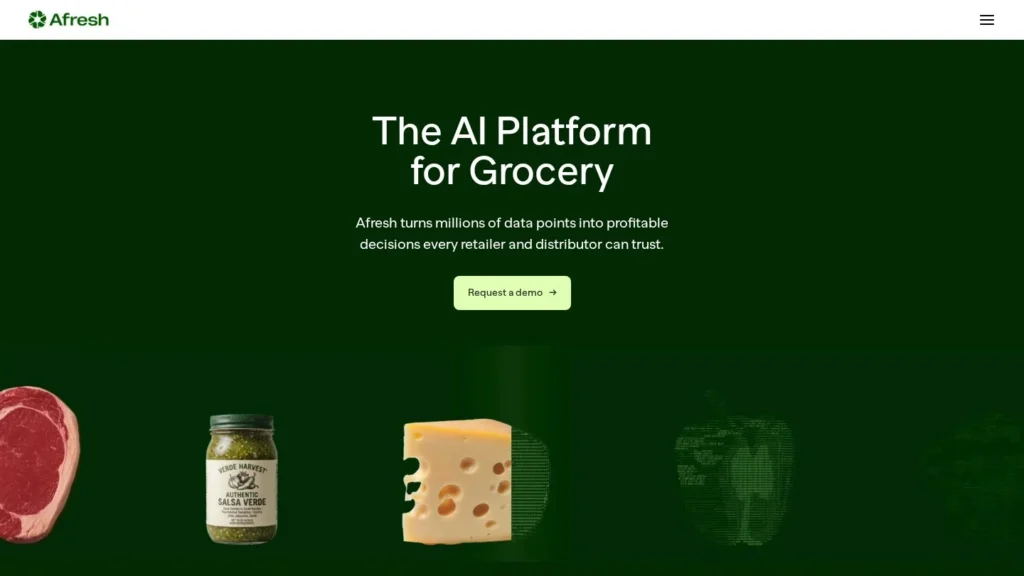
Afresh says its AI has kept more than 200 million pounds of food out of the trash since 2017, and that store teams accept its order recommendations more than 95% of the time. The grocery AI company automatically writes store orders for every item, from bananas to frozen pizza, and in April 2026 raised $34 million on the back of 70% year-over-year revenue growth. It is best for regional and national supermarket chains fighting shrink in fresh departments.
Afresh focuses on grocery, shares pricing through quotes and works with associates who count flagged items and review exceptions. We rate it 7.6/10 on our scale. We have not used Afresh ourselves; this review is based on Afresh’s product pages, funding announcement and trade press coverage.
200 Million Pounds of Waste and Afresh’s Other Headlines
- Afresh reports more than 200 million pounds of food waste prevented and 70% year-over-year revenue growth as of April 2026.
- It automatically writes orders for every item in the store; associates review flagged exceptions and submit.
- Since March 2026 one AI engine covers fresh, center store, frozen and general merchandise, plus distribution center buying.
- Afresh says typical deployment takes under four months without outside integrators; pricing is quote-only.
- Against Blue Yonder and Manhattan, Afresh is the grocery specialist; against Simbe Tally, it decides what to order rather than auditing shelves.
Afresh’s Company-Reported Funding and Operating Metrics
Afresh publishes more operating metrics than most grocery software vendors. All figures below are company-reported.
| Fact | Detail | Source and Date |
|---|---|---|
| Latest funding | $34 million led by Just Climate and High Sage Ventures, with all major existing investors participating | Afresh funding announcement, April 21, 2026 |
| Revenue growth | 70% year-over-year revenue growth over the prior 12 months | Afresh funding announcement, April 21, 2026 |
| Footprint | Live in more than 12,500 departments across 40 states | Afresh funding announcement, April 21, 2026 |
| Food waste | More than 200 million pounds of food waste prevented | Afresh funding announcement, April 21, 2026 |
| Reported results | Up to 25% less shrink, a 3% sales lift and a 7% improvement in inventory turns | Afresh funding announcement, April 21, 2026 |
| Fresh replenishment results | 80% stockout reduction and 50% faster ordering | Afresh Fresh Replenishment page, viewed October 2026 |
| Order volume | More than 320 million orders for shelf-stable items placed over the past year | The Shelby Report, March 17, 2026 |
| Adherence | Store teams follow recommendations at a 95% or higher rate across item types | The Shelby Report, March 17, 2026 |
| Deployment time | Under four months, without external system integrators, against the 12 to 18 months Afresh says most enterprise grocery platforms take | The Shelby Report, March 17, 2026 |
| Customers | Albertsons Companies, Meijer, Wakefern, Stater Bros. and Brookshire Brothers | The Shelby Report, March 17, 2026 |
Two figures stand out for a buyer. The 95% adherence rate suggests store teams trust the orders enough to submit them largely as written, which is where most ordering tools fail. And more than 60% of Afresh’s lifetime order volume came in the 12 months before April 2026, according to the company, which means much of its scale is recent.
The investor mix also says something. Just Climate, set up by Generation Investment Management, co-led the 2026 round, and its director framed food waste as a driver of emissions. For grocers that report on sustainability, pounds of food waste avoided is a metric Afresh already tracks, not one you have to build.
The results are vendor numbers stated as “up to” figures. They are useful for setting targets, but a pilot in your own stores is the only way to know what you will get.
The Daily Ordering Loop From Forecast to Submitted Order
Afresh started in the hardest part of the grocery store, bulk fresh produce, and expanded outward. In March 2026 it moved to one AI engine with department-specific data models covering every department.
The Daily Ordering Loop
- Forecast: probabilistic AI predicts demand for each item, accounting for perishability, random weight and volatile sales.
- Estimate inventory: Afresh estimates on-hand stock for each item and gives associates a short list of items to verify, so they do not recount the whole department.
- Write the order: the system pre-populates order quantities for every item in the store.
- Review exceptions: associates review only the items Afresh flags, then submit. Counts and overrides feed back into the next forecast.
Why Fresh Is Harder Than Packaged Goods
Most ordering software was built for packaged goods with barcodes, fixed case sizes and long shelf lives. Fresh items spoil in days, many are sold by weight, and demand swings with weather, holidays and promotions. Afresh’s CEO has described the company’s approach as the reverse of the industry norm: build for fresh first, then adapt to packaged goods. That history shows in features such as random-weight handling, inventory estimates that avoid full recounts, and production plans driven by recipes and yields.
Department-Specific Workflows
In meat and seafood, Afresh handles random-weight items and cutting decisions inside the ordering workflow. In bakery and prepared foods, it maps recipes and yield charts to sales so production matches demand and batch timing. In produce, it keeps inventory accurate without constant recounts.
Coordinated Buying
Afresh links store orders with distribution center buying and production planning. The Shelby Report described a two-week corporate steak promotion that automatically adjusts store replenishment, shifts warehouse purchasing and updates production schedules without manual handoffs between systems.
Full Platform or Back-End API, Starting in Produce
- Choose a deployment model: the full platform with mobile and web apps, or the AI engine feeding your existing ordering system through a back-end API.
- Start with a department: Afresh began in produce, its most proven department, before expanding across the store.
- Train store teams: guided workflows walk associates through counts and order reviews.
- Track adherence: managers watch order adherence and risky override reports to find stores that need coaching.
Counts, Exceptions and Supplier Calls Remain Manual
Associates still count the items Afresh flags, review exceptions and submit orders. Category managers set promotions and assortment, and buyers manage suppliers. Afresh’s CEO told The Spoon in March 2026 that most grocers are not yet equipped to run fully automated, cross-system workflows, so expect people in the loop for some time.
Demo Requests and Quotes for Grocery Pricing
Afresh does not publish a price list. Its product pages direct grocers to request a demo.
| Plan | Price | Billing | What’s Included | Limits |
|---|---|---|---|---|
| Full platform | Custom quote | Enterprise contract | AI engine plus mobile and web apps for store ordering, inventory and production | Grocery only |
| Back-end AI engine | Custom quote | Enterprise contract | Order recommendations pushed into your existing ordering system through an API | Your system handles the associate workflow |
| Additional solutions | Custom quote | Enterprise contract | Production planning, period ending inventory, recipe management and distribution center buying | Scope set by contract |
Shrink Savings on a $2 Million Produce Department
Without published prices, the useful math is the size of the prize. These scenarios apply Afresh’s reported “up to” results to our own illustrative assumptions about sales and shrink.
- One produce department with $2 million in annual sales: at an assumed 8% shrink rate, losses are $160,000 a year. A 25% cut would save $40,000, and a 3% sales lift would add $60,000 in sales.
- A 100-store chain with the same department profile: the same assumptions give $4 million a year in shrink savings and $6 million in added sales, the ceiling to compare against Afresh’s quote.
- Ordering time: if an associate spends an hour a day writing orders, 40% to 50% faster ordering saves 24 to 30 minutes a day, or about 146 to 183 hours a year per department.
Pricing Units and Pilot Results to Pin Down With Afresh
- Is pricing set per store, per department or by order volume?
- Does the back-end API option cost less than the full platform with apps?
- Are production planning, recipe management and distribution center buying separate modules?
- What results did comparable chains see in their first year, measured against control stores?
Other costs to plan for: store training and coaching to reach high adherence, internal IT time if you use the back-end API with your own ordering system, and data work to map recipes, yields and item hierarchies. Ask how pricing scales by store, department or order volume.
Afresh Compared With Blue Yonder AI Agents, Manhattan Active Agents and Simbe Tally
Grocers looking at AI for inventory usually weigh a specialist like Afresh against suite vendors, or pair it with shelf-scanning hardware.
| Agent | Starting Price | Free Plan | Main Strength | Main Trade-Off | Best For |
|---|---|---|---|---|---|
| Afresh | Custom quote | No | Automatic store orders built for fresh and full-store grocery | Grocery only; associates still review exceptions | Supermarket chains fighting fresh shrink |
| Blue Yonder AI Agents | Custom quote | No | Inventory, shelf and warehouse agents across the supply chain | Needs Blue Yonder software and an activation project | Large retailers on Blue Yonder |
| Manhattan Active Agents | Custom quote | No | Agents in order, store and warehouse execution software | Not focused on grocery forecasting | Retailers on Manhattan Active |
| Simbe Tally | Custom quote (per-store subscription) | No | Autonomous robot that audits shelves for stock and price errors | Finds problems rather than writing orders | Grocers and big-box stores that need shelf accuracy |
Afresh is the most direct fit for grocery ordering of the four. Blue Yonder and Manhattan make more sense when you are choosing a supply chain suite, and Afresh can feed its orders into those systems through its API. Simbe Tally is complementary: accurate shelf and inventory data from a robot makes any ordering forecast better. See more options in our AI agents for retail guide.
Where Afresh Fits Next to a Supply Chain Suite
The Spoon’s March 2026 coverage placed Afresh against older, often more expensive ERP suites such as Oracle NetSuite and SAP Retail, and against supply chain vendors Blue Yonder and Manhattan Associates. In practice, many grocers will not replace those systems outright. The back-end engine option lets Afresh supply the order quantities while an existing ERP or ordering system handles purchase orders and receiving. That makes Afresh a way to upgrade forecasting and ordering for grocery without a full platform migration.
Chains Fighting Fresh Shrink on Perishable Items
- Grocery chains with high fresh shrink: Afresh was built for perishable, random-weight and volatile items where generic ordering tools struggle.
- Grocers that want one system for the whole store: since March 2026 the same engine covers center store, frozen and general merchandise.
- Self-distributing grocers: distribution center buying ties warehouse purchases to store demand and promotions.
- Chains with prepared foods and bakery: production planning maps recipes and yields to sales.
- Grocers with sustainability targets: Afresh tracks pounds of food waste prevented, a figure it reports at more than 200 million pounds across its customers.
- Grocers with limited IT capacity: Afresh says deployment typically takes under four months without outside integrators.
Non-Grocery Retailers and Single Stores May Fit Other Tools
- Non-grocery retailers: Afresh is built for grocery departments and item types.
- Single independent stores: the product and its customer list point to multi-store chains.
- Grocers wanting fully lights-out ordering: associates still verify counts and review exceptions in the standard workflow.
- Buyers who need public pricing: every deal is quoted after a demo.
Up-To Results and Store Adoption Planning
- Vendor-reported results: shrink, sales and turns improvements are company figures stated as “up to”; insist on a measured pilot.
- Store adoption: value depends on associates counting flagged items and following recommendations; budget for coaching.
- Recent expansion: center store, frozen and general merchandise coverage arrived in March 2026, so references there will be newer than in produce.
- Integration choice: using the back-end API keeps the associate workflow in your existing system, so features such as guided counts depend on that system.
- Cross-system automation: Afresh’s own CEO says most grocers are early in automating across systems; plan a phased rollout.
Afresh’s $34 Million Raise and Full-Store Expansion
- On April 21, 2026, Afresh raised $34 million led by Just Climate and High Sage Ventures, reporting 70% year-over-year revenue growth.
- On March 17, 2026, The Shelby Report covered Afresh’s full-store expansion, which added center store, frozen, general merchandise and health and beauty to one platform.
- On March 27, 2026, The Spoon interviewed CEO Matt Schwartz about the expansion and the early state of agentic AI in grocery.
A Credible Shrink Fix at 5.1, With Room for Pricing Detail
For grocery chains working to reduce fresh shrink, Afresh is one of the more credible AI options on the market. It scores 7.6/10 on our scale: strong on autonomy and grocery depth, with room to grow through published pricing and public user ratings. The 95% adherence rate and a footprint of more than 12,500 departments suggest the product works in real stores, not just in pilots.
The wider platform is newer than the produce product. Center store and frozen coverage arrived in March 2026, so grocers buying for those departments should weight references accordingly and consider starting in fresh, where Afresh has the longest record.
The decision rests on your own numbers. Measure shrink, stockouts and ordering time in a set of stores, run Afresh in a matched group and compare. If the results land anywhere near the reported figures, the savings on a chain of any size are likely to outweigh the cost.
Does Afresh Place Orders by Itself, and at What Cost
How Much Does Afresh Cost?
Afresh does not publish prices. Grocers request a demo and receive a quote, and the cost depends on scope, such as which departments and solutions you deploy.
Does Afresh Place Orders Automatically?
Afresh automatically writes and pre-populates orders for every item. In its standard workflow, associates review flagged exceptions and submit, and promotions can trigger coordinated changes across stores, warehouses and production.
Which Departments Does Afresh Cover?
It started in produce and now covers meat, seafood, bakery, deli and prepared foods, plus center store, frozen, general merchandise and health and beauty since March 2026.
Which Grocers Use Afresh?
Afresh names Albertsons Companies, Meijer, Wakefern, Stater Bros. and Brookshire Brothers among its customers, and says it is live in more than 12,500 departments across 40 states.
Can Afresh Work With My Existing Ordering System?
Yes. Grocers can use Afresh’s full platform with its mobile and web apps, or run it as a back-end AI engine that pushes order recommendations into an existing ordering system.


User Reviews
Nobody has rated it here yet. Be the first AI Agents Choice user to rate Afresh.