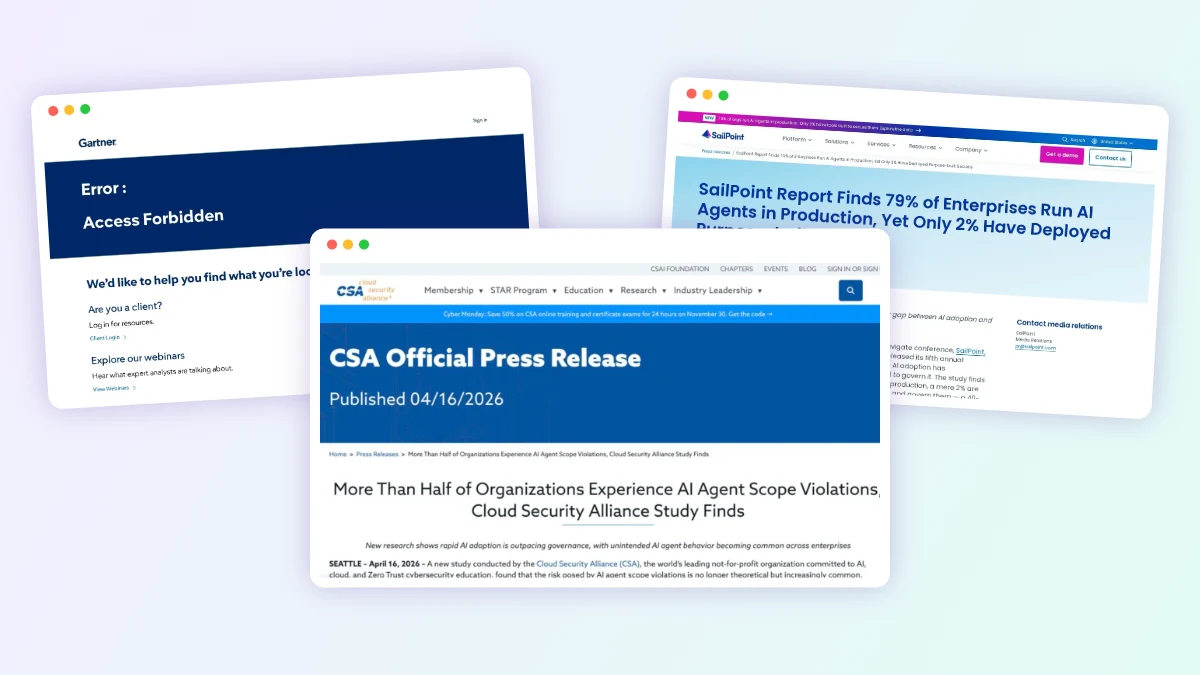
AI agent permission management is how a company controls what each AI agent can see and do. It sets which apps an agent opens, which data it reads and which actions it takes. Most firms now run agents, but very few manage their access with tools made for the job. In the SailPoint Horizons of Identity Security report from October 2026, 79% of firms ran AI agents in production. Only 2% used identity security tools built for agents.
So agents end up with more access than they need. In a Cloud Security Alliance (CSA) study released in April 2026, 53% of firms had seen AI agents go past the rights they were meant to have. And in a US survey of 300 security chiefs in September 2026, 78% had pulled permissions from an agent already running in production.
The number of agents is about to explode, too. Gartner expects the average Global Fortune 500 firm to have more than 150,000 agents in use by 2028. That is up from fewer than 15 per firm last year.
The rest of this page covers how many agents run, how much access they hold, who owns them, what goes wrong, how fast teams can cut access and what rules are in place.
AI Agents Now Hold Real Access in Most Companies
AI agents now hold real access in most companies, and they act at high volume. In an Okta survey fielded in March 2026, 92% of executives reported autonomous AI agents in use, and 58% called that use widespread. Among knowledge workers in the same survey, 68% used AI agents.
Agents spread across teams fast. In the CSA study, 43% of firms had more than half of their staff using AI agents often. IT led adoption at 53%, then security at 37%. Customer service and engineering each sat at 34%.
Agents add to a big crowd of machine accounts. In 2026 data from Palo Alto Networks, there are 109 machine IDs, AI agents included, for every human ID. In the SailPoint data, AI agents already make up 22% of all machine accounts.
| Measure | Figure | Survey and date |
|---|---|---|
| Bosses with AI agents in use | 92% | Okta, March 2026 |
| Firms with agents in production | 79% | SailPoint, October 2026 |
| Security chiefs who see 1,000+ agent actions a week | 84% | Agen.co, Sept 2026 |
| Machine IDs per human ID | 109 to 1 | Palo Alto Networks, 2026 |
| Agents per Fortune 500 firm by 2028 | 150,000+ | Gartner forecast, April 2026 |

To see how each team uses agents, read our enterprise AI agent adoption statistics.
AI Agent Permission Management Statistics on Excess Access
AI agent permission management statistics show that about half of firms have caught an agent with too much access. In the Agen.co by Frontegg survey of 300 US CISOs and CSOs, run from September 24 to 27, 2026, 49% had found an agent in production with more access than its job needed. Yet just 37% scope each agent’s access to the task it was built for.

Rights creep is close to routine. In the CSA study, only 8% of IT and security staff reported that their agents never go past the rights they were given. That study ran from September to November of last year with 445 replies.
Security leaders know it. In the Okta Global CISO report from July 2026, 81% of CISOs were worried about AI tools holding too much access. In the US, 65% were concerned about agents with too many rights.
The same habit shows up with human accounts. In the Palo Alto Networks report, 96% of firms admitted that human identities hold far more access than their roles need. Agents that copy a person’s rights inherit that excess. Our guide to AI agent guardrails covers ways to limit what an agent can touch.

Shared Logins and Missing ID Checks for Agents
Most firms still run agents on shared or borrowed logins. In the September 2026 Agen.co survey, 53% ran agents on shared or long-lived logins. Also, 40% saw agents running on a staff member’s own login. Only 18% check who an agent is before it acts.
Shared logins come with a cost. Firms that ran agents this way had a security incident rate of 60%. By contrast, firms that did not had a rate of 46%.
CISOs around the world report the same shortcuts. In the July 2026 Okta report, 21% used shared logins or broad service accounts to run agent access. Another 20% left agent control to the team that set the agent up. And one in four treat agents just as they treat human staff.
Firms also tend to give agents weaker rules than people. In the March 2026 Okta survey, only 34% always apply the same security controls to AI agents as to human workers. That means nearly two in three hold agents to a lower bar.
Read also: 10 Best AI Agents for YouTube Channel Management
Who Owns Each Agent and Its Access
Many AI agents have no named owner at all. In the CSA study, only 15% of firms had defined owners for 76% to 100% of their agents. A further 34% could see owners for only a quarter to half of them.
The job is split between teams. In the Agen.co survey, IT owns agents at 41% of firms and security at just 23%. Even so, security takes the blame for agent incidents at 48% of firms.
Unknown agents add to the problem. More than half of firms in the CSA study, 54%, had between 1 and 100 unsanctioned AI agents. In the Okta CISO report, 68% saw at least some unsanctioned AI or agent use, and 48% named weak sight of AI identities as their top barrier. In the US, that figure rose to 74%.
Reasons for that unsanctioned use are easy to see in the same Okta survey. Of the workers who used tools without approval, 80% found personal accounts easier, and 57% found the approval process too slow or too hard. Among those workers, more than 20% shared login details with AI tools.
Staff habits widen the gap. In the March 2026 Okta survey, 52% of workers used AI tools their employer had not approved. Across all workers, 16% shared login details with AI tools, and 36% shared HR data.
Breaches and Close Calls Tied to Agent Access
Nearly half of firms had a breach or other security event with an AI agent in the past year. The CSA study put the rate at 47%. In the Agen.co survey, 54% of US security chiefs reported a confirmed or suspected agent incident, and 61% of them learned about it after the fact.
| What the agent did | Share of cases | Survey and date |
|---|---|---|
| Agent reached data it should not have | 54% | Agen.co, Sept 2026 |
| Data went to an outside AI tool or model | 43% | Agen.co, Sept 2026 |
| Agent kept running after it should have stopped | 14% | Agen.co, Sept 2026 |
Confidence does not prevent incidents. In the same survey, 75% were very sure they knew how many agents they had. Yet 52% of that sure group still had an agent incident in the past 12 months. And in the March 2026 Okta survey, 58% of firms had an AI-related security issue or close call in the past 12 months.
Earlier data points the same way. In a SailPoint survey from May of last year, 80% of firms reported that their agents had taken actions no one intended. Also, 23% had seen agents tricked into revealing access credentials, and 39% had seen agents reach systems they were not cleared for. Tools in our prompt injection detection list target the tricks that cause these leaks.
Agent ID Tools Lag Behind Agent Use
Agent ID tools lag far behind agent use, by a ratio SailPoint puts at 40 to 1. In its October 2026 report, 85% of firms still used older ID tools that were not built for agents. And 54% sat at the lowest stage for agent ID.
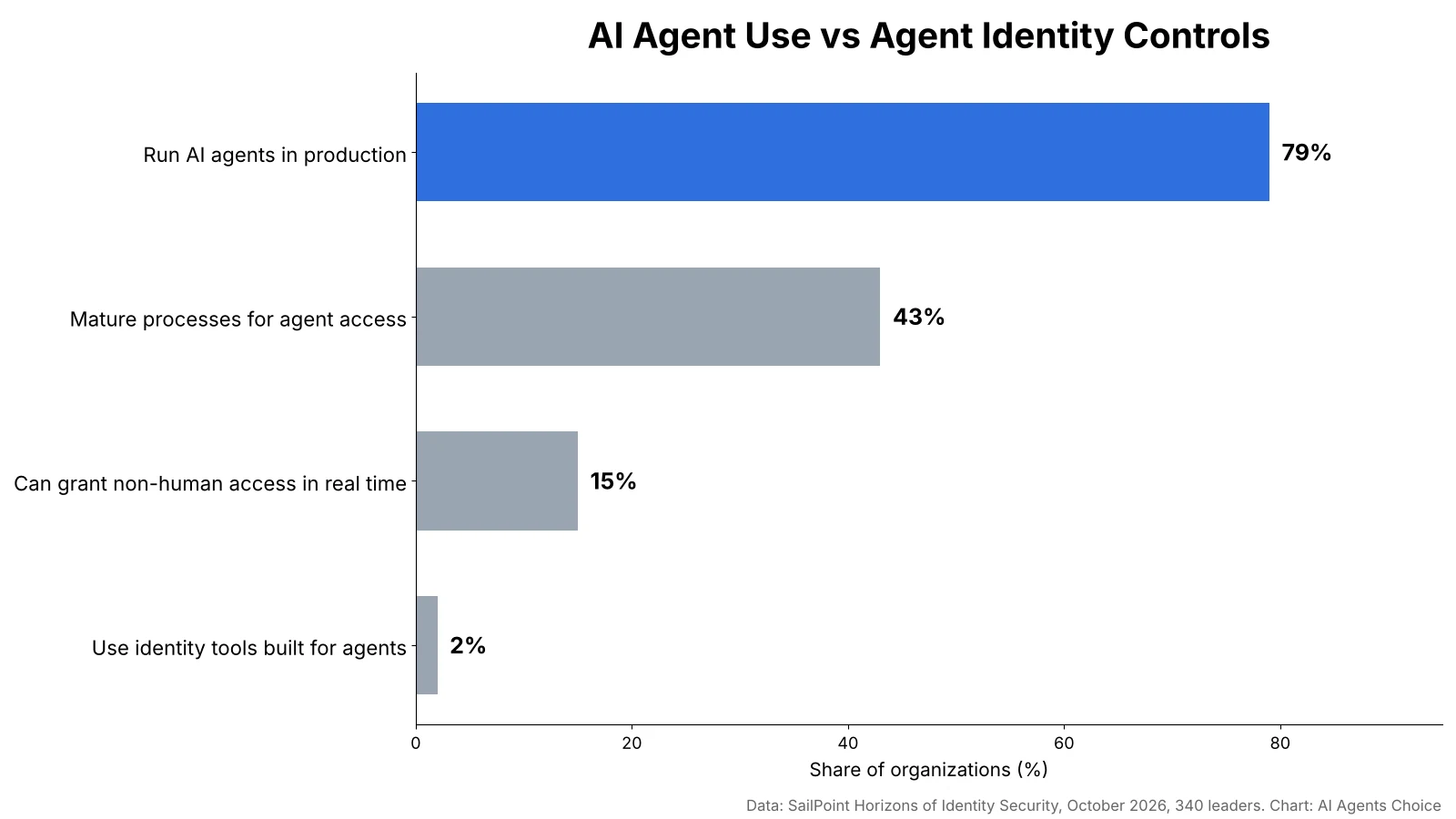

Human accounts are far better covered. In the same report, 87% rated their controls for people as good or better. But only 43% had mature steps for agent access. Just 15% could grant access to machine accounts in real time. Still, 80% felt their tool gap was moderate or smaller.
Plans are thin as well. In the Okta Businesses at Work 2026 report, 78% named control of machine access and rights as a top worry. Yet only 10% had a plan for running those IDs. Access requests in Okta data also grew more than 12 times over two years.

Few leaders feel sure on the basics. In the Okta CISO report, 47% were sure they could find every AI agent they run. Only 46% could control from one place what agents reach. And 45% could approve what each one does. Counting only those who strongly agreed, all three figures fell under 30%. Security teams comparing options can look at Microsoft Security Copilot and the wider cybersecurity agents list.
How Fast Teams Can Cut Off Agent Access
Just over half of CISOs can cut off an AI agent’s access within hours of a breach. In the July 2026 Okta report, the figure was 55%. Among firms with the most mature controls, 50% can cut access within minutes, against 26% on average.
Most teams have already had to step in. In the Agen.co survey, 78% had pulled rights from a running agent. After news of AI agents breaking out of test sandboxes, 84% of those security chiefs tightened rules, added tools or opened a review. A human approval step before risky actions helps here, as our piece on human-in-the-loop orchestration explains.
Rules, Audits and Spending Plans for Agent Control
Only 13% of firms think they have the right AI agent rules in place, based on a Gartner release from April 2026. In the CSA study, just 31% had formally adopted an AI agent policy. Another 50% had at least partly written one down.
Audits and rules are a weak point too. In the SailPoint report, 57% were sure they could meet AI rules. Yet only 43% were ready to show proof in an AI audit. In the CSA study, only 13% felt highly prepared for coming AI rules.
Gartner also sees a shakeout ahead. It predicts that 40% of large firms will demote or shut down AI agents by 2027. The cause is gaps in control that only show up after something goes wrong.
Spending plans point toward tools made for agents. In the Agen.co survey, 86% planned to buy an agent governance tool within a year. Meanwhile, 83% would trust an AI system to make agent access choices within set limits, but only 23% would hand those choices over fully. For teams on AWS, Amazon Bedrock Guardrails adds content and topic limits to agents built there.
The payoff shows up in the SailPoint data. Among firms that spend on machine ID security, 62% saw gains in output they could measure. Also, 46% could roll out AI faster and more safely. And 76% of leaders expect better ID control to win them better cyber insurance terms.
Related AI Agents



Read also: Enterprise AI Agent Adoption Statistics by Size, Stage and Region