
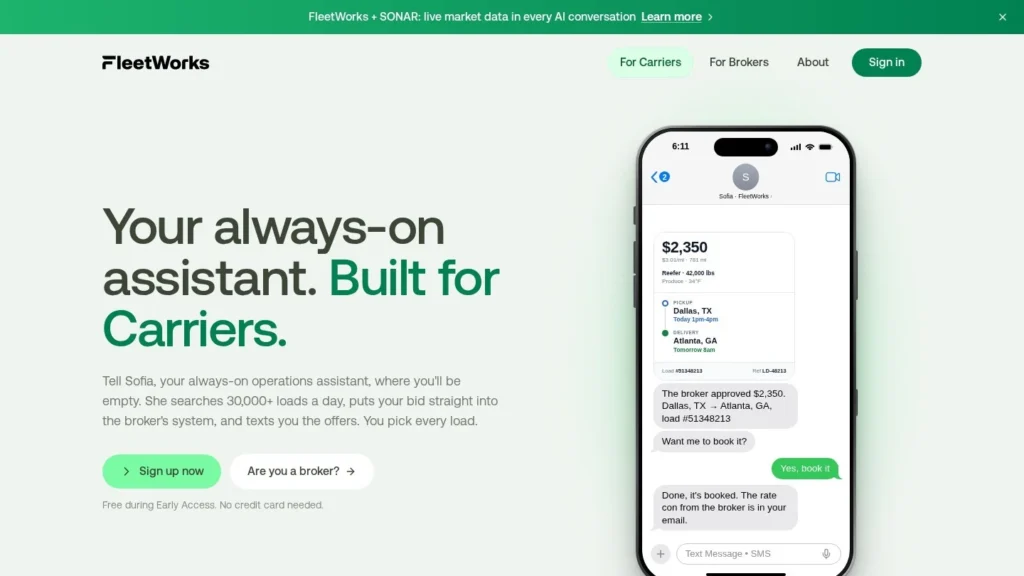
FleetWorks’ AI agents handle more than 30,000 loads a day for more than 40 freight brokerages, according to an August 2026 announcement, up from managing more than 5,000 trucks a year earlier. The company sells an always-on AI dispatcher: agents that call, text and message truckers, learn where they are headed and what they need to earn, and book them onto brokers’ loads. Brokers using it report about a 30% lift in loads booked per rep per day, the company says.
FleetWorks is best for truckload brokers whose reps spend their days hunting for capacity. Scope is the main point to weigh: it covers carrier sourcing, negotiation and booking rather than quoting or back office work, and pricing is shared through sales. Uber Freight is a named customer. We rate FleetWorks 7.9/10 on our scale. We have not used FleetWorks ourselves; this review is based on the company’s announcements and trade press coverage from TechCrunch and FreightWaves.
30,000 Loads a Day Across 40-Plus Brokerages
- FleetWorks’ agents handle more than 30,000 loads a day for more than 40 brokerages, with more than 29,000 vetted carriers in the network (August 2026).
- Brokers report about a 30% lift in loads per rep per day and 1% to 4% margin expansion on those loads, according to the company.
- Two-sided agents find freight for carriers and trucks for brokers, then book matched carriers directly into the broker’s system.
- Brokers set rate tolerances and escalation rules; since August 2026 agents negotiate against SONAR spot rates.
- Pricing is not published; FleetWorks raised $17 million led by First Round Capital in October 2025.
Post-YC Growth Reported by TechCrunch and FreightWaves
FleetWorks has grown quickly since leaving Y Combinator, and most of its figures come from its own announcements as reported by TechCrunch and FreightWaves.
| Fact | Detail | Source and Date |
|---|---|---|
| Daily volume | AI agents handle more than 30,000 loads a day | FreightWaves, August 2026 |
| Network | More than 40 brokerages and more than 29,000 vetted carrier MCs | FreightWaves, August 2026 |
| Funding | $17 million, including a $15 million Series A led by First Round Capital, with Y Combinator, Saga Ventures and LFX Venture Partners | TechCrunch, October 14, 2025 |
| Early carrier growth | More than 10,000 carriers onboarded in the first six months | TechCrunch, October 14, 2025 |
| Named customer | Uber Freight, among dozens of brokers using FleetWorks | TechCrunch, October 14, 2025 |
| Rep productivity | About a 30% lift in loads per day per person, 1% to 4% gross margin expansion on those loads and reps making about 50% more outbound calls | FreightWaves, October 14, 2025 |
| Phone trees | 96% success rate getting through automated phone trees | FreightWaves, October 14, 2025 |
| Onboarding | Brokers onboard in about a week, or as little as four hours; carriers in minutes | FreightWaves, October 14, 2025 |
| Award | Winner of FreightWaves’ inaugural AI Excellence in Supply Chain award; reported 1% lower procurement costs and 10% faster booking for brokers | FreightWaves, September 3, 2025 |
| Earlier scale | More than 5,000 trucks managed and 30% month-on-month growth, with a stated goal of connecting with half of all active US carriers by August 2026 | FreightWaves, September 3, 2025 |
| Market data | SONAR TRAC spot rates and coverage scores built into agents; automatic activation for brokers that use both | FreightWaves, August 2026 |
| Founders | CEO Paul Singer, a former Uber Freight product manager, and Quang Tran, who worked on moonshot projects at Airbnb | TechCrunch, October 14, 2025 |
The growth curve is the headline. In September 2025, FreightWaves reported FleetWorks managing more than 5,000 trucks and growing 30% a month. By August 2026, the company cited more than 29,000 carrier MCs and 30,000 loads a day. For a broker, network size matters because a matching agent is only as good as the carriers it can reach in your lanes.
The productivity figures are the ones to test. A 30% lift in loads per rep and 1% to 4% margin gains are company claims, but they are specific enough to verify in a pilot by comparing a FleetWorks desk with a control desk.
A Freight Marketplace With Agents on Both Sides
FleetWorks is built as a marketplace with agents on both sides. The founders started from a simple problem, as CEO Paul Singer put it to FreightWaves: carriers have a hard time sharing where they are and where they want to go. Nearly 80% of US truckload bookings are still made primarily by phone and email, according to the same report.
The Carrier Side
For carriers, FleetWorks acts as a virtual dispatcher. Agents learn when and where a truck will be available, what price the carrier needs, facility requirements and home-by deadlines. Carriers talk to the agent by phone, text, email, WhatsApp, Google Chat or Telegram, or use a portal. TechCrunch reported that FleetWorks uses off-the-shelf and custom voice and text models and tailors communication to each carrier.
The Broker Side
For brokers, agents identify the best available truck for each load, manage carrier relationships at scale and monitor loads in transit with GPS and agent check-ins. Specialized background models look for matches, and when one is found the carrier is inserted directly into the broker’s system, so reps do not need to learn a new interface.
Pricing Guardrails and Escalation
Brokers set rate tolerances and approval or escalation rules. Since the August 2026 SONAR partnership, agents reference SONAR’s TRAC spot rates and coverage scores while working toward a bookable price. When the market falls outside the broker’s guardrails, the agent escalates to a person with that market context attached. For brokers that already subscribe to SONAR, activation is automatic.
A Load From Posting to Booking
Based on FleetWorks’ descriptions, a typical load moves through the system in a few steps:
- Load appears: the broker’s load becomes visible to the broker-side agent without reps re-entering it in a new tool.
- Match: background models compare the load with what carrier-side agents know about truck locations, lanes, prices and home-by deadlines.
- Outreach: agents call, text or message suitable carriers, getting through automated phone trees with a reported 96% success rate.
- Negotiate: the agent works toward a bookable price within the broker’s tolerances, checking SONAR rates where available.
- Book: the carrier is inserted directly into the broker’s system; anything outside the guardrails goes to a rep.
- Track: GPS and agent check-ins follow the load, with alerts when something looks off.
Vetting and Fraud Controls
- Carrier onboarding: multiple agents qualify each carrier, verify insurance through a partnership with Highway and check network membership.
- Driver checks: photo and voice verification of drivers helps prevent fraud.
- Broker vetting: brokers on the platform are pre-verified.
- Human audit: a FleetWorks carrier management team reviews agent actions and audits outcomes.
Off-Guardrail Loads and Tracking Exceptions Go to Reps
Singer has said the AI takes autonomous actions but all of them are reviewable. People handle loads outside rate guardrails, exceptions flagged during tracking and carrier relationships that need judgment. One unnamed customer had a single rep booking 50 to 60 loads a day, which shows the model: fewer reps handling more loads, with agents doing the calling.
Sales-Arranged Access and a One-Week Onboarding
FleetWorks does not publish prices. Brokers arrange access through a sales conversation, and onboarding takes about a week, or as little as four hours, according to the company. Carriers can be onboarded in minutes.
| Plan | Price | Billing | What’s Included | Limits |
|---|---|---|---|---|
| Broker access | Custom quote | Contract | Broker-side agents, carrier matching, booking into your system, load tracking | Set by contract |
| SONAR integration | Included for brokers with a SONAR subscription | Activated automatically | TRAC spot rates and coverage scores inside agents | Requires SONAR |
What the Agents Could Add at Different Load Volumes
These scenarios apply FleetWorks’ reported results to illustrative brokerage volumes and load values we chose. They estimate what the agents could add, which is the number to weigh against the contract.
- A ten-rep truckload desk booking 20 loads per rep per day: over 21 working days that is 4,200 loads a month. A 30% lift would add about 1,260 loads a month, or 26 loads per rep per day.
- Margin on an assumed $2,000 load: 1% to 4% gross margin expansion equals $20 to $80 more per load, or $20,000 to $80,000 a month across 1,000 loads.
- Onboarding time: at about a week for brokers, or as little as four hours, the cost of getting started is small next to multi-week custom builds.
Costs to plan for: a SONAR subscription if you want market-based negotiation, staff time to set rate tolerances by lane, and the reps who still handle escalations and exceptions.
How to Run a Fair Pilot
- Pick a control desk: keep one comparable desk working the old way so changes in the market do not distort the results.
- Track three numbers: loads booked per rep per day, gross margin per load and time to cover.
- Set lane-level guardrails: start with conservative rate tolerances and widen them only where the agent books cleanly.
- Review escalations weekly: look at what the agent handed back and why, then adjust rules.
FleetWorks Compared With HappyRobot, Augie by Augment and Vooma
Most freight agents automate a broker’s existing calls and emails. FleetWorks is different in that it also brings a carrier network, with agents working for carriers as well as brokers.
| Agent | Starting Price | Free Plan | Main Strength | Main Trade-Off | Best For |
|---|---|---|---|---|---|
| FleetWorks | Custom quote | No | Two-sided agents with a network of more than 29,000 carriers | Covers capacity, not quoting or back office | Truckload brokers short on carriers per rep |
| HappyRobot | Custom quote | No | Voice, email and document agents in production at large brokers | High reported minimum spend | Large brokers and 3PLs |
| Augie by Augment | Custom quote | No | Front and back office freight work in one agent | Geared to mid-size and large operations | Brokers and 3PLs with high load volumes |
| Vooma | Custom quote | No | Email quoting and load building tied to McLeod and Turvo | Smaller team than leading rivals | Brokers with heavy email quoting |
FleetWorks and a quoting tool such as Vooma solve different halves of a broker’s day and can sit side by side. HappyRobot and Augie cover more of the operation, from carrier calls to tracking and billing, at a higher reported cost for HappyRobot. See more in our AI agents for logistics and voice AI agents guides.
Truckload Brokers Struggling to Cover Loads
- Truckload brokers that struggle to cover loads: agents call and text carriers around the clock to find trucks.
- Brokerages measured on loads per rep: the reported 30% lift goes straight to that metric.
- Brokers worried about fraud: Highway insurance checks and photo and voice driver verification are built in.
- SONAR subscribers: market-based negotiation activates automatically.
- Small carriers without a dispatcher: the carrier-side agent finds loads and matches routes for them.
Shippers, Forwarders and Brokers Focused on Quoting
- Shippers and forwarders: FleetWorks is built around truckload brokers and carriers.
- Brokers whose bottleneck is quoting or order entry: an email quoting agent fits better.
- Teams that need back office automation: billing, invoicing and documents are outside its scope.
- Buyers who need published pricing: you will need a sales conversation.
Self-Reported Gains and Lane Coverage Checks
- Company-reported figures: loads per rep, margin and booking speed gains come from FleetWorks. Run a controlled pilot.
- Lane coverage: a network of 29,000 carrier MCs is large, but check how many run your lanes and equipment types.
- Guardrail design: rate tolerances set too wide give away margin, and set too tight they push work back to reps.
- Carrier relationships: carriers may deal with an agent more than with your reps; decide which relationships stay human.
- Newer vendor: FleetWorks came out of Y Combinator’s Summer 2023 batch and is growing fast; ask about support and uptime commitments.
SONAR Rates and Coverage Scores Join the Agents
- In August 2026, FreightWaves reported that FleetWorks and SONAR partnered to put TRAC spot rates and coverage scores inside FleetWorks’ agents, citing more than 30,000 daily loads and 40 brokerages.
- On October 14, 2025, TechCrunch reported that FleetWorks raised $17 million led by First Round Capital and launched its always-on AI dispatcher.
- On September 3, 2025, FleetWorks won FreightWaves’ inaugural AI Excellence in Supply Chain award for its AI carrier rep.
A Pilot for Brokers Capped by Carrier Reach per Rep
For a truckload broker whose growth is limited by how many carriers each rep can reach, FleetWorks is worth a pilot. It scores 7.9/10 on our scale: high for autonomy and quick onboarding, with room to grow on pricing transparency and named integrations, and a neutral sentiment score.
The case rests on two numbers you can measure: loads booked per rep and margin per load. FleetWorks reports about 30% more of the first and 1% to 4% more of the second. Put one desk on FleetWorks for a month, keep a comparable desk as a control, and compare both figures before signing a longer contract. Because FleetWorks also brings its own carrier network, check during the pilot how many of the carriers it books are new to you and whether they perform as well on service as your regulars.
Fraud Prevention, Rep Replacement and the HappyRobot Contrast
How Much Does FleetWorks Cost?
FleetWorks does not publish prices. Brokers arrange access through a sales conversation. SONAR market data inside the agents activates automatically for brokers that already subscribe to SONAR.
Does FleetWorks Replace Carrier Sales Reps?
It changes their job. Agents do the calling, texting and matching, and reps handle escalations and relationships. FleetWorks reports reps booking about 30% more loads per day, and one customer had a single rep booking 50 to 60 loads a day.
How Does FleetWorks Prevent Freight Fraud?
Carrier onboarding agents qualify carriers, verify insurance through a partnership with Highway and check network membership. FleetWorks also uses photo and voice verification of drivers, and brokers on the platform are pre-verified.
How Is FleetWorks Different From HappyRobot?
HappyRobot automates a broker’s own calls, emails and documents across many workflows. FleetWorks focuses on capacity and runs a two-sided marketplace, with agents working for carriers as well as brokers and a network of more than 29,000 vetted carriers.
Who Founded FleetWorks?
CEO Paul Singer, a former product manager at Uber Freight, and Quang Tran, who worked on moonshot projects at Airbnb. The company started in Y Combinator’s Summer 2023 batch and is growing teams in San Francisco and Chicago.
User Reviews
Nobody has rated it here yet. Be the first AI Agents Choice user to rate FleetWorks.