
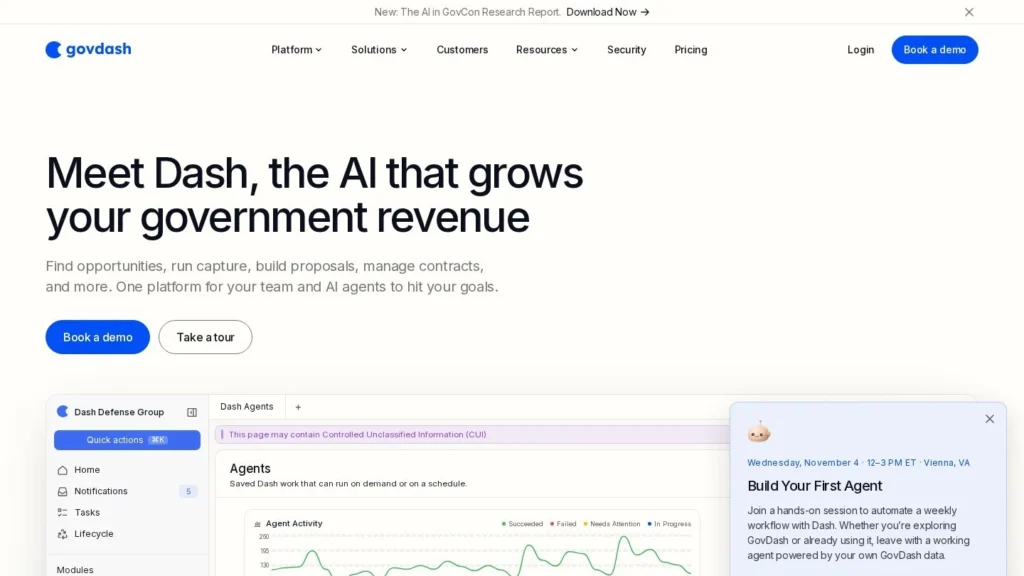
GovDash customers won more than $5 billion in government contracts in 2025, according to the company’s January 2026 Series B announcement. GovDash builds software for companies that sell to the U.S. government: it finds bids, pulls requirements out of solicitations, drafts compliant proposals and manages contracts after award, with an AI agent called Dash working across the whole cycle. It is best suited to small and midsize federal contractors that chase many opportunities with a small proposal team.
Price transparency is the main area GovDash could improve. Every plan is annual and quoted, and GovDash does not list seat prices or credit allotments, so the starting price is a custom quote. We rate GovDash 7.8/10 on our scale; the score reflects quote-only pricing and the lack of public ratings rather than its feature set. This review is based on GovDash’s pricing page, its announcements and press coverage; we have not used the product.
Annual Seat Plans With Unlimited Flex Seats
- Starting price: custom quote on annual plans; Starter begins with one Full seat and unlimited Flex seats, and Growth requires eight or more Full seats.
- Customer results: GovDash says customers won more than $5 billion in contracts in 2025 and pursued three times more opportunities.
- Growth: after a $30 million Series B in January 2026, GovDash reported 16x revenue growth and 18x customer growth to nearly 200 companies since its Series A.
- Security: FedRAMP Moderate equivalency, which matters for contractors handling controlled unclassified information.
- Our score: 7.8/10, with strong autonomy across the bid cycle; published pricing and public ratings would lift it further.
Traction Figures From the Company and Its Funding Press
GovDash has published more traction figures than most government contracting startups. All of them come from the company itself or from press coverage of its funding rounds, and each was checked on the source page.
| Fact | Detail | Source and Date |
|---|---|---|
| Series B | $30 million, oversubscribed, led by Mucker Capital and British Columbia Investment Management Corporation, with Northzone and Y Combinator | GovDash press release, January 15, 2026 |
| Growth since Series A | Revenue up 16x; customers up 18x to nearly 200 companies, including several of the top 100 U.S. government contractors | GovDash press release, January 15, 2026 |
| Customer wins | Customers won more than $5 billion in government contracts in 2025 and pursued three times more opportunities | GovDash press release, January 15, 2026 |
| Proposal speed | Proposal cycles cut to as little as 24 hours | GovDash press release, January 15, 2026 |
| SPATHE Systems | Draft turnaround cut 90%; no-notice IDIQ responses rose from two a month to seven or eight without new staff | GovDash press release, January 15, 2026 |
| Sumaria Systems | RFI turnaround cut from 2.5 weeks to three days; nearly 400 resumes standardized | GovDash press release, January 15, 2026 |
| Team size | Grew from three employees to more than 45 | GovDash press release, January 15, 2026 |
| Security | FedRAMP Moderate equivalency for defense contractors and firms handling controlled unclassified information | GovDash press release, January 15, 2026 |
| Earlier stage | $12 million raised in total including a $10 million Series A; about 30 federal contractors as customers; six employees | TechCrunch, April 16, 2024 |
| Origins | Started around 2022 and accepted to Y Combinator in 2022; co-founders Sean Doherty, Tim Goltser and Curtis Mason | TechCrunch, April 16, 2024 |
| Seat model | Unlimited Flex seats on all plans; Growth needs eight or more Full seats | GovDash pricing page, viewed October 2026 |
The growth figures matter most for a buyer judging vendor risk. In April 2024 GovDash had about 30 customers and six employees; by January 2026 it had nearly 200 customers, more than 45 staff and fresh funding led by Mucker Capital and BCI. That is a company more likely to be around for the length of a multiyear contract, though still a young one.
The customer metrics are more useful as questions than as forecasts. A 90% cut in draft turnaround or an RFI cycle reduced from 2.5 weeks to three days describes what was possible at one contractor with its own content library. Ask GovDash for references whose contract vehicles and proposal volume look like yours.
An ERP-Style Platform for Government Contractors
GovDash describes itself as an AI-driven enterprise resource planning platform for government contracting. In practice it is a set of modules that share one data layer, with the Dash agent working across them.
Discover: Finding Bids
Discover identifies bid opportunities that fit a company and sends alerts to a chosen inbox. TechCrunch reported that matching is based on a company’s past performance. In 2025 GovDash added GSA eBuy and state, local and education opportunities to the federal sources, which widens the net for contractors that also sell to states and cities.
Capture and Proposal: From Opportunity to Draft
- Qualify the opportunity. Capture works as a CRM for pipeline management and solution development, with visibility from first identification to proposal kickoff.
- Read the solicitation. GovDash pulls out requirements, required formats, evaluation factors and submission schedules from the solicitation documents.
- Check fit. It compares the company’s own information against the requirements; where the match is unclear, it asks the team to supply more detail for specific sections.
- Draft. Generative AI drafts the proposal, with compliance tracking, multi-proposal support and citation automation added in a 2025 backend overhaul.
- Review. A human reviewer approves each stage before the proposal moves on.
Contract: After the Award
The Contract module manages the full contract lifecycle. Post-award features include contract modifications, CLINs and hierarchical contract structures, so the same system that wrote the proposal can track what was won. GovDash also lists a Delivery area that is receiving investment and a pricing tool called Pricer.
Dash, the Agent Layer
Dash is GovDash’s AI agent. The company says it synthesizes data, keeps context and runs workflows across the organization, and that it became more autonomous and better integrated during 2025. On the pricing page, Dash runs in whichever modules a customer buys, with shared company knowledge, prompts and skills available to everyone and personal memory and skills for Full seat users. Admins can approve team agents that draw on shared credits.
Where Teams Use It
GovDash works in the browser and inside Microsoft 365 through add-ins; one G2 reviewer described using the Word add-in daily. It also offers a browser extension and MCP connectors for linking other tools. Help Center and Academy training are included on every plan.
Bid Calls, Pricing and Final Sign-Off Stay With You
Bid decisions, pricing strategy, technical solutions and final sign-off stay with the contractor. GovDash requires human approval at each stage, and co-founder Sean Doherty told TechCrunch in 2024 that its relevance checks are not foolproof. Proposal managers should treat drafts as a fast starting point that still needs subject matter review.
Plan Structure Published, Seat Prices Shared by Sales
GovDash publishes its plan structure but not its prices. Every plan is annual, and the pricing page directs buyers to sales for seat prices and credit allotments.
| Plan | Price | Billing | What’s Included | Limits |
|---|---|---|---|---|
| Starter | Quote from sales | Annual plan | 1 Full seat to start, unlimited Flex seats, Dash in chosen modules, shared knowledge, prompts and skills, personal memory for Full users, MCP connectors, Microsoft 365 add-ins, browser extension, Help Center, Academy and shared support | No SSO, custom roles, dedicated account manager or guided onboarding |
| Growth | Quote from sales | Annual commitment | Everything in Starter plus SSO, custom roles and permissions, a dedicated account manager, guided onboarding and quarterly reviews | Requires 8 or more Full seats; no centrally managed divisions |
| Enterprise | Quote from sales | Custom agreement | Everything in Growth plus a centrally managed account, segregated divisions and subsidiaries, leadership visibility, deployment options and custom support terms | Credit allotments defined in the agreement |
How Seats and Credits Work
Full seats get a monthly credit allotment that GovDash calls generous; publishing the number would help buyers plan. Flex seats are unlimited on every plan and draw from shared team credits, as do Full users who go past their allowance and any admin-approved team agents. That design lets a contractor give occasional contributors, such as engineers writing one technical volume, access without paying for a Full seat.
Seat Mix and Hours Saved for a Small Proposal Team
With no public prices, the useful arithmetic is about seat mix and time saved. These scenarios use GovDash’s own published structure and customer figures; the team sizes are our illustrative assumptions.
- A 10-person small business: on Starter, one proposal manager could hold the Full seat and nine part-time contributors could use Flex seats. The bill then depends on one Full seat price plus how many shared credits the Flex users burn.
- A 25-person business development shop: moving to Growth for SSO and guided onboarding means at least eight Full seats. Ask for the per-seat price on both plans and compare it with the cost of the onboarding you would otherwise run yourself.
- Measuring payback: SPATHE Systems went from two no-notice IDIQ responses a month to seven or eight without new staff, which is roughly 3.5 to 4 times the volume. Sumaria cut RFI turnaround from 2.5 weeks, about 17.5 days, to three days, about 83% faster. Use your own win rate and average award to see what extra bids are worth before you see a quote.
Other costs to ask about: credit overages, the price of moving Flex users to Full seats, implementation time for loading past performance and resumes, and whether Pricer and Delivery are included or sold separately.
GovDash Compared With Ask Sage, Grantable and WRITER Agent
Few dedicated government contracting agents are listed on our site, so this comparison includes the closest options a contractor might weigh: a secure government AI platform, a grant-writing agent with a similar proposal workflow, and an enterprise writing agent.
| Agent | Starting Price | Free Plan | Main Strength | Main Trade-Off | Best For |
|---|---|---|---|---|---|
| GovDash | Custom quote, annual | No | Bid search, solicitation parsing, proposals and contract management in one system | No published prices or credit amounts | Contractors bidding often on federal, state and local work |
| Ask Sage | $90 a month for 2 million tokens | No | FedRAMP High authorization and CUI-compliant models | General-purpose, so proposal workflows must be built | Defense contractors and agencies needing a secure AI workspace |
| Grantable | Free; paid from $50 a month | Yes | Low-cost proposal drafting with published prices | Built for grants, not federal procurement | Nonprofits and grant writers |
| WRITER Agent | $29 per user a month, billed annually (reported) | No | Governed enterprise writing agents with SOC 2 Type II | No government contracting data or compliance matrix | Large companies writing across marketing and sales |
For a contractor whose growth depends on bidding, GovDash is the only one of the four built around solicitations, compliance matrices and contract records. Ask Sage is the stronger choice when the priority is a FedRAMP High environment for sensitive data and the team is willing to set up its own workflows. Grantable and WRITER Agent are cheaper ways to get drafting help but miss the procurement data. More options are on our AI agents for government and small business agents pages.
Small Federal Contractors With Lean Proposal Teams
- Small federal contractors with lean proposal teams: GovDash was built for small businesses chasing government work and covers search, drafting and contract tracking in one place.
- Contractors answering many task orders: the SPATHE example of rising from two to seven or eight no-notice IDIQ responses a month shows where the time savings show up.
- Firms expanding into state and local bids: Discover added GSA eBuy and state, local and education opportunities in 2025.
- Teams that write in Word: the Microsoft 365 add-ins bring GovDash into the documents proposal writers already use.
- Companies handling controlled unclassified information: FedRAMP Moderate equivalency is a baseline many defense primes now expect from subcontractors’ tools.
Agencies Themselves and Occasional Bidders
- Government agencies: GovDash serves the companies that sell to government; agencies serving residents should look at tools such as Polimorphic.
- Occasional bidders: an annual plan may be more than a company that submits a few proposals a year needs.
- Buyers who need list prices: every plan is quoted, so firms that compare costs online will need a sales call first.
- Teams that need classified-level environments: GovDash reports FedRAMP Moderate equivalency, not FedRAMP High or impact level authorizations.
Credit Allotments to Confirm in the Contract
- Credit amounts: the pricing page calls Full seat credits generous without giving a number, and publishing it would help buyers. Get the monthly allotment, the shared team pool and overage pricing in the contract.
- Annual terms: Starter is an annual plan and Growth an annual commitment, so a pilot needs to be negotiated separately if you want one.
- Company-reported results: the $5 billion in wins and the customer case figures come from GovDash. They reflect featured customers rather than an average.
- Draft accuracy: proposals carry legal and past performance claims. Keep subject matter experts reviewing every section, since GovDash’s co-founder has said its relevance checks are not foolproof.
- Fast product change: GovDash overhauled its proposal backend in 2025 and is investing in new modules. Expect workflows to keep changing during a contract term.
A $30 Million Series B and 16x Revenue Growth
- On January 15, 2026, GovDash raised a $30 million Series B led by Mucker Capital and British Columbia Investment Management Corporation. It reported 16x revenue growth since its Series A, nearly 200 customers, more than $5 billion in customer contract wins in 2025 and FedRAMP Moderate equivalency, and said it would grow its New York and Virginia offices.
A Complete Option for Contractors Living on Bid Volume
For a small or midsize contractor that lives on bid volume, GovDash is one of the most complete AI options built for the job. It scores 7.8/10 on our scale: strong on autonomy, because it finds bids, reads solicitations, drafts proposals and tracks contracts, with room to grow on pricing value, since prices are shared by quote and every plan is annual. The neutral sentiment score reflects the absence of enough public ratings, not complaints.
The strongest evidence in its favor is traction: nearly 200 customers by January 2026 and more than $5 billion in reported customer wins in 2025. Before signing, ask for a reference with your contract vehicles, get the credit allotment in writing, and price the plan against the number of extra bids your team could realistically submit.
Seat Cost, Full Proposal Drafting and FedRAMP Status
How Much Does GovDash Cost per Seat?
GovDash does not publish seat prices. Starter is an annual plan that begins with one Full seat and unlimited Flex seats, and Growth requires eight or more Full seats. Seat prices and credit allotments come from its sales team.
Does GovDash Write Entire Government Proposals?
It drafts proposal sections from the solicitation’s requirements and the company’s own content, with compliance tracking and citation automation. A human reviewer approves each stage, and pricing, technical approach and final sign-off remain with the contractor.
Is GovDash FedRAMP Authorized?
GovDash reported FedRAMP Moderate equivalency in January 2026, aimed at defense contractors and companies handling controlled unclassified information. SSO and custom roles are available on Growth and Enterprise plans.
Can GovDash Find State and Local Bids?
Yes. In 2025 GovDash added GSA eBuy and state, local and education opportunities to Discover, alongside federal sources. Alerts go to an inbox the team chooses.
What Is the Difference Between Full and Flex Seats in GovDash?
Full seats get their own monthly credit allotment plus personal memory and skills. Flex seats are unlimited on every plan and draw on shared team credits, which suits occasional contributors such as engineers or reviewers.
User Reviews
Nobody has rated it here yet. Be the first AI Agents Choice user to rate GovDash.