
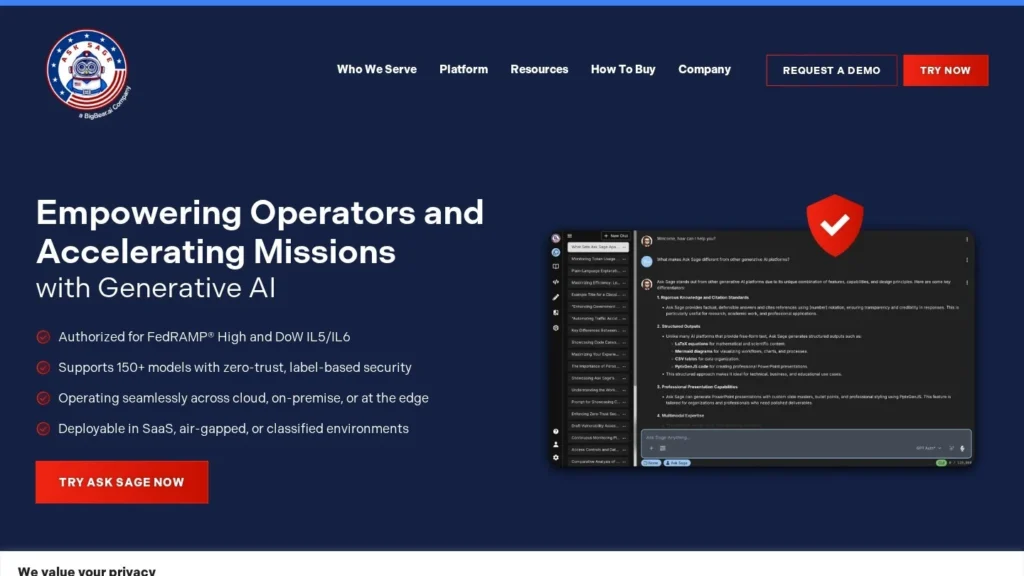
BigBear.ai paid $250 million in cash for Ask Sage, a deal it finalized at the end of 2025, when Ask Sage reported more than 100,000 users and 16,000 government teams. Ask Sage is a generative AI platform built for defense, intelligence and civilian agencies and the contractors that serve them. It gives staff a wide range of commercial and open-source models in one secure workspace, plus Agent Builder, a no-code tool for automating workflows. It is best suited to organizations that handle controlled unclassified information and need an authorized place to use AI.
The starting price is published: $90 a month for 2 million tokens, with no per-user fee. Ask Sage is a platform rather than a ready-made agent, so its value grows with the workflows your team builds, and prebuilt agents would make it quicker to start. We rate it 8.1/10 on our scale, with top marks for security and moderate marks for autonomy. This review is based on Ask Sage’s documentation, press releases and reseller materials; we have not used it.
Tokens From $90 a Month and FedRAMP High Status
- Starting price: $90 a month for 2 million tokens, assigned to users from an admin console, with no per-user fee and a 200,000-token minimum per user.
- Security: FedRAMP High authorization since March 2025, with CUI-compliant models flagged and CUI uploads blocked on other models.
- Scale: more than 100,000 users and 16,000 government teams at the time BigBear.ai finalized its $250 million acquisition.
- Agents: Agent Builder is a no-code visual tool for workflow automation that reseller Carahsoft says is designed to meet IL5 and IL6 requirements.
- Our score: 8.1/10, strongest on trust and security and pricing transparency, with room to grow in out-of-the-box autonomy.
BigBear.ai’s Deal and Ask Sage’s Own Records
Ask Sage’s figures come from its own press releases, BigBear.ai’s acquisition announcement and its documentation. Each was checked on the source page.
| Fact | Detail | Source and Date |
|---|---|---|
| Acquisition | Bought by BigBear.ai for $250 million in cash; deal finalized after being disclosed with BigBear.ai’s third-quarter 2025 results | BigBear.ai release on Business Wire, December 2025 |
| Users | More than 100,000 users, 16,000 government teams and hundreds of commercial organizations | BigBear.ai release on Business Wire, December 2025 |
| FedRAMP | FedRAMP High authorization for unclassified data including PII, PHI and CUI | Ask Sage press release, March 13, 2025 |
| Earlier footprint | 14,000 government teams across 27 agencies, 2,500 companies and more than 30,000 users across the Department of Defense | Ask Sage press release, March 13, 2025 |
| Founder | Nicolas Chaillan, former Chief Software Officer for the U.S. Air Force and U.S. Space Force | Ask Sage press release, March 13, 2025 |
| Starting price | $90 a month for 2 million tokens; no per-user fee; minimum 200,000 tokens per user | Ask Sage pricing documentation, viewed October 2026 |
| Model controls | Models marked as CUI-compliant; CUI dataset uploads blocked for non-compliant models; CUI labels applied by CAC/PIV users | Ask Sage documentation, viewed October 2026 |
| Agent Builder | No-code visual workflow automation designed to meet IL5/IL6 requirements | Carahsoft solutions brief, viewed October 2026 |
For a buyer, the security and adoption figures carry the most weight. FedRAMP High is the authorization level many agencies require before staff can paste sensitive but unclassified information into a tool, and Ask Sage’s growth from 14,000 government teams in March 2025 to 16,000 by the end of the year suggests that adoption continued after the authorization.
The acquisition cuts both ways. BigBear.ai is a public company with its own government contracts, which adds staying power. It also means Ask Sage’s packaging, roadmap and support model can change, so contracts signed now should fix the terms that matter to you.
The founder’s background also explains the product’s shape. Nicolas Chaillan ran software for the Air Force and Space Force before starting Ask Sage, and the platform reflects the priorities of that world: authorization first, model choice second, and agent features built on top of a controlled workspace rather than the other way around. Buyers coming from commercial AI tools should expect more controls and fewer ready-made automations.
A Secure Government AI Workspace With Agents
Ask Sage works like a secure AI workspace with an agent layer on top. Staff sign in, choose a model or let the platform choose one, and work with documents, prompts and plugins. Agent Builder then turns repeatable work into automated workflows.
Models and Model Selection
Ask Sage offers a wide range of commercial and open-source large language models. By default, a GPT Auto mode selects a model for each prompt. Users can filter models by category, including reasoning, MCP, image generation, video generation, vision and audio. Models marked with an asterisk are CUI-compliant and suitable for sensitive data; unmarked models are for research and testing only. Custom models can be requested from the Ask Sage team, and additional charges may apply.
Personas, Prompt Templates and Plugins
The default persona is Ask Sage, and teams can create their own personas with a name, description and system prompt, or use public ones such as a Prompt Engineer persona that helps write prompts. A Prompt Library holds templates for common use cases, and teams can add their own. Plugins sit in a panel in the prompt toolbar, grouped into categories that include acquisition, audio, automation and coding, and they can be filtered as free or paid.
Agent Builder
Agent Builder is where Ask Sage becomes an agent platform. According to a solutions brief published by government reseller Carahsoft, it lets agencies build secure, compliant AI workflow automation without code through a visual interface, and it is designed to meet IL5 and IL6 requirements. In practice, a team defines a repeatable process once, such as reviewing a document set or preparing a standard acquisition package, and the agent runs it.
Handling Sensitive Data
- Label the data. Users with CAC or PIV credentials can apply CUI labels to datasets.
- Pick a compliant model. Only models marked as CUI-compliant should process sensitive information.
- Let the guardrail work. Ask Sage blocks CUI dataset uploads to models that are not compliant.
- Choose where it runs. Agencies can use Ask Sage’s cloud or deploy it in their own cloud enclaves or on premises.
Workflow Design and Record Review Stay With Staff
Someone has to design and maintain each agent workflow, choose which models are allowed, and review outputs before they become official records or contract documents. Ask Sage provides the controls; agencies still own the policies for when AI output can be used and who signs off.
Published Starting Price, Quotes for Big Rollouts
Ask Sage publishes a starting price for enterprise purchases and quotes larger deployments.
| Option | Price | Billing | What’s Included | Limits |
|---|---|---|---|---|
| Enterprise purchase | From $90 a month for 2 million tokens | Monthly | Tokens bought in bulk and assigned to users in the administration console; access to the Ask Sage platform | Minimum 200,000 tokens per user; no per-user fee |
| On-premise and cloud deployment | Quote from sales | Set by contract | Ask Sage deployed in the customer’s cloud enclaves, on premises or both | Requirements, security posture and rollout timeline agreed with sales |
| Custom models | Additional charges may apply | Set by request | Custom models added at the customer’s request | Requested through Ask Sage support |
Usage Matters More Than Headcount Here
Token-based pricing makes headcount less important than usage. These scenarios use Ask Sage’s published starting price and per-user minimum; the team sizes are our illustrative assumptions, and the larger scenarios assume the same per-token rate holds at higher volumes.
- A 10-person contracts office: the 200,000-token minimum per user means 2 million tokens cover exactly 10 users at the minimum. That is $90 a month, or $1,080 a year, about $9 per user per month.
- A 50-person program office at the minimum allotment: 50 users times 200,000 tokens is 10 million tokens, five times the starting bundle. At the starting rate that is $450 a month, or $5,400 a year.
- Heavy users: if 10 analysts each need 1 million tokens a month, the office needs 10 million tokens, again $450 a month at the starting rate, even though headcount is a fifth of the previous scenario.
Hidden and variable costs to plan for: paid plugins, custom model requests, the cost of an on-premise or enclave deployment, and staff time to build and maintain agents in Agent Builder. Watch which models users choose, since token use differs by model and task.
Ask Sage Compared With GovDash, Microsoft Copilot Studio and ChatGPT Work
Government buyers usually compare Ask Sage with a purpose-built contracting agent and with the agent platforms of the large AI vendors.
| Agent | Starting Price | Free Plan | Main Strength | Main Trade-Off | Best For |
|---|---|---|---|---|---|
| Ask Sage | $90 a month for 2 million tokens | No | FedRAMP High with CUI-compliant models and no-code Agent Builder | Agents must be designed by the customer | Agencies and contractors working with CUI |
| GovDash | Custom quote, annual | No | Ready-made bid search, proposal and contract workflows | Quote-only pricing; FedRAMP Moderate equivalency rather than High | Contractors focused on winning bids |
| Microsoft Copilot Studio | $200 a month for 25,000 Copilot Credits | No | Deep ties to Microsoft 365, Teams and Power Platform | Credit billing is hard to forecast and needs Azure | Organizations standardized on Microsoft |
| ChatGPT Work | Free on desktop; $20 a month for Plus | Limited | End-to-end research, reports and recurring tasks | Usage-based consumption is hard to predict | Individuals and teams already on ChatGPT |
Ask Sage’s advantage is its authorization and model controls, which matter most when the data is sensitive. GovDash does more out of the box for a contractor’s business development team. Microsoft Copilot Studio fits agencies already deep in Microsoft tools, and ChatGPT Work suits general productivity where government authorization is not the deciding factor. See more on our AI agents for government and agent builders pages.
Defense Teams Handling CUI Daily
- Defense and intelligence teams: Ask Sage reported more than 30,000 users across the Department of Defense in March 2025, and its controls are built around CUI.
- Civilian agencies wanting one authorized AI workspace: FedRAMP High and model-level CUI flags give security teams a clear policy line.
- Government contractors: Ask Sage reported 2,500 companies as customers in March 2025, many of them handling sensitive program data.
- Teams that want model choice: GPT Auto and a wide model catalog avoid tying work to one AI vendor.
- Organizations with in-house builders: Agent Builder rewards teams that can define and maintain repeatable workflows.
911 Centers and Commercial Firms May Find Closer Fits
- Buyers wanting a finished agent for one task: a 911 center or permit office will get further with a purpose-built agent such as Polimorphic.
- Commercial teams without government requirements: the authorization adds less value when data is not regulated.
- Offices without anyone to build workflows: Agent Builder is no-code, and someone still designs, tests and updates each agent.
- Work needing classified environments: the FedRAMP High authorization covers unclassified data; confirm any higher-level requirement directly with the vendor.
Model Flags and Token Budgets to Plan
- Model choice and CUI: unmarked models are for research and testing only. Train users and restrict models by policy so sensitive data stays on compliant ones.
- Token budgeting: bulk tokens assigned per user can run out unevenly. Set allotments and review usage reports monthly.
- Ownership change: BigBear.ai now owns Ask Sage. Lock pricing, support and data handling terms into the contract.
- Agent maintenance: workflows built in Agent Builder need owners. Policy and template changes can break an agent quietly.
- Custom model charges: Ask Sage can add custom models on request, and additional charges may apply. Get those costs quoted before a team builds workflows that depend on them.
- Reseller language and authorization: treat the IL5 and IL6 language in reseller materials as a design goal and ask for the authorization documents that apply to your environment.
BigBear.ai Closes a $250 Million Acquisition
- At the end of December 2025, BigBear.ai finalized its $250 million acquisition of Ask Sage, describing it as a platform for secure deployment, orchestration and agentic use in defense, intelligence and other regulated sectors.
- On March 13, 2025, Ask Sage announced FedRAMP High authorization, reporting 14,000 government teams across 27 agencies and 2,500 companies as customers.
Practical for Agencies Working on Sensitive Unclassified Data
For agencies and contractors that need generative AI on sensitive but unclassified data, Ask Sage is one of the more practical choices, because the authorization, model flags and upload guardrails are already in place and the starting price is published. It scores 8.1/10 on our scale: 8.5 for trust and security and 6.5 for pricing value, with autonomy the area to grow, since most of its agent behavior depends on what customers build in Agent Builder.
The case for it is strongest where security approval is the bottleneck. A 10-person office can start for $90 a month, which makes a pilot cheap. Before scaling, confirm how tokens are priced at higher volumes, who will own each agent, and what BigBear.ai commits to on roadmap and support.
Token Pools, User Minimums and Ask Sage Billing
How Much Does Ask Sage Cost?
Enterprise purchases start at $90 a month for 2 million tokens, assigned to users from an admin console. There is no per-user fee, but each user needs at least 200,000 tokens. On-premise and cloud enclave deployments are priced by the sales team.
Is Ask Sage Approved for Controlled Unclassified Information?
Ask Sage received FedRAMP High authorization in March 2025 for unclassified data including PII, PHI and CUI. Only models marked as CUI-compliant should be used for that data, and the platform blocks CUI dataset uploads to other models.
Who Owns Ask Sage Now?
BigBear.ai, a public company based in McLean, Virginia, finalized its $250 million cash acquisition of Ask Sage at the end of 2025. Ask Sage was founded by Nicolas Chaillan, former Chief Software Officer for the U.S. Air Force and Space Force.
What Can Ask Sage Agent Builder Automate?
Agent Builder is a no-code visual tool for building secure workflow automation, according to Carahsoft’s solutions brief. Agencies use it to turn repeatable processes into agents; the specific workflows depend on what each team designs.
How Is Ask Sage Different From ChatGPT or Copilot?
Ask Sage is built around government security requirements, with FedRAMP High authorization, CUI-compliant model flags and on-premise options. It also lets users pick from many commercial and open-source models instead of one vendor’s.
User Reviews
Nobody has rated it here yet. Be the first AI Agents Choice user to rate Ask Sage.