
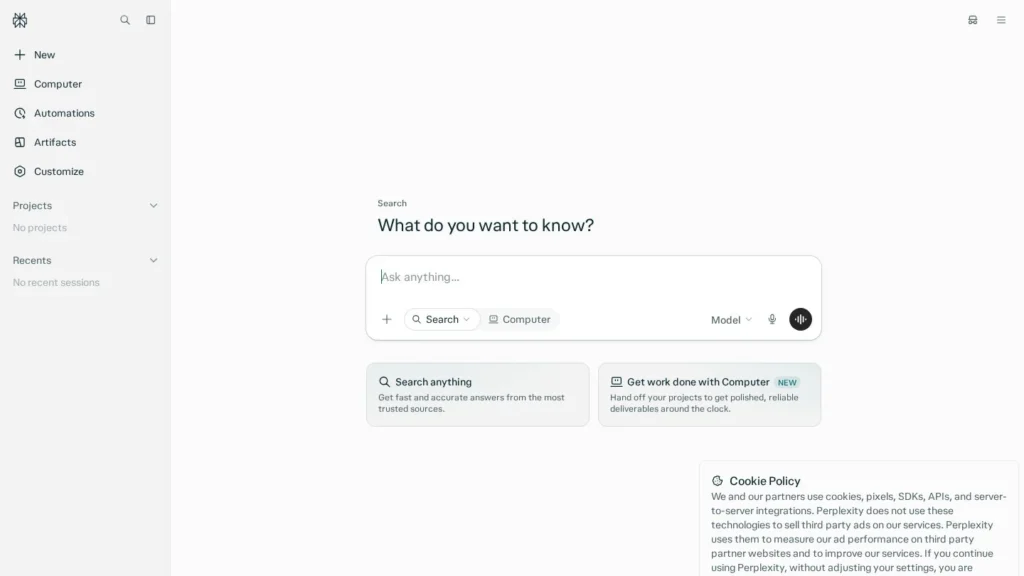
Perplexity’s Deep Research gives free users a taste and Pro subscribers about 20 full research runs a day for $20 a month. Ask it a complex question and it runs search after search, reads hundreds of sources, and within minutes writes a report with citations for each claim.
Perplexity launched the feature in February 2025, when it scored 21.1% on the Humanity’s Last Exam benchmark. In the app it sits among the search modes, and Perplexity’s plan pages now count usage as Research queries.
How It Works
After a user picks the research mode and types a question, the agent plans a series of searches, reads what it finds, refines its queries and repeats. It can run code in a sandbox for calculations. The finished report streams into an editable document, and since a 2026 upgrade it can also produce structured outputs such as presentations, spreadsheets, dashboards and simple websites. The model is chosen automatically in this mode; paid users have been moved onto Anthropic’s Claude Opus models.
Deep Research works on the web and in Perplexity’s apps for iOS, Android, Mac and Windows, and inside its Comet browser. Developers can call the same capability through the Sonar Deep Research API.
Pricing
The free plan includes limited research use. Pro costs $20 a month or $200 a year and allows about 20 Research queries a day, while Max costs $200 a month with no cap. For organizations, Enterprise Pro runs $40 per seat a month with 500 queries a day, and Enterprise Max costs $325 per seat. Verified students and educators can get Pro for $10 a month. On the API, Sonar Deep Research costs $2 per million input tokens and $8 per million output tokens, plus charges for citations, reasoning and searches, so one full query can cost $0.41 or more.
What to Watch Out For
Limits shift: at launch in 2025 Pro users were offered 500 research queries a day, against about 20 now, so check your plan’s current allowance. When it runs out, queries reportedly fall back to standard search. The agent reads the open web, so paywalled journals and internal documents are out of reach unless uploaded. Citations make checking easy, and checking is still necessary: a confident summary can misread a source.
User Reviews
No reviews yet. Be the first to rate Perplexity Deep Research.