
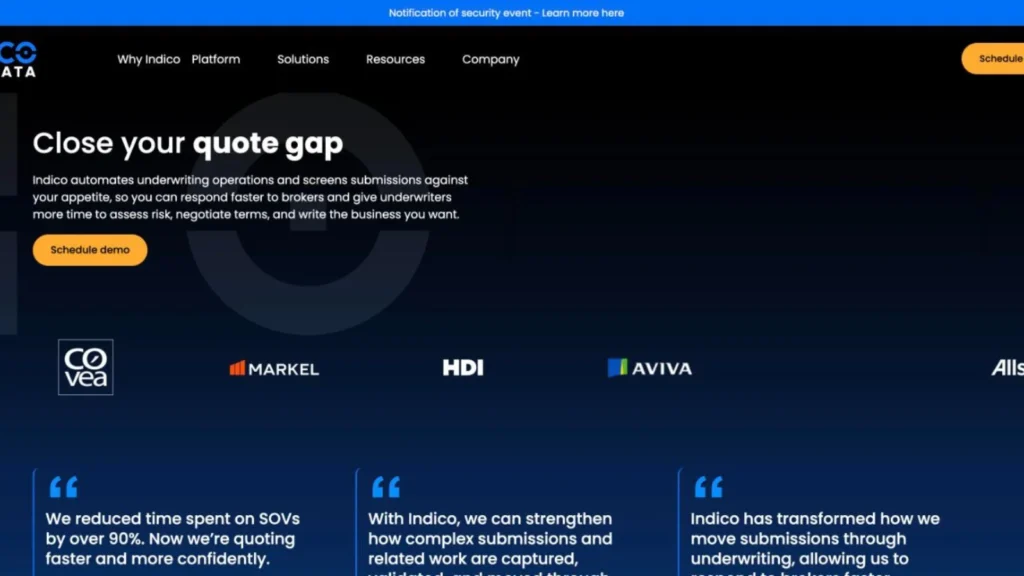
Indico Data says its agents have cut manual processing time by more than 80% and quadrupled submission handling capacity at the insurers using them. It also points to a $50 billion carrier that moved underwriting and renewal processing from seven days to 15 minutes. The Boston company sells configurable AI agents that turn broker emails, statements of values, loss runs and claim notices into clean, validated data and decisions.
Indico Data fits commercial and specialty carriers, MGAs and London Market firms that already run a policy system and need a smarter front door for submissions and claims. It works as a component rather than a finished workspace: pricing is shared by quote, and reviewers say teams may build their own front end around it. We rate it 7.8/10 on our scale. We have not used Indico ourselves; this review is based on Indico’s published materials, press releases and Gartner Peer Insights reviews.
Indico Data Facts for Carriers and MGAs
- Indico reports more than 80% less manual processing time, four times the submission capacity and 85% faster turnaround at insurers using its agents.
- Agents classify and extract documents, create or update submissions, score appetite and can auto-decline risks outside guidelines, with confidence scores and an audit trail.
- Pricing is quote-only; there is no free plan or self-serve trial.
- Gartner Peer Insights reviewers rate the intake product 4.8 out of 5 and note that it takes some setup rather than being plug-and-play.
- Compared with Federato and Kalepa, Indico is a lighter intake layer that feeds the systems you already run, such as Guidewire.
Outcome Figures, Mostly From Unnamed Customers
Indico publishes more outcome claims than most insurance AI vendors, though most come from unnamed customers.
| Fact | Detail | Source and Date |
|---|---|---|
| Manual work | More than 80% reduction in manual processing time at deploying insurers | Indico launch release, June 4, 2025 |
| Capacity | 4x increase in submission handling capacity | Indico launch release, June 4, 2025 |
| Turnaround | 85% faster underwriting and claims turnaround | Indico launch release, June 4, 2025 |
| Carrier story | A $50 billion carrier cut underwriting and renewal processing from 7 days to 15 minutes, per a customer story title on Indico’s site | Why Indico page, viewed November 2026 |
| SOV work | A customer says time spent on statements of values fell by more than 90% | Why Indico page, viewed November 2026 |
| Customer logos | Allstate, Sompo, Convex, Covea, Markel, HDI, Aviva and BHSI | Why Indico page, viewed November 2026 |
| Analyst recognition | Leader in Everest Group’s 2026 Insurance IDP PEAK Matrix; included in Gartner’s 2026 Hype Cycle for P&C Insurance | Why Indico page, viewed November 2026 |
| Integrations | Aon APP, Hyperexponential, Guidewire, Unqork and Azure OpenAI, plus customer-hosted LLMs | Indico clearance release, October 16, 2024 |
| LLM experience | Using enterprise large language models since 2018 | Indico clearance release, October 16, 2024 |
| User rating | 4.8 out of 5 from 3 ratings for Indico Intelligent Intake | Gartner Peer Insights, viewed November 2026 |
The logo list is the strongest signal here. Allstate, Markel, Aviva and HDI are demanding buyers, and their presence suggests Indico holds up in production at large carriers. The percentages are harder to use because the insurers behind them are not named; treat them as the ceiling of what a well-run deployment can reach.
The Gartner reviews add useful context. Reviewers like the accuracy and the small amount of training data needed, and note that Indico focuses on extraction and decisioning, so the user-facing workflow may be your job to build.
How Indico Moves a Submission From Inbox to Decision
Indico calls itself a decision automation company. Its platform sits between the inbox and your underwriting or claims systems, turning unstructured documents into structured data and next actions.
Agents in Indico Agent Studio
Agent Studio, launched in June 2025, ships with ready-made agents that can be adjusted and chained:
- Extraction and Classification: pulls and sorts submission data to cut manual keying.
- Summarization: writes brief summaries of submission documents to speed risk assessment.
- Validation: checks accuracy and completeness, with traceable outputs and real-time feedback.
- Data Enrichment: adds third-party property, weather and financial data.
- Web Research: adds summarized web information about insureds or claimants.
Agent Builder lets teams create custom agents from templates for extraction, classification, validation and summarization without deep technical skills. The Agentic Workflow Canvas is a drag-and-drop tool for chaining agents with conditional logic, parallel execution and data routing.
A Submission From Inbox to Decision
In the clearance workflow released in October 2024, Indico processes the submission inbox on its own. It separates and classifies documents, extracts data, suggests next actions, creates and updates submissions and can auto-decline risks based on underwriting guidelines. Each submission gets a summary, validation with confidence scores and links back to source documents, an In Good Order checklist and an elapsed-time tracker. Dynamic appetite scoring ranks what remains, and a submission copilot lets underwriters ask questions about the documents.
Claims and Other Workflows
The same platform handles loss run summarization and risk profiling, broker email and attachment ingestion, delegated authority bordereaux and claims first notice of loss with narrative extraction. Indico lists commercial property, energy, marine, agriculture, cyber, workers compensation and construction among supported lines, with mid-term adjustments as a use case.
Controls and Deployment
Every agent action is recorded in an audit trail, and review controls let staff approve or correct outputs. Indico supports cloud LLMs, including Azure OpenAI, as well as customer-hosted models. Gartner reviewers mention on-premises, private cloud and public cloud options. Results move into CRM, rating and policy administration systems through APIs or into an underwriting workspace.
Starting With One Line’s Submission Intake
Deployment starts with a demo, then a scoping exercise around one workflow, usually submission intake for a single line. Insurers supply sample documents and their underwriting guidelines, and Indico configures the extraction fields, validation rules and appetite scoring. Gartner reviewers note that models need only a small number of training samples, which shortens this stage. The team then connects outputs to the rating engine, policy system or workbench and decides which actions run automatically, such as declines, and which wait for a person.
After go-live, the work shifts to tuning. Confidence thresholds decide how much reaches a reviewer, and the audit trail shows where agents and humans disagree. Expanding to new lines or geographies reuses the same agents with new document types and rules, which Indico describes as configurable without rebuilding the platform.
What Humans Still Do
Underwriters review low-confidence fields, handle exceptions the guidelines do not cover and make the final pricing and binding decisions. Indico decides what is ready for them and what can be declined, which is where most of the reported time savings come from.
What Indico Data Contracts Look Like
Indico does not publish a price list. The table reflects what the company and its listings show.
| Plan | Price | Billing | What’s Included | Limits |
|---|---|---|---|---|
| Demo | Free | None | Walkthrough on sample or customer documents | No production use |
| Decision Automation Platform | Custom quote | Not published | Agent Studio, Agent Builder, Workflow Canvas, intake and clearance workflows | Scoped per line of business and workflow |
Sizing an Indico Deal by Line of Business
Because pricing is negotiated, the useful planning work is to size the inputs that drive the deal.
- An MGA with one busy program: start with inbox processing and clearance for a single line. Count monthly submissions and attachments, since document volume is the main measure of work, and track how many go unreviewed today.
- A specialty carrier with several lines: each line brings its own documents, such as SOVs for property or bordereaux for delegated business. Expect configuration time per line, plus integration work into Guidewire or your rating engine.
- A claims team adding FNOL: narrative extraction and routing on first notice of loss is a separate workflow, so ask whether it is priced as an add-on.
Gartner reviewers also mention that engagement and pricing can be flexible, including terms tied to outcomes, so it is worth asking whether a pilot can be priced against agreed accuracy or turnaround targets. That shifts some of the risk of the published claims back to the vendor.
Other costs to budget: internal IT time to build or adapt the front end that reviewers describe, LLM hosting if you choose customer-hosted models, and third-party data used by the enrichment agent.
Indico Data Compared With Federato, Kalepa, Sixfold and Pibit.AI
These tools all target insurance submissions, but they differ in how much of the workflow they own.
| Agent | Starting Price | Free Plan | Main Strength | Main Trade-Off | Best For |
|---|---|---|---|---|---|
| Indico Data | Custom quote | No | Configurable intake agents with named Guidewire, Aon APP and Hyperexponential links | Not plug-and-play, per reviewers | Insurers adding a smart front door to current systems |
| Federato | Custom quote | No | Portfolio-aware triage and explained draft quotes on a full core platform | Heavy implementation scope | Carriers rethinking core systems |
| Kalepa | Custom quote | No | Modules from intake through rating, quote and bind | No public pricing | Specialty and E&S underwriters |
| Sixfold | Custom quote | No | Reads submissions against appetite and recommends next steps | Narrower document workflow coverage | Underwriting risk analysis |
| Pibit.AI | Custom quote | No | Clears, extracts, researches and scores submissions | Younger vendor | Commercial insurers with heavy intake |
Indico is the most workflow-agnostic of the group: it covers underwriting, claims and bordereaux with the same agent toolkit. Federato and Kalepa give underwriters a finished workspace and go further into quoting. Sixfold and Pibit.AI focus on the underwriting decision itself. Browse more on our AI agents for insurance page.
The difference also shows up in who owns the project. Indico is often bought by operations or IT teams who want one intake layer across underwriting, claims and delegated authority. Federato and Kalepa are usually championed by underwriting leadership because they change the screen underwriters use every day. Knowing which group is driving the purchase will usually point to the right shortlist.
A sensible test is to pick one high-volume line, send the same 100 recent submissions through two vendors and compare extraction accuracy, the share that reach underwriters clean and the time to a usable record.
Carriers Heavy on SOVs, Loss Runs and Broker Emails
- Carriers with heavy document intake: SOVs, loss runs and broker emails are where Indico reports its largest gains.
- Insurers on Guidewire or using Aon APP or Hyperexponential: these are named integration targets.
- MGAs and delegated authority businesses: bordereaux processing is a built-in workflow.
- IT teams that want control: Agent Builder, the workflow canvas and customer-hosted LLM support suit insurers that like to configure their own flows.
Teams Wanting a Full Underwriting Workspace and Agencies
- Teams wanting a finished underwriting workspace: Kalepa or Federato provide more of the screen underwriters work in.
- Agencies and brokers: Indico is built for risk carriers; agency tools such as Sonant AI fit better.
- Small insurers without IT capacity: reviewers say some front-end and workflow building is needed.
- Buyers needing a published price: every contract is negotiated.
Indico Deployment Points to Plan For
- Customer metrics: the 80%, 4x and 85% figures come from Indico about insurers it does not name.
- Build effort: a Gartner reviewer said teams had to build their own front end and workflow around the extraction engine.
- Auto-declines: letting agents decline submissions saves time but needs careful guideline setup and monitoring to avoid turning away good business.
- Small public review base: the 4.8 rating rests on three Gartner Peer Insights reviews.
- Separate core needed: Indico feeds policy systems; it does not replace them.
- Model choices: customer-hosted LLMs give more data control but add hosting and maintenance work, while Azure OpenAI is simpler to run. Decide early, because it affects security review and cost.
- Scope per line: each new line of business brings new document types and rules, so plan expansion as a series of small projects rather than a single switch.
Indico Launches and Analyst Recognition
On June 4, 2025, Indico launched an agentic decisioning platform for insurance, adding Agent Studio, Agent Builder and the Agentic Workflow Canvas to its Decision Automation Platform. CEO Tom Wilde described it as the moment the industry shifts from automation to autonomy.
Indico’s website also lists recognition as a Leader in Everest Group’s 2026 Insurance IDP PEAK Matrix and inclusion in Gartner’s 2026 Hype Cycle for P&C Insurance.
How Indico Data Scores for Insurers
Indico Data scores 7.8/10 on our scale. It earns strong marks for integrations, controls and user sentiment: named links to Guidewire, Aon APP and Hyperexponential, an audit trail of every agent action, customer-hosted model support and a 4.8 rating from Gartner reviewers. The agents do real work, from creating submissions to declining out-of-appetite risks.
Published pricing and a ready-made front end would lift the score; reviewers say teams may build their own front end today. For a carrier with an IT team and a document problem, it is one of the more proven options; for a small insurer wanting a ready-made underwriting desk, Kalepa or Federato will feel more complete.
Run a pilot before committing to a wide rollout. Pick the line with the most painful documents, agree on accuracy and turnaround targets with underwriting, and ask Indico to show the audit trail for every automatic decline during the pilot. If the clean-submission rate and turnaround match even half of the published claims, the business case usually follows.
Carrier Questions About Indico Data
How Much Does Indico Data Cost?
Indico does not publish prices. Insurers request a demo and negotiate a contract, so ask how fees scale with document volume, workflows and lines of business.
Can Indico Data Decline Submissions on Its Own?
Yes. Its clearance workflow can auto-decline submissions based on underwriting guidelines, alongside creating and updating submission records. Insurers set the rules and can review outputs through confidence scores and audit trails.
Does Indico Work With Guidewire?
Yes. Indico names Guidewire among its downstream integrations, along with Aon APP, Hyperexponential and Unqork, and a Gartner reviewer mentions Guidewire InsuranceNow.
Which LLMs Does Indico Use?
Indico supports cloud LLMs including Azure OpenAI as well as customer-hosted models, and combines generative AI with discriminative and rules-based methods.
Is Indico Data a Policy Administration System?
No. Indico handles intake, triage and document decisions and passes results to your existing rating and policy systems. Federato is an example of a vendor that also sells policy administration.
User Reviews
Nobody has rated it here yet. Be the first AI Agents Choice user to rate Indico Data.