
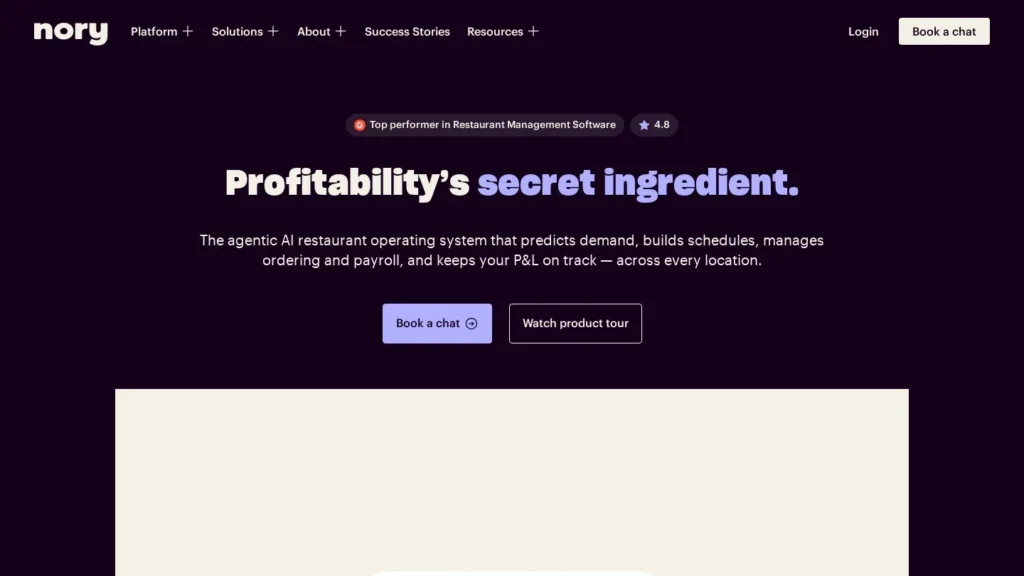
Nory says its customers typically cut labor costs by 10% to 20% and food waste by up to 50%, and one, Rocksalt, reported a 7% labor cost cut with 97.5% forecast accuracy. The London company sells a restaurant management platform whose AI assistants forecast demand every 15 minutes, build schedules, send supplier orders, prepare payroll and check invoices.
Nory is best for multi-location restaurant, cafe and franchise groups that want one forecast to drive labor, inventory and payroll. Points to plan for are pricing by quote, which G2 reviewers rate at the top of the cost scale, and an implementation that reviewers put at about three months. We rate it 7.8/10 on our scale. We have not used Nory; this review is based on Nory’s agents page and funding announcement, funding coverage and its G2 listing.
Seven Assistants and Nory’s 97 Percent Forecast Claim
- Seven assistants cover forecasting, scheduling, ordering, payroll, invoicing, compliance and reviews.
- Nory claims 97% revenue forecast accuracy, 10% to 20% labor savings and up to 50% less food waste.
- It raised a $37 million Series B led by Kinnevik in September 2025, for $62.6 million in total.
- G2 rates Nory 4.7 out of 5 from 51 reviews, with about three months to implement and 11 months to ROI.
- Pricing is by quote; G2 reviewers rate perceived cost at the highest level.
Customer Outcomes, Funding and G2 Data
Nory publishes customer outcomes, funding details and assistant metrics. G2 adds outside data on implementation and cost.
| Fact | Detail | Source and Date |
|---|---|---|
| Series B | $37 million led by Kinnevik; Accel, Base10, Triple Point, Samaipata | Nory announcement, September 16, 2025 |
| Total funding | $62.6 million | Nory announcement, September 16, 2025 |
| Growth | Revenue tripled and team doubled since the Series A | Nory announcement, September 16, 2025 |
| Customers named | Black Sheep Coffee (130 sites), Jamie Oliver Group, Azzurri, Rocksalt | Nory announcement, September 16, 2025 |
| Rocksalt | 7% labor cost reduction; 97.5% sales forecast accuracy | Nory agentic AI page, viewed November 2026 |
| Forecasting | Revenue and item sales every 15 minutes per location; 97% revenue accuracy | Nory agentic AI page, viewed November 2026 |
| Claimed savings | 10% to 20% labor cost; up to 50% food waste; 100+ admin hours | Nory agentic AI page, viewed November 2026 |
| Admin time | 100+ hours of admin saved per site each month | Tech.eu, September 16, 2025 |
| G2 rating | 4.7 out of 5 from 51 reviews | G2, viewed November 2026 |
| G2 user data | About 3 months to implement; ROI in about 11 months; perceived cost at the top of the scale | G2, viewed November 2026 |
The G2 data is the most useful for buyers because it comes from users rather than Nory. A 4.7 rating from 51 reviews is solid, and an 11-month payback suggests customers see results within the first year. The same reviewers rate Nory as expensive and report a three-month implementation, so it is a considered purchase for groups, not an impulse buy for a single cafe.
The assistant list itself has grown. At the Series B, Nory described Forecasting, Scheduling and Ordering as its core crew with a next generation arriving in 2026; the agents page now lists Compliance, Payroll and Invoicing as new features alongside them. That pace is encouraging, but it also means the newest assistants have less time in production than the forecasting engine that customers such as Rocksalt rely on.
The funding shows momentum. Tripling revenue since the Series A and raising from Kinnevik and Accel gives Nory the money to build the newer assistants and grow in the US, where it has opened a New York base. The customer list, from Black Sheep Coffee’s 130 sites to Jamie Oliver Group and P.F. Chang’s, spans cafes, casual dining and international brands.
Assistants on a Restaurant Management Platform
Nory is a restaurant management platform with modules for business intelligence, inventory, workforce and payroll. Its assistants sit on top and do the work those modules used to leave to managers.
Forecasting
The Forecasting Assistant predicts revenue and item sales for every 15-minute interval at every location and refreshes daily. Nory says it reaches 97% revenue accuracy. Every other assistant uses this forecast.
Scheduling and Compliance
The Scheduling Assistant builds rotas from the forecast, the labor budget and compliance requirements. Nory’s weekly flow shows the schedule arriving built on Monday with one click to approve. The newer Compliance Assistant applies labor rules by default for each country and region, which matters for groups operating in several jurisdictions.
Ordering and Inventory
The Ordering Assistant checks inventory against forecast demand, then creates and sends purchase orders to suppliers. Nory credits this with up to 50% less food waste, because stock follows expected sales rather than habit.
Payroll and Invoices
The Payroll Assistant builds pay runs from the shifts and timecards already in Nory. The Invoicing Assistant matches supplier invoices against purchase orders and delivery notes and flags discrepancies before payment; it does not pay invoices itself.
Reviews and Insights
The Customer Reviews Assistant analyzes guest reviews, links them to operating data, such as staffing on a busy night, and recommends fixes. It recommends rather than acts. The business intelligence module shows performance across locations, so an area manager can compare labor percentage, waste and sales by site in one view.
A Week With Nory
On Monday, the general manager of a city cafe opens Nory to find next week’s rota built from the forecast and the labor budget, checks it against two staff holiday requests and approves it. Midweek, the Ordering Assistant sees that a local event will lift Saturday sales, raises the bakery order and sends it to the supplier. When the delivery arrives with a short count, the Invoicing Assistant flags the mismatch before the invoice is paid. At the end of the pay period, the Payroll Assistant prepares the pay run from timecards. The manager reviews and approves at each step rather than building each item.
Three Months of Implementation, Sales Data First
Reviewers on G2 put implementation at about three months, and the order of work matters. Sales history and POS data come first, because the forecast depends on them. Labor rules, budgets and staff availability follow so the Scheduling Assistant can build realistic rotas. Recipes, stock counts and supplier catalogs come next for ordering, and payroll setup last. Many groups pilot at a few sites, compare forecast accuracy and labor cost against similar sites and then roll out region by region. Assign one owner for data quality at each site; a forecast fed by inaccurate stock counts will order the wrong amounts no matter how good the model is.
Managers Approve Rotas, Orders and Pay Runs
Managers approve schedules, review orders and pay runs, handle staff relationships and decide what to do about review themes. Finance teams still pay invoices and own payroll accuracy. Nory’s page shows one-click approval for schedules but does not spell out approval rules for every action, so ask which assistants act on their own and which wait for sign-off.
Quoted After a Demo, No Public Plans
Nory does not publish prices.
| Plan | Price | Billing | What’s Included | Limits |
|---|---|---|---|---|
| Nory platform | Custom quote | Quoted after a demo | Business intelligence, inventory, workforce and payroll modules with AI assistants | Scope set per operator; some assistants labeled new |
Nory offers an ROI calculator on its site. G2 reviewers rate its perceived cost at the highest level on G2’s scale.
Applying Nory’s Savings Range to a $500,000 Labor Bill
Without list prices, the useful math is the savings range Nory claims. The scenario below uses an illustrative group labor bill of $500,000 a year and food waste of $40,000 a year; replace them with your own figures.
- At Rocksalt’s reported 7% labor cut: a $500,000 labor bill falls by $35,000 a year.
- At the low end of Nory’s 10% to 20% claim: the saving is $50,000 a year.
- At the top of the claim: the saving is $100,000 a year.
- Food waste at Nory’s up to 50% claim: $40,000 of waste would fall by up to $20,000 a year.
G2 reviewers report a return in about 11 months, which suggests the subscription and implementation costs are recovered within the first year for typical customers. The other cost is time: a three-month implementation means managers learning a new system, cleaning recipe and stock data and changing how they schedule. If Nory replaces separate scheduling, inventory and payroll tools, count those subscriptions on the savings side.
Nory Compared With Toast IQ, Momos and Loman AI
Restaurant AI agents rarely overlap fully. Nory runs back-of-house operations; the others focus on data inside a POS, guest feedback or phones.
| Agent | Starting Price | Free Plan | Main Strength | Main Trade-Off | Best For |
|---|---|---|---|---|---|
| Nory | Custom quote | No | One forecast drives schedules, ordering, payroll and invoice checks | High perceived cost, three-month implementation | Multi-location restaurant and cafe groups |
| Toast IQ | $60/month plus $9 per employee | No | Answers and actions from Toast sales and labor data | Toast customers only | Restaurants on Toast |
| Momos | Custom quote | No | Guest complaint resolution and review replies across channels | Front-of-house only | Franchise brands managing guest feedback |
| Loman AI | $199/month | No | AI phone ordering and reservations | Phones only | Independents and groups missing calls |
Pick Nory when labor and food costs are the problem and you want forecasting, scheduling, ordering and payroll connected. Toast IQ is the lighter option for restaurants already on Toast that want answers from their data. Momos and Loman AI solve guest-facing problems and can run alongside Nory. In practice, a restaurant group could pair Nory in the back office with a guest-facing agent at the front, since the products do not compete for the same job. The main overlap is with POS-native tools such as Toast IQ, which focus on answers and actions from the POS data a restaurant already has, while Nory adds forecasting, ordering and payroll on top of the POS. See our restaurant AI agents guide for more.
Multi-Site Groups With High Labor Costs
- Multi-site cafe and restaurant groups: forecast-driven rotas and ordering pay off most across many locations.
- Operators with high labor costs: scheduling to 15-minute forecasts targets overstaffing in quiet periods.
- Groups with food waste problems: the Ordering Assistant ties stock to forecast demand.
- Operators in several countries: the Compliance Assistant applies labor rules by country and region.
- Finance teams tired of invoice errors: automatic matching to orders and delivery notes catches discrepancies before payment.
- Fast-growing brands: new sites can start with the same rota rules, ordering logic and reporting as existing ones, which keeps openings consistent.
Single Restaurants and Operators in a Hurry
- Single restaurants on a small budget: G2 reviewers rate the cost high, and simpler scheduling apps cost less.
- Operators needing a fast rollout: reviewers report about three months to implement.
- Teams wanting guest-facing AI: Nory focuses on back-of-house operations.
- Buyers who need list prices: all pricing is quoted.
Implementation Load and Integration Fit
- Implementation load: plan for about three months and assign an owner for recipes, stock counts and labor rules.
- Integration fit: the agents page does not yet name integrations; confirm your POS, payroll provider and accounting system.
- Approval rules: decide which supplier orders and pay runs need sign-off before letting assistants act.
- New features: the Compliance, Payroll and Invoicing Assistants are labeled new; check maturity in your country.
- Forecast quality: forecasts depend on clean sales history; new sites and menu changes will be less accurate at first.
- Vendor figures: the 97%, 10% to 20% and 50% claims are Nory’s; Rocksalt’s 7% is a more conservative benchmark.
- Staff experience: schedules built to 15-minute forecasts can mean shorter, more variable shifts; check that rota rules respect contracted hours and staff preferences.
- Supplier relationships: automatic purchase orders work only if supplier catalogs, prices and delivery days are kept current in Nory.
A $37 Million Series B Led by Kinnevik
- September 16, 2025: Nory raised a $37 million Series B led by Kinnevik, bringing total funding to $62.6 million.
- September 16, 2025: Coverage of the round highlighted plans for autonomous AI assistants and US expansion.
Rare Back-Office Action From a Restaurant AI
Nory is one of the few restaurant AI products that takes actions in the back office: it sends supplier orders, builds schedules and pay runs and checks invoices, all from one forecast. A 4.7 rating from 51 G2 reviews and an 11-month reported payback back up the vendor claims more than most rivals can.
Its approach also differs from most restaurant AI on the market, which talks to guests. Nory’s value shows up in the profit and loss statement, through labor, waste and admin time, which makes it easier to measure in a pilot than a guest-facing tool.
It scores 7.8/10 on our scale, with pricing that users rate as high, a three-month implementation, integrations Nory could name more clearly and newer assistants still maturing as the areas to weigh. For a group of ten or more sites with real labor and waste costs, the economics can work well; ask for references from a group of similar size and compare the quote with your Rocksalt-style conservative savings estimate before signing.
Implementation Time and What the Assistants Do
How Much Does Nory Cost?
Nory does not publish prices. Operators book a demo and can use the ROI calculator on Nory’s site. G2 reviewers rate its perceived cost at the highest level on the site’s scale.
What Do the Nory AI Assistants Do?
Seven assistants forecast revenue and item sales, build schedules, create and send supplier orders, build pay runs, match invoices to orders, apply labor compliance rules and analyze reviews against operating data.
How Long Does Nory Take to Implement?
G2 reviewers report an average of about three months to implement and about 11 months to see a return on investment.
Does Nory Place Supplier Orders Automatically?
The Ordering Assistant checks inventory against forecast demand and creates and sends purchase orders to suppliers. Operators should set approval rules for which orders need review.
Is Nory Available in the US?
Yes. Nory is based in London, serves customers including P.F. Chang’s, is using its Series B to expand in the US and has opened a New York base.
User Reviews
Nobody has rated it here yet. Be the first AI Agents Choice user to rate Nory.