
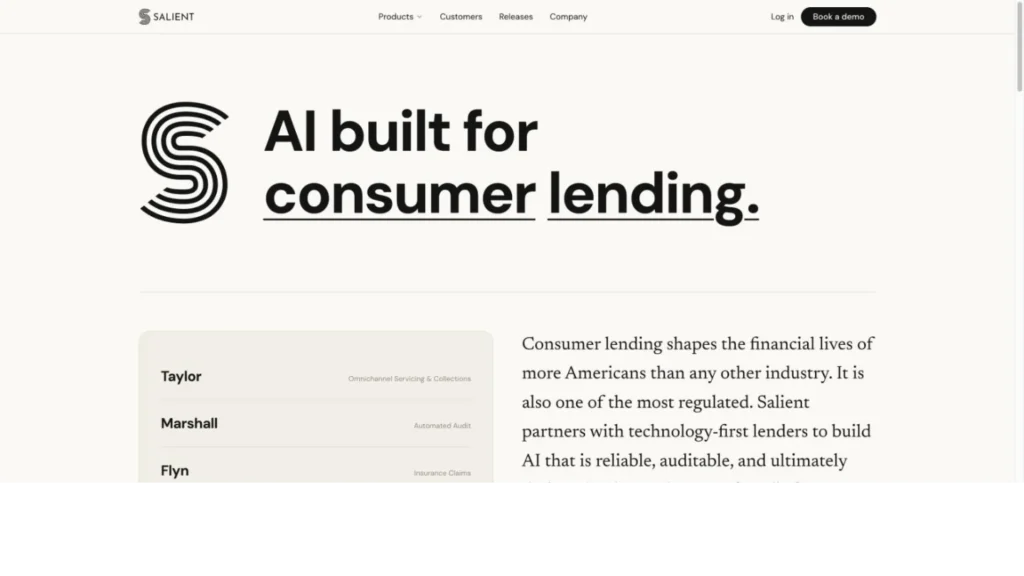
Salient is built for one job: running the phone side of loan servicing. Its voice agents take payments, chase late accounts, quote payoffs and handle hardship requests for auto lenders, consumer lenders, banks and credit unions. It is the best fit for lenders whose call centers spend most of their time on routine servicing and collections calls. The company says it handles more than 500,000 unique borrower interactions a day and cuts servicing costs by 50% on average.
Pricing is shared by quote, and most results so far come from the company. It is also well funded and growing fast: Fortune reported in December 2025 that annualized recurring revenue had passed $25 million, up from $14 million about six months earlier. This review is based on Salient’s product pages and news coverage as of October 2026; we have not tested it hands-on.
Salient’s Demo-Led Sales, $25M ARR and Lender Clients
- Starting price: Custom quote after a demo; no free plan or self-serve trial.
- Growth: Annualized recurring revenue above $25 million and a $350 million valuation as of June 2025, according to Fortune.
- Customers: More than five of the ten largest US auto lenders, including Westlake Financial, Exeter Finance and American Credit Acceptance.
- Compliance focus: Automated compliance testing before launch and monitoring of every call against TCPA, FDCPA and Reg F.
- Our score: 7.7/10, strong on autonomy and lending depth, with room to grow through published pricing and independent results.
What the Fortune Profile Revealed About Salient
Salient has shared more detail about its business than most young lending vendors, mainly through a December 2025 Fortune profile. Each figure was checked on the source page, and most are the company’s own.
| Fact | Detail | Source and date |
|---|---|---|
| Funding | $60 million Series A led by Andreessen Horowitz, with Y Combinator, Matrix Partners and Michael Ovitz | FinTech Futures, accessed October 2026 |
| Valuation | $350 million as of June 2025 | Fortune, December 18, 2025 |
| Revenue | Annualized recurring revenue above $25 million, up from $14 million about six months earlier, per CEO Ari Malik | Fortune, December 18, 2025 |
| Lender reach | Works with more than five of the top ten US auto lenders; Westlake Financial was the first major client | Fortune, December 18, 2025 |
| Named customers | American Credit Acceptance, Exeter Finance and Westlake Financial | FinTech Futures, accessed October 2026 |
| Transactions | More than $1 billion in transactions processed; lenders cut handle times by 60% | FinTech Futures, accessed October 2026 |
| Retention | Malik says Salient has never lost a customer and converted every pilot to a paid deal | Fortune, December 18, 2025 |
| Daily volume | More than 500,000 unique customer interactions a day | Salient voice AI page, accessed October 2026 |
| Cost and recovery | 50% average cost reduction; recovery rates matching human collectors; 100% compliance monitoring | Salient loan servicing page, accessed October 2026 |
| Deployment | Pilot to production in under four weeks | Salient loan servicing page, accessed October 2026 |
The customer list matters more than the revenue. Subprime auto lenders such as Westlake, Exeter and American Credit Acceptance run some of the most heavily regulated collections operations in consumer finance, and Fortune reported the founders worked from Westlake’s offices during the pilot to make sure calls met debt collection law. That is a hard environment in which to prove a voice agent.
Salient was started in 2023 by chief executive Ari Malik, who previously worked at Goldman Sachs and Tesla, and cofounder Mukund Tibrewala. Fortune reported that the $60 million round came about 18 months after founding and that Malik plans to avoid heavy cash burn, partly because Salient does not pre-train its own models. The market it targets is large: Fortune cited about $800 billion in new US auto debt issued each year and an estimated $20 billion to $30 billion spent by lenders on servicing annually.
The retention and cost figures are Salient’s own. Fortune pointed out that fintech and AI tools for lenders have historically seen high churn, partly because of regulatory risk, so ask for references that have run Salient for more than a year.
Voice Agents Taking Calls Off a Lender’s Contact Center
Salient sits between borrowers and a lender’s existing systems. It does not replace the loan servicing platform or the contact center; it takes the calls those systems would otherwise route to human agents.
Inbound Servicing Calls
- Verify the borrower. The agent confirms identity before discussing the account.
- Answer account questions. It gives balances, due dates and account details pulled from the servicing system.
- Take action. It processes payments, schedules promises to pay, changes due dates, produces payoff quotes and runs hardship assessments.
- Hand off when needed. Complex cases go to a human agent.
- Record everything. Every interaction is documented and searchable for audits and exams.
Outbound Collections and Reminders
On the outbound side, Salient runs collections outreach and payment reminders at high volume, 24 hours a day. Its loan servicing page describes these calls as TCPA compliant and says recovery rates match human performance. The company’s wider workflow list also covers loan modifications, payment arrangements, dispute resolution and total loss claims.
Workflows Beyond Payments
Salient’s loan servicing page lists the end-to-end workflows its agents cover: payment processing, loan modifications, payoff quotes, collections, account inquiries, payment arrangements, borrower verification, dispute resolution and total loss claims. FinTech Futures described the wider platform as also offering portfolio insights, fraud detection, automated workflows, compliance monitoring and customer communication tools, with planned expansion into credit dispute resolution, title management and complaint handling. That breadth matters because a lender gets more value when the agent can finish the call rather than transfer it.
A Three-Step Rollout From Connection to Deployment
Salient describes a three-step rollout: connect the lender’s systems (loan origination, loan management, payment processing and contact center software), run automated testing and validation including compliance testing, and then deploy the agents. It says this takes under four weeks from pilot to production. Fortune reported that Salient engineers work directly with customers during this process.
Hardship Cases, Disputes and Compliance Reviews
People handle escalations, unusual hardship cases, disputes that need judgment and anything outside the scripted workflows. Compliance teams still own call scripts, disclosures and contact rules, and should review samples of recorded calls, especially in the first months. Salient’s stated long-term goal is fully touchless servicing, but today it positions human agents as the backstop for complex cases.
Salient Pilots That Grow Into Contracts
Salient does not publish pricing. Contracts follow a demo and a pilot, and Fortune described clients steadily expanding their usage after signing.
| Plan | Price | Billing | What’s Included | Limits |
|---|---|---|---|---|
| Pilot | Custom quote | Agreed per pilot | System connections, automated compliance testing, agents on selected workflows | Demo required first |
| Production contract | Custom quote | Contract | Inbound and outbound servicing and collections calls, compliance monitoring, searchable call records | No self-serve plan or published rates |
Savings Ceiling for a 40-Seat Collections Floor
Without list prices, the useful math is on the savings side, using Salient’s own claims as a ceiling rather than a forecast.
A 40-seat collections floor. If Salient’s 50% average cost reduction held for your operation, it would equal the cost of about 20 of those seats. Ask the vendor to price the contract against that figure and to show how many calls a month the quote assumes.
Handle time. FinTech Futures reported lenders cutting handle times by 60%. On a call that takes a human 10 minutes, that would mean 4 minutes. Test this against your own call mix during the pilot, since hardship and dispute calls take longer than payment calls.
Hidden and variable costs. Budget for internal compliance review of call flows, IT time to connect servicing and payment systems, telephony costs if they are billed separately, and ongoing quality review of recorded calls. Ask how price changes as call volume grows or as you add workflows such as loan modifications.
Per-Call or Platform Fee and Other Quote Questions
- Unit of billing: whether the contract is priced per call, per minute, per account or as a flat platform fee.
- Volume assumptions: how many inbound and outbound calls a month the quote covers, and the rate above that.
- Workflow scope: which workflows are included at launch and what adding loan modifications or dispute handling costs later.
- Pilot terms: the length of the pilot, the success metrics and whether pilot fees are credited against the contract.
Salient Compared With interface.ai, Glia Banker and Retell AI
Buyers looking at Salient usually compare it with banking-specific voice agents and with general voice platforms they could build on themselves.
| Tool | Starting Price | Free Plan | Main Strength | Main Trade-Off | Best For |
|---|---|---|---|---|---|
| Salient | Custom quote | No | Servicing and collections workflows with FDCPA and Reg F compliance testing | Lending only; no published prices | Auto and consumer lenders with heavy call volume |
| interface.ai | Custom quote | No | Voice and chat agents with authentication and fraud checks for credit unions | Broad member service rather than collections depth | Credit unions and community banks |
| Glia Banker | Custom quote | No | Voice and digital agents with 1,000-plus banking goals and 100-plus integrations | Service-focused, not a collections specialist | Banks and credit unions running Glia’s contact center |
| Retell AI | $0.07 per minute | No ($10 credit) | Transparent per-minute pricing and flexible agent builder | You build and test the lending workflows and compliance yourself | Teams with developers building their own agents |
Salient’s advantage is depth in servicing and collections, an area where mistakes bring regulatory risk. interface.ai and Glia Banker cover a wider range of member and customer questions across a bank or credit union. Retell AI is far cheaper to start, but a lender would have to build the payment, hardship and compliance logic that Salient ships ready. See more on our voice agents page.
Auto Lenders, Especially in Subprime
- Auto lenders, especially subprime: Salient’s best-known customers are large auto finance companies, and its workflows include total loss claims and payment arrangements typical of auto loans. See also our automotive agents page.
- Consumer lenders with large collections teams: outbound reminders and collections calls are where the cost savings concentrate.
- Banks and credit unions with a busy loan servicing line: payoff quotes, due date changes and balance calls are routine and repeatable.
- Servicers under exam pressure: every call is recorded and searchable, and compliance testing runs before deployment.
- Lenders that cannot replace their servicing system: the agents connect to existing platforms. More lending options are on our banking agents page.
Full-Service Banks and Low-Volume Lenders
- Institutions wanting one agent for every banking service: Salient focuses on loan servicing, so deposit, card and branch questions need another tool.
- Small lenders with light call volume: a sales-led enterprise contract may be hard to justify.
- Teams wanting to self-serve and test today: there is no free plan or published price.
- Lenders unwilling to run AI on outbound collections calls: the regulatory review burden falls on you as well as the vendor.
TCPA and Reg F Rules Behind Collections Calls
- Vendor-reported results: the 50% cost reduction, recovery parity and retention claims come from Salient and its chief executive, not independent audits.
- Collections regulation: outbound calls fall under the TCPA, FDCPA and Reg F, and state rules can add more. Review consent, call frequency and disclosures before launch.
- Integration specifics: confirm your servicing platform, payment processor and contact center software are supported, and who maintains each connection.
- Security documentation: ask for security reports and data handling terms during procurement, since agents touch borrower identity and payment data.
- Borrower experience: callers in hardship or default are often stressed. Track complaint rates and transfer requests alongside payment rates, and make it easy to reach a person.
- A young company moving fast: Salient launched in 2023 and plans modules for loan management, credit reporting and charge-offs, according to Fortune. Roadmaps and terms can shift quickly.
Fortune’s December 2025 Profile of Salient
On December 18, 2025, Fortune published a profile of Salient reporting annualized recurring revenue above $25 million, a $350 million valuation as of June 2025, work with more than five of the ten largest US auto lenders and more than $1 billion in processed transactions. The article also described plans to add loan management, credit reporting and charge-off modules.
Salient’s $60 million Series A, reported by FinTech Futures, was led by Andreessen Horowitz with Y Combinator, Matrix Partners and Michael Ovitz, and named American Credit Acceptance, Exeter Finance and Westlake Financial as customers.
Focused on Servicing Calls, With a 5.3 Score
For lenders with high-volume servicing and collections calls, Salient is one of the most focused options available, and it scores 7.7/10 on our scale. The agents complete real work on the call, including taking payments and setting up promises to pay, inside one of the most regulated corners of consumer finance. A customer list that includes several of the largest US auto lenders, and revenue that Fortune reported nearly doubled in about six months, suggest it holds up in production.
The score reflects quote-only pricing and results that mostly come from the company, two areas Salient could open up. If you are a fit, run a pilot on one call type, compare handle time, payment rates and complaint rates with your human team, and have compliance review recorded calls weekly. Compare other options on our banking agents page.
Collections Leaders Raise These Points About Salient
How Much Does Salient Cost?
Salient does not publish prices. Lenders request a demo, run a pilot and then sign a contract sized to their call volume and workflows.
Can Salient Make Collections Calls Legally?
Salient says its agents are built for the TCPA, FDCPA and Reg F, with automated compliance testing before launch and monitoring of every interaction. Your institution remains responsible for consent, call frequency and disclosures, so review the call flows with counsel.
Which Lenders Use Salient?
Named customers include Westlake Financial, Exeter Finance and American Credit Acceptance. Fortune reported in December 2025 that Salient works with more than five of the ten largest US auto lenders.
How Long Does Salient Take to Deploy?
Salient says lenders move from pilot to production in under four weeks. The steps are connecting systems, automated testing and validation, and deployment.
Where Does Salient Hand Calls to People?
It focuses on loan servicing and collections, so it is not a general banking assistant for deposits or cards. Complex hardship cases, disputes that need judgment and escalations still go to human agents.
User Reviews
Nobody has rated it here yet. Be the first AI Agents Choice user to rate Salient.