
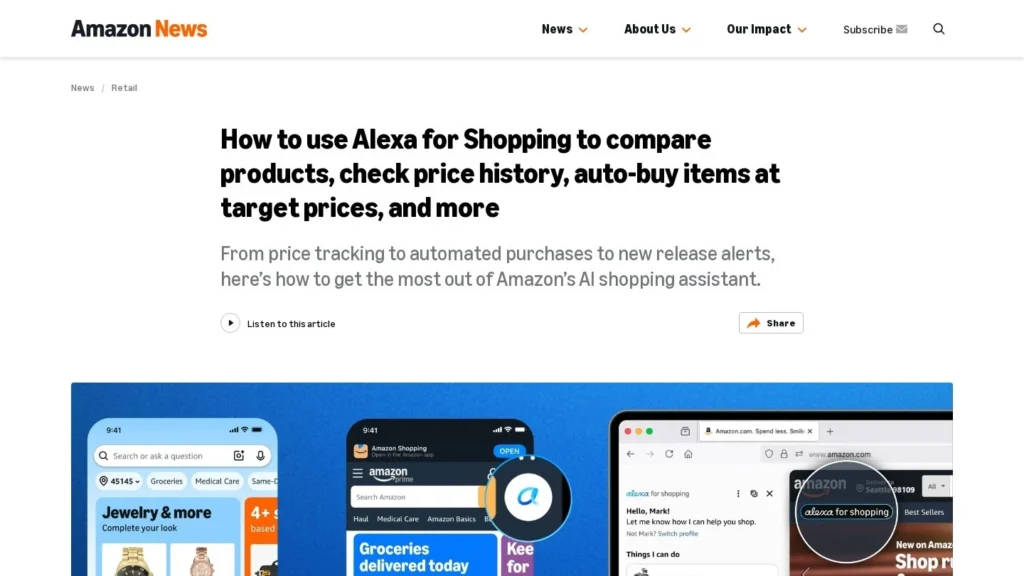
Alexa for Shopping is Amazon’s free agentic shopping assistant for US customers. It answers product questions, compares items, tracks prices and buys automatically when a price falls to the shopper’s target. Through Buy for Me, it can complete purchases on other merchants’ sites using the shopper’s Amazon payment and shipping details. Amazon folded its earlier assistant, Rufus, into Alexa for Shopping in May 2026, and Rufus drove nearly $12 billion in incremental annualized sales in 2025, according to Amazon’s fourth-quarter results as reported by PPC Land.
It suits US shoppers who buy often on Amazon and want price tracking, scheduled restocks and quick comparisons. Shoppers who want to approve every purchase in the moment should keep auto-buy off. We rate it 9.0/10 on our scale, with top marks for price and setup and a neutral user score.
Alexa for Shopping for US Amazon Shoppers
- Rufus, now part of Alexa for Shopping, drove nearly $12 billion in incremental annualized sales in 2025 and was used by more than 300 million customers.
- Auto-buy purchases at a target price; Amazon said auto-buy customers averaged 20% savings per purchase in November 2025.
- Buy for Me grew from 65,000 eligible products at launch to more than 500,000 by November 2025.
- Scheduled Actions and cross-device memory arrived with the May 13, 2026 move from Rufus to Alexa for Shopping.
- It is free for signed-in US shoppers, with no Prime or Echo device required.
Alexa for Shopping by the Numbers
Amazon shares figures about its shopping assistant in earnings materials and product posts, and trade press has tracked them closely.
| Fact | Detail | Source and Date |
|---|---|---|
| Incremental sales | Nearly $12 billion annualized in 2025, per Amazon’s Q4 results | PPC Land, February 7, 2026 |
| Users | More than 300 million customers used Rufus in 2025 | PPC Land, February 7, 2026 |
| Conversion | Rufus users converted at rates more than 60% higher than non-users (November 2025 data) | PPC Land, February 7, 2026 |
| Buy for Me | 65,000 products at launch to more than 500,000 by November 2025 | PPC Land, February 7, 2026 |
| Auto-buy savings | Customers averaged 20% savings per purchase (November 2025 announcement) | PPC Land, February 7, 2026 |
| Upgrades | More than 50 upgrades to Rufus in 2025 | PPC Land, February 7, 2026 |
| Auto Buy launch | Late November 2025 for US Prime members; 24 hours to cancel before shipping, per Modern Retail | eMarketer, November 2025 |
| Rebrand | Rufus retired and folded into Alexa for Shopping on May 13, 2026 | LetsDataScience, May 14, 2026 |
| Account tasks | More than 100 everyday actions, such as gift card balances, refunds and Subscribe and Save changes | About Amazon, updated October 29, 2026 |
The sales and conversion figures explain why Amazon keeps investing. A shopper who uses the assistant converts far more often, and $12 billion in incremental sales is a large figure for any AI agent. Those figures are Amazon’s own, and the attribution involves assumptions about customer behavior, as PPC Land noted.
For a shopper, the 20% average saving on auto-buy is the number that matters. It comes from purchases where customers set a target price and waited, so it reflects patience as much as the tool. The Buy for Me count shows how far Amazon now reaches into other stores: from 65,000 eligible products at launch to more than 500,000 within a year.
The eMarketer report adds a trust signal from outside Amazon. A Bain and Company survey it cited found 25% of shoppers trust retailers’ AI tools to handle the whole shopping journey, against 7% for AI platforms such as ChatGPT. That gap helps explain why Amazon keeps the agent inside its own store and account.
Inside Alexa for Shopping From Question to Checkout
Alexa for Shopping is built into Amazon’s app and website. The steps below follow Amazon’s own guide and launch coverage.
Opening the Assistant
In the Amazon Shopping app, tap the Alexa icon in the bottom navigation bar. On a desktop, it appears at the top of the screen. It is available to all US Amazon customers who are signed in. Since the May 2026 change, conversation history is shared across the app, the website and Echo devices, so a question asked on an Echo can continue on a phone.
Researching and Comparing
Shoppers ask product questions from the assistant or from the main search bar, compare items side by side and check 30, 90 and 365-day price history. It answers questions about uploaded photos, and it can transcribe a photo of a handwritten shopping list into cart items. Shop Direct shows extra products from outside stores alongside Amazon results.
Auto-Buy and Price Alerts
A shopper can ask it to buy headphones when they are 30% off, for example. Alexa for Shopping checks prices and either alerts the shopper or buys with the default payment method once the target is met. Conditional buying can add an item to the cart only when its price falls below a threshold. When Amazon launched auto-buy in late 2025, shoppers approved each tracked purchase with an Auto Buy button and had 24 hours to cancel before the order shipped, according to Modern Retail as cited by eMarketer.
Scheduled Actions and Reorders
Scheduled Actions run recurring research and purchases, such as restocking paper towels every month. The assistant also searches past orders to add repeat items to the cart and suggests alternatives when something is unavailable. “Update Me When” alerts shoppers to new releases.
Buy for Me on Other Sites
For eligible products sold by other merchants, Buy for Me completes the purchase using the shopper’s Amazon payment and shipping details. LetsDataScience described it as completing checkouts on third-party retailers’ sites. This is where Alexa for Shopping goes furthest beyond a search assistant.
Account Tasks
Amazon says the assistant handles more than 100 everyday actions, such as checking gift card balances, tracking refunds and adjusting Subscribe and Save deliveries. Those are small jobs, and having them in one place saves clicks.
A Household Example
A parent sets three Scheduled Actions: diapers every three weeks, coffee pods monthly and dishwasher tablets every six weeks. She asks the assistant to buy a specific stroller when it drops 25% and to tell her when a book series’ next volume comes out. On a Sunday, she photographs a handwritten grocery list and asks it to build a cart. Later, she asks whether a pair of running shoes sold by another store is eligible for Buy for Me, and the assistant completes that purchase with her saved card.
Using It by Voice on Echo
Echo owners can shop by voice with the same assistant. Since the May 2026 change, a conversation started on an Echo carries over to the app, so a shopper can ask for laundry detergent options in the kitchen and finish the comparison on a phone. Echo hardware is optional; the app and the website work on their own.
What the Shopper Still Decides
Shoppers choose targets, schedules and which purchases to automate. They check the seller and the final price, and they cancel or return anything that arrives wrong. The agent acts on the rules people set.
Alexa for Shopping Cost and Account Requirements
Alexa for Shopping has no subscription fee.
| Item | Detail | Source |
|---|---|---|
| Price | Free | LetsDataScience, May 2026 |
| Who can use it | US shoppers signed in to an Amazon account | About Amazon |
| Prime required | No, per coverage of the May 2026 rollout | LetsDataScience |
| Echo required | No; works in the app and on the website | LetsDataScience |
| Payments | Default Amazon payment method for auto-buy and Buy for Me | About Amazon |
What Shoppers Can Save or Spend
- Auto-buy on a $200 item: at the 20% average saving Amazon reported, a shopper would pay about $160, saving $40.
- Scheduled restocks: there is no fee, but recurring orders still cost money; review schedules every few months so you do not overbuy.
- Buy for Me purchases: prices are set by the other merchant; compare the final total before letting the agent buy.
Savings depend on patience. The 20% average comes from shoppers who set a target and waited for it. Items that rarely go on sale may never hit a target, so pair auto-buy with a price history check: if an item has not dropped below a level in 365 days, a lower target may never trigger.
The real cost is attention. A shopper with many auto-buy targets and schedules should check them regularly, since the agent will keep buying until told to stop.
Alexa for Shopping Compared With Perplexity Comet, Constructor AI Shopping Agent and Bloomreach Loomi Shopping Agent
Shopping agents split into assistants that work for the shopper across stores and agents that retailers put on their own sites.
| Agent | Starting Price | Free Plan | Main Strength | Main Weakness | Best For |
|---|---|---|---|---|---|
| Alexa for Shopping | Free | Yes | Auto-buy, scheduled restocks and Buy for Me checkout | US only; Amazon-centric | US Amazon shoppers |
| Perplexity Comet | Free browser; paid plans for more | Yes | AI browser that works across any site | Security researchers have reported prompt injection risks | Shoppers comparing many stores |
| Constructor AI Shopping Agent | Quote for retailers | No | Shopping agent on a retailer’s own site | Built for retailers, not shoppers | Mid-size and enterprise retailers |
| Bloomreach Loomi Shopping Agent | Quote for retailers | No | Conversational product discovery for retailers | Built for retailers | Retailers with large catalogs |
For shoppers, the choice is between Amazon’s agent, which knows their order history and can buy instantly, and a browser agent such as Comet, which works across any site. Retailers looking at the same trend can study Constructor and Bloomreach for their own stores. See more on our shopping agents and ecommerce agents pages.
Shoppers Who Get the Most From Alexa for Shopping
- Frequent Amazon buyers: reorders, Subscribe and Save changes and account tasks save clicks every week.
- Deal watchers: price history and auto-buy at a target price replace manual checking.
- Busy households: Scheduled Actions keep staples stocked.
- Echo owners: shared memory lets voice and app conversations continue across devices.
Shoppers Who May Prefer Another Approach
- Shoppers outside the US: Alexa for Shopping is a US service.
- People who compare many independent stores: a browser agent such as Comet searches the wider web.
- Anyone uneasy with automatic spending: use alerts and keep auto-buy off.
Spending, Privacy and Retailer Considerations
Auto-buy and Scheduled Actions spend money without a fresh click. Set a few targets, check them monthly and cancel any you no longer need. When auto-buy launched, shoppers had 24 hours to cancel before an order shipped, according to Modern Retail; check current cancellation terms in your order details.
Privacy is the second issue. The assistant uses past orders, lists and preferences, and since May 2026 it keeps conversation history across the app, the website and Echo devices. The Alexa Privacy Dashboard lets shoppers review and manage that data.
Children and shared accounts deserve a check too. Anyone with access to the account or a household Echo can talk to the assistant, so review purchase settings on shared devices and keep auto-buy targets on an account you control.
Retailers are a third consideration. In January 2026, some online retailers objected to Amazon’s AI completing purchases on their sites, according to LetsDataScience. Buy for Me depends on those merchants, so the list of eligible products may change. Shoppers should also remember that recommendations come from Amazon’s own store, where sellers also buy ads.
Amazon Shopping Agent Updates
In late November 2025, Amazon added an Auto Buy option to Rufus for US Prime members, eMarketer reported, with shoppers able to cancel within 24 hours before shipping. In February 2026, PPC Land reported that Amazon’s Q4 2025 results credited the assistant with nearly $12 billion in incremental annualized sales and more than 300 million users in 2025.
On May 13, 2026, Amazon retired Rufus and folded it into Alexa for Shopping, adding Scheduled Actions, conditional buying and cross-device memory, and making it free for all signed-in US shoppers. Amazon’s guide to the assistant was updated on October 29, 2026.
How Alexa for Shopping Scores as a Shopping Agent
Alexa for Shopping scores 9.0/10 on our scale. Pricing and setup score highest: it is free and built into the app. Autonomy is high because it buys at targets, restocks on schedules and checks out on other sites. Trust and integrations score lower: it lives inside Amazon’s store, and retailer objections show the limits of Buy for Me. User sentiment is neutral because there is no separate rating for the assistant on allowed review sites.
Amazon’s agent is a direct way for a US shopper to hand routine buying to AI, because it already knows their orders, addresses and payment details. The same closeness is the trade-off: it sees the market through Amazon’s store.
For a US shopper, start small: set one price target on an item you already plan to buy and one Scheduled Action for a staple, then check both after a month.
Shoppers’ Questions About Alexa for Shopping
Is Alexa for Shopping the Same as Rufus?
Yes, in effect. Amazon retired Rufus on May 13, 2026 and moved its features into Alexa for Shopping, adding Scheduled Actions and cross-device memory.
Is Alexa for Shopping Free?
Yes. It is free for US shoppers signed in to Amazon, with no Prime membership or Echo device required, according to launch coverage.
How Does Auto-Buy Work?
You set a target price or discount. Alexa for Shopping checks the price and either alerts you or buys with your default payment method once the target is met.
What Is Buy for Me?
For eligible products from other merchants, Amazon completes the purchase using your Amazon payment and shipping details. Eligible products grew past 500,000 by November 2025.
Can I Control What Alexa for Shopping Remembers?
Yes. The Alexa Privacy Dashboard lets you review and manage stored data, including conversation history shared across the app, the website and Echo devices.


User Reviews
Nobody has rated it here yet. Be the first AI Agents Choice user to rate Alexa for Shopping.