


Synthesia is the AI avatar video tool with the widest reach in corporate training. In January 2026 it had more than 50,000 customer teams and 2 million users, and over 90% of the Fortune 100 used it. Training teams that publish their numbers report cutting video cost or production time by 70% to 97%.
In the Synthesia AI in Learning and Development Report 2027, released on November 16, 2026, 73% of L&D teams that use AI make video with it. Yet only 40% of teams using AI for evaluation track how people do on the job. So the results Synthesia customers publish are mostly about speed and cost.
For a large company that needs SCORM, single sign-on and 140+ languages, Synthesia is the safe pick. A small course team will spend less on Colossyan, and HeyGen covers more languages and exports in 4K.
How Far Synthesia Has Spread Through Corporate Training
Synthesia raised a $200 million Series E at a $4 billion valuation on January 26, 2026. GV led the round, and Accel, Kleiner Perkins, NEA and Nvidia’s NVentures also took part. A year earlier the company had been valued at $2.1 billion. By that January the London firm had passed $100 million in annual recurring revenue and had more than 500 staff.
Bosch, Merck and SAP are among its enterprise clients, and big names like these use it for training as well as marketing.
| Measure | Number | Date |
|---|---|---|
| Teams that use it | 50,000+ | Jan 2026 |
| People who use it | 2 million+ | Jan 2026 |
| Share of the Fortune 100 | Over 90% | Jan 2026 |
| Worth | $4 billion | Jan 2026 |
| Yearly plan revenue | Over $100 million | Jan 2026 |
| Staff | 500+ | Jan 2026 |
| Video languages | 140+ | Nov 2026 |
Much of the Series E money is aimed at training. Synthesia is building chat-based Agents for staff training. Staff will be able to ask them questions, practice through role-play and get answers fitted to their role. The Basic, Starter and Pro plans already include 10 role-play sessions a month. Syren, its AI video agent, turns a prompt, PDF or link into a draft video.
Training Results Synthesia Customers Report
Most of the hard numbers in the Synthesia customer stories measure production speed and cost. Only a few cover what learners did after watching.
| Company | What they train | Reported result |
|---|---|---|
| Five Below | New store staff and team leads | Each video cost $400, down from $12,000. Over 90% of learners liked them. |
| Zoom | Sales training for 1,000+ sellers | Designers make videos 90% faster. Experts get back 15 to 20 hours a month. |
| Teleperformance | Rules, quality and career skills | Saves about 5 days and up to $5,000 per video. |
| Heineken | How to improve daily work | 70,000 staff trained in 170 countries. |
| Boldyn Networks | Video courses | 95% of learners finish. |
| Mondelez | Supply chain training | Made 4x faster. 100 hours of translation work done in 10 minutes. |
| SAP | In-house videos | Made 70% faster. |
The discount store chain at the top of the table has the fullest before-and-after. It used to pay outside agencies about $60,000 for five finished videos. In its first full year on Synthesia, it made more than 100 videos for $40,000, which is 20 times the output for two-thirds of the money. Its eight-person team also avoided $240,000 in vendor costs and grew output six-fold with no new hires.
Zoom kept its existing authoring tools. One senior instructional designer built more than 200 micro videos in Synthesia in about six months. Those videos then went into Rise 360 and Storyline as interactive sales modules, and one of them became a course called Deal Detective.
Boldyn’s 95% completion rate and the store chain’s learner ratings are the only learner-side numbers in the set. Every other result counts the hours and dollars saved by the people who make the videos.
How Common AI Video Is Across L&D Teams
The Synthesia AI in Learning and Development Report 2026 surveyed 421 people who work in L&D. Of them, 87% were using or piloting AI, and 52% used it to make video. Video came third, after voice generation and quiz drafting.

The 2027 edition, out in November 2026, nearly doubled the sample to more than 800 people in over 25 countries. Among teams using AI, 73% now make video with it, well ahead of the 60% they had expected. AI tutoring went the other way: some 70% expected to use AI for personal guidance or tutoring, and 29% do so today. Nearly half of teams, 46%, do not know what share of their L&D budget goes to AI.
Money is part of the pull, because L&D teams are being asked for more hours on a smaller budget. In the ATD 2026 State of the Industry report, released in May 2026, direct learning spend fell to $846 per employee from $1,254 a year earlier. Over the same period, formal learning hours per employee rose from 13.7 to 16.7.
The push also starts at the top. In a LinkedIn survey of 1,252 executives released on June 2, 2026, 90% felt their own roles need constant skill-building, and 78% admitted they move faster on AI than they can measure.
Blockers remain. In the 2026 Synthesia report, 58% of L&D teams named security as a barrier, 52% named accuracy and 44% named budget approval. Only 6% had none at all.
Read also: Creatify AI Alternatives for Video Ads: 8 Tools Compared
How L&D Teams Build Training Videos in Synthesia
The workflow is short. You write a script, pick an avatar and voice, add slides or screen captures, and Synthesia renders the video. A script edit makes a new version in minutes, which is the main draw when a policy changes.
Onboarding, compliance, sales training and translation come up again and again in the customer stories. The discount store chain sends new crew five-minute recap videos through its LMS, and staff can rewatch them later. Teleperformance runs compliance and quality training for more than 380,000 people in 170+ markets. For global teams, one-click translation covers 140+ languages and dubbing covers 70+. Heineken uses it to localize videos in minutes.
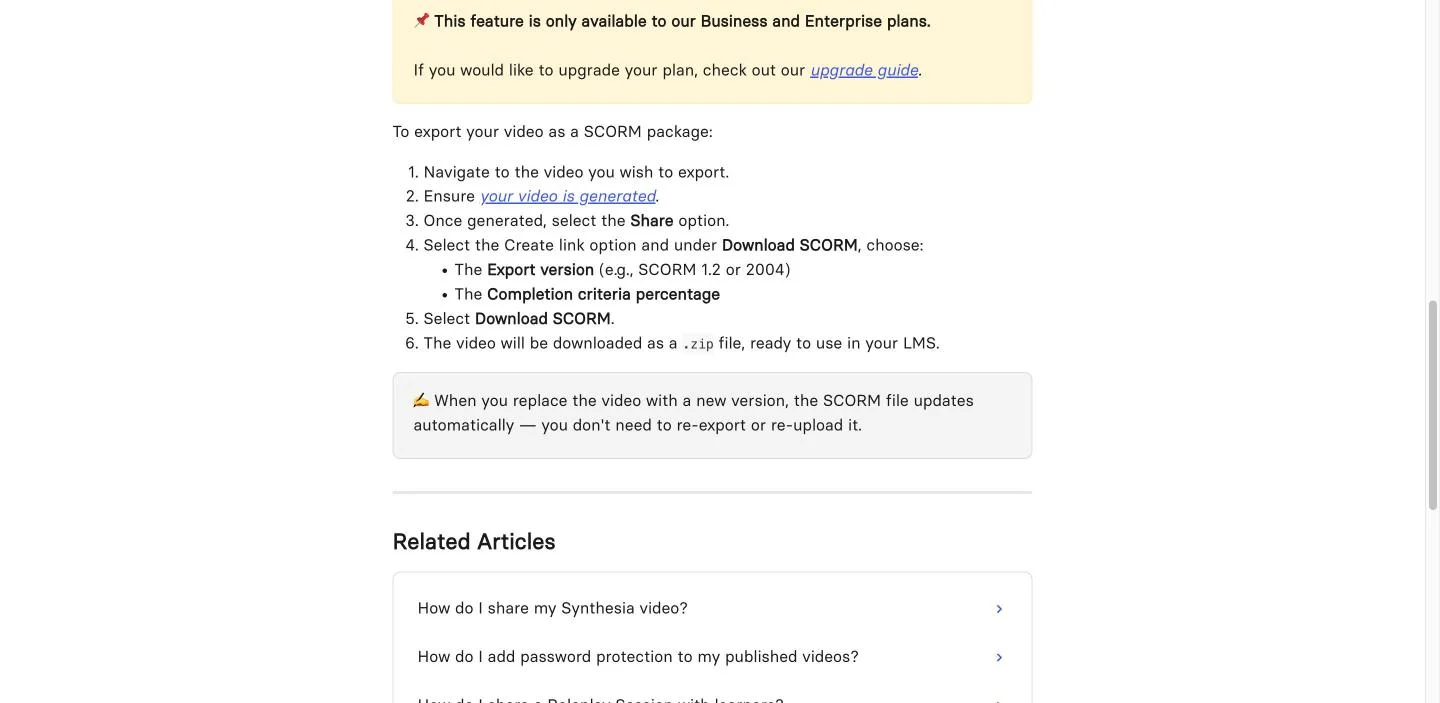
SCORM export needs the Business or Enterprise plan. You set a completion percentage, download a .zip and upload it to the LMS. Videos can also be embedded in an LMS, LXP or website, and Business adds quizzes, branching and clickable calls to action inside the video.
Captions are built from the script. Closed captions match it word for word, viewers can switch them on or off, and you can download them as .srt or .vtt files. They are not baked into a downloaded MP4, though. For MP4 files, turn on burned-in captions and export at 720p or higher, since captions look soft at 480p or lower.

A good first project is a course that changes often, such as a product update or a policy refresher, since those cost the most to reshoot. Load it into the LMS and track completion against the old version for a quarter, so you end up with the learner-side number most case studies lack.
Synthesia Pricing for a Corporate Training Team
Synthesia switched to credits in October 2026. A typical finished minute uses about 100 credits, and more when the avatar stays on screen. Business, the cheapest plan with SCORM, cost $79 a month billed yearly in November 2026.
| Synthesia plan | Price a month | Video allowance | What it adds for training |
|---|---|---|---|
| Basic | Free | 10 minutes a month | 9 stock faces, 1 editor |
| Starter | $19, or $14 billed yearly | About 150 minutes a year | 125+ stock faces, 3 of your own, 3 guests |
| Pro | $89, or $59 billed yearly | About 720 minutes a year | 180+ stock faces, quiz-style video, 5 guests |
| Business | $99, or $79 billed yearly, plus $20 per extra seat | Up to 18,000 minutes a year | SCORM, quizzes, branching, brand kits and quick translation |
| Enterprise | Price on request | No cap, with fair use | SSO, many workspaces, invoices and POs |
Take a three-person L&D team that needs SCORM. Business billed yearly is $79 plus two extra seats at $20, or $119 a month and $1,428 a year. That is about 12% of the $12,000 the store chain once paid an agency for a single video.
Before you pick a plan, count the training videos your team shipped last year and their average length. Multiply the total minutes by about 100 credits to see which allowance you need, then add room for the avatar time.
Monthly allowances reset each billing period and do not roll over, while credits bought on top last 12 months. A three-minute onboarding video uses about 300 credits, so the yearly Pro plan covers roughly 240 of them if the avatar is not on screen the whole time. A slide-heavy course with the avatar only at the start and end stretches the allowance further than a talking head that never leaves the frame. New customers, and free users who upgrade, can also use a Black Friday offer that runs from November 23 to December 7, 2026.
Concerns Training Leads Raise About AI Avatars
Consent comes up first, because a custom avatar copies a real person’s face and voice. The Synthesia AI governance program runs consent checks before custom avatars and voices go live, and it screens content as it is created. Synthesia was the first generative AI company certified to ISO/IEC 42001. It is also SOC 2 compliant, and its videos carry labels under Article 50 of the EU AI Act.
Avatar quality depends on the plan. Basic has 9 stock avatars, Pro has 180+ and Enterprise gets the full set, while the most lifelike Express-1 studio avatars cost an extra $1,000 a year on annual plans. Run any pilot that will decide a budget on a paid seat, because the free plan shows the fewest and simplest avatars.
Captions need a check of their own. They work well in the Synthesia player, but many LMS setups use downloaded MP4s, and there deaf learners rely on the burned-in captions. Check them before each release.
Synthesia reads whatever script it is given, and the captions repeat it word for word. A wrong step in the script turns into a wrong step on screen, in every language. Have a subject expert sign off on each script before it renders, as you would for a filmed video.
Proof that it helps learners is still thin. In the 2027 Synthesia report, only 32% of teams that shared results could name a real gain, such as faster time to skill or better retention. In the 2026 report, 59% kept personal learner data away from AI tools.
Synthesia vs HeyGen, Colossyan, Elai and D-ID for Training
HeyGen and Colossyan are the two rivals that also sell SCORM export. Elai and D-ID aim at narrower jobs.
| Avatar video tool | Paid plans, Nov 2026 | LMS and SCORM | Pick it when |
|---|---|---|---|
| Synthesia | Starter $19 a month; Business $99 a month | SCORM on Business and up | You run training at a big firm that needs SSO |
| HeyGen | Creator $29 a month, or $24 yearly; Business $149 a month | SCORM and LMS links on Business | You make sales or customer video and want 4K |
| Colossyan | Free Starter; Professional $59 a month billed yearly | 5 video and 5 course SCORM exports a month on Professional | You are a small team building full courses |
| Elai | Creator with 15 minutes a month or 180 a year; extra minutes $2.50 each | Turns PPTX and PDF files into video | You mostly convert slide decks |
| D-ID | Lite, Pro and Advanced plans after a 14-day free trial | Built for talking-head clips | You need quick presenter clips, not courses |
For enterprise L&D, Synthesia wins. It pairs use across 90% of the Fortune 100 with SSO, ISO 42001 and SCORM. A solo designer on a tight budget should skip it, since SCORM starts at $99 a month.
At $59 a month on the Professional plan, Colossyan is the cheapest SCORM option of the five. Its Enterprise SCORM works in any SCORM 1.2 or 2004 LMS, such as Workday or Docebo, and it works in 120+ languages. Heavy producers will run out fast, since Professional includes about 30 minutes of video a month.
HeyGen does best with sales training and with video that customers see. It covers 175+ languages, and its Video Agent drafts whole videos from a prompt. Teams that want SCORM for less than $149 a month should look elsewhere.
Teams sitting on stacks of old slide decks get the most from Elai, which turns PPTX and PDF files into video. With 75+ languages against 140+ for Synthesia, it is the wrong choice for wide localization.
Quick presenter clips and developer projects are what D-ID is built for, and it does not build tracked courses. Our list of AI video agents has more tools in this space.
Questions L&D Leads Ask Before Buying Synthesia
Can we make an avatar of a real trainer or our CEO?
Yes. Starter has 3 personal avatars and Pro has 5. Once an avatar is live, other people can use it only if you let them.
Which SCORM versions does Synthesia export?
SCORM 1.2 and SCORM 2004. If you later replace the video, the SCORM file updates by itself, so there is no re-upload to the LMS.
Can we pilot Synthesia for free?
Yes, on the Basic plan. Syren videos there are capped at 3 minutes, so pick a short module for the test.
Can learners pick their own language in one video?
Yes, on Business and above. One-click translation feeds a player that holds many languages, so one link serves them all. It pairs well with an AI onboarding agent for global new hires.
How do AI video tools fit with other translation tools?
Synthesia handles voice and lip-sync inside the video. Written course text, quizzes and job aids still need a text tool, and our list of AI translation agents covers that side.
Related AI Agents


Read also: Best Copy.ai Alternatives for Content and GTM Teams
Explore Agent Categories
Related Articles
 GuidesCreatify AI Alternatives for Video Ads: 8 Tools Compared
 GuidesBest Harness AI Alternatives for CI/CD and DevOps Teams
 GuidesBest Saleshandy AI Alternatives for Cold Email Teams
 GuidesBest Jasper AI Alternatives for Content Marketing Teams
 GuidesBest Copy.ai Alternatives for Content and GTM Teams
 GuidesStrawberry AI Alternatives for Teams That Automate Web Work
