
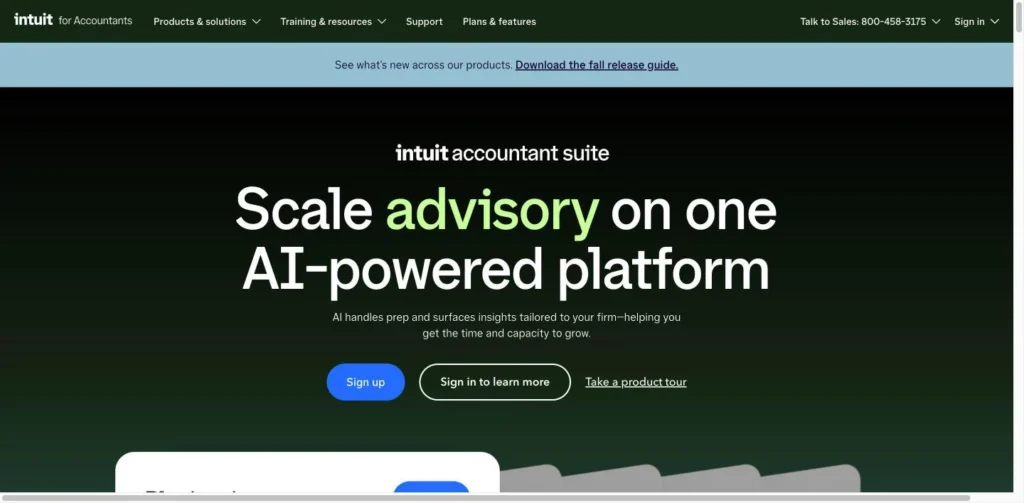
Intuit Accountant Suite costs nothing to start: the Core tier is free for US and UK accounting firms, and Intuit says it will stay free. Firms that want portfolio analytics pay $149 a month for Accelerate, and the AI-assisted Books Close tool adds $6 to $8 per client a month. Since QuickBooks Online Accountant is due to be retired in December 2026, most firms that serve QuickBooks clients will end up here whether they shop around or not.
The suite is best for bookkeeping and client advisory firms whose clients run QuickBooks Online and who want one workspace where Intuit’s agents chase receipts, reconcile statements, draft payroll and flag anomalies at close. The main thing to know is maturity: many features carried beta or coming soon labels through 2026, and each agent works only if the client’s own QuickBooks plan includes it. We rate it 8.5/10 on our scale. We have not used the suite ourselves; this review is based on Intuit’s launch materials, its May 2026 feature update and trade press coverage.
Free Core, $149 Accelerate and an $8 Books Close Add-On
- The Core tier is free; Accelerate costs $149 a month from July 1, 2026, and the Books Close add-on costs $8 per client a month for firms with up to 50 clients and $6 above that.
- Intuit says 94% of firms that switched did not go back, based on its own data from 13,000 firms between October 2025 and March 2026.
- Agents work inside each client’s QuickBooks plan: Accounting, Payroll and Payments Agents need Essentials or higher, and the Finance Agent needs Advanced.
- QuickBooks Online Accountant sunsets in December 2026, making the suite the default home for QuickBooks-focused firms.
- Against Karbon AI, Booke AI and Truewind, it is the cheapest to start but the narrowest, since it only serves QuickBooks clients.
Pricing and Adoption Figures Intuit Has Published
Intuit has published more about this suite’s pricing and adoption than most firm-software vendors publish about their AI tools. These are the figures we could confirm.
| Fact | Detail | Source and Date |
|---|---|---|
| Launch | Introduced at Intuit Connect as an AI-native platform for US accounting firms, at no cost | Intuit press release via Business Wire, October 28, 2025 |
| Parent scale | Intuit says it serves about 100 million customers worldwide | Intuit press release, October 28, 2025 |
| UK launch | Made available to UK-based accounting firms, free for now | Accountancy Age, February 17, 2026 |
| Accelerate price | Free in beta through June 30, 2026, then $149 a month from July 1, 2026 | Intuit in Accounting Today, May 1, 2026 |
| Books Close price | $8 per client per month for firms with 50 or fewer onboarded clients, $6 per client above 50, billed from July 1, 2026 | Intuit in Accounting Today, May 1, 2026 |
| Retention claim | 94% of firms that switch do not go back; firms are 1.7 times more likely to recommend it than QuickBooks Online Accountant (internal data, 13,000 firms, Oct. 23, 2025 to March 26, 2026) | Intuit in Accounting Today, May 1, 2026 |
| AI chat caps | During beta, 200 Intuit Intelligence questions on Core and 1,000 on Accelerate | Intuit in Accounting Today, May 1, 2026 |
| Legacy sunset | QuickBooks Online Accountant will be retired in December 2026, with migration training planned for summer 2026 | Intuit in Accounting Today, May 1, 2026 |
| Agent tiers | Payroll, Accounting and Payments Agents on QuickBooks Essentials and up; Customer Agent on Plus; Finance and Project Management Agents on Advanced | Insightful Accountant, viewed November 2026 |
| Client growth stat | Intuit cites 11.5% revenue growth for small businesses that use accounting and bookkeeping services | Accountancy Age, February 17, 2026 |
The retention and recommendation numbers are Intuit’s own, drawn from firms that chose to switch early, so they say more about satisfaction among early adopters than about the product’s fit for every practice. The pricing facts are more useful. A free Core tier and a $149 Accelerate tier put the suite well below most dedicated practice management tools, but the Books Close add-on scales with client count, so it becomes the main cost for larger firms.
The sunset date matters most. A firm that manages QuickBooks clients through QuickBooks Online Accountant today has until December 2026 to move, which means the real decision for most firms is which paid add-ons to turn on, and whether to run a separate tool such as Karbon or Truewind alongside it.
A Firm Layer on Top of Agents in Each Client’s QuickBooks
The suite has two layers. The firm layer is where accountants manage clients, staff and close work. The agent layer sits inside each client’s QuickBooks subscription and does the bookkeeping and payroll work. Intuit Intelligence, a chat assistant, connects the two.
The Firm Workspace
Every client file sits in one place with single sign-in, a firm-specific client number and a customizable dashboard that shows tasks, reminders and AI-generated insights. A proactive home dashboard alerts staff to problems such as disconnected bank feeds or failed third-party apps. Role-based access controls and, on Accelerate, user groups let a firm assign permissions in bulk. Consolidated audit logs give a firm-level view of changes across clients, showing up to 10 clients at a time.
Accounting, Payroll and Close Agents Firms Rely On
Based on Intuit’s published descriptions, the agents that matter most to firms are these:
- Accounting Agent: texts clients asking for missing receipts and compares PDF bank statements with account records to help reconcile. Needs QuickBooks Essentials or higher.
- Payroll Agent: collects employee hours, flags anomalies and sends a payroll draft for approval by text. Needs Essentials or higher and a QuickBooks Payroll subscription.
- Payments Agent: tracks payment patterns and drafts recurring invoices. Essentials or higher.
- Customer Agent: finds leads in email and drafts estimates. Plus or higher.
- Finance Agent: supports month-end close and produces KPI insights and monthly summaries. Advanced or higher.
- Project Management Agent: turns signed contracts into projects. Advanced or higher.
Close, Insights and Client Requests
The Books Close add-on standardizes review with custom templates, status tracking, comments on individual transactions and firm-wide thresholds and exclusions, with AI anomaly detection that spots issues during review. Client Insights, on Accelerate, benchmarks and monitors KPIs across QuickBooks, ProConnect Tax, Payroll and Bill Pay data and flags anomalies across the client base. Requests with AI handoff centralizes client communication, recaps AI-assisted conversations and surfaces questions that need an accountant. For US firms, a ProConnect Tax beta brings tax workflows and tasks into the same workspace.
Payroll Drafts and Adjusting Entries Need Approval
Payroll drafts go to a person for approval, and the close tools flag anomalies rather than book adjusting entries on their own. Intuit’s examples of what the agents can do, such as running client payroll or building firm-wide reports, still depend on staff reviewing the output. The suite also connects firms to Intuit’s own human experts when they need extra capacity.
Moving From QuickBooks Online Accountant to Core
US and UK firms sign up for the free Core tier, and firms already on QuickBooks Online Accountant move across, with Intuit planning migration training for summer 2026. A firm then chooses whether to add Accelerate or Books Close, and checks which QuickBooks plan each client is on, since that decides which agents can work on that file.
Firm Pricing From May 2026, Agents Billed per Client
Intuit published the suite’s firm-level pricing in its May 2026 update. Agent access is priced separately, through each client’s QuickBooks subscription.
| Plan | Price | Billing | What’s Included | Limits |
|---|---|---|---|---|
| Core | Free | None | Client management, dashboards, role-based access, Intuit Intelligence chat, Requests, audit logs | 200 AI chat questions during beta |
| Accelerate | $149 a month (free in beta to June 30, 2026) | Monthly, per firm | Core plus Client Insights with AI anomaly monitoring, user groups, portfolio-level insights (coming soon) | 1,000 AI chat questions during beta |
| Books Close add-on | $8 per client a month (50 or fewer clients); $6 per client above 50 | Monthly, per onboarded client | Close templates, status tracking, transaction comments, thresholds and AI anomaly detection | Intuit describes the tier boundary in two ways; confirm before signing |
| QuickBooks agents | Included in the client’s QuickBooks plan | Paid by the client’s subscription | Accounting, Payroll and Payments Agents (Essentials and up), Customer Agent (Plus), Finance and Project Management Agents (Advanced) | Payroll Agent also needs QuickBooks Payroll |
Bookkeeper Bills From One Person to a Growing Firm
These scenarios use Intuit’s published firm prices. Client counts are our own illustrative assumptions, and client-side QuickBooks subscriptions are left out because clients usually pay them.
- A solo bookkeeper with 30 clients on Core plus Books Close: 30 clients at $8 a month comes to $240 a month, or $2,880 a year, with no firm subscription.
- A five-person firm with 40 clients on Accelerate plus Books Close: $149 for Accelerate and $320 for Books Close (40 at $8), for $469 a month.
- A larger practice with 120 clients on Accelerate plus Books Close: if all 120 clients bill at $6, the total is $149 plus $720, or $869 a month. If instead the first 50 clients bill at $8 and the other 70 at $6, Books Close costs $820 and the total is $969 a month. The $100 gap is why it is worth getting Intuit’s tiering in writing.
Other costs sit on the client side. If a client is on QuickBooks Simple Start, the Accounting and Payroll Agents are not available on that file, so a firm that wants agent help may need to move clients to Essentials or higher. Payroll Agent also needs QuickBooks Payroll. Firms with many low-activity clients should count only onboarded clients they actually close each month, since Books Close bills per onboarded client.
Intuit Accountant Suite Compared With Karbon AI, Booke AI and Truewind
Firm-focused AI tools split into practice management platforms, bookkeeping agents and outsourced-style close agents. The suite blends the first two for QuickBooks clients only.
| Agent | Starting Price | Free Plan | Main Strength | Main Trade-Off | Best For |
|---|---|---|---|---|---|
| Intuit Accountant Suite | Free (Core); $149 a month for Accelerate | Yes | Free firm workspace with agents inside QuickBooks client files | QuickBooks clients only; many features in beta | QuickBooks-centric bookkeeping and advisory firms |
| Karbon AI | $59 per user a month (Team, billed annually) | No | Email triage, client summaries and work planning across any ledger | Agentic workflows still in early access | Firms that want practice management across mixed client stacks |
| Booke AI | $129 per business a month | No | Automated categorization and client follow-up on QuickBooks Online and Xero | Mixed reviews on accuracy and support | Bookkeepers serving many small clients on QBO or Xero |
| Truewind | Custom quote | No | AI close and bookkeeping service for client accounting teams | No published pricing | Client accounting services firms that want close done for them |
The suite wins on price and on being where QuickBooks client data already lives. Karbon is the stronger practice management tool for firms with clients on several ledgers. Booke AI covers Xero as well as QuickBooks. Truewind goes further toward finished close work but is sold by quote. Firms browsing more options can compare AI agents for accounting firms and the wider list of accounting agents, including Digits.
QBOA Firms Facing the December 2026 Sunset
- Firms already on QuickBooks Online Accountant: the old product sunsets in December 2026, and moving to Core costs nothing.
- Bookkeeping practices with many small QuickBooks clients: agents that chase receipts by text and reconcile statements cut the most tedious parts of monthly bookkeeping.
- Firms that run payroll for clients: the Payroll Agent collects hours and prepares drafts for approval inside the same system.
- US firms using ProConnect Tax: the books-to-tax link puts bookkeeping and tax tasks in one workspace.
- Advisory firms that benchmark clients: Accelerate’s Client Insights flags KPI anomalies across the whole client base for $149 a month.
Xero, Sage and NetSuite Practices
- Firms with mostly Xero, Sage or NetSuite clients: the suite and its agents only work with QuickBooks Online files.
- Firms that need practice management across every client: a ledger-neutral tool such as Karbon covers clients the suite cannot see.
- Tax-first and audit firms: the agents do bookkeeping and payroll work; tax preparation and audit testing need tools such as Filed or Basis.
- Firms outside the US and UK: availability elsewhere has been rolling out market by market, so check local launch status first.
- Firms that need finished features today: portfolio-level insights, payroll service delivery and other items were still listed as coming soon in 2026.
Beta and Coming-Soon Labels on Key Features
- Beta labels: Intuit’s own feature table in May 2026 showed several items in beta or coming soon, and Intuit notes that features are subject to change without notice.
- Client plan dependency: each agent depends on the client’s QuickBooks tier, so two clients in the same firm can have different agent coverage.
- Per-client add-on costs: Books Close scales with onboarded clients, and Intuit’s two descriptions of its tiering do not match exactly.
- AI chat caps: Intelligence questions were capped at 200 on Core and 1,000 on Accelerate during beta.
- Vendor statistics: the 94% retention and 1.7 times recommendation figures come from Intuit’s internal data, not an independent study.
- Platform commitment: agents, close workflows and insights all assume QuickBooks, so the more a firm builds on them, the more work a later move to another ledger becomes.
Launched Free at Intuit Connect in October 2025
- On October 28, 2025, Intuit launched Intuit Accountant Suite at Intuit Connect for US firms at no cost, with embedded AI agents and Intuit Intelligence.
- On February 17, 2026, Intuit launched the suite for UK accounting firms, again free at launch.
- On May 1, 2026, Intuit detailed its May feature release, including Requests with AI handoff, a ProConnect Tax beta, $149 Accelerate pricing from July 1, 2026 and the December 2026 sunset of QuickBooks Online Accountant.
A Zero-Cost Entry for Firms With QuickBooks Clients
For firms whose clients run QuickBooks Online, yes, and mostly because the entry price is zero. Intuit Accountant Suite scores 8.5/10 on our scale: strong on pricing value and ease of moving over, moderate on autonomy because many agent features still ask for approval or remain in beta, and neutral on user sentiment because public ratings have not built up yet. Intuit’s own data says 94% of firms that switched stayed, which fits a free product that replaces one firms already used.
The fit is narrower for mixed-ledger firms and for anyone expecting agents to finish the books without review. Start on Core, test Books Close on a handful of clients during a quiet month, and check each client’s QuickBooks tier before promising agent-driven bookkeeping. If most of your clients are on another ledger, a ledger-neutral tool may be a closer fit.
Free Access, QBOA Replacement and Required Client Plans
Is Intuit Accountant Suite Free?
The Core tier is free, and Intuit says it will remain available at no cost. Accelerate costs $149 a month from July 1, 2026, and the Books Close add-on is billed per onboarded client at $6 to $8 a month.
Does Intuit Accountant Suite Replace QuickBooks Online Accountant?
Yes. Intuit said in May 2026 that QuickBooks Online Accountant will sunset in December 2026 and planned migration training for summer 2026.
Which QuickBooks Plan Do Clients Need for the AI Agents?
The Accounting, Payroll and Payments Agents need QuickBooks Essentials or higher, with Payroll Agent also needing QuickBooks Payroll. The Customer Agent needs Plus, and the Finance and Project Management Agents need Advanced.
How Does Intuit Accountant Suite Compare With Karbon?
The suite is free to start and sits inside QuickBooks client files, while Karbon costs from $59 per user a month and manages work across clients on any ledger. Many firms that use other ledgers will find Karbon a better fit for practice management.
Can Intuit Accountant Suite Close the Books on Its Own?
No. The Books Close add-on runs templates and flags anomalies, and agents reconcile statements and draft payroll, but staff still review and approve the work. Several close and insight features were in beta during 2026.
User Reviews
Nobody has rated it here yet. Be the first AI Agents Choice user to rate Intuit Accountant Suite.