
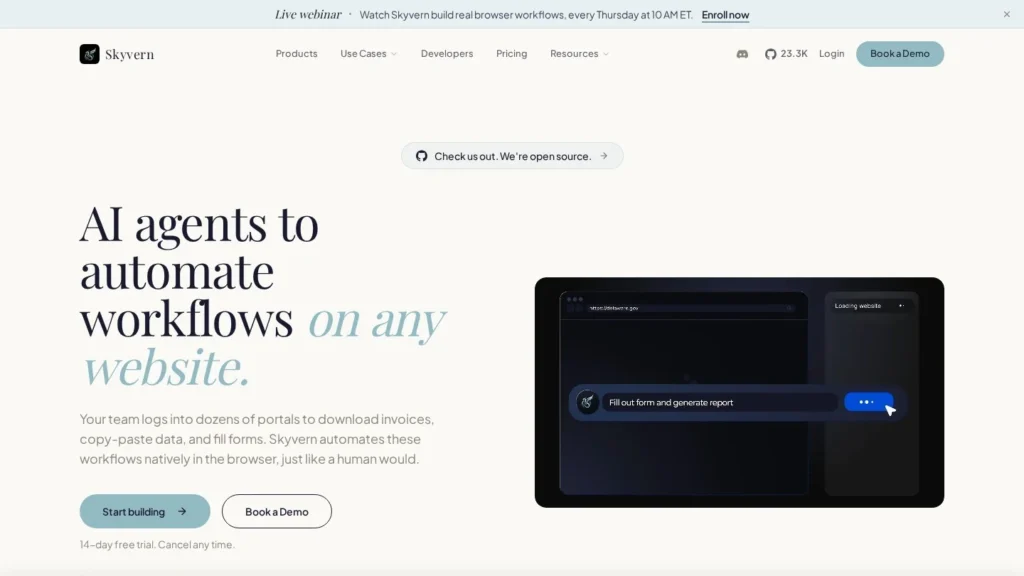
Skyvern’s $29 Hobby plan buys 30,000 credits a month, which the company estimates at about 1,200 browser actions. The product is an AI agent that operates websites the way a person would, logging in, filling forms, downloading files and extracting data, using large language models and computer vision rather than brittle scripts tied to page layouts.
The core code is open source under the AGPL-3.0 license, with roughly 23,000 GitHub stars, and the company also runs a managed cloud. Skyvern is a Y Combinator-backed startup based in San Francisco that announced a $2.7 million raise in December 2025.
How It Works
Developers or operations teams describe a goal in plain language, such as pulling invoices from a supplier portal, and Skyvern plans and carries out the steps. Larger jobs are built as agents, previously called workflows, made of blocks that can include loops, code and data extraction, with output checked against a schema before a run finishes. The agent can work across several browser tabs, follow links that open new tabs and handle pop-ups.
Skyvern can pull stored credentials from 1Password or Bitwarden, fill one-time passcodes from Gmail or TOTP apps and solve CAPTCHAs. It runs through a web-based studio, an SDK, a CLI and an MCP server, and offers webhooks for results. Customers can pick from models by OpenAI, Google, Anthropic, DeepSeek and others.
Pricing
Hobby costs $29 a month for 30,000 credits, 10 concurrent runs, basic CAPTCHA solving and datacenter proxies. Pro costs $149 a month for 150,000 credits, 25 concurrent runs, residential proxies with city-level targeting, two-factor support and team workspaces. Both come with a 14-day trial. Enterprise pricing is custom and adds self-hosting, SSO, a HIPAA BAA, SOC 2 reports and up to 100 concurrent runs. Skyvern bills per workflow execution, with credits varying by the length and complexity of each run, rather than per page or step.
What to Watch Out For
Credit use is hard to predict until you run real jobs, since long or complex sessions burn more. The AGPL license requires sharing changes if you offer a modified version as a network service, which matters for companies building products on top of it. Self-hosting with official support is limited to Enterprise, and some advanced models are enterprise-only. Remote browser sessions are capped at four hours. Like any browser agent, it can misread unusual pages, so production jobs need monitoring.
Recent News
Skyvern’s June 2026 changelog, published July 1, renamed workflows to agents, introduced a beta Workflow Studio with a live browser view, added multi-tab control and password-manager credential pulls, and added self-hosting support on Google Cloud.
User Reviews
No reviews yet. Be the first to rate Skyvern.