
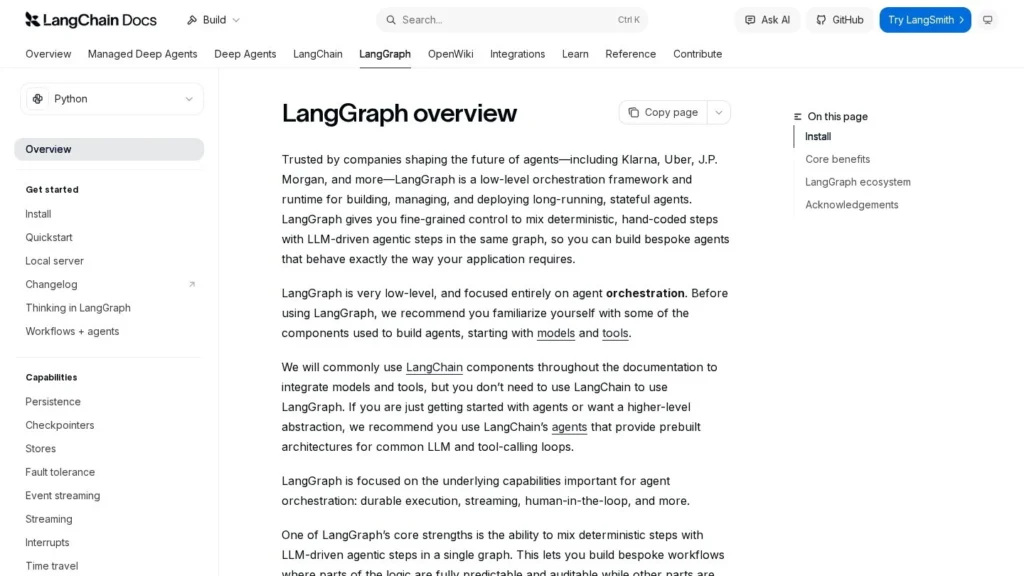
LangGraph costs nothing to use, and Klarna, Uber and J.P. Morgan run agents built on it. It is the open-source orchestration framework from LangChain, the San Francisco company that reached a $1.25 billion valuation in October 2025. Developers use it to build agents that run for a long time, keep state between steps and can stop for a human to check their work.
LangGraph reached version 1.0 in October 2025 alongside LangChain 1.0, and it ships in both Python and JavaScript.
How It Works
An agent in LangGraph is a graph. Nodes are steps, which can be plain code or calls to a language model. Edges decide what happens next, including branches, loops and retries. A shared state object carries data through the graph. That low-level design lets teams combine predictable code with model-driven decisions in one workflow, and it supports multi-agent setups where several agents hand work to each other.
Each step can be checkpointed to memory, SQLite or PostgreSQL, so an agent can resume after a crash or a restart. That durable execution is what makes LangGraph suited to jobs that run for hours or wait on a person. Agents can pause at any node so a human can inspect or edit their state before they continue. The framework also handles streaming, short-term memory within a session and long-term memory across sessions. Releases through 2026 added node timeouts and error handlers. Tracing and debugging run through LangSmith, LangChain’s paid platform.
Pricing
The LangGraph library is free. Costs come from LangSmith, which is optional. Its Developer plan is free for one seat with 5,000 base traces a month. Plus costs $39 per seat per month with 10,000 traces and one free small serverless deployment. Extra deployments are billed by the compute and memory they use, about $0.0675 per vCPU-hour for runtime. Enterprise pricing is custom. Teams can also host LangGraph agents on their own infrastructure.
What to Watch Out For
LangGraph is a developer tool, not a finished agent. It takes real engineering work, and its low-level approach means more code than higher-level frameworks that hide the plumbing. Release cadence is fast, and some updates have required database migrations, so teams should pin versions and test upgrades. Production monitoring and managed hosting push most serious users toward paid LangSmith plans, which is where LangChain makes its money.
User Reviews
No reviews yet. Be the first to rate LangGraph.