
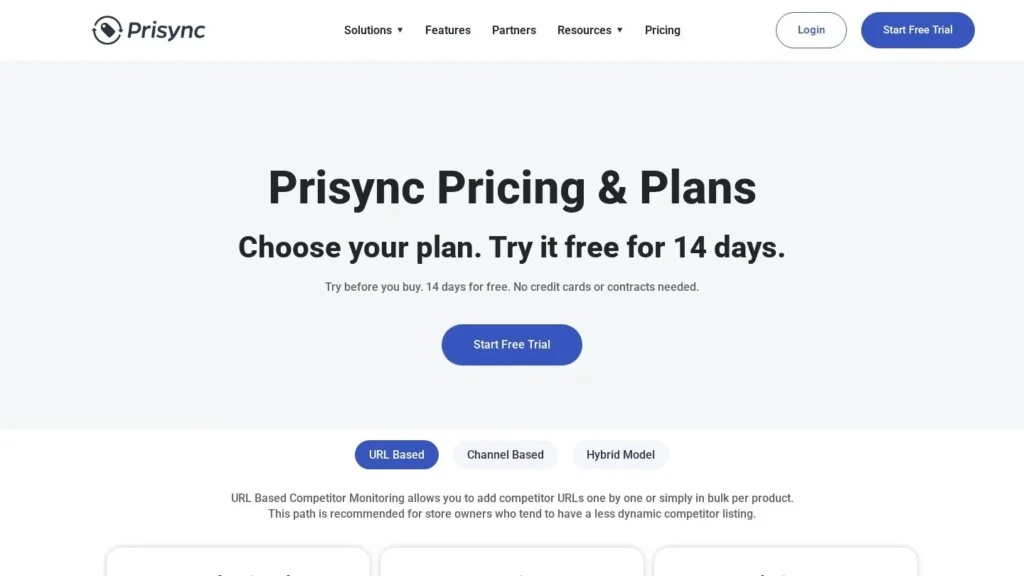
Prisync is a competitor price tracking and repricing tool for online stores. It reads rival product pages, Google Shopping and marketplaces up to three times a day, shows where your price sits against each competitor and, on Premium and Platinum plans, changes your prices by rules you set. Plans start at $99 a month for 100 products, with a 14-day trial that needs no card.
Prisync is built for retail catalogs. It fits stores and brands that compete on price for the same products sold elsewhere, and it holds 4.9 out of 5 across 243 reviews on the Shopify App Store. Companies tracking rival messaging or launches will want a different kind of tool. It scores 8.7/10 on our scale.
Prisync for Online Stores in Five Points
- URL Based plans cost $99, $199 and $399 a month for 100, 1,000 and 5,000 products, with unlimited competitors per product.
- Prices and stock update up to three times a day on any website and in any currency.
- The dynamic pricing engine, from the $199 Premium plan up, reprices by rules that combine your costs with competitor prices.
- Shopify App Store reviewers rate it 4.9 out of 5 across 243 reviews; GetApp reviewers give 4.8 across 129.
- API access adds 20% to the monthly fee, and catalogs above 5,000 products need a custom quote.
Prisync by the Numbers
Prisync publishes full plan details and keeps an active Shopify App Store listing with a large review base.
| Fact | Detail | Source and Date |
|---|---|---|
| Entry plan | URL Based Professional, $99 a month, up to 100 products | Prisync compare plans page |
| Top published plan | Hybrid Platinum, $799 a month, up to 5,000 products | Prisync compare plans page |
| Update frequency | Up to 3 times a day for URL tracking; daily for channel tracking | Prisync compare plans page |
| API pricing | 20% added to the monthly fee | Prisync compare plans page |
| Trial | 14 days, no credit card or contract | Prisync compare plans page |
| Shopify App Store launch | June 16, 2015 | Shopify App Store listing |
| Shopify rating | 4.9 out of 5 from 243 reviews; 96% five-star | Shopify App Store listing |
| Shopify-billed plans | $49, $199 and $399 a month for 100, 1,000 and 5,000 products | Shopify App Store listing |
| GetApp rating | 4.8 out of 5 from 129 reviews | GetApp |
| Capterra rating | 4.8 out of 5 from 129 reviews; reviewers credit SmartMatch with finding competitor URLs | Capterra |
Two numbers stand out for a buyer. The first is the 96% share of five-star ratings on Shopify, which suggests most merchants get what they expected. The second is the price gap between buying direct ($99 for the entry plan) and through the Shopify App Store ($49 for a plan with the same 100-product limit). Shopify merchants should compare both listings before signing up.
Prisync has run since 2015, which matters for a tool that stores price history you may want to analyze for seasonality.
Prisync’s Workflow From Product Match to New Price
Prisync works in four stages: import products, match competitors, collect prices and act on them.
Importing Your Catalog
Products come in through the Shopify or Magento extensions, by Excel upload or through the API. Each product carries its cost if you want margin-aware rules later. The plan limit counts products and variants, so a shirt in five sizes can use five slots on the Shopify-billed plans.
Matching Competitors to Each Product
With URL Based tracking, you add the product page URL for each competitor. There is no limit on competitors per product. Channel Based tracking finds offers on Google Shopping and marketplaces without manual URLs, and Hybrid combines both. Capterra reviewers credit a feature called SmartMatch with finding competitor URLs on its own, and Prisync also sells a competitor matching service for stores that want the matching done for them.
Collecting Prices and Stock
Prisync reads competitor prices and stock status up to three times a day for URL tracking and daily for channel tracking. It covers sites worldwide and converts currencies. The dashboard shows your price position against each rival, and Excel and category reports summarize the catalog.
Alerts on Price Changes
Premium sends daily email notifications of price changes. Platinum adds instant notifications, price history and MAP monitoring, which brands use to spot resellers advertising below minimum advertised price.
Repricing With the Dynamic Pricing Engine
On Premium and above, you write pricing rules. A rule can match the lowest competitor, sit a set amount below the average or stay a percentage above cost. Prisync calculates the new price for each product and pushes it to the store through the integration. Floors based on cost keep the engine from pricing below margin.
Writing Repricing Rules That Protect Margin
The rules decide whether dynamic pricing earns or loses money. Three patterns cover most stores, and each one should carry a cost floor.
- Match the lowest rival: Useful on high-traffic products where shoppers compare prices. Set a floor such as cost plus 15% so a rival clearance sale does not drag your price below margin.
- Stay a fixed amount below the average: Keeps you competitive without chasing the cheapest seller, who may be out of stock or unreliable.
- Hold a premium over the market: For products where your service or shipping is better, price a set percentage above the average and let the rule follow market moves.
Stock data matters here too. Prisync shows whether each rival has the product in stock, and matching an offer no shopper can buy only gives away margin, so review out-of-stock rivals before tightening a rule. Start with rules on a small group of products, watch a week of changes, then widen the scope.
A Week of Repricing at a 600-Product Store
Picture a Shopify store selling 600 kitchen products against four rivals. On the Premium plan the team imports the catalog with costs, adds rival URLs for its 200 top sellers and lets channel tracking cover the rest. The rule: match the lowest rival price, but never go below cost plus 20%. On Tuesday a rival cuts the price of a popular pan. Prisync picks it up on the next update, the rule lowers the store’s price to match, and the daily email lists the change. When the rival raises the price again on Friday, the rule moves the store’s price back up.
What Staff Still Decide
People set the rules, decide which rivals count and check matches when a competitor changes its URLs. Reviewers say URL upkeep is the main ongoing chore, so assign an owner for it.
Prisync Pricing Across Nine Plan Combinations
Prisync prices by product count and tracking model. All plans include unlimited competitors and a 14-day trial.
| Model and Plan | Monthly Price | Products | Updates | Key Additions |
|---|---|---|---|---|
| URL Based Professional | $99 | 100 | 3 times a day | Stock monitoring, Excel reports |
| URL Based Premium | $199 | 1,000 | 3 times a day | Dynamic pricing, marketplace and variant tracking, API |
| URL Based Platinum | $399 | 5,000 | 3 times a day | Instant alerts, price history, MAP monitoring |
| Channel Based Professional | $199 | 100 | Daily | One sales channel included |
| Channel Based Premium | $399 | 1,000 | Daily | Premium features plus one channel |
| Channel Based Platinum | $599 | 5,000 | Daily | Platinum features plus one channel |
| Hybrid Professional | $299 | 100 | Up to 3 times a day | One sales channel included |
| Hybrid Premium | $599 | 1,000 | Up to 3 times a day | Dynamic pricing, API |
| Hybrid Platinum | $799 | 5,000 | Up to 3 times a day | Instant alerts, price history, MAP |
Add-ons: API access costs 20% on top of the monthly fee, and extra sales channels cost $100 a month on Professional and $200 on Premium and Platinum. Catalogs above 5,000 products are quoted.
Choosing Between URL, Channel and Hybrid Tracking
The tracking model drives the price as much as the product count. URL Based is the cheapest and most precise, because you choose each rival page, and it updates up to three times a day. The cost is setup time: someone has to find and paste every competitor URL. Channel Based reads Google Shopping and marketplace listings instead, so there is no URL list to keep, but it updates daily and costs $100 to $200 more per tier. Hybrid combines the two for stores that want precise tracking on key rivals and broad coverage elsewhere.
A practical split for many stores is URL Based tracking on the top sellers, where a few rivals matter most, and channel tracking on the long tail. That points to Hybrid once the catalog passes a few hundred products.
Prisync Costs for Three Kinds of Store
- A 90-product niche store: URL Based Professional at $99 a month is $1,188 a year. It tracks prices and stock but does not reprice; changes stay manual.
- A 600-product store that wants repricing and API access: URL Based Premium at $199 plus 20% for the API is $238.80 a month, or $2,865.60 a year.
- A 3,000-product brand watching resellers and Google Shopping: Hybrid Platinum at $799 a month is $9,588 a year, with MAP monitoring, price history and one channel included.
Shopify merchants should price the App Store plans as well: the listing shows $49 for 100 products and $199 for 1,000, billed through Shopify, with extra charges for channel or hybrid tracking on the higher tiers.
Prisync Compared With Visualping, Klue and Crayon
Prisync is the e-commerce specialist in this group. The others watch web pages or brief sales teams.
| Agent | Starting Price | Free Plan | Main Strength | Main Weakness | Best For |
|---|---|---|---|---|---|
| Prisync | $99 a month | Trial | Product-level price and stock tracking with repricing rules | API and repricing cost extra tiers | Online stores and brands |
| Visualping | Free; $14 a month | Yes | Watches any page with AI importance flags | No product matching or repricing | Teams watching a few rival pages |
| Klue | Quote-based | No | Deal Tips and battlecards for sellers | No published pricing | B2B sales teams |
| Crayon | Quote-based | No | Field Agent and AI battlecards | High cost per reviewer data | Enterprise product marketing |
A store with a handful of rival product pages could start on Visualping’s free plan, but it would need to read each alert and change prices by hand. Prisync makes sense once there are dozens or hundreds of products to match and reprice. Klue and Crayon serve B2B sales teams and do not track product prices. See more in our competitor monitoring agents guide and the e-commerce agents category.
Online Retailers Competing on the Same Products
- Stores selling branded goods available elsewhere: When shoppers can buy the same item from several sites, price position decides sales, and Prisync shows it product by product.
- Shopify and Magento merchants: Native extensions import the catalog and push new prices back.
- Brands policing reseller pricing: Platinum adds MAP monitoring and a recommended price module for suppliers.
- Teams with 100 to 5,000 products: The published tiers cover this range, with custom quotes above it.
Sellers Who May Need a Different Tool
- Brands selling only their own unique products: With no identical products elsewhere, there is little to match. Broader market data tools suit them better.
- Amazon-only sellers: Prisync tracks Amazon prices, but repricing inside Seller Central is the job of dedicated Amazon repricers.
- B2B and software companies: Klue or Crayon track messaging and launches and brief sellers.
- Very large catalogs: Above 5,000 products the plans move to a custom quote, so enterprise retailers should compare it with dedicated pricing platforms.
URL Matching, Update Timing and Add-On Costs
- URL management: Reviewers name competitor URL upkeep as the main chore. Rival sites change URLs, and matches need fixing.
- Update delays: Some reviewers mention delays in data updates, in a few cases up to two days for new data to appear. Channel tracking updates daily, so it suits slower-moving categories.
- New products: Capterra reviewers note that new products are not added to tracking lists automatically, so add them when you launch.
- Repricing tier: Dynamic pricing starts at Premium. A Professional plan only tracks.
- API surcharge: API access adds 20% to the bill, which matters for stores feeding prices into their own systems.
- Two price lists: Direct and Shopify-billed prices differ. Check which one applies before you subscribe.
Our Read on Prisync for E-Commerce Pricing
Prisync scores 8.7/10 on our scale. Clear published pricing, unlimited competitors, a no-card trial and high ratings from merchants make it an accessible pick for stores that compete on price. The dynamic pricing engine turns tracking into action once a store reaches the Premium plan.
Prisync could improve by automating competitor URL upkeep and by publishing more on data security. For a store that sells products also sold elsewhere, the 14-day trial on the top 100 products is the cleanest test: compare the price changes it catches with what the team noticed by hand. If the trial shows rivals moving prices several times a week, the case for Premium and automatic repricing follows from the numbers. If rivals rarely move, the Professional plan with daily checks by the team may be enough.
Store Owners’ Questions About Prisync
How Much Does Prisync Cost Per Month?
Direct plans start at $99 a month for 100 products on URL Based tracking and go up to $799 for 5,000 products on Hybrid Platinum. The Shopify App Store lists Shopify-billed plans at $49, $199 and $399.
Does Prisync Change My Prices Automatically?
Yes, on Premium and Platinum. The dynamic pricing engine applies rules that combine your product cost with competitor prices and pushes new prices through the integration. Set a cost floor on every rule so a rival’s clearance sale cannot pull your price below margin.
Can Prisync Track Amazon and Google Shopping?
Yes. Channel Based and Hybrid plans pull offers from Google Shopping and marketplaces, and the Shopify listing names Amazon among supported sources.
Can I Try Prisync Before Paying?
Every plan has a 14-day free trial with no credit card or contract. There is no permanent free plan. Use the trial on your best-selling products, since those show price moves fastest and give the clearest read on whether the tool pays for itself.
How Many Competitors Can Prisync Track?
All plans allow unlimited competitors per product. The limit is the number of your own products: 100, 1,000 or 5,000 on published plans. On the Shopify-billed plans, variants such as sizes and colors count toward that limit, so check how your catalog is structured before choosing a tier.
User Reviews
Nobody has rated it here yet. Be the first AI Agents Choice user to rate Prisync.