
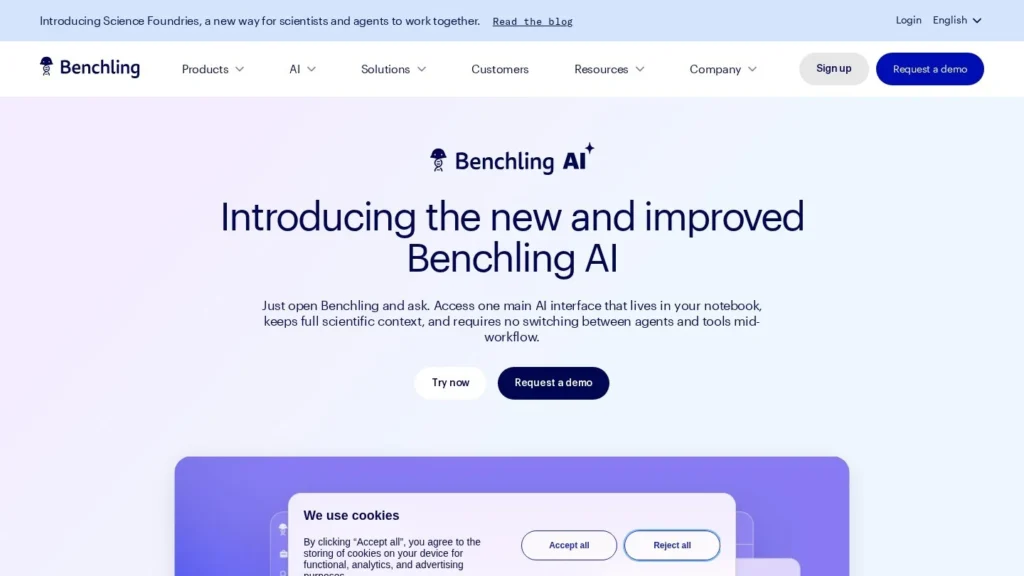
Benchling’s head of AI, Nicholas Larus-Stone, predicted on stage in May 2026 that AI agents would handle 75% of biology data analysis tasks within a year. His company is betting on that with Benchling AI, a set of agents and models built into the R&D software that many biotech and pharma labs already use for notebooks, sample registries and results.
Every Benchling subscription includes AI credits, and admins switch the features on from the admin console.
How It Works
A single assistant inside the Benchling notebook searches across a lab’s data, answers questions and keeps experimental context as work moves along. Agents handle specific jobs: turning PDFs and contract research organization reports into structured data, drafting notebook entries and study reports, writing SQL queries, checking notebook entries and, since May 2026, running exploratory data analysis. Experiment Optimization uses Bayesian methods to suggest the next conditions to test, mainly for bioprocess teams.
Model Hub runs structure prediction models such as AlphaFold 2, Chai-1 and Boltz-2 without leaving the platform. Teams can choose among models from Anthropic, Google, OpenAI, NVIDIA BioNeMo and Lilly TuneLab, and connect outside systems such as Teams, SharePoint and Slack through the Model Context Protocol. Benchling says it does not train its own models on customer data, logs AI actions in audit trails and holds SOC 2 Type 2 and ISO 27001 compliance.
Pricing
Benchling AI is not sold separately. SQL Writer and Notebook Check are included at no extra cost, while agents and models draw on credits that come with every subscription. The company does not publish dollar prices for Benchling itself or for extra credits. Academic scientists can use the AI features free through the academic plan.
What to Watch Out For
The AI only works on data stored in Benchling, so its value depends on how much of a lab’s work already lives there. Credit use is not priced publicly, which makes heavy use of models and agents hard to budget. Several pieces, including outsourced ordering and the newer agents, are early access or recently released. Generated analyses and reports still need review by scientists before they feed decisions.
Recent News
In May 2026, around the SynBioBeta conference, Benchling launched One-Click Ordering, Benchling Biologics and a Data Analysis skill for its AI. On August 27, 2026, it unveiled Benchling Agents, which can register molecules, process results and update workflows, shortly after announcing tools that let scientists build apps from plain-language descriptions.
User Reviews
No reviews yet. Be the first to rate Benchling AI.