

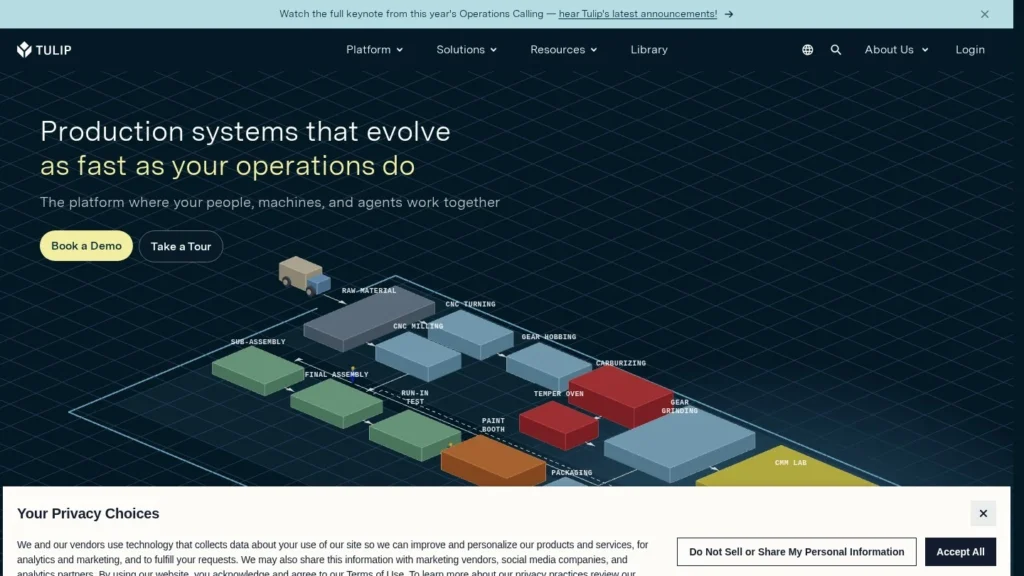
Tulip’s AI agents cost nothing extra for now. They are in open beta, opt-in and outside the company’s usage-based AI pricing, which is unusual for industrial software. The agents run on Tulip’s no-code platform, where 43,000 apps supported 60,000 frontline workers across about 1,000 customer sites in 2025.
Tulip pitches them as agents that act on problems instead of only flagging them, and named AstraZeneca, Eli Lilly, Stanley Black & Decker and DMG Mori case studies at the launch event.
How Tulip AI Agents Works
Tulip customers already build shop-floor apps for work instructions, quality inspections and machine monitoring without writing code. The agents sit on top of that data. Teams can build an agent from scratch in an agent builder, setting its role, instructions and the actions it is allowed to take, or download a prebuilt one from Tulip’s Library. Tulip’s examples include agents that enforce quality checks, reschedule production tasks, generate validation documentation and automate rework.
Every agent’s logic and actions are visible, which Tulip says matters for validation in regulated plants. The agents sit alongside Tulip’s other AI tools: an AI Chat widget, Chat with Tables for asking questions of production data, AI Composer for turning PDFs into apps, and Tulip MCP for connecting outside AI tools. Automations link workflows to ERP and PLM systems.
Tulip AI Agents Pricing
Tulip’s platform plans are reported at $100 per interface per month for Essentials and $250 for Professional, both billed annually, with Enterprise and Regulated Industries quoted on request. There is no free tier. AI features share a monthly allowance of 250, 500 or 1,000 AI actions depending on plan, and extra actions are bought through a Tulip representative. During the beta, agent usage is neither tracked nor billed, but expect that to change when agents become generally available.
What to Watch Out For
The agents are beta software, so features and pricing can shift. They only make sense for plants that run on Tulip, and per-interface pricing adds up across many stations. Tulip has published usage growth (adoption of its generative AI features rose 364% over two years) but not independent results for the agents themselves.
Recent News
Tulip unveiled its composable AI agents at its Operations Calling conference in October 2025. In January 2026 it raised $120 million in a Series D led by Mitsubishi Electric, valuing the company at more than $1.3 billion.
User Reviews
Nobody has rated it here yet. Be the first AI Agents Choice user to rate Tulip AI Agents.