
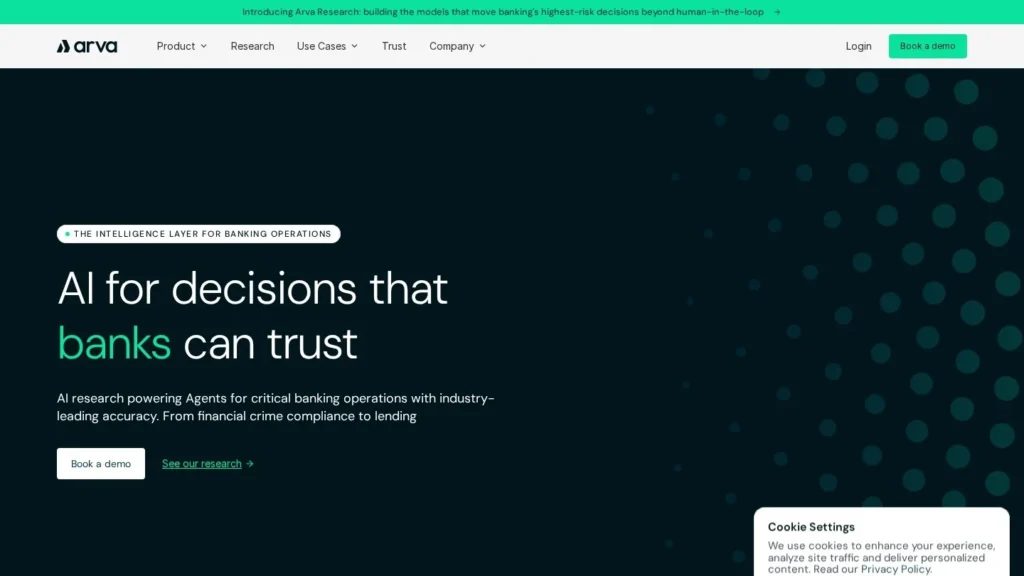
Arva AI builds AI agents that run KYB reviews on business applicants for banks, payment providers and fintechs. While a company is still in the onboarding flow, the agents research it online, verify its documents, check for fraud and message the applicant for anything missing, then decide low and medium-risk cases on their own. Arva reports that its agents handle up to 92% of reviews at deploying companies. Pricing is quote-based.
It fits financial institutions that onboard business customers and see applications pile up in analyst queues. It is a young company, founded in 2024 with about 20 staff, so buyers trade a focused product for less operating history. Consumer identity checks are better served by a verification platform. Arva AI scores 7.6/10 on our scale.
Arva AI KYB Agents in Five Points
- Arva’s agents review business applicants in real time: web research, document checks, fraud checks and messages to the applicant.
- Arva reports up to 92% of reviews handled by AI, more than 40% more straight-through processing and over 100,000 alerts a month.
- Its first proprietary model, Arva Intel, beat general-purpose models by 13% on precision in an independent evaluation, per Arva.
- FairPlay validates the agents against SR 11-7 and the NIST AI Risk Management Framework.
- Arva raised a $3 million seed round led by Google’s Gradient fund; pricing is quote-based.
Arva AI by the Numbers
Arva’s public figures come from its Y Combinator pages, its seed announcement and Finovate’s coverage of its partnerships and research launch.
| Fact | Detail | Source and Date |
|---|---|---|
| Founded | 2024; Y Combinator Summer 2024 batch | Y Combinator launch page, August 2024 |
| Team | About 20 employees, based in New York City | Y Combinator company profile |
| Seed round | $3 million led by Google’s Gradient fund, with Y Combinator, Amino Capital and Olive Tree Capital | FinTech Global, January 16, 2025 |
| AI share of reviews | Up to 92% of reviews handled by AI | Finovate, September 24, 2025 |
| Straight-through processing | More than 40% increase at deploying companies | Finovate, September 24, 2025 |
| Alert volume | More than 100,000 alerts processed a month | Finovate, September 24, 2025 |
| Arva Intel | 13% better precision than general-purpose models in an independent evaluation | Finovate, September 14, 2026 |
| Research effort | More than 5,000 hours of research, training and evaluation | Finovate, September 14, 2026 |
| Claimed savings | 80% lower operations spend and onboarding 100x faster | Y Combinator launch page, August 2024 |
| Problem size | Analysts verify by hand in over 40% of business onboarding cases | Y Combinator launch page, August 2024 |
The 92% figure is the one to test. It describes the share of reviews the agents handle at companies that deploy Arva, and it will depend on each institution’s risk appetite and customer mix. A bank onboarding mostly small domestic companies should see higher automation than one onboarding complex foreign entities.
The FairPlay partnership matters for a different reason. Banks cannot put an AI agent into a compliance process without model risk review, and evidence aligned with SR 11-7 and the NIST framework shortens that review. Arva’s founder led the FinCrime product team at Revolut Business, which shows in that focus.
The customer communication piece is often overlooked. Much of the delay in business onboarding is waiting: for a missing document, for an answer about ownership, for an analyst to send the next email. An agent that asks and reads the reply in the same session removes days of back-and-forth, which is where the drop-off Arva cites comes from.
How Arva Agents Review a Business Applicant
Arva targets the part of onboarding where a business applicant waits for an analyst. The agents do that analyst’s routine work while the applicant is still in the flow.
Why Business Onboarding Stalls
Arva’s launch page cites two problems. Analysts verify by hand in more than 40% of business onboarding cases, and slow onboarding can cause up to 50% of applicants to drop off. Compliance operations at large fintechs can cost millions a year, and manual reviews vary from analyst to analyst.
Web Due Diligence
The agent researches the business across registries, its website, social media and other public sources. It turns that unstructured material into a risk assessment: does the company exist, does it do what it says, and do any signals point to risk?
Document Verification and Fraud Checks
Uploaded documents go through AI document intelligence that extracts data and looks for signs of tampering or fraud. The agent also checks for known fraudsters connected to the application.
Talking to the Applicant
When something is missing or unclear, the agent handles the back-and-forth with the customer, asking for a document or an explanation and reading the reply. Applicants are not left waiting for an analyst to send an email days later.
Deciding or Escalating
For low and medium-risk cases within the institution’s rules, the agent completes the review in real time. Higher-risk cases go to analysts. Arva’s September 2026 research focuses on the highest-risk decisions, where it says AI has not yet been accurate enough to remove people safely.
Arva Intel and AgentCore
Arva Intel is a proprietary decisioning model built for data enrichment, transaction analysis and evidence-based reasoning. AgentCore turns analyst corrections and case outcomes into improvements that are backtested and versioned before release. The Research Lab plans to extend the work to payment exceptions, disputes and other customer investigations.
A Payment Provider Onboarding a Merchant
Picture a payment provider onboarding an online furniture store. The merchant submits its registration number and a utility bill. Arva’s agent pulls the company record from the registry, reads the store’s website and social pages, and checks that the address matches. The utility bill passes document checks, but the beneficial owner’s name is missing. The agent messages the applicant, who replies with a shareholder register. The agent extracts the owner, runs the checks, finds nothing adverse and approves the merchant inside the provider’s risk rules. A different applicant, a holding company with offshore owners, is routed to an analyst with the agent’s research attached.
Setting Up an Arva Pilot
- Pull a sample: Export a month of past business applications with the analysts’ final decisions and notes.
- Define risk tiers: Write down which applicants count as low, medium and high risk under your policy.
- Run the agent in shadow mode: Let the agent review the sample and compare its decisions with the analysts’.
- Check the disagreements: Read every case where the agent and analyst differ. Some will be agent errors, some analyst errors.
- Go live on one tier: Let the agent close low-risk cases first, then widen scope as agreement holds.
This is our suggested order for a careful rollout. It also produces the evidence a model risk team will ask for.
What KYB Analysts Keep at Arva
Analysts set the risk appetite, handle high-risk and unusual cases, correct the agent when it is wrong and sign off on policy. Their corrections feed AgentCore, so the agent improves over time.
Arva AI Pricing and What to Ask
Arva does not publish prices. Deployments are scoped with its team.
| Item | Price | Billing | What Is Included | Notes |
|---|---|---|---|---|
| KYB agents | Quote-based | Contract | Web due diligence, document checks, fraud checks, applicant messaging | Modular or end to end |
| AML alert review | Quote-based | Contract | Agent review of alerts at volume | Ask about per-alert pricing |
| Arva Intel and AgentCore | Ask in demo | Contract | Proprietary model and continuous improvement | Confirm availability |
Sizing the Opportunity From Your Queue
- A fintech onboarding 2,000 businesses a month: If 40% need a manual review, as Arva’s launch page states is common, that is 800 reviews. At 92% handled by AI, about 64 would remain for analysts.
- A bank with 30-minute manual KYB reviews: 800 reviews × 30 minutes is 400 analyst hours a month. Compare that with the quote.
- A payment provider losing applicants: If drop-off falls as reviews move to seconds, the revenue from retained merchants belongs in the business case.
The 30-minute review time is an example input. Use your own queue data and ask Arva to model it.
Questions to Ask Arva Before Signing
- Pricing unit: Is pricing per application, per alert, per decision or a platform fee?
- Data sources: Which registries and data providers does the agent read in our markets, and who pays for them?
- Integration: How does Arva connect to our onboarding flow and case management system?
- Override controls: Can analysts change risk thresholds themselves, and how fast do changes take effect?
- Audit trail: What evidence does each agent decision leave for examiners?
Arva AI Compared With Sumsub, Persona and Fenergo
These vendors approach compliance onboarding from different sides.
| Agent | Starting Price | Free Plan | Main Strength | Main Weakness | Best For |
|---|---|---|---|---|---|
| Arva AI | Quote-based | No | Agents that decide routine KYB reviews in real time | Young company | Fintechs and banks onboarding businesses |
| Sumsub | $1.35 per verification, $149 minimum | Trial | Self-serve verification with published prices | Business verification on Custom plans | Online businesses verifying consumers |
| Persona | $250 a month, 12-month term | Startup program | Configurable flows and case review agents | Agents in early access | Platforms with large review queues |
| Fenergo | Quote-based | No | KYRA agents in a client lifecycle platform | Enterprise implementation | Large banks with institutional clients |
Arva fits between them: narrower than Fenergo’s lifecycle platform and more focused on business review work than Sumsub or Persona. A fintech could use Sumsub to verify the people behind a business and Arva to review the business itself.
Using Arva Alongside a Verification Platform
Arva describes its product as usable as a module inside an existing compliance stack. In practice that means a fintech can keep its identity vendor for the people (directors, owners, signatories) and hand the business review to Arva: does the company exist, does its website match its stated activity, are its documents genuine, and is anything adverse online. The two outputs meet in the case file, and the analyst sees one combined picture for the cases that still need a person.
See more in our customer onboarding agents guide and the banking agents category, which also lists Bretton AI for investigation queues.
Fintechs and Banks Onboarding Business Customers
- Payment providers and merchant acquirers: Merchant onboarding needs KYB on every applicant, and real-time decisions reduce drop-off.
- Business banking fintechs: Arva’s founder ran FinCrime product at Revolut Business, the use case the product is built around.
- Banks and credit unions with KYB backlogs: Finovate lists banks and credit unions among Arva’s target customers.
- Compliance teams facing model risk review: FairPlay validation evidence aligned with SR 11-7 supports internal approval.
- Institutions with high applicant drop-off: Real-time decisions and agent messaging target the waiting that makes applicants give up.
Teams That May Choose a Different Approach
- Consumer apps: Sumsub or Persona handle individual identity verification at sign-up.
- Large banks wanting one lifecycle platform: Fenergo covers onboarding, reviews and screening in one system of record.
- Buyers requiring a long vendor track record: Arva was founded in 2024, so procurement teams with strict tenure rules may need extra review.
Vendor Maturity, Validation and Risk Appetite
- Company size: About 20 employees per its YC profile. Ask about support coverage and continuity plans.
- Company-reported figures: The 92% and 40% figures come from Arva. Test them on a sample of your own cases.
- Risk appetite: Decide which risk tiers the agents may close. Keep high-risk cases with analysts.
- Model governance: Ask for the FairPlay validation evidence and backtest results for your model risk team.
- Customer references: Arva says its systems are live at financial institutions. Ask for references.
Arva AI From Seed Round to Research Lab
In January 2025, Arva raised $3 million in a seed round led by Google’s Gradient fund to build out its AML and KYB automation. Gradient partner Eylul Kayin said the approach to automating business verification was what the industry needed.
On September 24, 2025, Finovate reported a partnership with FairPlay to validate Arva’s agents using scenario-based stress testing and documentation aligned with SR 11-7 and the NIST AI Risk Management Framework. On September 14, 2026, Arva launched its Research Lab and Arva Intel, with AgentCore turning analyst corrections into versioned improvements.
Arva AI for Faster Business Onboarding
Arva AI scores 7.6/10 on our scale. Agents that complete routine KYB reviews during onboarding, a reported 92% AI share of reviews and validation work aimed at bank model risk standards make it a focused option for institutions onboarding businesses.
It could improve by publishing pricing guidance and naming production customers. For a fintech with a KYB backlog, a pilot on a month of past applications, comparing the agent’s calls with analyst decisions, is the fastest way to see whether the automation rate holds for its own customers.
Pair the pilot with a drop-off measure. If applicants who get an answer in seconds finish onboarding more often than those who wait for an analyst, the case for Arva rests on revenue as well as analyst hours.
Compliance Teams’ Questions About Arva AI
What Does Arva AI Do?
Arva builds AI agents that run KYB and AML reviews for banks and fintechs. They research businesses, verify documents, check for fraud and message applicants, deciding low and medium-risk cases in real time.
How Much Does Arva AI Cost?
Arva does not publish prices. Deployments are quoted based on volume and modules.
Who Founded Arva AI?
Rhim Shah, who led the FinCrime product team at Revolut Business, and Oli Wales, a former lead product engineer at Opvia. The company went through Y Combinator in Summer 2024.
Is Arva AI Safe for Regulated Banks?
Arva works with FairPlay to validate its agents with stress testing and documentation aligned with SR 11-7 and the NIST AI Risk Management Framework. High-risk cases stay with analysts, and AgentCore keeps each model change backtested and versioned so reviewers can see what changed and when.
How Is Arva Different From Sumsub?
Sumsub verifies individuals at sign-up with self-serve pricing. Arva focuses on reviewing businesses and AML alerts with agents, sold through scoped deployments. Many fintechs that onboard businesses will need both kinds of check, one for the people and one for the company.
User Reviews
Nobody has rated it here yet. Be the first AI Agents Choice user to rate Arva AI.