
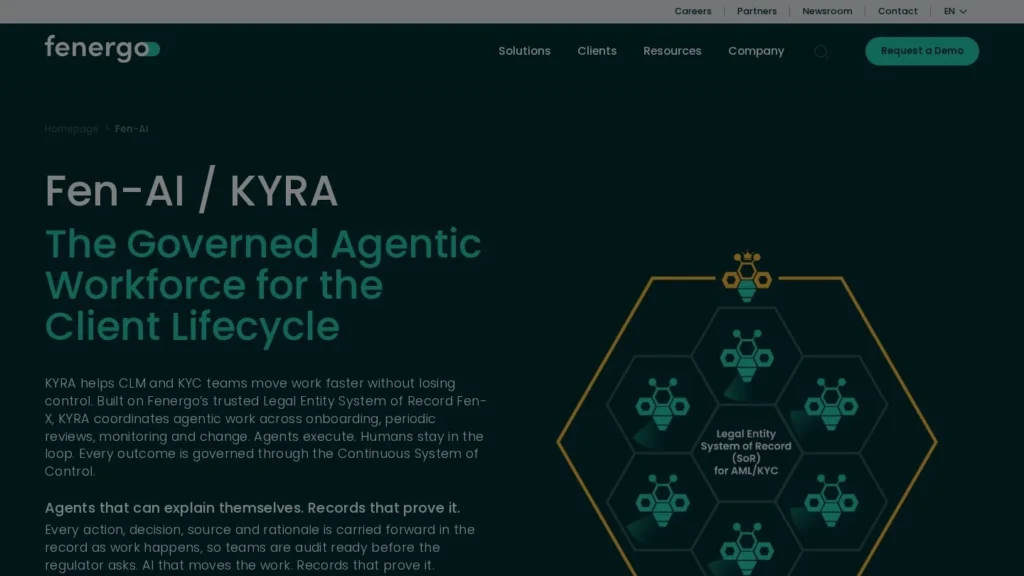
Fenergo is a client lifecycle management platform for banks and other financial institutions, and its KYRA agents take on the routine work of KYC onboarding: pulling entity data from providers, clearing screening hits, reading documents and filling in workflow steps. Fenergo says the agents can cut operating costs on those tasks by up to 93%. Pricing is quote-based.
It fits banks, asset managers and fund administrators that onboard corporate and institutional clients and run periodic reviews on thousands of entities. The Citco Group and Northern Trust were early adopters. Fintechs verifying consumers at sign-up will find a self-serve identity tool quicker to start. Fenergo scores 7.7/10 on our scale.
Fenergo KYRA Agents in Five Points
- Fenergo launched its FinCrime Operating System with six AI agents on May 28, 2025; the agents are now branded KYRA.
- Fenergo states up to 93% lower operating cost, up to 45% shorter periodic reviews for low-risk clients and up to 72% faster document handling.
- KYRA agents source data, resolve screening hits, process documents, flag significant changes, complete tasks and build reports.
- Every agent request is authenticated and every decision attributed and logged; humans remain accountable.
- Pricing is quote-based through enterprise contracts.
Fenergo by the Numbers
Fenergo’s agent figures come from its May 2025 launch release and its KYRA product page.
| Fact | Detail | Source and Date |
|---|---|---|
| FinCrime OS launch | Agentic AI layer combining onboarding, KYC, screening, ID&V and transaction monitoring | Fenergo press release, May 28, 2025 |
| Agents at launch | Six: Data Sourcing, Screening, Document, Significance, Autocompletion and Insights | The Fintech Times, May 29, 2025 |
| Operating cost | Up to 93% reduction on automated tasks | Fenergo press release, May 28, 2025 |
| Periodic reviews | Up to 45% shorter for a straight-through low-risk review | Fenergo press release, May 28, 2025 |
| Documents | Up to 72% faster document handling | Fenergo press release, May 28, 2025 |
| Early adopters | The Citco Group and Northern Trust | Fenergo press release, May 28, 2025 |
| Current agents | KYRA:Complete, Screen, Docs, Source, Signal and Report | Fenergo KYRA page |
| Industry problem | 7 in 10 institutions lost a client to slow onboarding, an estimated $2.72 billion cost | Fenergo KYRA page |
| Partners | AWS, Salesforce, Deloitte, PwC, LSEG, Moody’s, LexisNexis | Fenergo KYRA page |
All three performance numbers are stated as “up to,” which means best-case results from Fenergo’s own estimates. The 45% figure is specific: a straight-through periodic review of a low-risk client. That is the case agents should handle best, so a bank can treat it as a ceiling for its low-risk book and expect less on complex entities.
The early adopters matter more than the percentages. Citco and Northern Trust run institutional onboarding at scale, and their participation suggests the agents were built against real enterprise workloads. Ask for reference calls with institutions of similar size.
The industry figure on Fenergo’s page frames the stakes: 7 in 10 institutions say they lost a client to slow onboarding, at an estimated cost of $2.72 billion. For a corporate bank, onboarding speed is a revenue question as much as a compliance one, and the agents are pitched at both.
How KYRA Agents Handle a Corporate KYC File
Fenergo organizes its agents into four classes: Automation, Intelligence, Autonomy and Compound. The six named KYRA agents sit in the Automation class.
Why Corporate KYC Takes So Long
Opening an account for a person needs one ID and one face. Opening one for a company is slower. The bank has to find out who owns and controls it, which can mean tracing shares through several holding companies. It has to check each owner and director against sanctions and watch lists. It has to read registry extracts, articles and registers that arrive in different formats from different countries. Then it has to do much of this again at every periodic review. Each step is routine on its own, and there are many of them. That is the work KYRA is aimed at.
The Six Automation Agents
- KYRA:Source: Retrieves client data from providers, reconciles it with the record and flags conflicts before they reach the profile.
- KYRA:Screen: Resolves routine screening hits by comparing matches and assessing materiality.
- KYRA:Docs: Classifies documents, extracts data and links it into records ready for review.
- KYRA:Signal: Decides which events or data changes meet thresholds for escalation.
- KYRA:Complete: Fills routine fields, forms and workflow steps using known rules.
- KYRA:Report: Turns authorized lifecycle data into governed reports and dashboards.
Intelligence, Autonomy and Compound Classes
Beyond automation, the Intelligence class watches across clients and events, assembles context and surfaces the next judgment for a person without closing decisions itself. The Autonomy class keeps context over time, coordinates steps and acts within approved policy, escalating when confidence, sensitivity or regulation calls for a person. The Compound class combines several agents dynamically to make operations more predictive.
Where People Stay in Charge
Humans set the rules, review exceptions and control what gets committed. Fenergo states that KYRA does not replace compliance teams and does not become the accountable party. Every request is authenticated, every decision attributed, and actions, sources and reasoning are logged to Fen-X, the legal entity system of record.
Connections to Bank Systems and Other Agents
Fen-AI reaches Fen-X through MCP. An A2A interface routes requests from approved client, Fenergo and third-party agents through one governed entry point. CLM for Salesforce brings the platform to banks that run relationship management on Salesforce, and Integration Hub and Flows connect to other systems. Data partners include LSEG, Moody’s and LexisNexis.
The Command Centre
A role-based Command Centre shows agent activity in real time: tasks completed, analyst hours returned, manual effort avoided, throughput gained, entities covered and workload by agent. Operations leads use it to decide where to extend automation.
A Corporate Client Onboarding With KYRA
Picture a bank onboarding a mid-size trading company with three directors and two corporate shareholders. KYRA:Source pulls registry and data provider records and reconciles them with what the relationship manager entered, flagging a mismatch in the registered address. KYRA:Docs reads the certificate of incorporation and shareholder register and links the data to the entity. KYRA:Screen runs the directors through screening and clears two false-positive name matches, leaving one possible match for an analyst. KYRA:Complete fills the routine fields. The analyst reviews the address conflict and the one screening hit, then approves. Six months later, KYRA:Signal notices a change of director and decides it meets the threshold for a review.
Preparing for a Fenergo Deployment
- Map the policy: Agents act on known rules, so write the screening materiality and escalation thresholds down first.
- Line up data providers: Confirm which providers KYRA:Source will query and how licenses are handled.
- Choose the first workload: Low-risk periodic reviews are where Fenergo states the clearest gains.
- Set Command Centre targets: Agree how analyst hours returned and throughput will be judged after go-live.
Fenergo Pricing and Enterprise Contracts
Fenergo does not publish prices. Licensing is agreed through demos and enterprise contracts.
| Item | Price | Billing | What Is Included | Notes |
|---|---|---|---|---|
| FinCrime OS | Quote-based | Enterprise contract | Onboarding, KYC, screening, ID&V, transaction monitoring | Scope by modules |
| KYRA agents | Ask in demo | Enterprise contract | Source, Screen, Docs, Signal, Complete, Report | Confirm which agents are licensed |
| CLM for Salesforce | Ask in demo | Enterprise contract | Fenergo client lifecycle management inside Salesforce | For Salesforce banks |
Building the Business Case From Analyst Hours
With no list price, the case rests on review volumes and analyst time.
- A bank with 4,000 low-risk periodic reviews a year: If each takes 3 analyst hours, that is 12,000 hours. At Fenergo’s stated ceiling of 45% less time, the maximum saving is 5,400 hours; plan for less.
- A fund administrator onboarding 600 entities a year: If document handling takes 2 hours per entity, that is 1,200 hours; a 72% ceiling would return up to 864.
- A screening team clearing false positives: Count the hits cleared each month and the minutes per hit to size the KYRA:Screen opportunity.
The hours per review are example inputs for the arithmetic. Use your own figures and ask Fenergo how pricing scales with entities, users or agents.
What to Settle Before Signing
- Agent licensing: Are all six KYRA agents included, or licensed one by one?
- Data provider costs: KYRA:Source queries outside providers. Are those data costs part of the Fenergo contract or billed by the provider?
- Volume basis: Is pricing tied to entities, reviews, users or modules?
- Implementation partner: Fenergo lists Deloitte and PwC as partners. Will a partner run the deployment, and at what cost?
- Model governance support: What documentation does Fenergo provide for model risk review of the agents?
Fenergo Compared With Sumsub, Persona and Bretton AI
These vendors all automate compliance onboarding, at very different scales.
| Agent | Starting Price | Free Plan | Main Strength | Main Weakness | Best For |
|---|---|---|---|---|---|
| Fenergo | Quote-based | No | KYRA agents across the full client lifecycle | Enterprise implementation and pricing | Banks onboarding institutional clients |
| Sumsub | $1.35 per verification, $149 minimum | Trial | Self-serve verification with published prices | Business verification on Custom plans | Online businesses verifying consumers |
| Persona | $250 a month, 12-month term | Startup program | Configurable flows and case review agents | Agents in early access | Platforms with large review queues |
| Bretton AI | Quote-based | No | Agents that run KYC, AML and sanctions investigations | No published pricing | Banks with large alert queues |
Fenergo is the system of record for client data; Sumsub and Persona verify individuals at sign-up; Bretton AI works investigation queues. A large bank might run Fenergo for corporate onboarding and an investigation agent for alert backlogs.
Fenergo’s A2A interface is relevant here. It routes requests from approved third-party agents through one governed entry point, so an investigation agent from another vendor could, in principle, work against the same client record under Fenergo’s controls. Ask both vendors how that connection would work in your setup.
See more in our customer onboarding agents guide and the banking agents category.
Banks and Asset Managers With Institutional Clients
- Corporate and investment banks: Multi-entity onboarding with ownership chains is where data sourcing and document agents save the most.
- Fund administrators: Citco’s early adoption points to fit for high-volume investor and entity onboarding.
- Institutions with periodic review backlogs: Signal and Complete agents target the low-risk reviews that fill analysts’ queues.
- Banks on Salesforce: CLM for Salesforce keeps onboarding inside the relationship management system.
- Compliance teams with high false-positive rates: KYRA:Screen clears routine screening hits so analysts see only the matches that need judgment.
- Institutions planning for agent-to-agent work: The A2A interface and MCP access let a bank connect its own agents and approved third-party agents under one set of controls.
Institutions That May Want a Lighter Option
- Fintechs verifying consumers: Sumsub or Persona start faster with self-serve flows.
- Small banks and credit unions: An enterprise CLM deployment may be more than needed; check vendors built for smaller institutions.
- Teams needing a quick pilot: Fenergo deployments involve integration work, so timelines run longer than self-serve tools.
- Businesses onboarding small companies online: A fintech verifying sole traders and small firms at sign-up may get further with a KYB service built for self-serve onboarding, such as Arva AI.
Vendor Estimates, Integration Work and Peer Checks
- Up-to figures: Cost and time savings are maximums from Fenergo. Measure baselines before go-live.
- Implementation: Expect integration with core systems, data providers and possibly Salesforce.
- Accountability: Agents do not become the accountable party, so keep sign-off roles clear in procedures.
- Peer references: Ask for calls with institutions of similar size that run the agents in production.
- Model governance: Bring model risk teams in early; Fenergo states the OS was built in line with global AI acts and regulatory guidelines.
Fenergo’s Agentic FinCrime OS Release
On May 28, 2025, Fenergo launched its FinCrime Operating System with an agentic AI layer that unifies onboarding, KYC, screening, ID&V and transaction monitoring. CEO Marc Murphy described the aim as turning compliance from a reactive cost center into a strategic advantage.
Crowdfund Insider and The Fintech Times listed the six launch agents, from data sourcing and screening to the Insights co-pilot, and named The Citco Group of Companies as an early adopter. A Command Centre dashboard lets users monitor agent activity in real time.
Fenergo for Institutions With Heavy KYC Loads
Fenergo scores 7.7/10 on our scale. Agents that cover data sourcing, screening, documents and task completion inside a system of record, with authentication and attribution on every decision, make it a fit for banks and asset managers with large onboarding and review volumes.
It could improve by publishing pricing guidance and more customer results from the agents. For a bank with a periodic review backlog, a pilot on low-risk reviews with Command Centre tracking is the cleanest way to test the 45% claim against real work.
Start with one agent and one queue. KYRA:Screen on false-positive screening hits is a contained test: the volume is high, the decision rules are clear and the Command Centre shows hours returned within weeks. Expand to data sourcing and documents once the first agent earns the analysts’ trust.
Compliance Leaders’ Questions About Fenergo KYRA
How Much Does Fenergo Cost?
Fenergo does not publish prices. FinCrime OS and KYRA agents are licensed through enterprise contracts after a demo.
What Are Fenergo KYRA Agents?
KYRA is Fenergo’s set of governed AI agents for the client lifecycle. The named agents source data, resolve screening hits, process documents, flag significant changes, complete routine steps and build reports.
Do Fenergo Agents Make Final KYC Decisions?
No. Humans set the rules, review exceptions and control what is committed. Fenergo states that KYRA does not become the accountable party. Agents act within defined permissions and policy boundaries and escalate when confidence, sensitivity or regulation requires a person.
Which Banks Use Fenergo Agents?
The Citco Group and Northern Trust were named among early adopters of the FinCrime OS in May 2025. Ask Fenergo for reference calls with institutions in your own segment and region.
Does Fenergo Work With Salesforce?
Yes. Fenergo offers CLM for Salesforce, and Salesforce is listed among its partners.
User Reviews
Nobody has rated it here yet. Be the first AI Agents Choice user to rate Fenergo.