

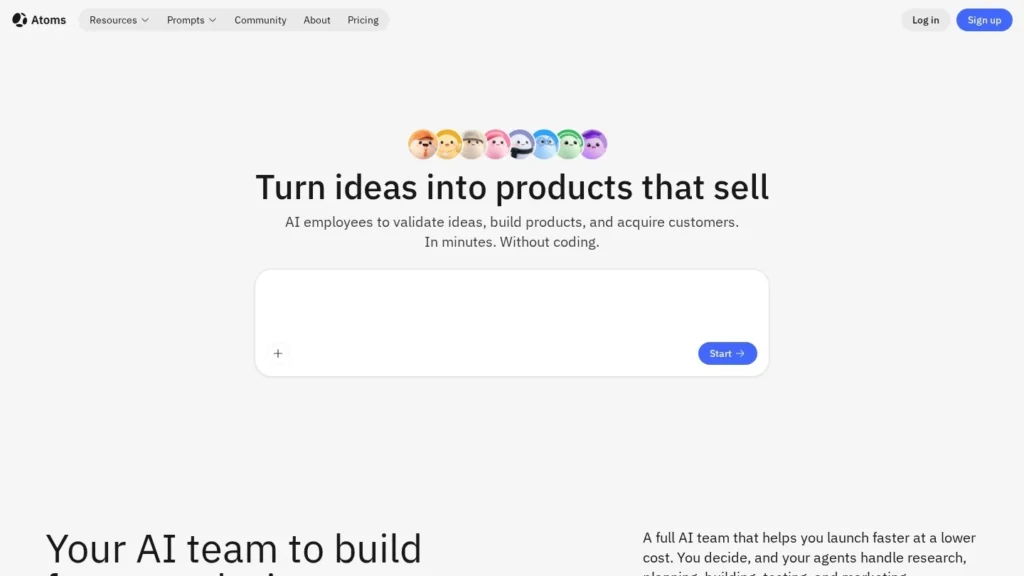
Atoms reached 500,000 registered users and $1 million in annual recurring revenue within a month of launching in February 2025, when it was still called MGX. The product gives you a team of AI agents, a team leader, researcher, product manager, architect, engineer, data analyst and SEO specialist, that plans, builds and deploys a working web app with login, database, payments and hosting from a chat prompt. It suits founders, indie makers and small teams that want a launched product without writing code.
Credits are the main planning point. The free plan includes 25 credits a month, Pro costs $20 a month for 100 credits, and complex apps or repeated fixes use them quickly, which is the most common theme in user reviews. Atoms comes from DeepWisdom, the Shenzhen company behind the open-source MetaGPT framework. We rate it 8.5/10 on our scale. We have not used Atoms ourselves; this review is based on its published plans, third-party pricing records and news coverage as of October 2026.
From MGX to Atoms and 500,000 Users in Its First Month
- MGX, renamed Atoms on January 13, 2026, hit 500,000 registered users and $1 million in ARR in its first month, according to 36Kr and VKTR.
- The free plan gives 15 credits a day up to 25 a month; Pro is $20 a month ($16 billed annually) for 100 credits, and Max is $100 a month ($79 annually) for 500.
- Seven agent roles split the work, and Atoms Cloud adds login, database and hosting, with Stripe payments, GitHub sync and full code export.
- Credit use is the main thing to watch: Product Hunt reviewers rate it 4.4 out of 5 and mention heavy credit use during fixes, buggy output and some data loss.
- Against Lovable, Atoms is slightly cheaper to start ($20 versus $25 a month for 100 credits); against Manus and Genspark it is more focused on shipping a full app.
DeepWisdom’s Traction Figures From Early 2026
Atoms is young, and its maker has published unusually detailed traction figures. Most come from the company and were reported by technology press in early 2026.
| Fact | Detail | Source and Date |
|---|---|---|
| Rename | MGX (MetaGPT X) was renamed Atoms on January 13, 2026, to make the name easier for ordinary users to say | 36Kr, January 15, 2026 |
| Early users | 500,000 registered users worldwide one month after the February 2025 launch, without advertising | 36Kr, January 15, 2026 |
| Early revenue | Subscription ARR passed $1 million within a month of launch (company-claimed) | VKTR, February 2, 2026 |
| Usage | 1.2 million monthly visits, more than 10,000 applications generated a day and paying users in over 100 countries, as of September 2025 | VKTR, February 2, 2026 |
| Funding | About 220 million yuan (about $30.8 million) across two rounds in the first half of 2025, from investors including Ant Group, Cathay Capital, Jinqiu Fund and Baidu Ventures | 36Kr, January 15, 2026, and Let’s Data Science, January 26, 2026 |
| Company | DeepWisdom, founded in 2019 and based in Shenzhen, has about 100 staff with plans to double headcount | VKTR, February 2, 2026 |
| Founder | CEO Alex Wu Chenglin worked on large-scale AI projects at Huawei and Tencent before founding DeepWisdom | 36Kr, January 15, 2026 |
| Open source | MetaGPT, open-sourced in June 2023, has nearly 60,000 GitHub stars; the Foundation Agents organization has more than 150,000 | 36Kr, January 15, 2026 |
| Company test claims | More than 45% better results than competitors at 20% of their cost, and a complete website in about five minutes, from DeepWisdom’s own tests | 36Kr, January 15, 2026 |
| Research output | Nine papers submitted to NeurIPS, five accepted and three selected for oral presentations | 36Kr, January 15, 2026 |
| Pricing | Free 15 credits a day (25 a month), Pro $20 a month for 100 credits with top-ups of 250 for $50 or 350 for $70, Max $100 a month for 500 credits and up to 10,000 with higher tiers | Toolradar pricing record, October 2026 |
The early numbers show real demand: half a million sign-ups in a month is rare for a paid developer tool. The ARR figure is smaller than Lovable’s, which 36Kr cites at $100 million, and every growth figure here comes from the company. The cost figure, better results at a fifth of rivals’ prices, comes from DeepWisdom’s own tests, so it is a reason to try Atoms and compare it with your current tool.
Ownership matters for buyers. Atoms is run by a Shenzhen company backed by Ant Group and Baidu Ventures, and VKTR reported in February 2026 that the platform runs largely on open-source models such as Alibaba’s Qwen and DeepSeek. Teams with data residency or procurement rules should check the terms before building anything that holds customer data.
An App Brief Split Across a Team of Agents
Atoms treats an app request like a brief to a small software company. You describe the idea in chat, the team leader agent splits the job, and each specialist agent works on its part while you watch and redirect.
The Agent Team
- Mike, team leader: takes the request, assigns work and keeps the agents in order.
- Iris, deep researcher: investigates the idea, market and references before anything is built.
- Emma, product manager: turns the brief into requirements.
- Bob, architect: designs the structure of the app.
- Alex, engineer: writes and fixes the code.
- David, data analyst: handles data tasks and analysis.
- SEO specialist: VKTR lists an SEO Specialist as the seventh role, aimed at getting a launched site found.
From Prompt to Live App
The result is a running web app rather than a code snippet. Atoms Cloud provides user login, database storage and hosting, and Stripe handles payments, so a landing page, internal tool or simple paid product can go live from one workspace. A drag-and-drop visual editor handles layout changes, deployment takes one click, custom domains are supported on paid plans, and code can be synced or exported to GitHub. Atoms lists Gemini and GPT models as built in, so no API keys are needed. Race Mode, on the Max plan, runs the same prompt across several models at once and keeps the best result; Toolradar’s record describes it as giving three times the accuracy.
Fifteen Free Daily Credits and a Template to Start
- Sign up free: start on the free plan with 15 credits a day.
- Pick a template or write a brief: a template library helps structure the first prompt.
- Let the research run: the researcher and product manager shape the plan before coding starts.
- Review and redirect: watch each agent’s output and correct course in chat or in the visual editor.
- Deploy: publish in one click, then connect a domain and Stripe on a paid plan.
Testing With Real Users and Watching Fix Loops
You still decide what to build, judge whether the result works and test it with real users. Reviewers report that fixes can loop and consume credits, so someone needs to spot when to stop prompting and edit directly or export the code. Anything involving payments, personal data or security rules needs a human check before launch.
Monthly Subscriptions That Bundle Credits
Atoms charges monthly subscriptions that include a set number of credits. Plan details below combine Atoms’ published plans with Toolradar’s October 2026 record of the official pricing page.
| Plan | Price | Billing | What’s Included | Limits |
|---|---|---|---|---|
| Free | $0 | None | 15 credits a day, 2GB storage, 2 cloud projects | Capped at 25 credits a month |
| Pro | $20 a month ($16 billed annually) | Monthly or annual | 100 credits a month, 10GB storage, private projects, custom domains | Top-ups of 250 credits for $50 or 350 for $70 |
| Max | $100 a month ($79 billed annually) | Monthly or annual | 500 credits a month, 100GB storage, Race Mode, double the compute of Pro | Higher credit tiers up to 10,000 credits cost more |
Credit Needs Depend on App Size and Fixes
The usage levels below are our own illustrative assumptions; the prices are the published ones. How many credits an app needs depends on its size and how many fixes it takes.
- A first-time builder testing an idea: the free plan covers a small landing page or prototype within 25 credits a month. If that runs out mid-build, Pro is $20 for the month.
- A solo founder in a launch month: Pro gives 100 credits for $20. Needing 350 credits means one 250-credit top-up at $50, for $70 in total. Both the plan and the top-up work out to $0.20 a credit, the same rate as Max at $100 for 500 credits, so Max only becomes cheaper when billed annually.
- A small agency building client sites: Max billed annually is $79 a month, or $948 a year against $1,200 paid monthly, a $252 saving. That brings the rate to about $0.158 a credit and adds Race Mode, which helps when quality matters more than speed.
Variable costs to plan for: credits spent on repeated fixes, which reviewers say add up fastest; top-ups during busy months; and running costs once a live app has real users. Pro billed annually at $16 a month is $192 a year, $48 less than paying monthly.
Atoms Compared With Lovable, Manus and Genspark Super Agent
Prompt-to-app builders split into dedicated app builders and general agents that can also build sites. Atoms and Lovable are the first kind; Manus and Genspark are the second.
| Agent | Starting Price | Free Plan | Main Strength | Main Trade-Off | Best For |
|---|---|---|---|---|---|
| Atoms | Free; Pro $20 a month for 100 credits | Yes (25 credits a month) | Named agent team with research, backend, payments and hosting built in | Credit use climbs on complex builds and fixes | Founders who want a launched app with payments |
| Lovable | Free; Pro $25 a month for 100 credits | Yes (5 daily credits, up to 30 a month) | Polished app builder with credits that roll over while subscribed | Hosting and in-app AI usage billed on top | Product teams building prototypes and MVPs |
| Manus | Free; paid from $20 a month for 4,000 credits | Yes (300 daily refresh credits) | One agent for research, slides, apps and content | Ownership dispute and data issues in 2026 | Individuals who want a general-purpose agent |
| Genspark Super Agent | Free; Plus $24.99 a month | Limited (lifetime allowance) | Documents, slides, sheets and simple sites from one tool | Credits charged for failed attempts | Small teams producing office work and simple sites |
Credits are not comparable across products, so compare on a real build. On list price for 100 credits, Atoms is $5 a month cheaper than Lovable, and its research step and built-in Stripe payments suit founders who want to charge from day one. Lovable has the longer track record and rolls unused credits over. Manus and Genspark are better when the app is one task among many. Engineers who want an agent inside an existing codebase should look at Devin instead. More options are in our guides to multi-agent tools and AI agents for startups.
Non-Technical Founders and Indie Makers
- Non-technical founders: a working app with login, database, payments and hosting is what you get back, rather than code to hand to a developer.
- Indie makers testing ideas: the research phase and free plan make it cheap to check an idea before spending on a build.
- Small agencies shipping simple client sites: Max billed annually brings credits to about $0.158 each and adds Race Mode.
- People who want to see the process: each agent’s work is visible, which makes it easier to learn and to redirect.
- Builders who want an exit: GitHub sync and full code export mean the app can move to a developer later.
Fixed Budgets and Strict Vendor Rules Call for Extra Checks
- Teams that need predictable monthly costs: credit use varies with app complexity and fixes.
- Companies with strict data or vendor rules: check DeepWisdom’s terms, hosting and model providers before building with customer data.
- Engineers working in large existing codebases: Atoms builds new apps; a coding agent such as Devin or GitHub Copilot Cloud Agent fits that work.
- Developers who want full control and self-hosting: the open-source MetaGPT framework is free under the MIT license, with only model costs to pay.
- Buyers who want a long track record: Atoms is under two years old, and its reported $1 million in early ARR is small next to Lovable’s $100 million cited by 36Kr.
Credit Use During Bug Fixes and Build Reliability
- Credit use during fixes: Product Hunt reviewers name heavy credit use while fixing bugs as a common theme; set a budget per project.
- Reliability: reviewers also mention buggy output, context handling and occasional data loss, so export code to GitHub often.
- Company-reported figures: user counts, ARR and the 20%-of-the-cost figure come from DeepWisdom and its own tests.
- Model sourcing: Atoms lists Gemini and GPT models as built in, while VKTR reported the platform runs largely on open-source models such as Qwen and DeepSeek; ask which models handle your project.
- Paid features for launch: private projects and custom domains start on the Pro plan, so a real launch needs at least $16 to $20 a month.
- Race Mode only on Max: the multi-model option that Atoms ties to higher accuracy needs the $100 plan.
DeepWisdom Takes Atoms Into the US Market
- On February 2, 2026, VKTR reported that DeepWisdom is entering the US market with Atoms, citing paying users in more than 100 countries and about 100 staff.
- On January 26, 2026, Let’s Data Science covered the rebrand as a step toward commercial deployment, with built-in backend, payments and SEO agents.
- On January 15, 2026, 36Kr reported the MGX to Atoms rename of January 13 and DeepWisdom’s roughly 220 million yuan raised in 2025.
Good for Founders Who Keep an Eye on Credits
For founders and small teams who want a live web app with payments without hiring a developer, yes, with an eye on credits. Atoms scores 8.5/10 on our scale: strong on autonomy and ease of setup, with clear published prices and a free plan, and room to grow in trust documentation and build reliability. The multi-agent team does more than generate code: it researches, plans, builds, deploys and wires in Stripe.
Its traction, 500,000 users in the first month, shows the idea lands with builders. Start on the free plan, build something small, then move to Pro and track how many credits each fix costs before committing to Max. Export your code regularly, and keep sensitive data out until you have read the terms.
What Atoms Costs After the Free Credits
How Much Does Atoms Cost Once the Free Credits Run Out?
Pro costs $20 a month, or $16 a month billed annually, for 100 credits, with top-ups of 250 credits for $50 or 350 for $70. Max costs $100 a month, or $79 billed annually, for 500 credits, and higher tiers go up to 10,000 credits.
Is Atoms the Same Product as MGX and MetaGPT?
Atoms is the new name for MGX, also called MetaGPT X, which launched in February 2025 and was renamed on January 13, 2026. MetaGPT is the separate open-source multi-agent framework from the same team, free to self-host under the MIT license.
Which Company Owns Atoms?
Atoms is built by DeepWisdom, a company founded in 2019 and based in Shenzhen, led by founder and CEO Alex Wu Chenglin. Its investors include Ant Group, Cathay Capital, Jinqiu Fund and Baidu Ventures.
Is Atoms Cheaper Than Lovable for a First App?
On list price, Atoms Pro is $20 a month for 100 credits and Lovable Pro is $25 for 100. Credits cost different amounts of work in each product, so the cheaper option depends on how many prompts and fixes your app takes.
Can I Take My Atoms App Code to GitHub?
Yes. Atoms supports GitHub sync and full code export, so a developer can take over the project or host it elsewhere. Exporting often is also a sensible safeguard given user reports of occasional data loss.
User Reviews
Nobody has rated it here yet. Be the first AI Agents Choice user to rate Atoms.