
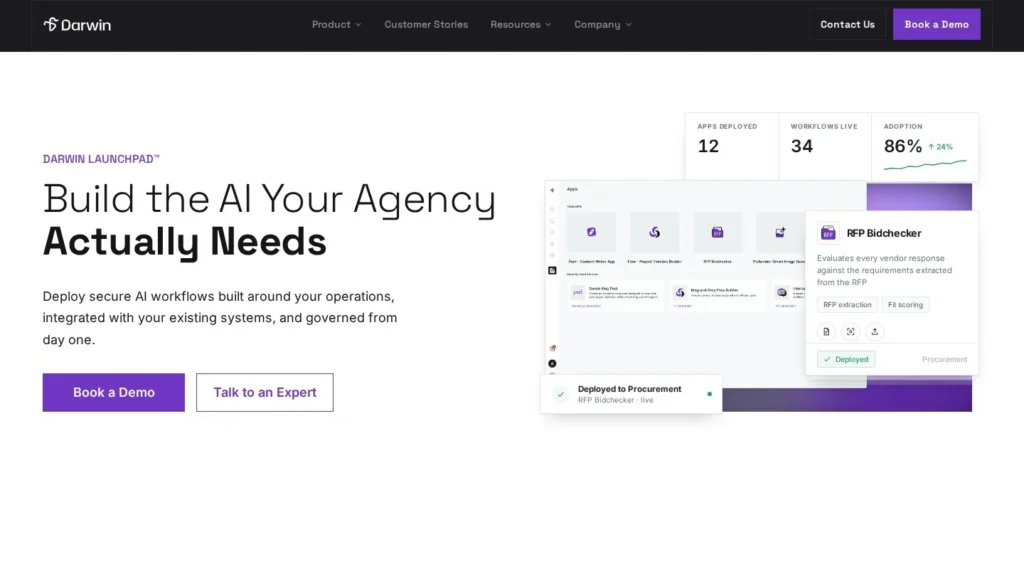
Darwin AI was founded in 2024 and had a $15 million Series A led by Insight Partners within about a year. In February 2026, Government Technology added it to the GovTech 100, one of eight newcomers that year. The company sells state and local governments two products that work together: LaunchPad, where agencies build and run governed AI workflows for back-office work, and Govern, which enforces an agency’s AI policy across departments.
Darwin is best for cities, counties, transit agencies and state departments that want to automate procurement, HR and clerk’s office tasks while keeping a firm grip on records rules and AI policy. Points to weigh are that prices are not published, the company is newer, and its workflows keep people in the approval loop by design, so it automates steps rather than whole jobs. It is sold by quote, and we rate it 7.6/10 on our scale. We have not used Darwin ourselves; this review is based on Darwin’s LaunchPad page and company announcements, and trade press coverage of its funding.
A $15 Million Series A a Year After Founding
- Darwin raised a $15 million Series A in October 2025 led by Insight Partners, with UpWest and Resolute Ventures, about a year after its 2024 founding.
- LaunchPad apps score vendor bids against RFP requirements, route procurement approvals, redact personal data in documents and email, and turn screen recordings into procedures.
- Every workflow runs with human-in-the-loop approvals and audit trails, and Darwin states SOC 2 Type 2 with TX-RAMP and GovRAMP badges.
- Customer logos include Seattle, Louisville, Texas DPS, CapMetro, Jefferson County and Houston Community College.
- Against Ask Sage and Polimorphic, Darwin is the governance-first choice for back-office automation; it has no published price.
Funding News and Product Pages as the Record
Darwin is a newer company, so most figures come from its funding announcement and its own product pages.
| Fact | Detail | Source and Date |
|---|---|---|
| Founded | 2024, by CEO Noam Maital and CTO Asaf Fadida; based in Palo Alto, California | Washington Technology, October 27, 2025 |
| Series A | $15 million led by Insight Partners, with UpWest and Resolute Ventures | Darwin announcement, October 23, 2025 |
| Board | Brenda Harvey, former general manager of IBM Public Sector and Federal, joined the board | Darwin announcement, October 23, 2025 |
| States | Darwin names Texas, Ohio, California, Illinois and Washington as partnership states | Darwin announcement, October 23, 2025 |
| Recognition | Named to Government Technology’s 2026 GovTech 100, one of eight newly added companies | Darwin announcement, February 3, 2026 |
| Other lists | Selected for the TechCrunch and Greenfield Partners Disrupt 60 and the Center for Public Sector AI’s AI 50 | Darwin announcement, February 3, 2026 |
| Time to deploy | First workflow deployed in one day, with no coding from agency staff | Darwin LaunchPad page, viewed November 2026 |
| Time savings claim | More than 40 hours of potential monthly time savings per department | Darwin LaunchPad page, viewed November 2026 |
| Customer logos | CapMetro, Seattle, Louisville, Texas DPS, Jefferson County, Renton, Lake Stevens, Hopkinsville, NCTCOG, COTA and others | Darwin LaunchPad page, viewed November 2026 |
| Security | SOC 2 Type 2, with TX-RAMP, GovRAMP and NIST badges | Darwin LaunchPad page, viewed November 2026 |
The funding and board choices say a lot about the strategy. Insight Partners led the round, and a former head of IBM’s public sector business joined the board, which signals that Darwin plans to sell to larger state agencies, not only small towns. Chief executive Noam Maital framed the pitch around public records laws and emerging state and federal AI standards, so the company leads with compliance and sells automation on top of it.
The customer logos span big cities such as Seattle and Louisville, transit agencies such as CapMetro and COTA, Texas DPS and the regional council NCTCOG. The time-savings figure is a vendor estimate of potential, not a measured result, so ask reference agencies what they actually saved.
LaunchPad, Govern and Finch in One Platform
Darwin is one platform with three parts. LaunchPad builds and runs workflows, Govern sets and enforces the rules those workflows must follow, and Finch reports on the whole AI program.
LaunchPad Apps
- BidChecker: scores vendor responses against the requirements in an RFP, so procurement staff start from a ranked view rather than a stack of PDFs.
- Flow: tracks procurement timelines and routes approvals to the right people.
- RedactIt: finds and redacts personal information in documents, email and PST archives, a common bottleneck in public records requests.
- SOP Studio: turns screen recordings into step-by-step procedures, useful when experienced staff retire.
- TaskLine: handles project and portfolio tracking, with an option to add items to Outlook.
Custom Workflows
Beyond the ready-made apps, agencies design their own workflows. Darwin lists use cases in procurement (bid evaluation, RFP summaries, contract review), HR (hiring, onboarding, policy questions), the clerk’s office (records requests, agendas and minutes), and finance, legal, communications, public safety and IT. Its funding announcement also mentions permitting. Darwin says a first workflow can go live in one day with no coding from agency staff.
A Sample Workflow: Scoring Bids
Darwin’s LaunchPad page demonstrates BidChecker on an RFP that lists FedRAMP Moderate as a requirement. In a flow like that, the procurement officer loads the RFP and the vendor responses, the app checks each response against each stated requirement and produces a score, and the officer reviews the scores before Flow routes the evaluation for approval. The officer stays responsible for the award; the app removes the hours of reading needed to build the first comparison. The same pattern of AI preparation followed by human sign-off runs through Darwin’s sample records request workflow, where RedactIt marks personal data and a clerk approves the release.
Governance Built In
Every workflow runs with human-in-the-loop approvals, audit trails, secure access to language models and granular guardrails. Darwin Govern turns written policy into automated safeguards, shows which AI tools departments use, sends governance alerts through a notification center and extends Microsoft Purview sensitivity labels beyond Microsoft products. Finch answers questions about the governance program and turns answers into scheduled reports. A free Policy Wizard drafts an AI policy for agencies starting from scratch.
Staff Approve Bids, Redactions and Minutes
Darwin keeps people in charge of decisions by design. Staff approve bid scores, sign off on redactions, route final approvals and publish minutes. The platform automates the preparation work and records who approved what, which is what public records laws and procurement rules usually require.
Quotes Through Cooperative and State Contracts
Darwin does not publish prices. The table summarizes how it is sold, based on its LaunchPad page and announcements.
| Option | Price | Billing | What’s Included | Limits |
|---|---|---|---|---|
| Darwin LaunchPad | Custom quote | Contract | Prebuilt apps and custom governed workflows | Scope set per agency |
| Darwin Govern | Custom quote | Contract | AI policy enforcement, usage visibility, records and data governance | Scope set per agency |
| Policy Wizard | Free | None | Drafts an agency AI policy | Policy drafting only |
| Contract vehicles | Per contract | Cooperative, state or federal | Purchase without a separate bid where the vehicle allows | Eligibility depends on the agency |
Darwin has announced a TXShare cooperative contract and a listing on Civic Marketplace, which can let eligible agencies buy without running their own procurement.
Framing a Quote From Your Agency’s Volumes
Without a price list, the planning work sits with the agency. These scenarios show how to frame a quote; the volumes are our own illustrative assumptions.
- A city procurement office running 40 bids a year: ask for a price for BidChecker and Flow alone, and compare it with staff hours spent scoring responses. Darwin’s claim of 40 hours a month per department is a ceiling to test, not a number to budget on.
- A clerk’s office with a public records backlog: RedactIt is the most direct saving. Measure current redaction hours on a sample of requests, then ask for a pilot on the same sample.
- A county rolling out AI policy first: start with Govern and the free Policy Wizard, then add LaunchPad workflows once policy is in place. Ask whether Govern and LaunchPad are priced separately or together.
Costs to ask about: implementation and training, model usage charges if any, the number of departments and users covered, data hosting and multi-year price protection.
Darwin AI Compared With Ask Sage, Polimorphic and Govstream.ai
Government AI agents divide into resident-facing agents, specialist tools for one process and platforms that let agencies build their own. Darwin is a platform, with governance as its main feature.
| Agent | Starting Price | Free Plan | Main Strength | Main Trade-Off | Best For |
|---|---|---|---|---|---|
| Darwin AI | Custom quote | No (free Policy Wizard) | AI policy enforcement and governed back-office workflows in one platform | No public pricing; young company | State and local agencies automating procurement, HR and records |
| Ask Sage | $90 a month for 2 million tokens | No | FedRAMP High workspace and agent builder | Agents must be built by the customer | Defense, federal agencies and contractors |
| Polimorphic | $2 per call (AI Voice, 12-month contract) | No | Resident-facing voice, search and service requests | Per-call billing counts transfers | City halls with heavy phone and walk-in volume |
| Govstream.ai | Custom quote | No | AI permitting assistants for staff and applicants | Narrow focus and early stage | Permitting and development services departments |
Darwin and Ask Sage both let agencies build their own AI tools, but Ask Sage targets federal and defense work with FedRAMP High, while Darwin targets state and local back offices with TX-RAMP and GovRAMP. Polimorphic and Govstream.ai solve a single public-facing problem each. An agency could run Polimorphic on its phone lines and Darwin behind the scenes. See more in our AI agents for government and workflow automation guides.
The buying process differs too. Ask Sage publishes token prices, Polimorphic’s AI Voice is listed on AWS Marketplace at $2 per call, and Darwin and Govstream.ai sell by quote. For Darwin, the cooperative contract route matters more than a list price, since it can let an eligible agency skip a separate bid. Agencies weighing a platform against a single-purpose tool should ask how many departments will use it in the first year: a platform pays off when several offices share one governance layer, while a point tool can be cheaper for one urgent problem.
Procurement Offices and Clerk’s Teams
- Procurement offices: BidChecker and Flow target the slowest parts of a bid cycle: scoring responses and chasing approvals.
- Clerk’s offices and records teams: RedactIt and agenda and minutes workflows address public records and meeting workloads.
- Agencies writing their first AI policy: the free Policy Wizard and Govern turn policy into rules the platform enforces.
- CIOs managing scattered AI use: Govern shows which AI tools departments use and applies Microsoft Purview labels more widely.
- Agencies facing staff turnover: SOP Studio captures procedures from screen recordings so knowledge stays when people leave.
- Texas agencies: TX-RAMP and the TXShare cooperative contract shorten the path to purchase.
Resident-Facing Needs and FedRAMP High Buyers
- Agencies wanting a resident-facing agent: Darwin automates internal work; tools such as Polimorphic or Citibot answer residents.
- Federal and defense buyers needing FedRAMP High: Ask Sage holds that authorization.
- Buyers who want published prices: Darwin sells only by quote and contract vehicle.
- Teams looking for fully unattended automation: every workflow keeps a person in the approval loop.
Production References From a 2024 Startup
- Company age: Darwin was founded in 2024. Ask for references running LaunchPad workflows in production and for contract terms that cover the full term.
- Integration depth: its pages document Microsoft Purview and Outlook. Confirm connections to your ERP, HR, permitting and records systems in writing.
- Vendor estimates: the 40-hours-per-department and one-day deployment figures are Darwin’s own; pilot first.
- Certification status: Darwin states SOC 2 Type 2; check the current status of its GovRAMP and TX-RAMP listings with the program offices.
- Model choices: the LaunchPad page refers to secure model access without naming providers. Ask which models process agency data and where.
Insight Partners Backs Darwin in October 2025
- On October 23, 2025, Darwin announced a $15 million Series A led by Insight Partners, with UpWest and Resolute Ventures, and named former IBM public sector leader Brenda Harvey to its board.
- On October 27, 2025, Washington Technology reported that the funding would go to developing Govern and LaunchPad, expanding deployment support and growing the team.
- On February 3, 2026, Darwin said it was named to Government Technology’s 2026 GovTech 100, one of eight companies newly added that year.
A Pilot Makes Sense for Back-Office Automation Plus Governance
For state and local agencies that want to automate back-office work and govern AI use at the same time, Darwin is worth a pilot. It scores 7.6/10 on our scale: strong on trust and security, moderate on autonomy and integrations, and published pricing and public ratings would lift it further. The product’s design matches how government works, with human approvals, audit trails and records rules built in, and its customer logos from Seattle to Texas DPS show real adoption.
The open questions are price, integration depth and the company’s track record. Start with one process, such as bid scoring or records redaction, measure staff hours before and after, and buy through a cooperative contract if one applies.
Contract Vehicles and Darwin Pricing
How Much Does Darwin AI Cost?
Darwin does not publish prices for LaunchPad or Govern. Agencies get a quote, often through cooperative, state or federal contract vehicles. Its Policy Wizard for drafting an AI policy is free.
What Is Darwin LaunchPad?
LaunchPad is Darwin’s platform for building and running governed AI workflows. It includes apps such as BidChecker, Flow, RedactIt, SOP Studio and TaskLine, and lets agencies build custom workflows for procurement, HR, the clerk’s office and other departments without coding.
Is Darwin AI Secure Enough for Government Data?
Darwin states it holds SOC 2 Type 2 and shows TX-RAMP, GovRAMP and NIST badges. Workflows include human approvals, audit trails and guardrails, and Darwin Govern enforces agency AI policy and Microsoft Purview sensitivity labels.
How Does Darwin Compare With Ask Sage?
Both let agencies build their own AI tools. Ask Sage targets federal and defense work with FedRAMP High and publishes token pricing from $90 a month, while Darwin targets state and local back offices and sells by quote.
Can Darwin Help With Public Records Requests?
Yes. RedactIt finds and redacts personal information in documents, email and PST archives, and Darwin lists records requests among its clerk’s office workflows. Staff still review and approve each release.
User Reviews
Nobody has rated it here yet. Be the first AI Agents Choice user to rate Darwin AI.