
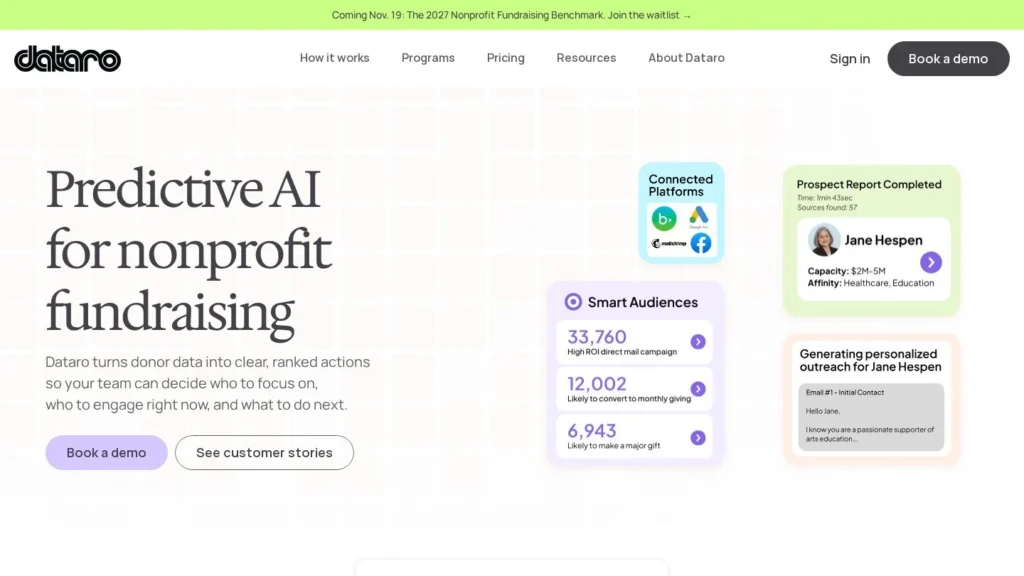
Dataro is one of the few nonprofit AI vendors that prints its prices: $15,000 a year plus 10 cents per active donor to start, which it says falls to $0.25 per donor for a charity with 100,000 supporters. Save the Children uses it and also invested in its $14.28 million Series A in February 2026, a rare case of a customer backing its fundraising software.
Dataro suits mid-size and large charities with tens of thousands of active donors and a CRM such as Raiser’s Edge NXT or Salesforce, especially direct mail and mid-level programs that want to stop mailing everyone. Its agent, ProspectAI, researches major-gift prospects on its own; the rest of the platform scores and ranks donors rather than writing or sending outreach. The $15,000 platform fee is the main point to plan for. We rate it 8.4/10 on our scale. We have not used Dataro ourselves; this review is based on Dataro’s published pricing, funding and launch coverage, and Capterra reviews.
$15,000 a Year Plus a Few Cents per Active Donor
- Entry price is published: Essentials from $15,000 a year plus $0.10 per active donor; Growth from $25,000 plus $0.12.
- Save the Children both uses Dataro and joined its $14.28 million Series A, led by Blueprint Equity, in February 2026.
- ProspectAI, launched in July 2025, researches prospects across the public web and returns cited donor profiles in minutes, for US records only.
- Two-way weekly sync covers Raiser’s Edge NXT, Salesforce, HubSpot, Virtuous and more, with SOC 2 Type II on every plan.
- Capterra reviewers rate it 4.8 from 10 reviews, praising support and targeting but noting integration effort.
Pricing Page and Series A Figures
Dataro’s public figures come mostly from its pricing page and its February 2026 funding round.
| Fact | Detail | Source and Date |
|---|---|---|
| Customers | More than 300 organizations in the US, UK, Australia, New Zealand, Canada and other markets | Pulse 2.0 funding report, February 17, 2026 |
| Latest funding | $14.28 million Series A led by Blueprint Equity, with Save the Children and Basis Set | Pulse 2.0, February 17, 2026 |
| Leadership | Co-founders Tim Paris (CEO), David Lyndon (CTO) and Chris Paver (COO); Salvatore Salpietro appointed Chief Growth Officer | Pulse 2.0, February 17, 2026 |
| Entry price | Essentials from $15,000 a year plus $0.10 per active donor; as little as $0.25 per donor at 100,000 donors | Dataro pricing page, viewed October 2026 |
| Worked example | 10,000 active donors cost about $16,000 a year on Essentials or $26,200 on Growth | Dataro pricing page, viewed October 2026 |
| Models | Four core models on every plan and more than 20 models in total | Dataro pricing page, viewed October 2026 |
| Time to launch | Most organizations go live in four to six weeks | Dataro pricing page, viewed October 2026 |
| Security | SOC 2 Type II and data residency in the US, Canada, UK and Australia on all plans | Dataro pricing page, viewed October 2026 |
| ProspectAI launch | Autonomous research agent that scans the web in real time and builds donor profiles; ChildFund Australia among early users | NonProfit PRO, July 8, 2025 |
| Capterra | 4.8 out of 5 from 10 reviews; 4.7 for ease of use and 5.0 for customer service | Capterra listing, viewed October 2026 |
The pricing facts are the ones buyers rarely get from nonprofit AI vendors. Because the per-donor rate is small and the platform fee is fixed, Dataro gets cheaper per donor as a file grows: about $1.60 per donor at 10,000 on Essentials, $0.40 at 50,000 and $0.25 at 100,000. That shapes who it is for.
The funding round also says something about direction. Dataro told investors it will spend on AI-native workflows and US growth, and ProspectAI is the first piece that behaves like an agent. Expect more of the platform to move from scoring donors to doing research and preparation work.
Scoring Donors Beside the CRM and Writing Back
Dataro sits beside a charity’s CRM rather than replacing it. It reads the donor history already there, makes predictions and writes them back.
Donor Scoring and Audiences
- Connect the CRM: Essentials supports Raiser’s Edge NXT, Salesforce Nonprofit Success Pack and Nonprofit Cloud, HubSpot, CharityCRM, Beacon and Virtuous; Growth adds Blackbaud CRM, Microsoft Dynamics and custom Salesforce setups; Enterprise adds other CRMs, data warehouses and Snowflake. Sync runs both ways every week.
- Score every donor: four core models (next gift likelihood, recommended channel, lifetime value forecast and estimated age) run on every plan.
- Add specialist models: mail appeals, lapsed donor reactivation, major gifts, mid-level giving, and recurring gift churn and conversion. Essentials includes three, Growth six and Enterprise all of the 20-plus models.
- Build audiences: teams pull ranked segments for an appeal and can send audiences to Meta Ads and Google Ads.
- Report and benchmark: dashboards compare results with sector benchmarks; Dataro also publishes a nonprofit fundraising benchmark report.
ProspectAI, the Research Agent
ProspectAI is the part Dataro describes as an autonomous AI agent. A fundraiser names a prospect, and the agent scans the web in real time using large language models, pulling biographical details, wealth indicators, philanthropic interests, affiliations and news coverage. It returns an executive-ready profile with citations, a job that prospect researchers often spend hours on. Each plan includes a yearly number of research credits: 300 on Essentials, 1,000 on Growth and 3,000 on Enterprise. ProspectAI covers US records only.
Appeals, Audiences and Stewardship Remain Staff Work
Staff decide which appeal to run, which audiences to mail, what to say and when to ask. Dataro also offers AI-assisted content, but sending and stewardship stay with the team. Someone also needs to keep CRM data tagged consistently; Capterra reviewers say this took technical help during setup.
A Typical Appeal Cycle
Based on Dataro’s published features, a spring mail appeal would run like this. The weekly sync brings the latest gifts from the CRM into Dataro. The mail appeal model ranks every active donor by likelihood to respond, and the recommended channel model flags donors better reached by email or digital ads. The team picks a cutoff, pulls the mail list from the scored CRM records, pushes a digital audience to Meta Ads or Google Ads, and uses lapsed donor and recurring giving models to build separate reactivation and upgrade segments. After the appeal, results flow back through the CRM and benchmarking reports compare performance with the sector. Capterra reviewers describe this pattern producing higher response while mailing fewer donors.
Platform Fee Plus a Rate per Active Donor
All plans are billed annually and combine a platform fee with a rate per active donor, defined as anyone with at least one gift in the past 24 months, counted at the end of the previous quarter. Prices are shown in dollars on Dataro’s pricing page as of October 2026.
| Plan | Price | Billing | What’s Included | Limits |
|---|---|---|---|---|
| Essentials | From $15,000 a year plus $0.10 per active donor | Annual | Core models, AI-assisted content, benchmarking, CRM integration, Meta and Google Ads connections, dedicated CSM | 3 specialist models, 300 research credits, 5 users, 10 custom fields |
| Growth | From $25,000 a year plus $0.12 per active donor | Annual | Everything in Essentials plus marketing platform integrations | 6 specialist models, 1,000 research credits, 10 users, 25 custom fields |
| Enterprise | Custom fee plus $0.14 per active donor | Annual | All models, custom CRM integrations, multi-entity setups, SSO, priority SLA, executive sponsor | 3,000 research credits, unlimited users, 80 custom fields |
A 10,000-Donor Charity Pays About $16,000
- A regional charity with 10,000 active donors: Essentials comes to $15,000 plus $1,000, or $16,000 a year (about $1,333 a month and $1.60 per donor). Growth would be $26,200.
- A national charity with 50,000 active donors: Essentials is $20,000 a year ($0.40 per donor); Growth is $31,000 ($0.62 per donor), worth it mainly for the extra specialist models, users and research credits.
- A large organization with 250,000 active donors: Essentials would be $40,000 and Growth $55,000 a year, while Enterprise adds unlimited users and SSO at a custom fee plus $35,000 in donor charges.
Other costs are mostly internal: staff time to clean and tag CRM data, and extra prospect research if a major gifts team needs more profiles than its credits cover. Dataro says most organizations go live in four to six weeks.
Choosing Between Essentials and Growth
Growth costs $10,000 more in platform fees plus 2 cents more per donor, so the gap is $10,200 at 10,000 donors, $11,000 at 50,000 and $12,000 at 100,000. In return a charity gets three more specialist models, 700 more prospect research credits, five more users, 15 more custom fields and marketing platform integrations. A charity running mail, mid-level and major gifts programs at once will likely need more than three specialist models; one focused on a single annual appeal may not. Enterprise mainly matters for federated organizations with several entities, for SSO and for custom data warehouse connections.
Dataro Compared With Virtuous Momentum, Blackbaud Development Agent and Version2
| Agent | Starting Price | Free Plan | Main Strength | Main Trade-Off | Best For |
|---|---|---|---|---|---|
| Dataro | From $15,000/year plus $0.10 per active donor | No | Published pricing, broad CRM support and donor scoring | Does not send outreach; $15,000 floor | Appeal targeting and prospect research |
| Virtuous Momentum | Custom quote | No | Daily gift officer priorities and drafted outreach | No published pricing; does not send on its own | Major and mid-level gift officers |
| Blackbaud Development Agent | Custom quote | No | Runs inside Raiser’s Edge NXT | US Raiser’s Edge NXT customers only for now | Mid-level donor cultivation at scale |
| Version2 | Custom quote | No | Fully autonomous AI fundraiser that solicits and stewards | Results are company-reported; no published pricing | Unassigned donor portfolios |
The four tools split the fundraising job. Dataro decides who to ask and researches prospects; Momentum and Blackbaud’s agent help gift officers work their portfolios; Version2 goes furthest and runs donor conversations itself. Dataro is the only one with a published price and the only one that works across many CRMs. Charities often pair a scoring tool like Dataro with an outreach tool. See more in our AI agents for nonprofits guide.
Appeal Teams and Charities With Large Donor Files
- Direct mail and appeal teams: ranked audiences let a charity mail fewer, likelier donors; Capterra reviewers report lower printing and postage costs.
- Charities with 50,000 donors or more: the fixed fee spreads to well under a dollar per donor.
- Major gifts teams with research backlogs: ProspectAI turns hours of web searching into a cited profile, as ChildFund Australia described at launch.
- Organizations on mainstream nonprofit CRMs: Raiser’s Edge NXT, Salesforce, HubSpot and Virtuous are supported on the entry plan.
- Charities with data residency needs: hosting is available in the US, Canada, UK or Australia.
Small Nonprofits With Shorter Donor Histories
- Small nonprofits: with a few thousand donors, the $15,000 fee makes each donor score costly relative to the file, and the models have less history to learn from.
- Teams that want an agent to do the outreach: Dataro ranks and researches; it does not send appeals or steward donors on its own.
- Non-US major gifts programs: ProspectAI covers US records only.
- Buyers who need to test before talking to sales: there is no self-serve trial.
- Teams without anyone to manage data: reviewers say integration and consistent tagging took technical help.
Weekly Score Refresh and Donor Count Drift
- Weekly sync: scores refresh weekly, so same-week gifts and changes may not be reflected.
- Active donor count drift: the per-donor charge is based on gifts in the past 24 months, measured quarterly, so a successful acquisition campaign raises next period’s bill.
- Model limits by plan: Essentials includes only three specialist models; check which ones your program needs before choosing a tier.
- Reporting fit: one Capterra reviewer found reports did not match how their data was recorded, and another missed a custom fiscal year setting.
- Pace of change: reviewers mention frequent releases that are hard to keep up with.
Blueprint Equity and Save the Children Back Dataro
- On February 17, 2026, Pulse 2.0 reported Dataro’s $14.28 million Series A led by Blueprint Equity, with Save the Children and Basis Set, to expand in the US and build AI-native workflows.
- On July 8, 2025, NonProfit PRO covered the launch of ProspectAI, Dataro’s autonomous research agent for major donor prospecting.
A Sound, Transparent Buy for Large Donor Files
For charities with a large donor file and a mainstream CRM, Dataro is a sound, transparent buy. We score it 8.4/10 on our scale: strong on integrations, security and user sentiment, middling on autonomy because most of the platform informs decisions rather than acting on them. The published pricing is a real advantage in a category where most tools are quote only, and the economics improve sharply with scale.
Smaller nonprofits should run the numbers first. At 10,000 donors the bill is $16,000 a year, or $1.60 per donor, and the value depends on whether better targeting saves more than that in mailing costs or adds more in gifts. Ask for a demo on your own data, which is how Dataro runs them, and compare predicted against actual response on your next appeal.
Dataro’s Annual Fees by Tier
How Much Does Dataro Cost Each Year?
Essentials starts at $15,000 a year plus $0.10 per active donor, Growth at $25,000 plus $0.12, and Enterprise is custom plus $0.14. Dataro’s own example puts 10,000 active donors at about $16,000 a year on Essentials.
Does Dataro Offer a Free Trial?
No. Dataro does not offer self-serve trials; it runs demos scoped to an organization’s own data and CRM instead.
What Does ProspectAI Actually Do?
It researches a named prospect across public web sources, including news, and returns a cited profile covering biography, wealth indicators, philanthropic interests and affiliations. Each plan includes a set number of research credits per year, and it covers US records only.
Which CRMs Does Dataro Work With?
The entry plan supports Raiser’s Edge NXT, Salesforce Nonprofit Success Pack and Nonprofit Cloud, HubSpot, CharityCRM, Beacon and Virtuous. Growth adds Blackbaud CRM, Microsoft Dynamics and custom Salesforce setups, and Enterprise adds other CRMs and Snowflake.
How Is Dataro Different From Version2 or Virtuous Momentum?
Dataro predicts who will give and researches prospects; it does not contact donors. Version2 runs donor conversations itself, and Momentum helps gift officers plan and draft outreach. Many charities would use Dataro to pick audiences and another tool to engage them.
User Reviews
Nobody has rated it here yet. Be the first AI Agents Choice user to rate Dataro.