
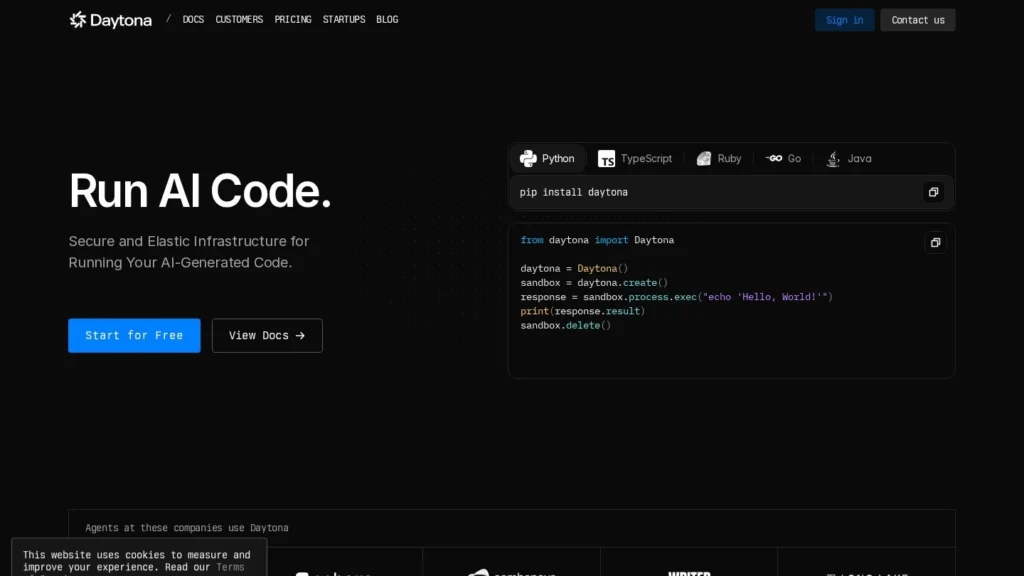
Daytona suits AI developers who want fast, usage-only sandboxes with GPU options and the ability to fork a running agent into parallel paths. New accounts get $200 of free compute without a card, and after that the bill is $0.0504 per vCPU-hour and $0.0162 per GiB of memory per hour, charged by the second.
The company is young and growing fast. It reported a $1 million forward revenue run rate in under three months and raised a $24 million Series A led by FirstMark in February 2026. Daytona scores 8.5/10 on our scale; it could add more published detail on certifications, and custom tiers ask for a monthly top-up.
Daytona for Agent Builders Who Need Fast, Forkable Sandboxes
- Daytona bills sandboxes per second at $0.0504 per vCPU-hour and $0.0162 per GiB-hour of memory, with $200 of free compute.
- Sandboxes start in under 90 milliseconds, per Daytona, and can be paused, snapshotted or forked into parallel branches.
- GPU sandboxes are listed from $0.57 to $6.25 per hour, and Windows sandboxes are available.
- FirstMark led a $24 million Series A in February 2026; Datadog and Figma Ventures invested.
- Daytona reported a $1 million forward revenue run rate in under three months, doubled six weeks later.
Daytona by the Numbers
These figures come from Daytona’s February 2026 funding release, its pricing page and its support center.
| Fact | Detail | Source and Date |
|---|---|---|
| Series A | $24 million, led by FirstMark Capital | Daytona release, February 5, 2026 |
| Other investors | Pace Capital, Upfront Ventures, E2VC, Darkmode; strategic: Datadog, Figma Ventures | Daytona release, February 2026 |
| Revenue pace | $1 million forward run rate in under 3 months, doubled 6 weeks later | Daytona release, February 2026 |
| Team size | About 20 people | Daytona release, February 2026 |
| Named customers | LangChain, Turing, Writer, SambaNova | Daytona release, February 2026 |
| Sandbox creation | Under 90 milliseconds from code to execution | Daytona pricing page, 2026 |
| Free compute | $200, no credit card | Daytona pricing page, 2026 |
| Startup credits | Up to $50,000 | Daytona pricing page, 2026 |
| Custom tier example | $2,000 monthly top-up for 500 vCPU, 1,000 GB RAM, 5,000 GB storage | Daytona support article, 2026 |
The revenue pace is the figure a buyer should note. Reaching a $1 million run rate in under three months shows that agent developers were paying for the product from launch, which lowers the risk of building on it.
The team size cuts the other way. About 20 people serve customers from Y Combinator startups to Fortune 100 companies, and Daytona said it was hardware-constrained when it raised. Teams planning large launches should agree capacity with Daytona ahead of time.
Strategic money from Datadog and Figma Ventures suggests both companies see agent sandboxes as part of their own products’ future.
The customer names point to who the product serves today. LangChain builds agent frameworks, Writer sells enterprise agents, Turing works on model training data and SambaNova runs AI hardware and inference. All four run large volumes of model-generated work that needs a safe place to execute.
How Daytona Gives Each Agent a Computer
Daytona calls its sandboxes programmatic, composable computers. A developer describes what the agent needs, and Daytona creates it in milliseconds.
Configuring CPU, Memory, GPU and Operating System
Each sandbox can be set for CPU, memory, storage, GPU, network and operating system. Windows sandboxes cost $0.0858 per vCPU-hour. GPU sandboxes run on Nvidia cards from the RTX 4090 to the B300 and on AMD’s MI355X.
Forking Into Parallel Branches
An agent can fork a running sandbox into several branches, each with the same files and state. That lets a coding agent try three fixes at once and keep the one whose tests pass, or lets a research agent explore several decision paths without starting over.
Snapshots and Pauses
Sandboxes can be paused or snapshotted at any point in a run. A snapshot preserves state mid-execution, so when a step fails the agent can return to the last good point.
What the Developer Builds
Daytona does not supply the agent. Developers write the loop that calls the model, decide which actions reach the sandbox and set limits on what the agent may run. Reinforcement learning teams use the same sandboxes as training environments for models.
Where Daytona Sits in an Agent Stack
Most teams pair Daytona with an agent framework. A developer might build the planning loop in LangGraph, Mastra or the OpenAI Agents SDK, and expose a tool that sends code to a Daytona sandbox. The framework decides what to do next; Daytona runs the work and returns output, files and errors.
This split keeps responsibilities clear. If an agent misbehaves, the sandbox limits the damage to a disposable computer, and the developer can inspect a snapshot of the state at the moment things went wrong.
A Coding Agent Using Forks, Step by Step
A team building a code-repair agent might clone a repository into a sandbox, run the failing test, then fork the sandbox into four branches. The model writes a different fix in each branch, each branch runs the test suite, and the agent keeps the passing branch and discards the rest. The team pays only for the seconds each branch ran.
Daytona Rates, Credits and Custom Tiers
Daytona bills every resource by the second and lists its rates publicly. There is no monthly platform fee on pay-as-you-go.
| Item | Price | Billing | Included | Limits |
|---|---|---|---|---|
| Free start | $0 | Wallet credit | $200 in compute, no card | Standard tier limits |
| vCPU | $0.0504 per hour | Per second | None | Tier limits apply |
| Memory | $0.0162 per GiB per hour | Per second | None | Tier limits apply |
| Storage | $0.000108 per GiB per hour | Per second | First 5 GiB free | Tier limits apply |
| Windows | $0.0858 per vCPU per hour | Per second | None | Tier limits apply |
| GPUs | $0.57 to $6.25 per hour | Per second | Preemptible options | By card type |
| Custom tier | Monthly top-up, e.g. $2,000 | Prepaid, credited in full | Higher guaranteed limits | New top-up each month |
| Enterprise | Contact sales | Custom | Larger limits, SSO, audit logs, BYOC | By agreement |
Preemptible GPU prices run lower; an H100 is listed at $2.27 an hour preemptible. Volume discounts are offered as usage grows, and eligible startups can apply for up to $50,000 in credits.
Billing by the second matters for agents because most tasks are short. A sandbox that runs a test suite for 40 seconds is charged for 40 seconds, so a coding agent that spins up hundreds of brief sandboxes a day pays for the work done and little else. Teams should still watch for sandboxes that are never closed, since those keep drawing from the wallet.
Three Daytona Bills Worked Out
These scenarios use Daytona’s published rates.
- Prototype on free credit: a sandbox with 2 vCPUs and 4 GiB costs $0.1656 per hour, so the $200 credit covers about 1,207 hours.
- Production coding agent: 2,000 hours a month at that size costs $331.20. Keeping 20 GiB of storage all month adds about $1.18 for the 15 GiB above the free allowance.
- GPU evaluation runs: 100 hours on a preemptible H100 costs $227. The same hours on the higher listed H100 rate of $3.95 cost $395.
At full use, the $2,000 custom tier with 500 vCPU, 1,000 GB RAM and 5,000 GB storage costs about $42 an hour, so the top-up covers about 47 hours at full capacity. Daytona’s own support article notes that a lower tier may cost less if usage stays below the commitment.
How Daytona and E2B Bills Compare at the Same Workload
Because the vCPU and memory rates match, the gap comes from fees. At 2,000 sandbox-hours a month with 2 vCPUs and 4 GiB, usage costs $331.20 on either platform. On Daytona that is close to the whole bill, plus any storage above 5 GiB. On E2B, sessions longer than one hour need the $150 Pro plan, which brings that month to $481.20.
The picture changes with free allowances and add-ons. E2B includes up to 20 GiB of disk on Pro, while Daytona charges for storage beyond 5 GiB, though at $0.000108 per GiB-hour the amounts stay small. Teams that need high concurrency should compare Daytona’s custom tiers with E2B’s Pro+ and Pro++ add-ons using their own peak numbers.
Daytona Compared With E2B, Browserbase and Steel
Daytona and E2B both sell general sandboxes for agents; Browserbase and Steel sell hosted browsers.
| Product | Starting Price | Free Plan | Main Strength | Main Weakness | Best For |
|---|---|---|---|---|---|
| Daytona | Pay as you go | $200 compute credit | GPU sandboxes, forking and snapshots | Custom tiers need monthly top-ups | Coding, computer-use and RL agents |
| E2B | Free; Pro $150/month plus usage | Yes, $100 credit | Pause and resume with memory saved | Pro fee for sessions over one hour | Code-running agents with long user sessions |
| Browserbase | Free; Developer $20/month | Yes | Managed headless browsers | Browser work only | Web-browsing agents |
| Steel | $0 plus usage; Scale $250/month | Yes | Hosted browser sessions | Browser work only | Scraping and browser agents |
Daytona and E2B charge identical hourly rates for vCPU and memory. Daytona has no monthly fee on pay-as-you-go and lists GPUs and Windows; E2B gives a fixed free tier and documents pause and resume in detail. Our agent infrastructure page lists more options.
Developers and Labs That Fit Daytona
- Coding agent startups: forking lets an agent test several fixes in parallel and keep the winner.
- Reinforcement learning teams: Daytona names RL as a main use case, and GPU sandboxes cover training and evaluation.
- Teams with spiky usage: no platform fee and per-second billing mean quiet months cost little.
- Startups with credits: the $50,000 program can cover months of early usage.
- Agent evaluation teams: snapshots let a team reset a sandbox to the same starting state for every test run, which keeps comparisons fair.
When Daytona May Not Be the First Choice
- Buyers who need certifications listed up front: the pricing page links a Trust Center but does not name certifications, so security teams will need to request documents.
- Browser-only agents: a hosted browser such as Browserbase is closer to the job.
- Non-technical teams: Daytona is an API product; business users may prefer a finished agent from our coding agents list.
- Steady low usage on a custom tier: the monthly top-up can exceed actual spend.
- Teams that want a fixed monthly bill: wallet billing tracks usage closely, which is efficient but harder to budget than a flat subscription.
Daytona Capacity, Top-Ups and Paperwork
Custom tiers carry a monthly top-up. The full amount goes into the wallet and unused balance rolls over, but a new top-up is due each month, so teams should size the tier to real usage.
Daytona said in February 2026 that it was hardware-constrained and planned to add capacity and new regions with its funding. Teams that need hundreds of GPUs at once should confirm availability before launch.
Preemptible GPUs are cheaper but can be reclaimed. Long training jobs on preemptible cards need checkpointing, which Daytona’s snapshots can supply.
Enterprise features such as SSO, audit logs and bring-your-own-cloud are sold through sales. The pricing page links a Trust Center, an SLA and a DPA, which procurement teams should review early.
Security reviews deserve time on the calendar. Agents that run model-written code inside a sandbox still handle customer data if you pass it in, so teams should decide which secrets and datasets enter a sandbox, how long snapshots are kept and who can read them. Enterprise customers can use bring-your-own-cloud to keep sandboxes inside their own accounts.
Forking multiplies cost as well as speed. Four branches running for ten minutes bill like one sandbox running for forty, so agents should close losing branches as soon as a winner is clear.
Daytona Funding News
- February 5, 2026: Daytona raised a $24 million Series A led by FirstMark Capital, with Datadog and Figma Ventures as strategic investors, to add hardware capacity, open new regions and hire.
Daytona Fits Agent Teams That Want Usage-Only Compute With GPUs
Daytona earns 8.5/10 on our scale. Published per-second rates, $200 of free compute, fast sandbox creation, forking and GPU options all count in its favor. It could publish its certifications on the pricing page, and the monthly top-up on custom tiers asks teams to forecast usage.
For developers building coding, computer-use or reinforcement learning agents, Daytona belongs on the shortlist next to E2B, since both charge the same CPU and memory rates and the choice comes down to forking, GPUs and billing style.
Before committing, run a week of real traffic on the free credit and record sandbox-hours, peak concurrency and storage. Those three numbers decide whether pay-as-you-go or a custom tier costs less, and they make the conversation with Daytona’s sales team about Enterprise limits concrete.
Builders’ Questions About Daytona Sandboxes
What Does a Daytona Sandbox Cost per Hour?
A sandbox with 2 vCPUs and 4 GiB of memory costs $0.1656 per hour, billed by the second. Storage above 5 GiB and GPUs cost extra at published rates.
Does Daytona Have a Free Tier?
New accounts get $200 in free compute with no credit card. Eligible startups can apply for up to $50,000 in credits.
Can Daytona Run GPU Workloads?
Yes. Daytona lists Nvidia RTX 4090, RTX 5090, RTX PRO 6000, H100, H200, B200 and B300 cards plus AMD MI355X, from $0.57 to $6.25 per hour.
What Is Forking in Daytona?
Forking copies a running sandbox into parallel branches with the same state. Agents use it to try several approaches at once and keep the best result.
How Is Daytona Different From E2B?
Both charge the same vCPU and memory rates. Daytona bills from a prepaid wallet with no monthly fee and offers GPUs and forking, while E2B has a free tier with a fixed credit and a $150 Pro plan for longer sessions.
Who Uses Daytona?
Daytona’s funding release names LangChain, Turing, Writer and SambaNova, and says customers range from early-stage Y Combinator companies to Fortune 100 enterprises.
Does Daytona Offer Enterprise Controls?
Yes. The Enterprise plan adds larger limits, single sign-on, audit logs and bring-your-own-cloud deployment, and pricing comes from Daytona’s sales team. The pricing page also links a Trust Center, SLA and DPA.
User Reviews
Nobody has rated it here yet. Be the first AI Agents Choice user to rate Daytona.