
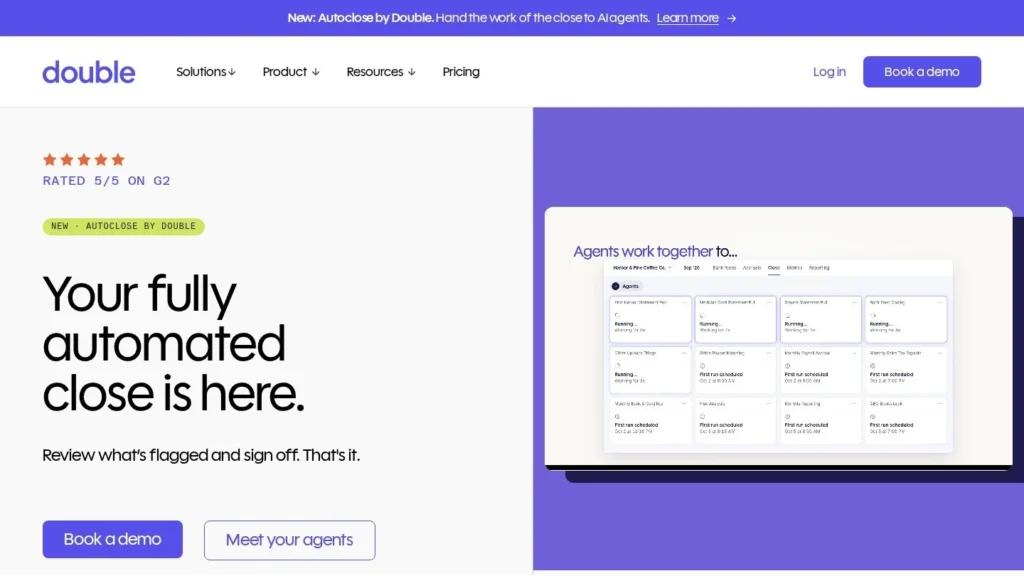
Double, the bookkeeping platform G2 lists as formerly Keeper, now sells Autoclose, a $500 a month add-on that hands the first pass of each client’s month-end close to AI agents. The agents pull statements, code bank feeds with each client’s rules, reconcile accounts and flag variances, and a person approves every close. Customer firms report large time savings: MCO Bookkeeping says it saves roughly 375 hours a month.
It is best for bookkeeping and client accounting firms closing many small business clients on QuickBooks Online or Xero. The main limit is that the per-client platform rates are not published, so the total bill needs a demo and a quote. We rate it 8.4/10 on our scale, helped by a 5.0 rating from 79 G2 reviews. We have not used Double ourselves; this review is based on Double’s website, pricing page and public reviews.
Double Facts for Bookkeeping Firm Owners
- Autoclose agents retrieve statements, code bank feeds, reconcile accounts and flag variances, then a human reviews and approves the close.
- Autoclose costs $500 a month for the firm; the platform is billed per connected client, with unlimited users.
- MCO Bookkeeping reports about 375 hours saved a month and final reviews down from 90 to as little as 12 minutes per client.
- Two-way sync covers QuickBooks Online, Xero, Sage Intacct and NetSuite.
- G2 reviewers give Double 5.0 out of 5 across 79 reviews.
Double by the Numbers
Double publishes several named customer results and part of its pricing, which makes it easier to size than many close tools.
| Fact | Detail | Source and Date |
|---|---|---|
| Autoclose price | $500 a month, firm-wide add-on | Double pricing page, viewed November 2026 |
| Billing basis | Per connected client per month; unlimited users | Double pricing page, viewed November 2026 |
| MCO Bookkeeping | Roughly 375 hours a month saved; final review cut from 90 minutes to as little as 12 minutes per client | Double UK page, viewed November 2026 |
| Springstead Solutions | Close finished 10 days faster | Double website, viewed November 2026 |
| Attivo Partners | 1,000 hours saved per month | Double website, viewed November 2026 |
| MCO client portal | 95% client portal adoption | Double website, viewed November 2026 |
| Dental Accounting Group | 10 hours a month saved on client communication | Double UK page, viewed November 2026 |
| Ledger sync | Two-way sync with QuickBooks Online, Xero, Sage Intacct and NetSuite | Double pricing page, viewed November 2026 |
| G2 rating | 5.0 out of 5 from 79 reviews | G2, viewed November 2026 |
The MCO Bookkeeping figures are the most concrete. Cutting final review from 90 minutes to as little as 12 minutes per client is the kind of change that lets one reviewer cover several times more clients. Those numbers come from Double’s own pages and describe the wider platform, not Autoclose alone, so treat them as a ceiling to test.
Attivo Partners’ 1,000 hours a month and Springstead Solutions’ 10-days-faster close point the same way. Even if your firm sees a fraction of those gains, the time freed in review is where Autoclose earns back its $500 a month. A firm that bills staff time at $50 an hour would need to save 10 hours a month to cover the add-on.
The pricing structure matters as much as the results. Because users are free and the platform is billed per connected client, firms pay in line with the work they bring in. Autoclose at a flat $500 a month gets cheaper per client the more clients a firm runs through it.
Inside a Double Autoclose Month
Autoclose sits on top of Double’s practice management, client portal and close tools. The agents do the repetitive groundwork; the firm’s staff own the judgment.
Pulling Statements and Coding Transactions
At month end, agents pull each client’s bank and card statements. They auto-code bank feeds using the rules set for that client, and Double’s AI bank feeds match transactions and flag exceptions that need a person. Automatic categorization and posting of transactions run through the two-way sync, so changes show up in QuickBooks Online or Xero.
Reconciling and Flagging Variances
Agents reconcile accounts and flag variances. Double’s AI also catches coding errors, builds schedules and runs flux analysis that compares balances across periods. File Review reports flag common coding errors and suggest how to fix each transaction.
Drafting Entries With Ask Double
Ask Double is a chat agent that builds journal entries, including complex ones, for a person to review before anything posts. AI commentary can draft the narrative for a client’s financial summary.
Chasing Clients for Missing Information
Uncategorized transactions and missing documents are a common reason closes stall. Double automates client reminders and gives clients a portal to answer questions, which MCO Bookkeeping says reached 95% adoption among its clients.
A Worked Example of the Review Step
Picture a client with two bank accounts and one credit card. At month end the agents pull the three statements, code the bank feed using the rules your team set for that client, and reconcile each account. Transactions that do not match a rule show up as exceptions, a jump in software spend shows up in the flux analysis, and an unexplained deposit triggers a client reminder through the portal. The reviewer opens the close, works through the flags, accepts or edits the agent’s coding, posts any journal entries Ask Double drafted, and approves. MCO Bookkeeping’s reported drop from 90 minutes to as little as 12 minutes per client describes that final review step.
What Staff Still Do
Double is explicit that a human reviews and approves every close and that AI output should be easy to verify. Staff manage the close, answer questions the agents raise, review flagged variances and track KPIs across clients.
How the Platform Around Autoclose Helps
Autoclose depends on the rest of Double. Practice management tracks which client closes are open, who owns them and what is overdue. The client portal collects answers and documents. Reporting turns closed books into financial summaries, where AI commentary drafts the narrative. A firm buying Autoclose is in practice buying into this whole workflow, which is why the per-client platform price matters as much as the add-on.
Setting Up Double
Firms start with a personalized demo. A client counts as connected once its QuickBooks Online or Xero file is imported, and at least one connected client is needed to start a subscription. Pilots are arranged after the demo and a signed contract, and finance teams on the annual plan get dedicated onboarding, data migration and a customer success manager.
Double Plans and Add-Ons
| Plan | Price | Billing | What Is Included | Limits |
|---|---|---|---|---|
| Accounting firm platform | Per connected client (tiered rates not listed) | Monthly | Practice management, close tools, client portal; unlimited team members and client contacts | At least one connected client |
| Autoclose add-on | $500 per month | Monthly, firm-wide | AI agents for statements, coding, reconciliation and variance flags | Requires the platform |
| Tax Suite | Included with $200 per month | Annual commitment | Tax workflows | Annual commitment |
| Team emails | $10 per connected team email per month | Monthly | Extra connected email inboxes | One practice email included in Core |
| Internal finance teams | Quote | Annual flat rate | Full platform, NetSuite, Sage Intacct, QBO and Xero sync, onboarding, migration, CSM, priority support | Contact sales |
Autoclose Costs for Three Firm Sizes
These examples cover only the published add-on prices; your per-client platform fee comes on top.
- Solo bookkeeper with 30 clients: Autoclose at $500 a month works out to about $16.67 per client per month, or $6,000 a year.
- Ten-person firm with 100 clients: the same $500 spreads to $5 per client per month. Adding five team email inboxes at $10 each adds $50, for $550 a month in add-ons.
- Firm adding tax work: the Tax Suite’s $200 a month annual commitment comes to $2,400 a year on top of Autoclose’s $6,000.
The largest unknown is the tiered per-client rate. Ask for it at your current and expected client counts, and check whether the tier changes as you connect more clients mid-year.
Double Compared With Booke AI, Karbon AI and Truewind
| Product | Starting Price | Free Plan | Main Strength | Main Weakness | Best For |
|---|---|---|---|---|---|
| Double Autoclose | $500 per month add-on; platform per client by quote | No (trial mentioned) | Close agents inside a full practice platform | Per-client rates unpublished | Bookkeeping firms with many small clients |
| Booke AI | $129 per business per month | No | Focused AI bookkeeping and reconciliation | Per-business price adds up for large books | Bookkeepers on QBO or Xero |
| Karbon AI | $59 per user per month (Team, billed annually) | No | Practice management and email triage at scale | Close work depends on other tools | Firms coordinating work across teams |
| Truewind | Custom quote | No | AI bookkeeping with service support | No published price | Client accounting services firms |
Double’s distinguishing feature is that the close agents live inside the same platform as client communication, tasks and reporting, and that its pricing is per client rather than per user. Booke AI is a lighter, per-business AI bookkeeping tool. Karbon is the practice management leader by review count, with AI focused on email and work coordination. Truewind combines AI with service for client accounting teams. Browse the full set in our accounting firm agents category.
A fair comparison looks at total cost per client per month. For Booke AI that is the published $129 per business. For Double it is the quoted per-client platform rate plus the $500 Autoclose fee divided across your clients. For Karbon it is $59 per user spread across the clients each user handles. Running those three numbers for your own firm is a quick way to see which model suits your mix of staff and clients.
Firms That Fit Double Autoclose
- Bookkeeping firms with dozens to hundreds of monthly clients: the flat $500 add-on gets cheaper per client as the book grows.
- Firms on QuickBooks Online and Xero: two-way sync keeps the ledger as the system of record.
- Growing teams adding staff: unlimited users mean hiring does not raise software costs.
- Firms struggling to get answers from clients: automated reminders and the client portal target the most common close delay.
Firms That May Want a Different Close Tool
- Tax-first practices: a tax agent such as TaxDome Atlas or Filed may fit the workload better.
- Firms with only a handful of clients: a per-business tool such as Booke AI may cost less than a $500 add-on.
- Project-based advisory firms: G2 reviewers say Double’s metrics suit recurring bookkeeping more than project work.
Double Autoclose Adoption Considerations
Plan the change for your team. Moving from manual coding to reviewing agent output changes junior staff roles: fewer hours entering transactions, more hours checking exceptions and talking to clients. Explain the shift early and decide who owns rules for each client, since that person shapes how well the agents perform.
Get the full price in writing. The per-client platform fee is the bigger number for most firms and is not published. Ask about tiers, mid-year changes and annual discounts.
Clean rules make better agents. Autoclose codes bank feeds using each client’s rules, so messy or outdated rules will produce messy first passes. Budget time to tidy rules for your largest clients before turning the agents on.
Keep review discipline. Double requires human approval of every close, which is the right design, but busy seasons tempt reviewers to approve quickly. Use the variance flags and flux analysis as a checklist rather than a formality.
Think about data portability. Double syncs both ways with the ledger, so the books stay in QuickBooks Online or Xero, but rules, notes, client conversations and workflow history live in Double. Ask how to export them if you ever change platforms.
Reporting is a known gap. G2 reviewers ask for deeper reporting, so list the reports your clients and partners expect and confirm Double produces them, or plan to export data to another tool.
Check where the agents get their data. Autoclose pulls bank and card statements for each client, so confirm which banks and card issuers it can reach, how credentials or feeds are connected, and what happens when a client’s bank changes its connection. Missing statements are a common reason closes slip, agent or not.
Customer results are vendor-published. The 375 hours and 10-days-faster figures are from Double’s pages. Run Autoclose on a sample of clients for two or three closes and compare hours with your own time tracking.
How Double Scores for Bookkeeping Firms
Double earns 8.4/10 on our scale. User sentiment is its strongest area, with a 5.0 G2 rating across 79 reviews, and autonomy and integrations are solid: agents handle statements, coding, reconciliation and variance flags, with two-way sync to the main ledgers. Pricing value and setup score lower because the per-client rates are not published and a demo comes first. Publishing those rates would make Double easier to compare.
For bookkeeping firms closing many monthly clients on QuickBooks Online or Xero, Autoclose is a strong candidate to test, with human approval built in. Smaller practices should price it against per-business tools first.
A good pilot runs two or three month-end closes on a mix of simple and messy clients. Record reviewer minutes per client before and after, count how many agent codings you change, and check whether client questions get answered faster through the portal. Those three numbers will tell you more than any case study.
Bookkeeper Questions About Double Autoclose
How Much Does Double Autoclose Cost?
Autoclose is a $500 a month add-on for the whole firm. The underlying platform is billed per connected client at tiered rates that Double quotes after a demo.
Is Double the Same Company as Keeper?
G2 lists the product as Double, formerly Keeper, and Double’s own pages still use the Keeper name in places.
Does Autoclose Post Entries Without Review?
Agents code and reconcile, and Ask Double drafts journal entries for review before posting. Double states that a human reviews and approves every close.
How Does Double Compare With Booke AI?
Booke AI charges $129 per business per month for AI bookkeeping. Double bundles practice management and a client portal with a flat $500 Autoclose add-on, which suits firms with larger client books.
Which Ledgers Does Double Support?
Double documents two-way sync with QuickBooks Online, Xero, Sage Intacct and NetSuite, with connected clients counted by imported QuickBooks Online or Xero files.
User Reviews
Nobody has rated it here yet. Be the first AI Agents Choice user to rate Autoclose by Double.