
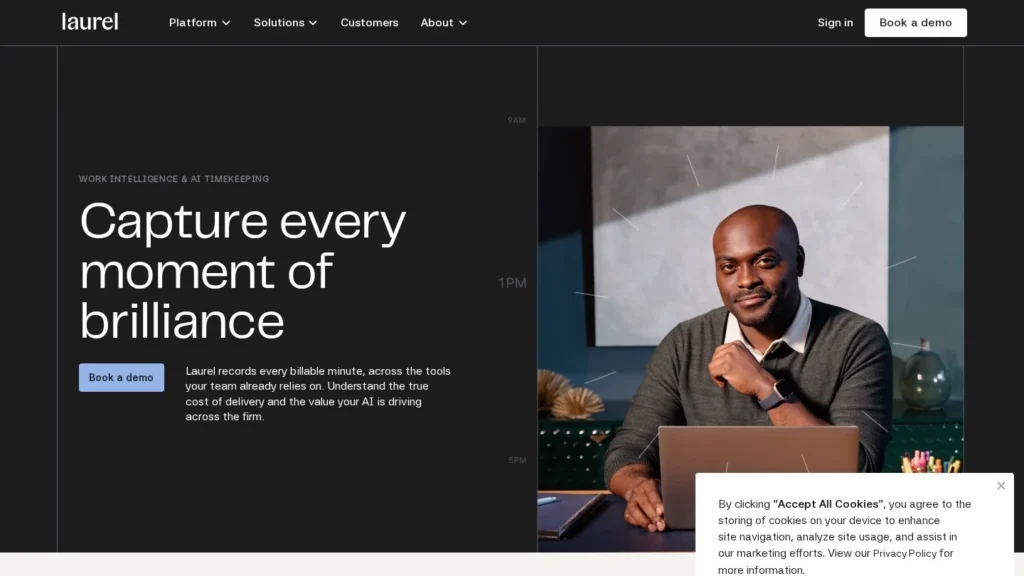
Laurel attacks a quiet leak in accounting and law firms: time that professionals work but never record. The company says its AI recovers more than 28 billable minutes per professional per day by building timesheets from real activity in email, meetings and documents. Ernst & Young and Grant Thornton are customers, and an EY tax partner calls it one of the firm’s most impactful AI investments. Laurel raised a $100 million Series C led by IVP in June 2025.
It is best for mid-size and large accounting, tax, audit and consulting firms with formal time policies. The main limits are that pricing is quote-only and that the billing agents were still listed as coming soon. We rate it 7.7/10 on our scale, with security its strongest area. We have not used Laurel ourselves; this review is based on Laurel’s website, press releases and coverage of its funding.
Laurel Facts for Firm Partners and COOs
- Laurel captures work across email, meetings and documents, maps it to clients and cost codes, and drafts timesheets for professionals to approve.
- The company reports more than 28 billable minutes recovered per professional per day and profit gains of 4 to 11%.
- Ernst & Young and Grant Thornton use Laurel, among more than 100 legal, accounting and consulting firms.
- Security includes SOC 2 Type II, ISO 42001, single-tenant firm-specific models, no public LLMs and bring-your-own-key encryption.
- Pricing is by quote after a demo or ROI analysis.
Laurel by the Numbers
Laurel publishes more outcome figures than most AI vendors in professional services, which gives firms a starting point for a business case.
| Fact | Detail | Source and Date |
|---|---|---|
| Series C | $100 million led by IVP, with GV, 01A and returning backers including TIME Ventures | Laurel release, June 10, 2025 |
| Growth | ARR up 300% and usage up 500% over the prior 12 months | Laurel release, June 10, 2025 |
| Customer base | More than 100 legal, accounting and consulting firms in the US, UK, EU, Australia and Canada | Laurel release, June 10, 2025 |
| Named users | Ernst & Young, Grant Thornton, Reed Smith; Freshfields and Crowell & Moring also named | SiliconANGLE, June 10, 2025 |
| Time recovered | More than 28 billable minutes per professional per day | Laurel release, June 10, 2025 |
| Profit and realization | Profit up 4 to 11% and realization up 1 to 4% for customers | Laurel release, June 10, 2025 |
| Value processed | Over $5 billion in gross market value, including $360 million plus in net-new value | Laurel release, June 10, 2025 |
| Accounting results | 0.94 more billable hours per professional each week; firm revenue up 3% | Laurel for accounting page, viewed November 2026 |
| Signal launch | Work intelligence platform capturing more than 99% of billable activity | Laurel release, February 11, 2026 |
| Certifications | SOC 2 Type II and ISO 42001 | Laurel for accounting page, viewed November 2026 |
Two figures are worth putting side by side. The headline 28 billable minutes a day is a daily measure of activity captured; the accounting page’s 0.94 more billable hours per professional each week is closer to what ends up on an invoice. The gap between them is a reminder that captured time is not the same as billed time, because some recovered work will be written off or fall under fixed fees.
The 300% ARR growth and the $100 million round show large firms are adopting Laurel quickly. The named users skew toward the largest firms, so mid-size practices should ask for references closer to their own size.
The security credentials in the table are also unusual for this category. ISO 42001 is a standard for managing AI systems, and Laurel lists it alongside SOC 2 Type II. For firms whose clients ask how AI touches their data, that certification and the single-tenant design give risk teams something concrete to review.
Inside Laurel’s Timekeeping Workflow
Laurel replaces memory-based time entry with an AI that watches the work and drafts the record. The professional stays responsible for what is submitted.
Capturing Work as It Happens
Laurel captures activity across Microsoft Office, email, meetings, PDF readers, web browsers and messaging tools. It groups related activities, for example drafting a memo and emailing the client about it, into one block of work. Laurel says 18% of billable hours are lost to memory gaps, and this capture step is meant to close that gap.
Mapping Activity With the Work Graph
The Work Graph classifies each block of activity to a client, project and cost category. It learns from the firm’s own coding conventions, so the suggestions reflect how your firm codes engagements, not a generic template. Laurel describes its True Time capture as 99% accurate.
Checking Compliance at Entry
Time policies are checked when the entry is created: missing matter codes, wrong categories or rule breaks are caught before submission instead of during month-end cleanup. For assurance work, where independence and documentation matter, Laurel describes machine-drafted, human-approved timesheets.
Approving and Submitting Time
The accounting page adds detail on what this looks like day to day: up to 30 minutes recovered each day and 2.88 more time entries per person daily, according to Laurel. More entries usually means finer-grained records, which helps when clients question a bill.
Professionals review the drafted entries, adjust descriptions or codes where needed and submit. Laurel says this cuts time spent on recording by up to 80%. The approval step keeps accountability with the person who did the work.
Signal for Firm Leaders
Signal, launched in February 2026, aggregates the same data for leadership. It compares work patterns before and after AI adoption to show which tools save time, predicts the time and staffing future projects need, flags redundant tasks and bottlenecks, and benchmarks performance while surfacing workload and burnout patterns. It was built partly on Braid, a data aggregation company Laurel acquired.
Rolling Laurel Out Across a Firm
Deployment follows the pattern of other enterprise software in large firms. Identity runs through SSO and SCIM, so accounts are created and removed with the firm’s directory. Laurel trains firm-specific models on the firm’s own conventions and keeps data in-region, which matters for firms with offices in the EU, UK or Australia. A typical evaluation starts with an ROI analysis, then a pilot group in one practice area before a wider rollout.
The people side takes as much planning as the technology. Professionals who have filled timesheets from memory for years need to trust that drafted entries are accurate and fair, and managers need to agree how to treat time the AI captures but the professional chooses not to submit.
Billing Agents on the Roadmap
Laurel’s accounting page lists billing as coming soon, with AI agents that check each bill before it goes out. Firms evaluating Laurel today should treat that as roadmap rather than a current feature.
Laurel Contract and Pricing Structure
| Plan | Price | Billing | What Is Included | Limits |
|---|---|---|---|---|
| Laurel time platform | Quote | Contract | AI time capture, Work Graph classification, compliance checks, drafted timesheets | Scope agreed with sales |
| Signal | Quote | Contract | Work intelligence for AI ROI, pricing, forecasting and talent insights | Scope agreed with sales |
| ROI analysis | Free on request | Not applicable | Estimate of recovered time and revenue for your firm | Based on your firm’s data |
What Laurel’s Figures Imply for Three Firms
Laurel does not publish fees, so these scenarios apply its own outcome figures to show the scale of value a firm would weigh against a quote. They are illustrations, not guarantees.
- Regional firm with 50 billing professionals at $150 an hour: 0.94 extra billable hours a week over 46 working weeks is 2,162 hours, or $324,300 a year at standard rates.
- National firm with 200 professionals at $200 an hour: the same rate of recovery is 8,648 hours, or about $1.73 million a year before write-offs.
- One professional using the headline figure: 28 minutes a day over five days and 46 weeks is about 107 hours a year of captured time, not all of it billable.
Costs to ask about include implementation, security review time, any per-user fees for non-billing staff, and whether Signal is priced separately from the core platform.
Laurel Compared With Karbon AI, TaxDome Atlas and DataSnipper
| Product | Starting Price | Free Plan | Main Strength | Main Weakness | Best For |
|---|---|---|---|---|---|
| Laurel | Custom quote | No | Automatic, policy-checked timesheets with strong security | Pricing unpublished; enterprise focus | Large firms that bill or track time |
| Karbon AI | $59 per user per month (Team, billed annually) | No | Practice management with AI email triage and work planning | Time capture is not its core | Firms coordinating client work |
| TaxDome Atlas | $800 per seat per year (Essentials) | No | All-in-one practice platform with AI agent | Built for small and mid-size firms | Tax and bookkeeping firms |
| DataSnipper | Custom quote | No | Audit evidence testing in Excel | Not a time or billing tool | Audit teams |
These products sit in different parts of an accounting firm’s stack. Karbon and TaxDome run the work itself, from client communication to task tracking; DataSnipper speeds up audit testing; Laurel measures and records the work for billing and profitability. Large firms often run several of them together. Laurel’s closest competitors are other time capture tools rather than the agents above. Browse more in our accounting firm agents and law firm agents categories.
A firm choosing between them should start from the problem. If work falls through the cracks between staff and clients, practice management with AI comes first. If audit testing eats the most hours, an audit agent pays back faster. If partners suspect billable time is going unrecorded, or cannot tell which fixed-fee engagements make money, Laurel is aimed squarely at that question.
Firms Likely to Benefit From Laurel
- Large accounting and advisory firms billing by the hour: recovered minutes turn into revenue at scale.
- Assurance and tax practices with strict time policies: compliance checks at entry and drafted timesheets reduce cleanup.
- Firms moving to fixed fees: accurate time data shows which engagements are profitable, and Laurel cites fixed-fee margin gains.
- Firms investing heavily in AI tools: Signal is designed to show which tools actually save time.
Practices That May Not Need Laurel Yet
- Small firms on monthly fixed fees: without hourly billing or time-based profitability work, the return is smaller; TaxDome Atlas or Karbon AI may cover more of the day-to-day need.
- Firms wanting a published monthly price: Laurel works through demos and quotes.
- Teams uneasy about activity capture: if staff or clients object to activity-based timekeeping, settle that policy question first.
Laurel Rollout Considerations
Activity capture needs clear communication. Professionals will want to know what is captured, who sees it and how it is used. Explain that entries are drafted for them to approve, and agree whether managers can see raw activity or only submitted time.
Expect a learning period for classification. The Work Graph learns from the firm’s own coding conventions, so the first weeks will need more corrections than later ones, especially for staff who split time across many clients. Track correction rates during the pilot to see how quickly suggestions improve.
Run the security review early. Laurel’s posture is strong, with SOC 2 Type II, ISO 42001, single-tenant firm-specific models, no public LLMs, bring-your-own-key encryption, SSO, SCIM and in-region storage, but email and document capture will still draw questions from IT, risk and independence teams.
Test the outcome figures on your own data. The 28 minutes, 4 to 11% profit gains and 3% revenue increase are vendor-reported. A pilot group with a before-and-after comparison is the most reliable way to confirm them.
Plan for billed versus captured time. More captured time does not always mean more revenue if partners write it off. Pair the rollout with a review of write-off policy so recovered time reaches invoices.
Check fit with your practice management and billing systems. Laurel’s value depends on time flowing cleanly into the systems that produce invoices and profitability reports. Ask which systems Laurel connects to in production at firms like yours and how codes are kept in sync when engagements change.
Treat billing agents as roadmap. If automated bill review is a reason to buy, ask for a delivery date and terms in the contract.
Laurel Company Milestones
On June 10, 2025, Laurel announced a $100 million Series C led by IVP, with GV and 01A participating, reporting 300% ARR growth and 500% usage growth over the prior year. SiliconANGLE’s coverage named Ernst & Young, Freshfields, Grant Thornton and Crowell & Moring among its users. On February 11, 2026, Laurel launched Signal, a work intelligence platform built partly on its acquisition of Braid, with The Bonadio Group quoted as a user.
How Laurel Scores for Accounting Firms
Laurel earns 7.7/10 on our scale. Trust and security score near the top thanks to SOC 2 Type II, ISO 42001, single-tenant models and bring-your-own-key encryption, and autonomy is solid: the AI captures, classifies, checks and drafts time with professionals approving. Pricing value is its weakest score because nothing is published, and setup reflects an enterprise rollout. Publishing an entry price for mid-size firms would widen its reach.
For larger accounting and advisory firms that bill by the hour or need reliable time data for fixed-fee pricing, Laurel is a well-funded, security-conscious option with a clear business case to test. Small fixed-fee practices can wait.
A focused pilot answers most open questions: pick one practice area with clear billing, compare a quarter of Laurel-drafted time against the prior quarter, and track both captured hours and what partners actually billed. That evidence is what a firm’s leadership will want before a wider contract.
Partner Questions About Laurel
How Much Does Laurel Cost?
Laurel does not publish prices. Firms book a demo or request an ROI analysis, and pricing is agreed with sales.
Does Laurel Submit Time Without Approval?
No. Laurel drafts timesheets from captured activity and checks them against policy, and professionals approve before submission.
Is Laurel Safe for Client Data?
Laurel lists SOC 2 Type II, ISO 42001, GDPR, CCPA and HIPAA, uses single-tenant firm-specific models without public LLMs, and supports bring-your-own-key encryption and in-region storage.
Which Accounting Firms Use Laurel?
Ernst & Young and Grant Thornton are named customers, and The Bonadio Group is quoted in Laurel’s Signal launch.
How Is Laurel Different From Practice Management Software?
Practice management tools such as Karbon run client work and tasks. Laurel focuses on capturing and coding the time spent on that work, and on profitability and AI ROI insights through Signal.
User Reviews
Nobody has rated it here yet. Be the first AI Agents Choice user to rate Laurel.