
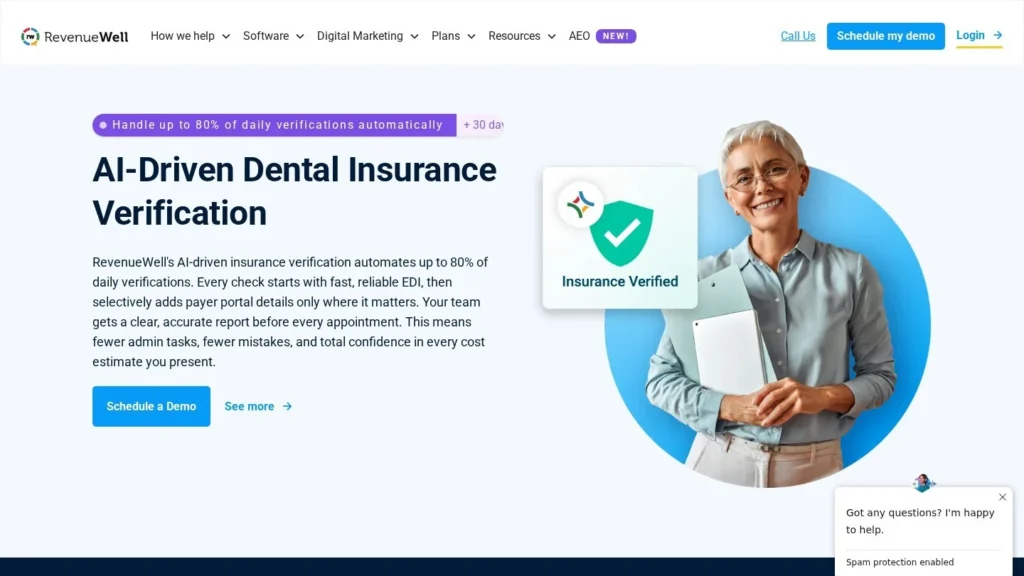
RevenueWell says its AI agents can automate up to 80% of a dental office’s daily insurance verifications. What makes the approach different is where it starts: with the patient. Someone booking online snaps a photo of an insurance card, an AI reader pulls out the payer and member details, and verification runs on its own three days before the visit, with a code-level benefits report landing in the practice management system.
It is best for practices that already use, or want, RevenueWell for scheduling, reminders and forms, because verification is sold as an add-on to that platform. The main thing to plan for is cost visibility: the add-on is priced by quote, and the platform’s Starter plan is listed at $189 per user per month. We rate it 8.2/10 on our scale. We have not used RevenueWell; this review is based on RevenueWell’s product page and release notes, trade press coverage and its Capterra listing.
80% Automated Checks and Card Capture at Booking
- RevenueWell says AI agents can automate up to 80% of daily verifications, checking eligibility through EDI first and payer portals only when needed.
- Patients upload insurance cards when they book, and the AI card reader extracts payer, member ID and group number, with automatic texts or emails when details are missing.
- Verification is an add-on with no listed price, advertised with 30 days free; the RevenueWell Starter plan is listed at $189 per user per month.
- The RevenueWell platform holds a 4.4 out of 5 rating from 83 Capterra reviews, and some reviewers raise contracts, support and verification accuracy.
- Compared with Zuub and Foji, RevenueWell is the only option that also collects the card from the patient and runs reminders, forms and an AI Receptionist.
RevenueWell’s Percentages Alongside Capterra Figures
RevenueWell publishes plenty of percentages for its verification agent, and stating the baselines behind them would make them easier to use. The platform-level figures from Capterra and the launch history fill in the rest.
| Fact | Detail | Source and Date |
|---|---|---|
| Reported automation | Up to 80% of daily verifications automated | RevenueWell verification page, viewed October 2026 |
| Reported coverage gains | 40% more procedures verified, 25% deeper verification detail, 20% more data returned, 15% better performance in complex cases (no baselines stated) | RevenueWell verification page, viewed October 2026 |
| Code coverage | Eligibility shown for 800+ CDT dental procedure codes, for primary and secondary plans | RevenueWell verification page, viewed October 2026 |
| Verification timing | Runs three days before the visit with a same-day backup; Medicaid reruns monthly; results in a few minutes depending on payer response | RevenueWell verification page, viewed October 2026 |
| Free period | 30 days free advertised for AI Insurance Verification | RevenueWell verification page, viewed October 2026 |
| First launch | Insurance Verification launched as an add-on to the RevenueWell Marketing Platform, pulling data from provider portals, clearinghouses and practice data | Dental Products Report, April 11, 2024 |
| 2026 update | Automatic verification from patient-submitted insurance details and an AI card reader rolling out to platform customers during 2026 | RevenueWell release notes, August 27, 2026 |
| Platform rating | 4.4 out of 5 from 83 reviews; value for money 4.2 | Capterra listing, viewed October 2026 |
| Platform entry price | Starter plan at $189 per user per month; Professional and Premium quoted | Capterra listing, viewed October 2026 |
| Industry recognition | G2 Leader badge for Summer 2026 shown on the product page | RevenueWell verification page, viewed October 2026 |
For a buyer, the most useful number here is the 80% automation claim, because it tells you how many verifications still reach a person. If a practice handles 30 verifications a day over 20 working days, that is 600 a month, and 80% automation would leave about 120 for staff. The other percentages are relative improvements without a starting point, so they are harder to apply until RevenueWell shares the baselines.
The Capterra rating covers the whole RevenueWell platform rather than the verification agent alone. That still matters, because verification lives inside the same account, contract and support team. Reviewers praise reminders, texting and form building, and the concerns that recur (support access, contract length, cancellation) apply to any add-on bought on top.
The product has also had time to mature. It launched in April 2024 and gained the card reader and patient-driven verification in 2026, which is a longer track record than several newer dental verification agents.
Verification That Starts on the Booking Form
RevenueWell’s verification agent sits inside a patient engagement platform, so the workflow begins earlier than most verification tools: at the online booking form.
From Card Photo to Eligibility Check
- Capture the card: on the appointment request form, the patient uploads an insurance card by photo or PDF. The AI-powered Insurance Card Reader extracts the payer, member ID, group number and plan details for review before submission.
- Chase what is missing: if details are incomplete, RevenueWell automatically texts or emails the patient before the appointment and asks for a card.
- Verify: the AI agents check eligibility through EDI first and pull details from payer portals only when needed, handling portal multi-factor logins in the background.
- Report: a dynamic benefits form shows explanation of benefits, past services and eligibility dates for each procedure code, across more than 800 CDT codes, for primary and secondary plans.
- Sync: the report syncs to the practice management system, where staff use it to give patients cost estimates.
When It Runs
Verification starts automatically when a patient schedules or submits insurance details. A check runs three days before the visit, and a same-day verification acts as a backup. Medicaid plans are rerun automatically at the start of each month. Staff can also trigger a rerun by hand or run a check on the day of the appointment. RevenueWell says a verification takes a few minutes, depending on how fast the payer responds.
Connecting Only a Handful of Payer Portals
According to RevenueWell, a practice may need to connect only one or two payer portals, or three to five, depending on which insurers its patients use, since EDI covers the rest. Card capture works through RevenueWell’s appointment request forms and automated requests, so practices already using those forms have little to change. RevenueWell said the card reader would roll out gradually to Marketing Platform customers during 2026.
AI Receptionist and the Rest of the RevenueWell Suite
The same account can run RevenueWell’s AI Receptionist, a voice agent that handles routine calls around the clock, along with online scheduling, reminders, forms, texting, reviews and payments. Since August 2026, practices can switch on the voice agent before their text messaging registration is approved.
Benefits Reports and Unverifiable Patients for Front Desk Staff
Staff still review the benefits report, build and explain estimates, and handle patients whose coverage cannot be verified or who never upload a card. RevenueWell’s own figure of up to 80% automation implies that a share of verifications will still need a person on any given day.
Tiered Platform Plans Plus a Quoted Verification Add-On
RevenueWell prices the platform in tiers and sells verification as an add-on. The figures below are from Capterra and RevenueWell’s product page.
| Plan | Price | Billing | What’s Included | Limits |
|---|---|---|---|---|
| Starter | $189 per user per month | Monthly | Online scheduling, basic forms, recall and reminders, texting, payments, PMS integration | Verification not included |
| Professional | Custom quote | Contract | Adds advanced campaigns, reviews and surveys, patient portal, social media, custom forms, phones | Quote only |
| Premium | Custom quote | Contract | Adds mobile-optimized websites, consultative services and ADA TV | Quote only |
| AI Insurance Verification | Custom quote | Add-on | Card reader, automatic verification, benefits reports synced to the PMS | 30 days free advertised |
Starter Bills for One-User and Three-User Dental Offices
These scenarios cover the listed Starter platform price only, because the verification add-on is quoted. User counts are our assumptions.
- A solo office with one user: $189 a month, or $2,268 a year, before the verification add-on.
- A practice with three users: $567 a month, or $6,804 a year, before the add-on.
- A practice with five users: $945 a month, or $11,340 a year, at which point the Professional quote may make more sense.
Other costs to ask about: the add-on price and whether it is per location, the contract length (a frequent complaint on Capterra), and whether phones and the AI Receptionist sit in a higher tier. Use the 30 free days to count how many verifications still reach staff.
Add-On Price and Payer Coverage Questions for the Demo
Ask for the add-on price in writing, including whether it is charged per location, per provider or per verification. Ask which payers are covered by EDI and which need portal logins for your patient mix, and how a failed portal login is reported. Ask whether your practice management system receives the full benefits form or only a summary, and whether the card reader is already live on your account. Finally, ask what happens at the end of the 30 free days and how long the contract runs.
RevenueWell AI Insurance Verification Compared With Weave AI Receptionist, Zuub and Foji AI Agents
Dental offices can buy verification from a patient engagement platform, as with RevenueWell or Weave, or from a verification specialist such as Zuub or Foji.
| Agent | Starting Price | Free Plan | Main Strength | Main Trade-Off | Best For |
|---|---|---|---|---|---|
| RevenueWell AI Insurance Verification | $189 per user per month platform (listed); add-on quoted | No (30 days free advertised) | Starts with the patient’s card and runs inside scheduling and reminders | Add-on price not listed; contract complaints | Practices that want one patient platform |
| Weave AI Receptionist | Custom quote | No | Answers calls and texts around the clock, books appointments and takes payments | No public pricing | Practices focused on calls and messaging |
| Zuub | $299 per user per month (listed) | No | Dedicated verification with strong reviews | Per-user pricing grows with the team | Offices that want a verification specialist |
| Foji AI Agents | $699 a month flat (listed) | No | Portal reading with session recordings | Narrow PMS coverage | Open Dental offices wanting a flat fee |
If verification is the only problem, Zuub and Foji are more focused and publish clearer prices. If the front desk also needs reminders, forms, texting and an AI Receptionist, RevenueWell bundles more of that work into one account. For call handling first, compare Weave and Arini, and see the full list in our AI agents for dental practices guide.
Current RevenueWell Offices and Online-Booking Practices
- Existing RevenueWell customers: the add-on plugs into forms and reminders the practice already runs.
- Practices where patients book online: card capture at booking means fewer missing details at check-in.
- Offices with many Medicaid patients: automatic monthly reruns catch eligibility changes without staff reminders.
- Practices tired of portal logins: EDI-first checks and background MFA reduce how often staff sign into payer sites.
Verification-Only Buyers and Large DSOs
- Practices that only want verification: buying a patient engagement platform to get it may cost more than a specialist like Zuub or Foji.
- Buyers who avoid long contracts: several Capterra reviewers describe long terms and trouble canceling.
- Large DSOs with central billing teams: enterprise verification tools such as Videa AutoVerify or Ivy by Overjet are aimed at that scale.
- Teams that need fully published pricing: the add-on and upper tiers are quote only.
Baselines, Accuracy Checks and Contract Terms at RevenueWell
- Baselines to request: the 80%, 40%, 25%, 20% and 15% figures are RevenueWell’s, and it could help buyers by stating what they are measured against.
- Verification accuracy: at least one Capterra reviewer raised concerns about the accuracy of insurance verification. Compare reports against the payer portal for your top carriers during the trial.
- Contracts and cancellation: long contracts and difficulty canceling come up in some reviews. Read the term and exit clauses before signing.
- Support access: some reviewers report long waits for support and occasional outages.
- Gradual rollout: RevenueWell said the card reader would reach platform customers gradually during 2026, so confirm your account has it before relying on it.
What RevenueWell’s August 2026 Release Notes Added
- On August 27, 2026, RevenueWell’s August release notes added automatic verification from patient-submitted insurance details, an AI card reader rolling out through 2026, and the option to enable the AI Receptionist voice agent before text messaging registration is approved.
Worth the 30 Free Days for Existing RevenueWell Customers
For practices already on RevenueWell, it is worth turning on for the 30 free days. RevenueWell AI Insurance Verification scores 8.2/10 on our scale: good autonomy and a sensible patient-first workflow, with room to grow through a listed add-on price and stronger reviews of the wider platform. Starting with the card at booking, verifying three days ahead and rerunning Medicaid monthly covers the steps that usually slip at a busy front desk.
For practices that only need verification, a specialist is simpler. Zuub and Foji publish prices and focus on one job. The patient-first design is the strongest argument for RevenueWell: an insurance card captured at booking and checked three days ahead gives the front desk time to resolve problems before the patient is in the chair, rather than at the check-in window. Whichever route you take, measure how many verifications still reach staff after a month, and check the contract length before you commit.
Dental Office Questions on RevenueWell Verification
How Much Does RevenueWell Insurance Verification Cost?
RevenueWell does not list a price for the verification add-on; it is quoted after a demo. Capterra lists the platform’s Starter plan at $189 per user per month, and RevenueWell advertises 30 days free for verification.
Does RevenueWell Verify Insurance Automatically?
Yes. Verification starts when a patient books or submits insurance details, runs three days before the visit with a same-day backup, and reruns Medicaid plans at the start of each month. Staff can also trigger reruns by hand.
What Is the RevenueWell Insurance Card Reader?
It is an AI feature on RevenueWell’s forms that extracts the payer, member ID, group number and plan details from a photo or PDF of the patient’s card. If details are missing, RevenueWell asks the patient by text or email.
Is RevenueWell Insurance Verification HIPAA Compliant?
RevenueWell describes the system as HIPAA compliant and says all portal login credentials are encrypted.
How Does RevenueWell Compare With Weave?
Both are dental patient engagement platforms with AI receptionists. RevenueWell adds an AI insurance verification agent with card capture and EDI-first checks, while Weave AI Receptionist answers calls and texts around the clock, books appointments and takes payments. Neither lists a price for its AI features.



User Reviews
Nobody has rated it here yet. Be the first AI Agents Choice user to rate RevenueWell AI Insurance Verification.