


Shift Technology says early users of its Shift Claims agents, AXA Switzerland among them, reached 60% overall automation and handled claims 30% faster. Numbers like that explain the rush. Still, most claims teams first want to know which parts of a claim an AI agent can take over today.
Today that means intake, document review, coverage checks, routing and simple settlements. Adjusters still decide the complex, injured and disputed claims. For a carrier that wants one platform across the claim, Shift Claims and Five Sigma’s Clive are the closest to end to end. For a single job, such as first notice of loss calls or file review, a narrower agent does the work with less integration.
We went through launch releases, customer stories and product pages from eight claims AI vendors. Then we mapped each one to the claim stage it handles. Our research turned up one rule shared by all eight. The agents prepare and recommend, while a licensed person makes the call on anything unusual.
Where AI Agents Fit in Insurance Claims Processing
A claim moves through the same stages at almost every carrier. So we matched each stage to what an agent does there and to vendors that sell that piece.
| Claim stage | What the AI agent does | Vendors that cover it |
|---|---|---|
| First notice of loss | Takes the report by phone, chat or email at any hour and opens the claim | Liberate, Strada, Five Sigma, Bevaya |
| Document intake | Reads, sorts and extracts data from claim notices, medical records and estimates | Indico Data, Bevaya, Agentech |
| Coverage and liability | Checks the policy, exclusions and liability against the facts | Shift Technology, Five Sigma |
| Triage and routing | Scores complexity and exposure, then sends the claim to automation or the right handler | Shift Technology, Indico Data |
| File review and QA | Checks the file against carrier rules and flags gaps | Agentech, Five Sigma |
| Settlement | Processes simple claims straight through when rules allow | Shift Technology, Five Sigma |
| Policyholder updates | Answers status calls and texts, then logs them | Strada, Sonant AI, Liberate |
You do not need every stage at once. In our view, the first wins come where volume is high and decisions are simple, such as intake and status calls.
Eight Vendors Selling AI Agents for Claims Processing
We compiled this table from each vendor’s own releases and product pages. None of the eight publishes a price list, so every deal is quoted.
| Vendor | Main claims work | Built for | Named users we found |
|---|---|---|---|
| Shift Technology (Shift Claims) | Assess, route and settle claims across the lifecycle | Carriers | AXA Switzerland |
| Five Sigma (Clive) | Routine claim work on top of any claims system | Insurers, MGAs, TPAs, reinsurers | Starr, Fast Cover |
| Agentech | Hundreds of task agents preparing each claim file | Carriers, TPAs, adjusting firms | Odie Pet Insurance, Mid-America Catastrophe Services |
| Bevaya (formerly Roots Automation) | Claim indexing, FNOL and FROI setup, document work | Carriers, brokers, TPAs | Backed by Liberty Mutual Strategic Ventures |
| Indico Data | Classify, extract and route claim documents | Commercial and specialty carriers, MGAs | Allstate, Sompo, Markel, Aviva, HDI |
| Liberate | Voice FNOL, quotes and policy changes | P&C carriers and large agencies | Aspire General |
| Strada | FNOL, claims status and back-office claim setup | Carriers, MGAs, TPAs | Hippo, Clearcover, Accelerant |
| Sonant AI | Answers agency calls, including claims requests | Independent insurance agencies | O’Connor Insurance, BIG Pickering |
For more vendors, including underwriting tools such as Sixfold and Kalepa, browse our insurance AI agents category.
End-to-End Claims Agents for Carriers
These two platforms aim at the whole claim. Both sit on top of the carrier’s existing claims system, so nobody has to replace a core platform first.
Shift Claims by Shift Technology

Shift Technology has sold AI to insurers since 2014, first for fraud detection. Shift Claims adds agents across the whole claim. They assess coverage, liability, damage, injury and subrogation from the documents. Then they score each claim for complexity, urgency and exposure.
Based on that score, a claim goes either to straight-through processing or to the right handler. Handlers get guidance on document review, decisions and negotiation. Besides the 60% automation figure, Shift says early adopters cut claims losses by 3%. See our Shift Technology listing.
Clive by Five Sigma

Clive connects to any claims management system through REST APIs. It is trained on each insurer’s own standard operating procedures. Then task agents handle single jobs, such as Clive Coverage for coverage decisions and Clive Inspection for quality checks.
Five Sigma reports 25% higher adjuster productivity, 80% fewer errors and 10% shorter cycle times in a white paper published by Google Cloud. In practice, Starr chose Clive for global commercial and specialty claims in January 2026. Fast Cover, a Sydney travel insurer, put it into live production in April 2026. See our Clive listing.
Read also: Best AI Agents for Document Processing: 5 Tools With Real Prices
AI Agents That Prepare Claim Files for Adjusters
Much of a desk adjuster’s day goes to reading and checking documents. These three agents do that preparation, then hand a cleaner file to a person.
Agentech
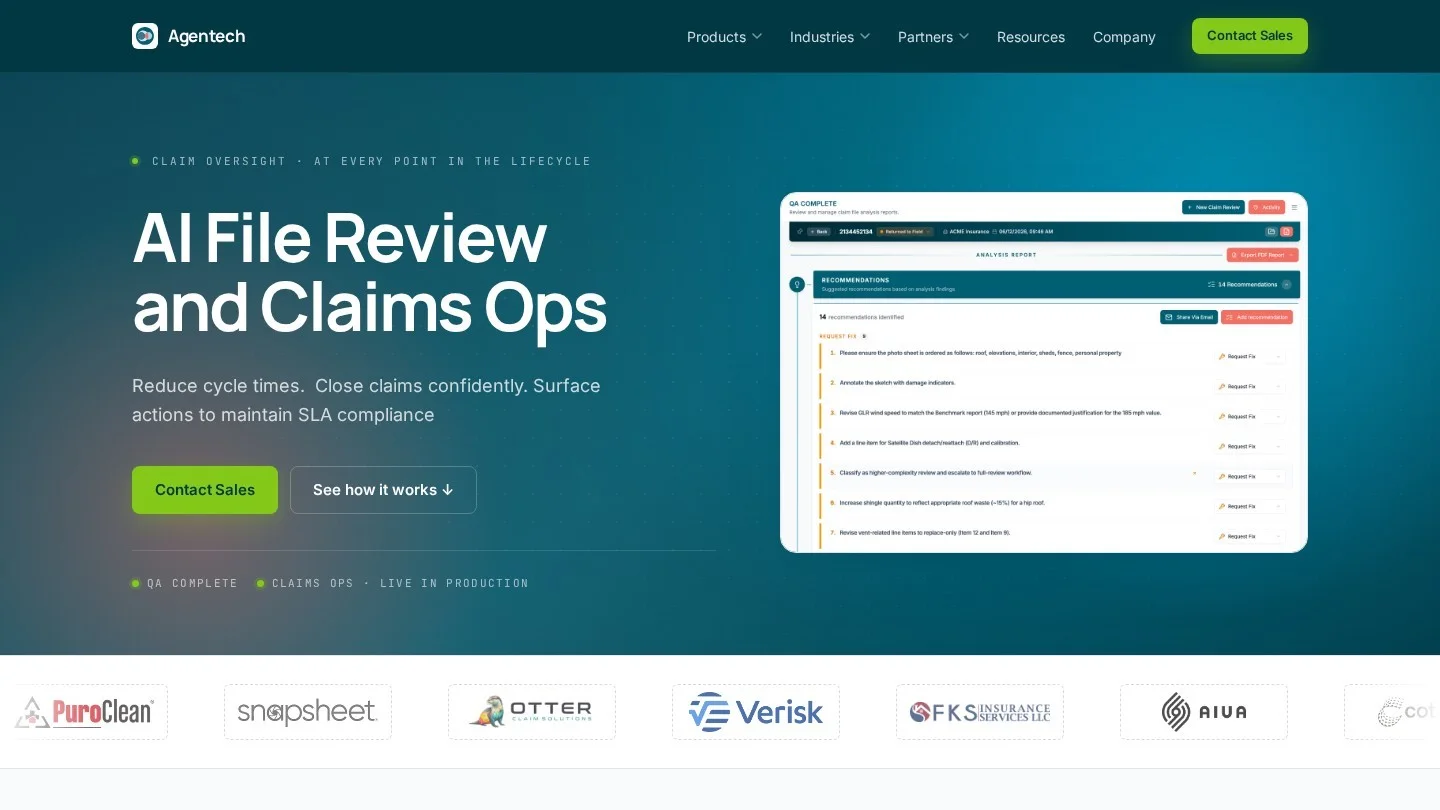
Agentech puts more than 100 small agents on one claim file. Each does one job, such as reading a medical record or checking an estimate against carrier rules. The company says this lifts claims throughput three to four times without extra staff.
Odie Pet Insurance uses several hundred Agentech agents to extract data, build pet health profiles and review medical records. Also, Mid-America Catastrophe Services uses its QA Complete suite for residential property claims. The agents never adjudicate, though. Adjusters make every decision. See our Agentech listing.
Bevaya
Roots Automation renamed its platform Bevaya in May 2026. Its InsurGPT models were trained on more than 300 million insurance documents. Prebuilt agents cover claim indexing, FNOL and FROI setup, plus submissions and loss runs.
Before the rename, the company reported an 85% rise in claims processing capacity at a US third-party administrator. Human review and explainability controls decide which agent actions run. It connects with Guidewire ClaimCenter. See our Bevaya listing.
Indico Data
Indico Data classifies, extracts and routes insurance documents, including claim notices and FNOL documents. Every extracted field carries a confidence score and a link back to its source document. Then an audit trail records each agent action.
Its customer logos include Allstate, Sompo, Markel, Aviva and HDI. Indico says insurers using its agents cut manual processing time by more than 80%. Our roundup of AI agents for document processing compares more extraction tools.
Voice and Chat Agents for First Notice of Loss
The first call after a loss is often the busiest moment for a claims team. So these agents answer it, open the claim and pass the hard cases to a person.
Liberate
Liberate’s voice agent, Nicole, takes first notice of loss around the clock and issues a claim number. It writes results into Guidewire, Duck Creek and Snapsheet. A Supervisor layer logs every call and escalates to licensed staff.
Liberate says its agent resolves about 80% of FNOL calls alone at Aspire General. It also reports cutting hurricane claim response from 30 hours to 30 seconds for clients it did not name. See our Liberate listing.
Strada

Strada handles FNOL by phone, chat or email, then does the back-office work. Its agents set up the claim, and browser agents work in carrier portals that lack an API. Every action is logged.
Strada says it contains 80% of contacts end to end. Its customers include Hippo, Clearcover and Accelerant. See our Strada listing.
Sonant AI
Independent agencies get claims calls too. Sonant AI answers them, verifies the caller and looks up the policy in the agency management system. Then it writes a note to the client record or warm-transfers the call. Sonant says O’Connor Insurance got an 8x return in 30 days and reclaimed 58 staff hours a month.
How Insurers Keep Humans in Charge of Claims Agents
Each vendor we studied keeps a person in the loop in some form. However, the level of control differs, so pick it on purpose.
- Recommendation only. The agent suggests a next step, and an adjuster acts. Five Sigma offers this as the first of its three modes.
- Working alongside adjusters. The agent does the prep work, such as Agentech’s file reviews, and a person decides.
- Straight-through processing. The agent closes simple claims within rules. Shift Claims and Clive both offer it for simple claims.
- Escalation on exceptions. Voice agents such as Liberate hand calls to licensed staff when a case goes beyond their rules.
We would begin in the first mode and move up one claim type at a time. Our guide to human-in-the-loop orchestration shows how approval gates work in practice.
Rolling Out AI Agents in a Claims Operation, Step by Step
We would plan a first rollout in five steps. Each one comes from how the vendors above deploy.
- Pick one claim type. Choose a high-volume, low-severity line, such as pet, travel or simple auto glass claims.
- Write down the procedure. Agents like Clive learn from your standard operating procedures, so gaps in the playbook become gaps in the agent.
- Check the integration path. Confirm the agent can read and write your claims system, such as Guidewire, Duck Creek or Snapsheet.
- Set the autonomy level. Begin with recommendations, then allow straight-through processing once results hold steady.
- Measure against today. Track cycle time, leakage, reopen rate and the share of claims a person had to touch.
For the measuring step, our guide to AI agent benchmarking explains how to build a test set from closed claims before you go live.
Claims Processing AI Agent Questions From Insurers
Can AI Agents Settle Insurance Claims on Their Own?
Some can, for simple claims within set rules. Shift Claims and Five Sigma’s Clive both offer straight-through processing. Complex, injury and disputed claims still go to adjusters.
Do Claims AI Agents Replace the Claims System?
No. Shift Claims, Clive and Liberate all work on top of existing systems such as Guidewire and Duck Creek.
How Much Do AI Agents for Claims Processing Cost?
All eight vendors in our research sell through quotes. Strada, for example, charges a platform fee plus per-minute usage, with lower rates at higher volume.
Which Carriers Use AI Agents for Claims?
Named users include AXA Switzerland with Shift Claims, Starr and Fast Cover with Clive, Aspire General with Liberate and Odie Pet Insurance with Agentech.
Related AI Agents


Read also: Multi-Agent Communication Protocols: MCP, A2A, AG-UI, ANP and FIPA-ACL
Explore Agent Categories
Related Articles
 GuidesBest AI Agents for Document Processing: 5 Tools With Real Prices
 GuidesSynthesia AI Video Usage Among Corporate Training Teams
 GuidesBest CAMEL AI Alternatives and What They Cost
 Guides100 AI Agent Statistics for Retail Companies
 GuidesLLM or AI Agent? AI Search Engines and What They Actually Are
 GuidesCan You Trust an AI Agent?
