
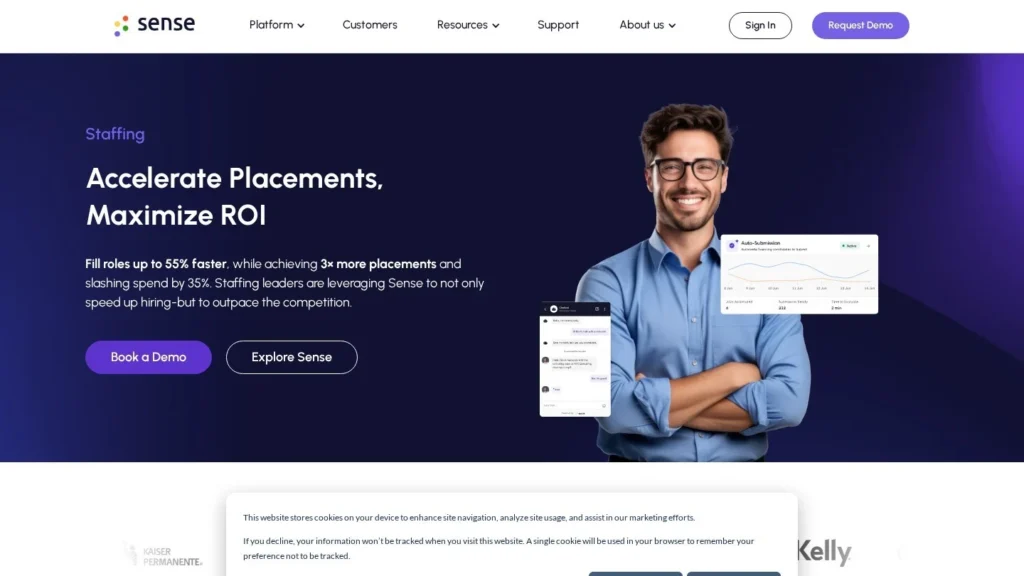
Sense says it works with 5 of the 10 largest staffing firms in the world, and it has turned its candidate texting platform into a set of AI agents for the front end of staffing: an AI Recruiter, an AI Interviewer and an AI Receptionist that screen applicants by voice and text, book interviews and pull past candidates back into new orders. The agents connect two ways to staffing ATSs such as Bullhorn, Avionte, JobDiva and Labor Edge.
Sense AI Recruiter is best for staffing agencies that place hourly and contract workers at volume and lose candidates to slow follow-up. Buying is the main thing to plan for: Sense shares pricing by quote, and reviewers say setup takes work. G2 users rate the platform 4.5 out of 5 from 567 reviews. We rate it 8.1/10 on our scale, a score that mostly reflects quote-only pricing. We have not used Sense ourselves; this review is based on Sense’s product pages, TechCrunch’s funding coverage and public review sites.
Sense Serves Half the 10 Biggest Staffing Firms
- Sense says it works with 5 of the 10 largest staffing firms in the world, and its agents cover screening, scheduling and redeployment.
- Voice AI calls candidates to prescreen and book interviews, while SMS, WhatsApp and chat messages fire automatically through the candidate journey.
- Two-way integrations with Bullhorn, Avionte, JobDiva and Labor Edge let the agents re-engage candidates already in your ATS.
- Pricing is quote-only, so budget time for a demo and ask how voice minutes and texts are billed.
- G2 users rate Sense 4.5 out of 5 from 567 reviews, though some reviewers cite slow setup and occasional outages.
Sense’s Long Track Record With Staffing Firms
Sense has been selling to staffing firms since well before the current wave of AI agents, and its published figures reflect that history.
| Fact | Detail | Source and Date |
|---|---|---|
| Staffing reach | Works with 5 of the 10 largest staffing firms in the world; “thousands of companies” use Sense | Sense staffing page, viewed October 2026 |
| Vendor-reported staffing results | Fill roles up to 55% faster, 3 times more placements, 35% lower spend, 30% higher recruiter output, 3,000 recruiter hours saved | Sense staffing page, viewed October 2026 |
| Candidate satisfaction | 4.6 out of 5 candidate satisfaction (vendor figure) | Sense staffing page, viewed October 2026 |
| Copilot time savings | AI Copilot saves recruiters about 1.5 hours a day on average; job matching lifts recruiter productivity up to 50% (vendor figures) | Sense AI product page, viewed October 2026 |
| Series D | $50 million led by SoftBank Vision Fund 2 at a $500 million valuation, bringing total funding to $90 million | TechCrunch, December 5, 2021 |
| Customers in 2021 | More than 600 customers, including Amazon, Sears and Vaco; revenue and headcount more than doubled in the prior year | TechCrunch, December 5, 2021 |
| Founder | Co-founder and CEO Anil Dharni previously co-founded Funzio, which GREE acquired for $210 million | TechCrunch, December 5, 2021 |
| G2 rating | 4.5 out of 5 from 567 reviews | G2, viewed October 2026 |
| Capterra rating | 4.7 out of 5 from 38 reviews; 4.6 for ease of use and 4.8 for customer service | Capterra, viewed October 2026 |
The staffing figures are ambitious, and each comes from Sense. Three times more placements and 35% lower spend are the kind of figures that depend heavily on the starting point: an agency that barely followed up with applicants will see bigger gains than one with a disciplined desk. Ask Sense for a reference customer of similar size and job mix and compare their before and after numbers to yours.
The funding record matters in a different way. A $500 million valuation in 2021 and more than 600 customers at the time point to an established vendor rather than a young startup, which lowers the risk of the product disappearing mid-contract. The 567 G2 reviews back that up.
Sense Between the ATS and the Candidate
Sense sits between the ATS and the candidate. It reads job orders and candidate records from the ATS, runs conversations through its agents, and writes results back through two-way integrations.
AI Recruiter, AI Interviewer and Voice AI
- AI Recruiter: Sense’s recruiting agent for engaging and moving candidates through the pipeline, sold as part of its staffing suite.
- AI Interviewer and Voice AI: conversational voice AI that phones candidates to handle prescreening and interview scheduling.
- AI Receptionist: listed in the staffing suite for answering candidate contact.
- AI chatbot: a website chatbot that answers FAQs, takes instant applications, runs prescreens and supports sourcing.
- AI Copilot: a generative assistant for recruiters that drafts job descriptions, prescreening questions and emails.
A Typical Candidate Journey
- Apply: a candidate applies through the chatbot or a job board, and the agent answers questions and runs a prescreen.
- Screen: the Voice AI or a text conversation asks the screening questions the agency set and scores the candidate.
- Schedule: the agent books an interview and sends reminders and follow-ups by SMS, WhatsApp, email or chat.
- Match: candidate scoring and job matching suggest which open orders fit.
- Redeploy: when an assignment ends or a new order arrives, agents re-engage people already in the talent pool. Sense says customers close over 70% of roles from existing talent.
Demo, Scoping and ATS Connection
- Demo and scoping: Sense sells through a personalized demo, and the products, channels and seats are set in the quote.
- Connect the ATS: integrations with Bullhorn, Avionte, JobDiva, Labor Edge, Salesforce and the major corporate ATSs carry job and candidate data both ways.
- Build workflows: agencies set triggers, templates and screening questions. Capterra reviewers say this step can be time-consuming for less technical users.
- Set handoffs: decide when a recruiter should take over through Live Chat.
Channels and Apps
Sense reaches candidates on the channels staffing desks already rely on: phone calls through the Voice AI, SMS, WhatsApp, email, a website chatbot and Sense’s own iOS and Android app. Messages are personalized and triggered by each candidate’s stage, so a new applicant, a candidate with an interview tomorrow and a worker finishing an assignment each get different outreach without a recruiter writing it. For agencies hiring in countries where candidates use WhatsApp as their main messaging app, having it in the same workflow as SMS and voice avoids running a separate tool for those markets.
The breadth has a cost in setup. Each channel needs templates, timing rules and handoff points, and Capterra reviewers say building those workflows is the slowest part of getting started. A practical approach is to plan the first three or four journeys before onboarding, such as new applicant, interview reminder and end of assignment, and add more once those run cleanly, rather than trying to automate every touchpoint in the first month.
Placements, Pay Rates and Live Chat Takeovers
Client relationships, pay rates, offers and final placement decisions stay with recruiters. Smart filters flag issues for review, and Live Chat lets a recruiter step into any conversation, which is where judgment calls such as a borderline screen should go.
Personalized Demos in Place of Plan Prices
Sense does not publish plan prices. Its staffing page and product pages direct buyers to a personalized demo.
| Plan | Price | Billing | What’s Included | Limits |
|---|---|---|---|---|
| Sense staffing suite | Custom quote | Set in contract after a demo | Agents, messaging, Voice AI, chatbot, scheduling, matching and ATS integrations as scoped | Products, channels and seats depend on the quote |
Setting a Budget Ceiling From Rival Price Points
Without published figures, the useful exercise is to set a ceiling before the demo. Two published prices from tools in the same space give a frame of reference.
- Benchmark against a seat-priced CRM: five recruiters on Recruiterflow’s published Platform plan at $149 per user per month pay $745 a month, or $8,940 a year, for an agency ATS and CRM with sequences. If a Sense quote for five recruiters lands far above that, it should be justified by voice screening and redeployment, which Recruiterflow’s base plan does not offer.
- Benchmark against a sourcing agent: five hireEZ Growth seats at $549 per user per month cost $2,745 a month. Sense solves a different problem, engagement and screening rather than outbound sourcing, but the figure shows what agencies already pay for AI recruiting seats.
- Usage to ask about: voice minutes, SMS and WhatsApp messages can be bundled or billed by volume. A desk sending thousands of shift reminders a month should ask for the overage rate in writing.
Sense AI Recruiter Compared With Bullhorn Amplify, Carv and Olivia by Paradox
All four put agents in front of candidates at volume, but each starts from a different base: an engagement platform, an ATS, an agent suite and a conversational hiring assistant.
| Agent | Starting Price | Free Plan | Main Strength | Main Trade-Off | Best For |
|---|---|---|---|---|---|
| Sense AI Recruiter | Custom quote | No | Voice, text and WhatsApp agents with two-way staffing ATS sync | No published pricing; setup effort | Staffing firms on Bullhorn, Avionte or JobDiva |
| Bullhorn Amplify | Custom quote | No | Agents built into the staffing ATS itself | Only works inside Bullhorn | Agencies already on higher Bullhorn tiers |
| Carv | Custom quote | No | Separate agents for screening, scheduling, rediscovery and re-assignment | Younger vendor with no public ratings | Large staffing and RPO operations |
| Olivia by Paradox | Custom quote | No | Mature conversational hiring for frontline roles | Overkill for low-volume hiring | Large employers hiring hourly staff |
The choice usually follows the ATS. An agency on Bullhorn can try Amplify without adding a vendor, but Sense covers more ATSs, so it suits firms on Avionte, JobDiva or Labor Edge, or groups running several systems. Carv offers a more granular set of agents and counts ManpowerGroup as a partner, but has no public review base yet. Olivia by Paradox is aimed at employers rather than agencies. Sense’s advantage is breadth of channels and a long staffing track record, and since every one of these rivals is also quote-only, price comparison happens only in sales calls. Browse more in our AI agents for recruitment agencies and AI voice agents guides.
High-Volume Shift Staffing Desks
- High-volume staffing agencies: light industrial, healthcare and other shift-based desks with many applicants per order get the most from automatic screening, scheduling and reminders.
- Agencies on Avionte, JobDiva or Labor Edge: Sense is one of the few agent platforms with two-way integrations into these staffing systems.
- Firms with large dormant databases: redeployment agents re-engage past candidates, which Sense says closes over 70% of roles from existing talent.
- Teams whose candidates prefer text or WhatsApp: Capterra reviewers say texting through Sense often gets faster replies than email or phone.
Small Search Firms and Self-Serve Buyers
- Small search firms: a few recruiters placing senior professionals may not use voice screening at volume, so they could end up paying for capacity they do not need.
- Buyers who want self-serve pricing: every deployment starts with a demo and a quote.
- Teams without someone to build workflows: reviewers say setup takes time and can be hard for less technical users.
- Agencies needing outbound sourcing first: Sense focuses on engaging applicants and existing candidates; dedicated sourcing agents such as hireEZ or Juicebox fit that job better.
Reported Results, Reliability and Consent Rules
- Vendor-reported results: figures such as 3 times more placements, 35% lower spend and 55% faster fills come from Sense’s own materials.
- Reliability: a few Capterra reviewers report periodic unavailability, reconnection problems and slow issue resolution, which matters more when agents run reminders for live shifts, so ask about uptime commitments.
- Messaging consent: automated calls, SMS and WhatsApp to candidates are subject to consent and opt-out rules that vary by country and state, so confirm how Sense records consent.
- Reporting requests: some reviewers want deeper analytics, easier exports and simpler broadcast management.
- Compliance detail: Sense shows an AICPA SOC badge and a Warden Assured badge for its matching. Ask for the SOC report type and the scope of any bias assessment before rollout.
Voice Billing and ATS Write-Back Terms
- How are voice and text billed? get bundled volumes and overage rates in writing.
- Which ATS fields does Sense write back? two-way sync is only useful if notes, statuses and screening results land where recruiters look.
- Who builds the first workflows? ask whether onboarding includes building your screening and redeployment flows.
- Can we start with one desk? a single-branch pilot measured on fill rate and time to fill is easier to judge than a full rollout.
Built Well for Staffing, With Pricing Shared by Quote
Sense AI Recruiter scores 8.1/10 on our scale. The product side is strong for staffing: voice prescreening, automated scheduling and redeployment across SMS, WhatsApp and chat, with two-way integrations into more staffing ATSs than most rivals. G2 users rate it 4.5 from 567 reviews, and Sense says it works with half of the 10 largest staffing firms. The score reflects pricing, which is shared by quote, and setup effort reported by reviewers, two areas Sense could improve.
For a staffing agency with high applicant volume and a large, underused database, Sense is a strong shortlist candidate, especially if you run Avionte, JobDiva or Labor Edge rather than Bullhorn. Small search firms and teams without anyone to own workflows may be better served by simpler, published-price tools.
What Staffing Firms Check Before Signing With Sense
How Much Does Sense Cost for a Staffing Agency?
Sense does not publish prices. It quotes after a personalized demo, and cost depends on the products, channels and seats you choose. Ask how voice minutes and text messages are billed.
Does Sense Integrate With Bullhorn and Avionte?
Yes. Sense lists two-way integrations with Bullhorn, Avionte, JobDiva, Labor Edge and Salesforce for staffing, plus Workday, Greenhouse, iCIMS, SAP SuccessFactors and Oracle Taleo for corporate teams.
Can Sense Call Candidates by Phone?
Yes. Its conversational Voice AI phones candidates to prescreen them and schedule interviews. Recruiters can take over conversations through Live Chat.
How Does Sense Help With Redeployment?
Its agents re-engage candidates already in the talent pool using two-way ATS data, and candidate scoring and matching suggest who fits a new order. Sense says customers close over 70% of roles from existing talent.
Who Owns Sense?
Sense Talent Labs is a San Francisco company co-founded by CEO Anil Dharni. It raised a $50 million Series D led by SoftBank Vision Fund 2 in December 2021 at a $500 million valuation, according to TechCrunch.
User Reviews
Nobody has rated it here yet. Be the first AI Agents Choice user to rate Sense AI Recruiter.