
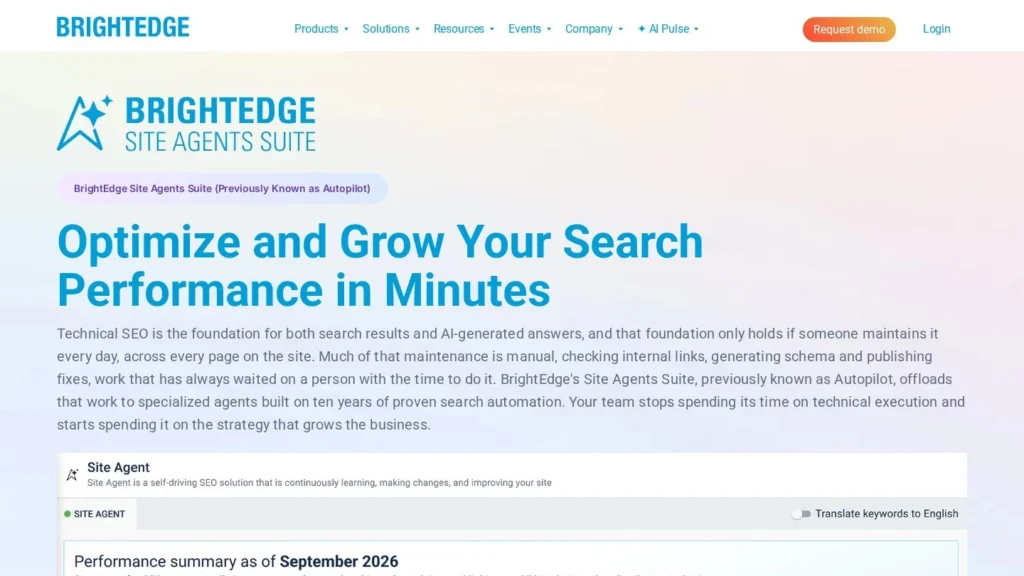
BrightEdge launched Autopilot in September 2019 as “the industry’s first self-driving SEO technology,” and within six months it was running on 1,000 customer sites. Campbell’s Soup, an early user, reported a 204% year-over-year traffic lift. In 2026 the product is presented as the Site Agents suite: three agents that maintain internal links, structured data and on-page tags across large websites.
BrightEdge Autopilot is best for large enterprises already paying for BrightEdge that want routine technical SEO handled without developer tickets. It comes as part of the platform: BrightEdge said it does not charge separately for Autopilot, so the price is the price of a BrightEdge platform contract, which G2 reviewers describe as high. We rate it 8.0/10 on our scale. We have not used BrightEdge ourselves; this review is based on BrightEdge’s product page and launch materials, its WordPress.org and Optimizely listings, press coverage and G2 reviews.
1,000 Sites in Six Months and Campbell’s 204% Lift
- Autopilot reached 1,000 customer sites within six months of its 2019 launch, and Campbell’s Soup reported a 204% year-over-year traffic lift.
- Site Agent builds internal links and Schema Agent deploys JSON-LD automatically; Publishing Agent updates titles, meta tags and H1s only after a person confirms.
- BrightEdge said at launch that it does not charge separately for Autopilot, but it requires the BrightEdge enterprise platform.
- It runs through a WordPress plugin, last updated in July 2026, and a one-time-install Optimizely CMS connector.
- G2 users rate BrightEdge 4.4 out of 5 from 905 reviews, with cost and a learning curve as the most common themes.
From the 2019 Launch to Today’s Site Agents
BrightEdge is an established enterprise vendor, and Autopilot’s public record runs from its 2019 launch to the current Site Agents product page and plugin listings.
| Fact | Detail | Source and Date |
|---|---|---|
| Launch | Unveiled as “the industry’s first self-driving SEO technology” | BrightEdge news item, September 18, 2019 |
| Early adoption | Deployed across 1,000 BrightEdge customer sites in its first six months | Search Engine Land, 2019 |
| Customer result | Campbell’s Soup: 204% year-over-year traffic lift | Search Engine Land, 2019 |
| Pricing at launch | BrightEdge said it does not charge separately for Autopilot | Search Engine Land, 2019 |
| Technology | Built on BrightEdge Data Cube, Data Mind and BrightEdge Instant, plus Trilibis, a responsive design platform BrightEdge acquired | Search Engine Land, 2019 |
| Current agents | Site Agent (internal links), Schema Agent (JSON-LD) and Publishing Agent (titles, meta titles and H1s with human confirmation) | BrightEdge product page, viewed October 2026 |
| WordPress plugin | Version 1.1.19 released July 20, 2026; 500+ active installations; tested with WordPress 7.0 | WordPress.org, viewed October 2026 |
| Optimizely connector | One-time install, zero-touch optimization, feature-level control and activity monitoring | Optimizely connector listing, viewed October 2026 |
| Offices | San Mateo, Cleveland, New York and Chicago in the US, London and Bordeaux | Optimizely connector listing, viewed October 2026 |
| G2 rating | BrightEdge platform: 4.4 out of 5 from 905 reviews | G2, viewed October 2026 |
Two numbers matter most for a buyer. The 1,000 sites in six months show that Autopilot was rolled out broadly across BrightEdge’s existing customer base rather than sold as a separate product, which is still how it reaches customers. The 204% Campbell’s figure is a single, vendor-published result from the launch period; treat it as a sign of what automation can do on a large site with neglected internal linking, not as a forecast.
The July 2026 plugin release is a useful signal in the other direction. A product launched in 2019 that is still being updated for current WordPress versions is one BrightEdge continues to maintain, and the move to named agents shows it has been folded into the company’s newer AI products such as SEO Copilot and AI Catalyst.
Specialized Agents Built on a Decade of Search Automation
BrightEdge describes the Site Agents suite as specialized agents powered by machine learning and AI, drawing on ten years of search automation refined across enterprise sites. Each agent covers one job.
Site Agent
Site Agent builds and places internal links automatically. It connects high-performing pages to pages that target priority keywords, passing authority to the pages you most want to rank. This continues the original Autopilot feature that found orphan pages, pages with no internal links pointing to them, and linked them into the site automatically. The WordPress plugin exposes this as a Link Equity Manager.
Schema Agent
Schema Agent generates JSON-LD structured data and deploys it automatically as pages change. Structured data helps search engines understand what a page is about, such as a product, article or organization, and keeping it current by hand is tedious on sites with thousands of templates.
Publishing Agent
Publishing Agent pushes recommended title tag, meta title and H1 updates into WordPress, Drupal or another major CMS. This is the one agent with an explicit approval step: BrightEdge says a person confirms every change before it goes live.
Delivery Through Plugins and Connectors
- WordPress: the BrightEdge Autopilot plugin is activated and configured on a BrightEdge Settings page. It requires WordPress 5.7 or later and PHP 5.6 or later, and recent versions added mobile page and image optimization.
- Optimizely CMS: the connector is a one-time install that BrightEdge says needs no heavy developer or IT support. It runs in the background, self-calibrates, checks for updates and lets teams choose which features to apply and monitor activity.
- Other CMSs: Publishing Agent works with Drupal and other major CMSs, according to the product page.
Where It Came From
The 2019 version of Autopilot was pitched by CEO Jim Yu as “self-driving SEO with zero touch,” a way to scale a marketer’s time across the organization. It fixed, optimized and linked orphan pages automatically, resolved duplicate content and self-optimized mobile pages. It ran on BrightEdge’s Data Cube and Data Mind technologies and BrightEdge Instant, and used Trilibis, a responsive design platform BrightEdge had acquired, for the mobile work. The current agents keep the linking work and add schema and CMS publishing.
Linking the Site and Installing the Plugin
- Connect the site to BrightEdge: Autopilot runs on sites linked to a BrightEdge account.
- Install the integration: activate the WordPress plugin and configure it on the BrightEdge Settings page, or install the Optimizely connector once.
- Choose features: decide which automations apply, such as link building, schema or mobile optimization, using the feature controls.
- Set approvals: route Publishing Agent title, meta and H1 updates to the people who must confirm them.
- Monitor: review activity logs and rankings, and widen or narrow scope as results come in.
Publishing Agent Changes Wait for Approval
People approve every Publishing Agent change, decide which Autopilot features run on which sites and keep an eye on activity logs. Strategy, keyword priorities and content still come from the SEO team, supported by the rest of the BrightEdge platform. Large sites should also agree with engineering which templates and sections the agents may change, since internal links and schema are deployed automatically.
Bundled Into BrightEdge’s Enterprise Platform
BrightEdge sells Autopilot as part of its enterprise SEO platform rather than as a standalone subscription. The items below are what BrightEdge and its partners have stated publicly.
| Plan | Price | Billing | What’s Included | Limits |
|---|---|---|---|---|
| BrightEdge platform | Enterprise contract | Set by BrightEdge | Autopilot and Site Agents alongside BrightEdge SEO products | Requires a BrightEdge customer relationship |
| Autopilot | No separate charge (stated at 2019 launch) | Included with the platform | Site Agent, Schema Agent and Publishing Agent | Runs on sites connected to BrightEdge |
| WordPress plugin | Free download | None | Link Equity Manager, mobile page and image optimization | WordPress 5.7+ and PHP 5.6+ |
| Optimizely connector | One-time install | None stated | Zero-touch optimization, feature controls, activity monitoring | Optimizely CMS sites |
What Autopilot Adds for an Existing Customer
Because Autopilot is bundled, the useful cost question is what it adds for a BrightEdge customer and what a non-customer would pay for comparable automation elsewhere. Rival prices below come from our listings for those tools.
- An existing BrightEdge customer: based on BrightEdge’s launch statement, switching on Autopilot adds no software fee. The cost is internal: time to agree rules with the web team, review Publishing Agent changes and monitor activity.
- A mid-size company not on BrightEdge: Search Atlas OTTO’s Pro plan at $319 a month billed annually comes to $3,828 a year, and Alli AI’s Business plan is reported at $2,990 a year. A full BrightEdge contract is a much larger commitment made for the whole platform, not for automation alone.
- An agency or multi-site group: Alli AI’s Agency tier is reported at $5,990 a year for 15 sites. BrightEdge makes more sense when the same company already needs enterprise keyword research, site audits, reporting and content tools.
Other costs to plan for include training, since G2 reviewers mention a learning curve, and engineering time to approve agent scopes on complex sites.
BrightEdge Autopilot Compared With Search Atlas OTTO, Alli AI and AirOps
OTTO and Alli AI are the closest rivals: both deploy technical and on-page fixes automatically. AirOps is a different kind of tool, focused on content for AI search, but often competes for the same enterprise SEO budget.
| Agent | Starting Price | Free Plan | Main Strength | Main Trade-Off | Best For |
|---|---|---|---|---|---|
| BrightEdge Autopilot | No separate charge on the BrightEdge platform | No | Internal links, schema and on-page tags inside an enterprise platform | Requires a BrightEdge contract | Enterprises already on BrightEdge |
| Search Atlas OTTO | $79 a month billed annually | No (7-day trial) | Ships fixes through a pixel on an entry plan | Pixel changes live outside the CMS source | Agencies and in-house marketers |
| Alli AI | $299 a month (reported) | No (10-day trial) | Live on-page changes across many sites via a snippet | Higher entry price for one small site | Agencies managing many sites |
| AirOps | Free Solo plan | Yes (Solo) | Content workflows for AI search with CMS publishing | Not a technical SEO fixer | Content operations teams |
A notable difference is where changes live. BrightEdge’s Publishing Agent writes updates into the CMS after approval, while OTTO and Alli AI serve many changes through a pixel or snippet layer. Teams that want their CMS to remain the single source of truth may prefer the BrightEdge approach. Scope is the other difference. OTTO and Alli AI are bought for automation; BrightEdge Autopilot comes with keyword research, site audits, reporting and content strategy tools in one contract, which suits enterprises that want one vendor for SEO but is a larger commitment than automation alone. More options are on our AI agents for SEO and enterprise pages.
Current Customers and Big Sites With Weak Internal Links
- Current BrightEdge customers: Autopilot is part of the platform, so the main cost is internal setup time.
- Large sites with weak internal linking: Site Agent links priority pages and orphan pages automatically, the work behind the Campbell’s result.
- Teams on WordPress, Drupal or Optimizely: maintained plugins and connectors cover these CMSs directly.
- Organizations that require approvals: Publishing Agent waits for a person to confirm every title, meta and H1 change.
- Sites with many templates: Schema Agent keeps JSON-LD in step as pages change.
Smaller Businesses and Content-Hungry Teams May Prefer Other Tools
- Small and mid-size businesses: the required BrightEdge platform is an enterprise purchase; OTTO starts at $79 a month billed annually.
- Teams that need content written: Autopilot handles technical and on-page SEO; tools such as Frase or AirOps write and publish articles.
- Companies wanting a quick self-serve trial: Autopilot is delivered as part of the BrightEdge platform, not as a standalone sign-up.
- Sites on unsupported platforms: check that your CMS is covered before planning around Publishing Agent.
Platform Commitment and Changes Without Per-Item Approval
- Platform commitment: Autopilot comes with BrightEdge, so the automation stays with the platform.
- Automatic changes: Site Agent and Schema Agent deploy without a per-change approval; use the feature controls to limit scope on sensitive sections.
- Dated proof points: the 1,000-site and Campbell’s figures come from 2019; ask BrightEdge for recent customer references.
- Cost and complexity: G2 reviewers mention high costs, slow-loading reports and a learning curve for the BrightEdge platform.
- Overlap with newer products: BrightEdge also sells SEO Copilot, AI Catalyst and AI Agent Insights; confirm which features sit in which product before signing.
An Easy Switch to Flip for BrightEdge Customers
For enterprises already on BrightEdge, yes: turning on automation that BrightEdge said carries no separate charge is an easy decision, provided the web team agrees the scope. BrightEdge Autopilot scores 8.0/10 on our scale. It does real work on its own, linking pages and deploying schema automatically, and its approval step for titles and headings suits cautious organizations. The WordPress plugin’s July 2026 update shows the product is still maintained.
For everyone else, the verdict depends on the wider platform. Autopilot is not a reason by itself to buy BrightEdge when OTTO or Alli AI automate similar fixes at published prices. Buy BrightEdge for its full enterprise SEO suite, and treat Autopilot as a valuable part of that package.
Is Autopilot Now Called Site Agents
Is BrightEdge Autopilot the Same as Site Agents?
BrightEdge’s Autopilot product page now presents the product as the Site Agents suite, made up of Site Agent, Schema Agent and Publishing Agent. It builds on the Autopilot automation BrightEdge launched in 2019.
Does BrightEdge Charge Extra for Autopilot?
At launch, BrightEdge said it does not charge separately for Autopilot. It comes with the BrightEdge enterprise platform, so the cost is the platform contract.
Does BrightEdge Autopilot Change My Site Without Approval?
Partly. Site Agent places internal links and Schema Agent deploys JSON-LD automatically. Publishing Agent, which updates title tags, meta titles and H1s, requires a person to confirm each change before it goes live.
Which CMS Platforms Work With BrightEdge Autopilot?
BrightEdge offers a WordPress plugin and an Optimizely CMS connector, and Publishing Agent works with WordPress, Drupal and other major CMSs. The WordPress plugin was tested with WordPress 7.0 in its July 2026 release.
How Does BrightEdge Autopilot Compare With Search Atlas OTTO?
Both automate technical and on-page fixes. OTTO is sold self-serve from $79 a month billed annually and deploys many changes through a pixel, while BrightEdge Autopilot comes with an enterprise platform and writes approved title and heading changes into the CMS.
User Reviews
Nobody has rated it here yet. Be the first AI Agents Choice user to rate BrightEdge Autopilot.