
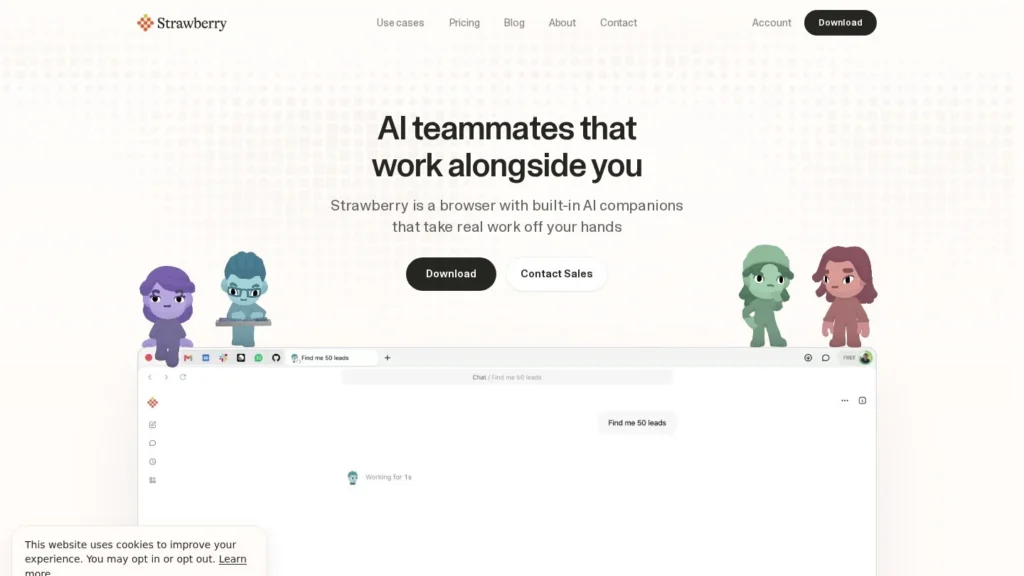
Strawberry Runs AI Companions in the Browser Where Teams Already Work
Strawberry’s beta reached #1 of the day on Product Hunt on April 22, 2025, and in October 2026 the Stockholm company released version 1.0. It is a desktop browser with AI “companions” that do repetitive web work for sales, recruiting, support and marketing teams, inside the sites those teams are already logged into.
Strawberry suits non-technical teams that spend hours in HubSpot, LinkedIn, Bullhorn and internal dashboards. The Free plan includes 500 credits a month, and paid plans start at $20. Speed is the main complaint in reviews. Strawberry scores 8.9/10 on our scale.
Strawberry for Sales and Recruiting Teams
- Strawberry 1.0 launched in October 2026 after a beta that reached #1 on Product Hunt in April 2025.
- Companions research sites in parallel, enter data, source leads and update CRMs inside logged-in tools.
- Free includes 500 credits a month; Intern is $20 for 6,000 credits; browsing itself is free.
- General Catalyst and EQT Ventures led a $6 million round in October 2025.
- Product Hunt reviewers rate it 4.8 out of 5 across 13 reviews.
Strawberry’s Funding, Founders and Launch Figures
Strawberry’s funding coverage, its 1.0 launch report, its pricing page and Product Hunt supply these facts.
| Fact | Detail | Source and Date |
|---|---|---|
| Funding round | $6 million, led by General Catalyst and EQT Ventures | Silicon Canals, October 14, 2025 |
| Angel backers | Founders of Lovable, Hugging Face and Supabase | Silicon Canals, October 14, 2025 |
| Founders | Charles Maddock (CEO), Arian Hanifi, Sebastian Thunman | Silicon Canals, October 14, 2025 |
| Beta access | First 10,000 beta sign-ups offered free access | Silicon Canals, October 14, 2025 |
| Version 1.0 | Launched October 2026, free to try; Series A planned | Retail Technology Innovation Hub, October 26, 2026 |
| Product Hunt | #1 of the day on April 22, 2025; 4.8 from 13 reviews | Product Hunt, 2026 |
| Free plan | 500 credits a month, no card | Strawberry pricing page, 2026 |
| Top-up credits | $0.01 per credit, rolling over | Strawberry pricing page, 2026 |
The investor list explains part of the product’s direction. The founders of Lovable, Hugging Face and Supabase build tools that non-engineers use to make software. Strawberry applies a similar idea to browser work: a sales rep should be able to hand a repetitive task to an agent without writing a script.
The beta gave the first 10,000 sign-ups free access and onboarded customers on a rolling monthly basis. Version 1.0 opened the product to any team, with a free tier and published paid plans, and the company said it would follow the launch with a Series A round.
A year passed between the funding round and version 1.0. In that time the product moved from a self-driving browser for individuals to companions that whole teams can share, with team billing and admin controls.
How a Strawberry Companion Handles a Task
Strawberry is a full browser. Users browse as normal, and when a task repeats, they hand it to a companion.
Working Inside Logged-In Sites
Since the companion runs in the same browser as the user, it can act on login-protected platforms such as a CRM or an applicant tracking system. Strawberry names HubSpot, LinkedIn and Bullhorn as examples. It can research several websites in parallel, generate content and handle data entry, meeting follow-ups, lead sourcing and CRM updates.
Watching, Pausing and Replaying Runs
Product Hunt reviewers single out one feature: the user can watch a companion work, pause it, replay a run and step in to guide it. That visibility matters when the agent is writing into a live CRM, where a wrong click changes real records.
Companions That Learn and Get Shared
Companions remember how a team works and improve with use. A companion trained once can be used by everyone on the team and keeps what it learned. On Team plans, companions, skills and team context are shared across seats.
Scheduled Tasks and Connected Apps
Every plan includes scheduled tasks, memory across chats, device sync and interactive dashboards. Companions connect to Gmail, Slack and Notion, and users can link ChatGPT. Paid users can choose which AI models to use, and Expert mode is available on paid tiers.
Efficient, Default and Expert Modes
Strawberry offers different modes for different jobs. The Free plan includes Efficient and Default modes with curated AI models. Paid plans let users choose the model and add Expert mode for harder tasks. A team can keep routine data entry on a cheaper mode and save Expert mode for research that needs more reasoning.
A Recruiter’s Morning Sourcing Run, Step by Step
A recruiter asks a companion to find 20 backend engineers in Berlin on LinkedIn who match a job brief. The companion searches, opens profiles in parallel tabs and checks each against the brief. It drafts a short note for each match and adds the candidates to Bullhorn with the right job tag. The recruiter watches the first few, corrects one mistake in how titles are read, and lets the rest run. The next morning, a scheduled run repeats the search for new profiles.
Free, Intern, Part-Time and Full-Time Plans on Strawberry
Strawberry prices by credits. Browsing is free; credits are used when a companion drafts, researches or extracts data.
| Plan | Price | Billing | What’s Included | Limits |
|---|---|---|---|---|
| Free | $0 | None | 500 credits a month, Efficient and Default modes | No card; monthly credits do not roll over |
| Intern | $20 a month | Monthly or annual (2 months free) | 6,000 credits a month | Credits reset monthly |
| Part-Time | $85 a month | Monthly or annual | 25,000 credits a month | Credits reset monthly |
| Full-Time | $250 a month | Monthly or annual | 75,000 credits a month | Credits reset monthly |
| Team | Not listed | Per seat | Own allowance per seat, shared companions and skills, admin controls, 3 free seats per team | Seats added in Team settings |
| Enterprise | Custom | Invoice | Pooled credits, rollover, onboarding, custom terms | By contract |
Credit Math for a Five-Person Sales Pod
All three paid tiers cost about a third of a cent per credit: $20 for 6,000, $85 for 25,000 and $250 for 75,000. Top-ups cost $0.01 per credit, three times the plan rate, though they roll over.
Five reps on Intern pay $100 a month for 30,000 credits in total. On annual billing with two months free, each Intern seat comes to $200 a year, or $1,000 for the five. If one rep runs out of credits every month and tops up 3,000 credits, that adds $30 a month, enough that moving that rep to Part-Time at $85 for 25,000 credits makes more sense.
Strawberry does not publish how many credits a typical task uses. Teams should track a week of real work on the Free plan’s 500 credits before choosing a tier.
Strawberry Compared With Comet, Opera Neon and Fellou
All four are browsers with agents built in. They differ in who they are built for and how they charge.
| Agent | Starting Price | Free Plan | Main Strength | Fit Note |
|---|---|---|---|---|
| Strawberry | $20 a month (Intern) | Yes, 500 credits | Shared companions for team workflows in CRMs and ATSs | Sales and recruiting teams |
| Comet by Perplexity | Free; Pro $20 a month adds background work | Yes | Search-led browsing with an assistant | Individuals who research heavily |
| Opera Neon | Free; Standard reported at $19.90 a month | Limited | Autonomous browsing with Skills and MCP connections | Users who want to plug in their own agents |
| Fellou | Free; Plus $19 a month | Yes | Agentic browser with scheduled tasks | Individuals automating web tasks |
Strawberry’s difference is the team model: companions that one person trains and everyone shares, with per-seat allowances and admin controls. Comet, Neon and Fellou focus on individual users. On price, the four sit close together at about $20 a month for a first paid tier, so the choice comes down to fit. Opera Neon suits people who want to plug in their own agents through MCP, and Comet suits heavy researchers already paying for Perplexity Pro. Strawberry is the one built around shared team workflows in CRMs and applicant tracking systems. For more choices, see our browser and computer-use agents.
Account Access and Data Questions for Strawberry
A companion works with the user’s own logins, so it can do anything the user can do in that CRM or applicant tracking system. That is what makes it useful, and it is also what a security team will ask about first.
Strawberry’s pricing page states that it does not train on customer content, and it links to a Trust Center. Team plans add admin controls and unified billing. Before a rollout, ask Strawberry where session data and logins are stored, which certifications it holds, how long run recordings are kept and whether admins can limit which sites a companion may act on. Starting companions on read-only work, such as research and list building, keeps risk low while the team learns how they behave.
A Two-Week Strawberry Trial for a Recruiting Team
Days one to three: two recruiters install Strawberry on the Free plan and move their daily LinkedIn sourcing into it. They watch each run and note every correction.
Days four to seven: they train one companion on the team’s sourcing brief and Bullhorn tagging rules, then share it. They count credits used per candidate added.
Week two: the companion runs on a morning schedule. The recruiters compare candidates added per hour with their own pace in the first week. If the numbers hold and credits stay within a paid tier, the team buys seats for everyone and keeps the trained companion as the shared starting point.
Teams That Get the Most Out of Strawberry
Recruiting teams that source candidates on LinkedIn and log them in Bullhorn fit the product closely, since those are named examples. Sales development reps who research accounts and update HubSpot are another close fit.
Agency teams that manage lead lists for several clients can also gain. Each client’s process can live in its own trained companion, and a new account manager can pick it up on day one without relearning the steps.
Support and marketing teams with repetitive web chores, such as copying data between dashboards or drafting follow-ups after calls, can also hand work to companions. Small teams gain from the free seats and shared companions, since one trained companion serves everyone.
Who May Wait Before Adopting Strawberry
Teams that need speed above all may want to wait. Slow performance is the most common Product Hunt complaint, and the team says it is working on smoothness and token use per task.
Teams with very high volumes should also do the credit math first. Strawberry does not publish credits per task, and a rep who runs out mid-month pays three times the plan rate for top-ups.
Companies with strict security reviews should request Strawberry’s compliance details first. The pricing page states that Strawberry does not train on customer content and links to a Trust Center, but it does not list certifications such as SOC 2. Developers who need large-scale, headless automation will find an API-based browser platform a closer fit.
Product Hunt Reviewers on Speed and Control
Strawberry holds 4.8 stars from 13 Product Hunt reviews and has about 2,700 followers there. Reviewers praise the control: watching, pausing, replaying and guiding the agent. Several call onboarding approachable for beginners and report time saved on research, email, lead generation and forms.
The criticism is mainly about speed. Some reviewers say the browser feels less smooth than a traditional one and that small tasks take longer than expected. Complex workflows can need clearer instructions, and one reviewer found the free allowance tight. The maker replied that it is reducing tokens per task and improving smoothness.
Strawberry Milestones Since the Beta
- April 22, 2025: Strawberry’s beta reaches #1 of the day on Product Hunt.
- October 14, 2025: Strawberry raises $6 million led by General Catalyst and EQT Ventures.
- October 26, 2026: Strawberry releases version 1.0 of its AI agent platform and plans a Series A.
How Strawberry Scores as a Team Browser Agent
Strawberry scores 8.9/10. Setup and pricing score well: it installs as a browser, the Free plan needs no card and plan prices are published. Autonomy is good for web chores inside logged-in tools. Trust scores lower because certifications are not listed, and sentiment reflects speed complaints from a small set of reviews.
For a recruiting or sales team buried in copy-paste work across web tools, Strawberry is worth a trial on the Free plan. Train one companion on your most repetitive task, share it with the team and measure credits used before choosing a tier.
What Sales and Recruiting Leads Ask About Strawberry
When Did Strawberry 1.0 Launch?
Strawberry released version 1.0 of its AI agent platform in October 2026, after a beta that opened in 2025. The company said it plans to raise a Series A after the launch.
Is Strawberry Free to Use?
Yes. The Free plan includes 500 credits a month with no card. Browsing is always free, and credits are used only when a companion works.
Can Strawberry Work in Our CRM?
Strawberry runs in the browser where you are logged in, so companions can act on login-protected platforms. Strawberry names HubSpot, LinkedIn and Bullhorn as examples.
Can Several People Share One Companion?
Yes. A companion trained once can be used by the whole team and keeps what it learned. Team plans share companions, skills and context across seats.
Does Strawberry Train AI on Our Data?
Strawberry’s pricing page states that it does not train on customer content. More detail is available through its Trust Center.
Who Is Behind Strawberry?
Strawberry was founded in Stockholm by Charles Maddock, its CEO, with Arian Hanifi and Sebastian Thunman. General Catalyst and EQT Ventures backed its $6 million round.
Do Unused Strawberry Credits Carry Over?
Monthly plan credits do not roll over. Top-up credits, bought at $0.01 each, do. Enterprise plans include pooled credits with rollover.
User Reviews
Nobody has rated it here yet. Be the first AI Agents Choice user to rate Strawberry.