
Amazon Nova Act is AWS’s service for building and running fleets of browser agents. Developers describe each step in natural language, wrap it in Python, and deploy the result inside their own AWS account, where agents fill forms, pull data, complete checkouts and test web apps. AWS says the agents reach over 90% task reliability at scale. It is best for engineering teams already on AWS that need repetitive web workflows to run dependably in production.
Pricing is a flat $4.75 per agent hour, and time spent waiting for a human answer is not billed. Nova Act currently runs in the US East (N. Virginia) region, and production work calls for Python and AWS skills, so more regions and simpler setup are the areas to watch. This review is based on AWS’s published documentation, pricing and launch coverage; we have not tested it hands-on.
$4.75 an Agent Hour and a 90% Reliability Claim
- Price: $4.75 per agent hour of active work; parallel agents are billed separately and human-in-the-loop waiting is free.
- Reliability figure: AWS reports over 90% task reliability at scale, from a model trained together with its orchestrator and tools.
- Built for production: one-step deployment to Bedrock AgentCore Runtime, a console with step-level screenshots, and human escalation dashboards.
- Current scope: one region, US East (N. Virginia), and developer skills needed beyond the no-code playground.
- Our score: 8.5/10, strong on autonomy and AWS integration, with room to grow on ease of setup and public ratings.
Nine Months From Research Preview to General Release
Nova Act went from research preview to general availability in about nine months. Each item below was checked on the source page.
| Fact | Detail | Source and date |
|---|---|---|
| General availability | December 2, 2025, at AWS re:Invent | AWS News Blog, December 2, 2025 |
| First unveiled | March 2025, as a research preview from Amazon AGI Lab | SiliconANGLE, December 2, 2025 |
| Reliability claim | Over 90% task reliability at scale | AWS News Blog, December 2, 2025 |
| Model | Custom Nova 2 Lite model, trained with the orchestrator, tools and SDK using reinforcement learning in simulated “web gyms” | AWS News Blog, December 2, 2025 |
| Price | $4.75 per agent hour; parallel agents billed separately; human-in-the-loop waiting not billed | Amazon Nova pricing page, accessed October 2026 |
| Region | US East (N. Virginia) | Nova Act user guide, accessed October 2026 |
| Launch partner | 1Password; credentials fetched from the vault during workflows, with secrets protected by AWS Nitro Enclaves | SiliconANGLE, December 2, 2025 |
| Developer tools | Web playground, Python SDK, CLI, IDE extension for VS Code, Kiro and Cursor, AWS console | Nova Act user guide, accessed October 2026 |
| Target use cases | Data entry, data extraction, checkout flows and web QA testing | Nova Act user guide, accessed October 2026 |
The reliability figure is the number that matters most, because inconsistent agents are the main reason browser automation projects stall. AWS attributes it to vertical integration: the model, the orchestrator that runs the agent loop, the browser actuator and the tools were trained together rather than assembled from different vendors. That is a credible design choice, and since the 90% figure is Amazon’s own, results will vary by site.
The pricing model is the second signal. Billing by active agent hour, rather than per token or per call, makes costs track the length of the work. For long, slow workflows that is easier to budget; for quick tasks it removes the risk of a token bill spiking on a page full of text.
Acts, Steps and Workflows in Nova Act
Nova Act organizes work into a few concepts. An act is one natural-language task, such as searching a site for a product. Each act runs as a loop of steps, where the model looks at the page and takes an action. A session is a browser instance that runs one or more acts in sequence, and a workflow is the full job: acts plus the Python code that ties them together. Every time a workflow runs, the console records it as a workflow run with inputs, timing and results.
From Prototype to Production
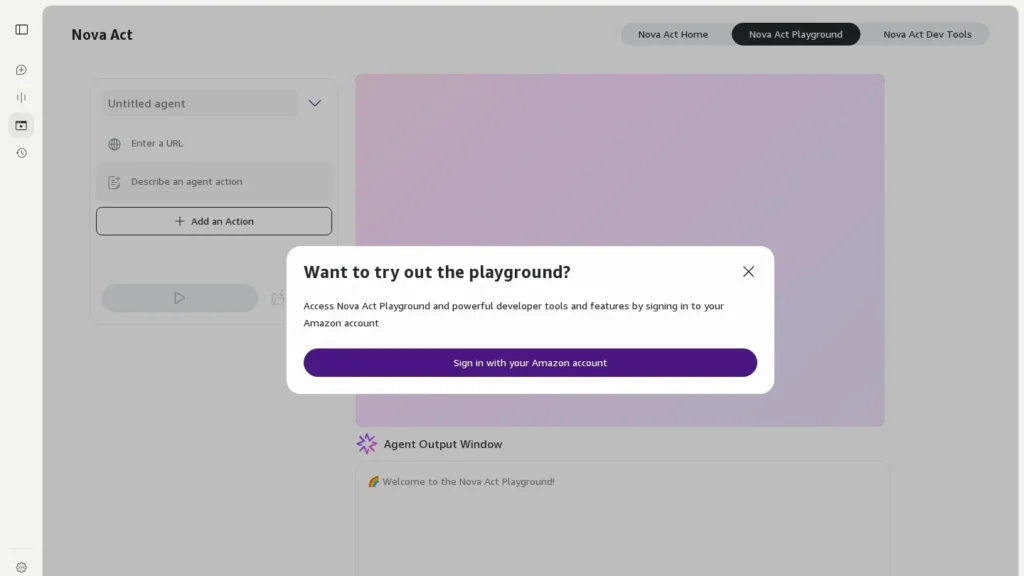
- Prototype in the playground: at nova.amazon.com/act you type instructions in plain English and watch an agent work in a live browser, including in Nova Act Gym, a simulated travel booking site for practice.
- Build in your IDE: an extension for VS Code, Kiro or Cursor offers a notebook-style builder mode with a live browser view and logs that show the model’s reasoning at each step.
- Deploy: the extension’s deploy tab packages the workflow into a Docker container, pushes it to Amazon ECR, creates IAM roles and S3 buckets and runs it on Amazon Bedrock AgentCore Runtime.
- Monitor: the Nova Act console shows dashboards of workflow runs, with reasoning, actions and screenshots for every step.
- Escalate: when a workflow needs approval or information, supervisors get notifications in custom dashboards and can step in.
Tools and Other Agents
Agents are not limited to clicking. The user guide says Nova Act can call external tools through APIs and remote MCP servers, and it works with the Strands Agents framework, where Nova Act acts as a specialized browser tool inside a larger multi-agent system. Advanced teams can skip the IDE and use the SDK or CLI for custom deployments.
Logins and Credentials
Many real workflows sit behind a login. 1Password joined as a launch partner so agents can retrieve credentials from a 1Password vault during user-directed workflows. According to SiliconANGLE’s launch coverage, those secrets are protected with AWS Nitro Enclaves and are not exposed to outside parties.
Use Cases That Fit Best
The user guide names four jobs. Data entry covers populating web forms and CRM or ERP records across sites that lack an API. Data extraction means moving through a site, filtering results and pulling fields from unstructured pages or dashboards. Checkout flows include purchase or booking steps through payment and confirmation. Web QA testing runs full user journeys in a real browser to confirm that an app still works after a release. All four share a pattern: the same steps repeat many times with different inputs, which is where a trained agent and an hourly meter make sense.
Workflows that change shape every time, such as open-ended research, fit less well. A general research agent or a consumer agentic browser is a better tool for that kind of one-off work.
Developers Own the Code, Approvals and IAM Setup
Developers design and code the workflow, choose when agents should pause for approval and handle exceptions that agents escalate. Someone also needs to own the AWS account, IAM permissions and monitoring. Nova Act removes the repetitive clicking, not the engineering.
One Pay-as-You-Go Rate on the AWS Bill
AWS lists one rate for Nova Act workflows.
| Plan | Price | Billing | What’s Included | Limits |
|---|---|---|---|---|
| Nova Act workflows | $4.75 per agent hour | Pay as you go on your AWS bill | Agent time while actively working; model, orchestration and browser actions | Each parallel agent billed separately |
| Human-in-the-loop waiting | $0 | Not billed | Time an agent spends waiting for a person to respond | Applies only to waiting for human input |
Pricing a 200-Test Weekly QA Regression Run
Weekly QA regression suite. A team runs 200 end-to-end tests, each taking about six minutes of agent time. That is 20 agent hours, or $95 per full run. Running it every weekday for 22 days would be 440 hours, or $2,090 a month.
Back-office data entry. One agent works two hours a day entering orders into a supplier portal for 22 working days. That is 44 agent hours, or $209 a month.
Large parallel fleet. Ten agents run eight hours a day for 22 days to process insurance or procurement forms. That is 1,760 agent hours, or $8,360 a month, which shows how parallel agents multiply the bill.
Hidden and variable costs. Your workflow may touch other AWS services, such as S3 storage and the container image in ECR, which are billed under their own pricing. Slow websites lengthen every task, and retries add agent time. The free human-in-the-loop waiting time helps workflows that need approvals.
Budgeting Agent Hours
Because the meter runs on active agent time, the best way to forecast spend is to time a sample of real runs in the playground or IDE, multiply by expected monthly volume and add a margin for retries. Workflows that pause for human approval do not pay for the wait, so adding a review step to a sensitive flow does not raise the bill. Cutting unnecessary page loads and splitting long workflows into shorter acts with Python logic in between can reduce agent hours.
Amazon Nova Act Compared With Browser Use, Skyvern and Anchor Browser
All four run agents in real browsers, but they differ in who operates the infrastructure and how you pay. Nova Act bills by agent hour on your AWS invoice, Browser Use and Skyvern sell credits or usage on their own clouds, and Anchor Browser sells monthly plans for hosted browsers that your own agents control.
| Tool | Starting Price | Free Plan | Main Strength | Main Trade-Off | Best For |
|---|---|---|---|---|---|
| Amazon Nova Act | $4.75 per agent hour | Pay as you go | AWS-native fleets with monitoring and human escalation | One AWS region; Python skills needed | Engineering teams on AWS |
| Browser Use | Free open source; cloud pay as you go | Limited | Open-source library that works with many models | You run and maintain the agents | Developers who want model choice |
| Skyvern | $29 a month (Hobby) | No | Portal logins, 2FA and CAPTCHA handling | Action-based credits can climb | Form-heavy back-office work |
| Anchor Browser | Free; from $50 a month | Yes | Cloud browsers for agents with on-premise option | Large price steps between tiers | Teams that need hosted browsers and compliance |
Nova Act is the natural pick when your company standardizes on AWS and wants agents inside its own account with IAM controls. Browser Use offers more model choice and open-source code. Skyvern is stronger out of the box for portals with two-factor logins and CAPTCHAs. Anchor Browser supplies hosted browsers that any agent framework can drive. Business teams that do not want to write code should look at Airtop. See all options on our browser automation agents page.
AWS-First Engineering and QA Teams
- AWS-first engineering teams: deployment, permissions and monitoring stay inside an account you already govern; see our enterprise agents page.
- QA teams testing web apps: end-to-end user journeys written in natural language are easier to maintain than brittle selector scripts.
- Operations teams with high-volume data entry: forms, CRM and ERP updates across sites without APIs are a listed use case.
- E-commerce and travel workflows: checkout and booking flows, including payment and confirmation, are a stated target.
- Multi-agent builders: Strands Agents and MCP support let Nova Act serve as the browser tool in larger systems; see our agent frameworks page.
No-Code Teams and Non-US Data Rules Point to Other Options
- Non-technical teams: beyond the playground, building production workflows means writing Python.
- Companies with data residency rules outside the US: the service runs only in US East (N. Virginia).
- Teams on other clouds: deployment targets Bedrock AgentCore Runtime inside AWS.
- People who want a personal browsing assistant: a consumer tool such as Comet by Perplexity fits one-off errands better.
One US Region and a Self-Reported Reliability Figure to Test
- Single region: check whether running workloads and handling data in US East (N. Virginia) meets your compliance needs.
- Vendor reliability figure: the over 90% figure is AWS’s own, so measure success rates on your target sites before scaling.
- Parallel costs: every concurrent agent has its own meter, so a fleet scales the bill linearly.
- Site terms: automating third-party websites can conflict with their terms of use; confirm before deploying.
- IAM scope: the deploy flow creates IAM roles and S3 buckets, so review what permissions the agents receive.
General Availability Arrives in December 2025
On December 2, 2025, AWS announced general availability of Nova Act at re:Invent, adding the playground, IDE extension, one-step deployment to Bedrock AgentCore Runtime and a monitoring console. SiliconANGLE reported the same day that 1Password joined as a launch partner for credential access, that pricing moved to an hourly model and that Nova Act had first been unveiled in March 2025.
A Fit for AWS Teams Running Browser Work at Volume
For engineering teams on AWS that need browser workflows to run reliably at volume, yes. Amazon Nova Act scores 8.5/10 on our scale. Its strengths are a model trained specifically for browser work, a clear path from prototype to monitored production, human escalation that does not bill for waiting time and one simple hourly rate.
Simpler setup for teams without Python and AWS skills, and more regions, would lift the score. The reliability figure is promising and comes from Amazon, so testing it on your own sites is a good step. Prototype your hardest workflow in the playground, measure success rates over a few hundred runs, then estimate monthly agent hours before rolling it out.
Teams outside AWS, or those who want business users to build agents themselves, may find a hosted builder or an open-source library a better fit. For AWS shops, Nova Act covers the whole path from a first prototype to a monitored fleet without leaving the account they already manage.
Billing per Agent Hour and Free Waiting Time
How Much Does Amazon Nova Act Cost?
Nova Act workflows cost $4.75 per agent hour of active work. Each parallel agent is billed separately, and time spent waiting for a person in a human-in-the-loop step is not billed.
Which Model Powers Nova Act?
Nova Act runs on a custom Nova 2 Lite model. Amazon trained it together with the orchestrator, tools and SDK using reinforcement learning in simulated websites.
Can Nova Act Log In to Websites Securely?
Yes. 1Password is a launch partner, so agents can fetch credentials from a 1Password vault during workflows. SiliconANGLE reported that those secrets are protected by AWS Nitro Enclaves.
Do I Need to Code to Use Nova Act?
You can prototype without code in the web playground. Production workflows combine natural-language act() calls with Python, and deployment uses an IDE extension, the SDK or the CLI.
Where Is Amazon Nova Act Available?
The user guide lists the US East (N. Virginia) AWS region. Workflows deploy to Amazon Bedrock AgentCore Runtime in that region.
User Reviews
Nobody has rated it here yet. Be the first AI Agents Choice user to rate Amazon Nova Act.